Sign up for the daily CJR newsletter.
In 2022, Kash Patel, now the director of the FBI, published The Plot Against the King, the first in his series of illustrated children’s books. In The Plot and its two sequels, which draw on the stolen-2020-election conspiracy theory and the Trump-Russia probe, Patel appears as a wizard in a pointy blue hat (“Kash the Distinguished Discoverer”) who helps “King Donald” battle a series of foes who seek to usurp his throne. These include “Hillary Queenton,” “Baron Von Biden,” “Comma-la-la-la,” and “the heralds,” Patel’s name for the press, who spread rumors and lies about King Donald being a cheater. The heralds hold trumpets labeled “NYT,” “CNN,” and “The Post.” “Don’t just trust the person with the loudest trumpet,” Patel urges readers at one point.
It’s easy to laugh at Patel’s books, which are marketed as “a fantastical retelling of the terrible true story.” But they also capture something of the Trump administration’s alarming desire for retribution, which Patel is intent on weaponizing the FBI to achieve. Patel, who is forty-six, rose rapidly through the ranks during Donald Trump’s first term in a variety of national security roles, distinguished less by his competence than by his unswerving loyalty to the president. As he said on Steve Bannon’s War Room podcast in 2023, “We’re gonna come after the people in the media who lied about American citizens, who helped Joe Biden rig presidential elections. We’re gonna come after you—whether it’s criminally or civilly, we’ll figure that out—but yeah, we’re putting you all on notice.”
At 6:05am on January 14, the FBI executed a search warrant at the home of Hannah Natanson, a Washington Post reporter who had spent much of Trump’s first year back in office covering the Department of Government Efficiency (DOGE) as it took a hatchet to the civil service. After Natanson posted her contact details on the Reddit forum r/fednews, her Signal became a kind of grand terminus for whistleblowers. She followed up with many of the sources and referred others to colleagues. In January of 2025, “I just posted this sort of vague question relating to this one tip,” Natanson told the Post’s podcast last April. “And it took off.”
On December 24, Natanson published a first-person piece about becoming the paper’s “federal government whisperer” and gaining “1,169 contacts on Signal, all current or former federal employees who decided to trust me with their stories.” The three weeks between the article and the FBI search of her apartment created an opening. Was the administration exacting retribution for Natanson’s reporting? What might the implications be for future national security journalism—or newsgathering in general? This was the first time the Justice Department had raided a journalist’s home in connection with a national security leak investigation and, as CJR’s Riddhi Setty wrote, many saw it as a blatant violation of the First Amendment.
Although the Justice Department and the FBI executed the raid, which Maddy Crowell wrote about for CJR in January, the search request for Natanson’s home came from the so-called Department of War, according to an X post from Pam Bondi, the attorney general. During the raid, FBI agents seized Natanson’s phone, work computer, personal laptop, and smartwatch. Investigators reportedly told Natanson that she was not the probe’s target. They also “assisted” her in applying her right index finger to a Post-owned MacBook Pro, providing access to all its data, and took photographs of Signal conversations before they could auto-delete, according to a DOJ court filing.
Soon afterward, attorneys representing the Post demanded the FBI return the materials it had seized. The raid was “a prior restraint and a violation of the reporter’s privilege that flouts the First Amendment and ignores federal statutory safeguards for journalists,” they argued. On January 21, the US District Court for the Eastern District of Virginia issued a standstill order, instructing the government to preserve but not review any of the seized materials. Meanwhile, attorneys for the Reporters Committee for Freedom of the Press (RCFP) filed an application to unseal the search warrant affidavit justifying the raid. On January 30, the court granted that request. A partially redacted document, dated January 13, outlined how the FBI, on January 8, had arrested and charged a man named Aurelio Perez-Lugones, a systems engineer and information technology specialist who worked for a government contractor, with “unlawfully retaining classified national defense information.” The FBI sought authority from the court to seize Natanson’s electronic devices “because there is probable cause to believe the devices contain ‘evidence of a crime,’ ‘contraband, fruits of crime, or other items illegally possessed,’ and ‘property…used in committing a crime.’”
Legal observers, however, were quick to notice that the Justice Department’s lawyers had omitted any reference to the 1980 Privacy Protection Act, a federal law that prohibits raids targeting journalists or newsrooms, protecting reporters from searches and seizures of material unless they themselves are suspected of committing crimes related to that material. Gabe Rottman, RCFP’s vice president of policy, said the government had “ignored a crucial press freedom guardrail.”
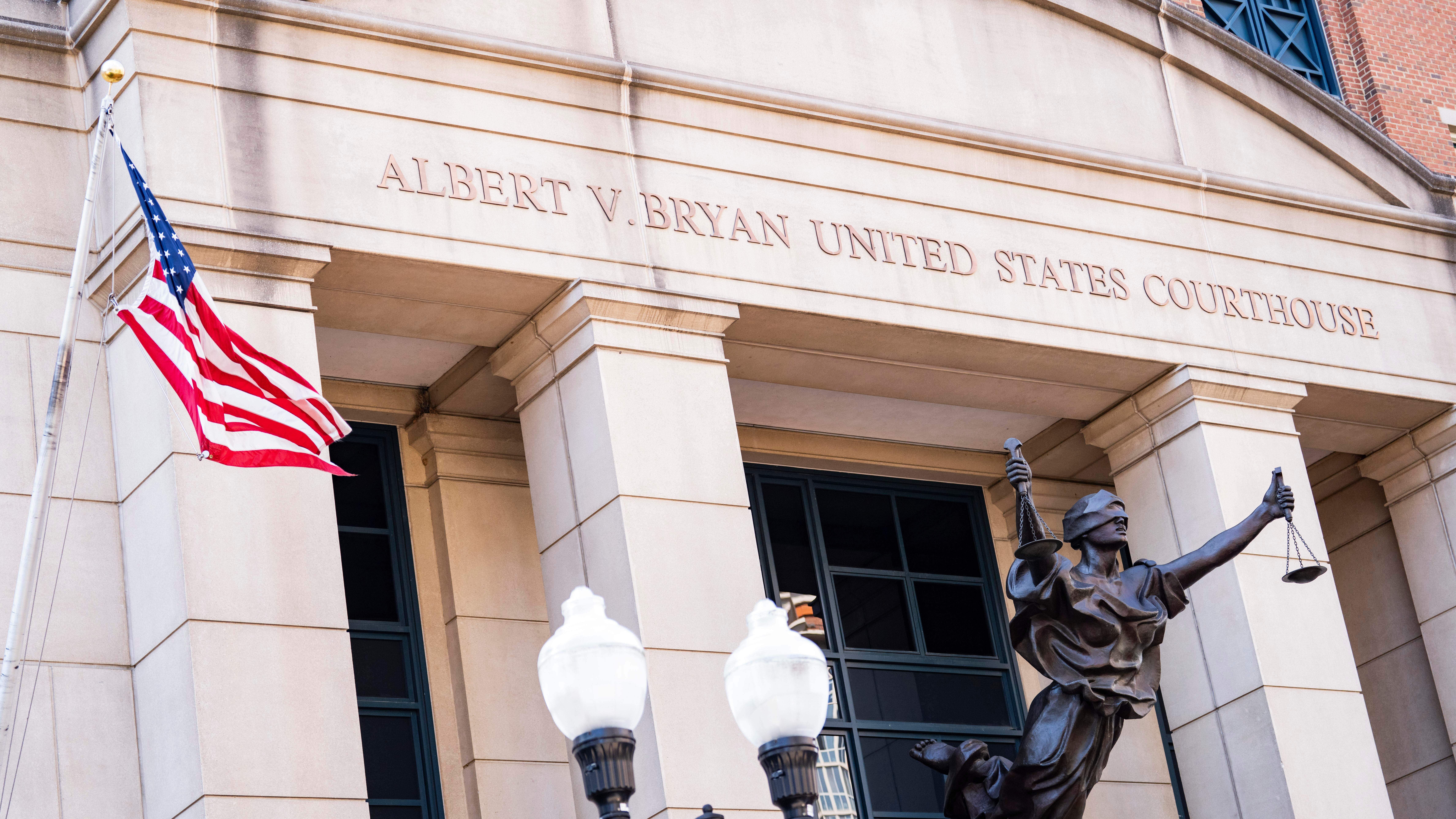
Visitors to the federal courthouse for the Eastern District of Virginia are welcomed by a statue of Lady Justice, blindfolded and holding balanced scales; the Natanson case appeared to suggest another kind of blindness—to the law itself. In a fiery court hearing on February 20, Judge William B. Porter rebuked the Justice Department for failing to alert him about the 1980 law. “Why didn’t you raise it?” Porter said, according to a New York Times report. “How could you miss it? How could you think it doesn’t apply?” (“Sit down!” Porter also reportedly shouted at one of the government lawyers who tried to interject during his grilling.) One Justice Department lawyer, Christian Dibblee, said he understood the judge’s “frustration,” adding that the decision had been made by higher-level officials. Despite another government lawyer apologizing to the judge, it seems the Trump administration had “decided that the 1980 law did not bar the search, because it concluded for itself that Ms. Natanson had probably violated the Espionage Act,” the Times wrote.
This brought the case into perilous and untested waters regarding First Amendment protections: a reporter for an established news organization has never been charged under the Espionage Act, as Kyle Paoletta has written for CJR; the government has historically gone after whistleblowers, such as Daniel Ellsberg in the 1971 Pentagon Papers case, or Edward Snowden when he gave documents to journalists exposing National Security Agency surveillance. Charging a reporter under an arcane 1917 law would be another attempt by the administration to close the legal gap between reporters and sources when it comes to sharing information. “Although it hasn’t charged Natanson with a crime, the Department of Justice contends that she, along with her source, violated the Espionage Act by possessing classified documents,” Seth Stern, chief of advocacy at the Freedom of the Press Foundation, wrote over the weekend. “In Natanson’s case, the notion that a journalist or publisher can violate the Espionage Act by obtaining government secrets in the first place is a red line that many administrations decided against crossing in prior decades.”
On February 24, Porter ruled that the Justice Department could not search Natanson’s electronic devices—instead, the court itself would review the seized materials. The language of Porter’s opinion was interesting. He directly addressed the Trump administration’s linked aims of “stopping unauthorized disclosures and purging employees perceived as disloyal to the administration’s agenda,” and said the Justice Department couldn’t be trusted with wholesale access to Natanson’s devices—which would be “the equivalent of leaving the government’s fox in charge of the Washington Post’s henhouse.” But he stopped short of returning all devices to Natanson and the Post, because “classified national security information may be among the seized material.” He also tried to give the administration the benefit of the doubt. “The Court’s genuine hope is that this search was conducted—as the government contends—to gather evidence of a crime in a single case, not to collect information about confidential sources from a reporter who has published articles critical of the administration,” he wrote.
The administration, though, has rejected efforts to chart a compromise. On March 10, the Justice Department appealed Porter’s order, arguing that it “violates the Constitution’s separation of powers and that journalists are not protected from searches when the government fears they could possess sensitive government materials,” the Post reported. Government lawyers also said, last Wednesday, that it would be difficult for the court to review the material because it contains “classified documents” for which “Top Secret with SCI [Sensitive Compartmented Information] clearance” would be needed.
For now, we await the outcome of that appeal; the court’s standstill order remains in place, meaning the government cannot search the seized devices. But whatever the eventual First Amendment consequences of the case, the impact for Natanson is clear: her tipline has gone dark.
Other Notable Stories…
- The Israeli military bombed a media car in southern Lebanon on Saturday, killing three journalists in what the Committee to Protect Journalists (CPJ) called part of a “disturbing pattern” of “Israel accusing journalists of being active combatants and terrorists without providing credible evidence.” The three people killed, CPJ said, were Ali Shoaib, of Hezbollah-affiliated Al-Manar TV; Fatima Ftouni, of pro-Hezbollah Al-Mayadeen TV; and her brother Mohamad Ftouni, a freelance photojournalist. At least four other journalists have been killed across the Middle East since the US and Israel attacked Iran on February 28, CPJ said. Last year, Jon Allsop wrote for CJR about Israel’s claims that it doesn’t target “journalists, as such.”
- Last week the New York Times accused the Defense Department of defying a federal court ruling over restrictive press rules that were deemed unconstitutional on March 20 by the US District Court for the District of Columbia. The Pentagon has signaled its intention to appeal; it issued revised media rules last Monday that the Times said were a “thinly veiled attempt to flout this court’s ruling.” A couple of days later, the Pentagon Press Associated filed an amicus brief supporting the Times. For more about the background of the case, see Ivan L. Nagy’s reporting for CJR earlier this month.
- On Monday, the Supreme Court rejected an appeal from Priscilla Villarreal, a citizen journalist known online as La Gordiloca, who accuses authorities in Texas of wrongfully arresting her after she asked for and obtained nonpublic information about cases from police. Villarreal was charged with two felony counts of misuse of information after she spoke to a police officer and published the identities of suicide and car crash victims on Facebook in 2017, according to Reuters. Justice Sonia Sotomayor dissented, saying: “It should be obvious that this arrest violated the First Amendment.”
- On Friday, US District Judge Troy Nunley, an Obama appointee, temporarily paused the merger between media companies Nexstar and Tegna, which the Federal Communications Commission and the Department of Justice approved last week. The merger has been championed by Donald Trump (“GET THAT DEAL DONE!” he wrote on social media) and would create a broadcasting behemoth. For CJR last week, Carolina Abbott Galvão interviewed Diana Moss, the vice president and director of competition policy at the Progressive Policy Institute, about the merger.
- Matt Brittin, formerly Google’s president in Europe, the Middle East, and Africa, will become the next director general of the BBC, replacing Tim Davie, who was forced out under pressure from right-wing forces after a BBC documentary featured a clumsy edit of a Trump speech. Brittin’s lack of editorial experience has worried some BBC insiders, The Guardian reports. The broadcaster, which employs more than five thousand journalists, is expected to appoint someone who does have an editorial background to a new deputy director general role.
- And Tracy Kidder, the narrative journalist whose deep reporting and staggering levels of research allowed him to tell true stories that were novelistic and immersive in scope, died last week of lung cancer, his family said. Kidder, who was eighty, won the Pulitzer Prize for General Nonfiction for The Soul of a New Machine, published in 1981, which explored the nascent computer industry. Later, he spent an entire school year in a Massachusetts classroom for the 1989 book Among Schoolchildren. And for his most recent book, 2023’s Rough Sleepers, he chronicled the work of Dr. Jim O’Connell, who dedicated his career to caring for homeless patients. Earlier in his career, Kidder had attempted to use a “swashbuckling first person” narrative style, he told the Times, which hadn’t worked. But over time, he said, “I found a writing voice, the voice of a person who was informed, fair-minded, and always temperate—the voice, not of the person I was, but of the person I wanted to be.”
Has America ever needed a media defender more than now? Help us by joining CJR today.