Sign up for the daily CJR newsletter.

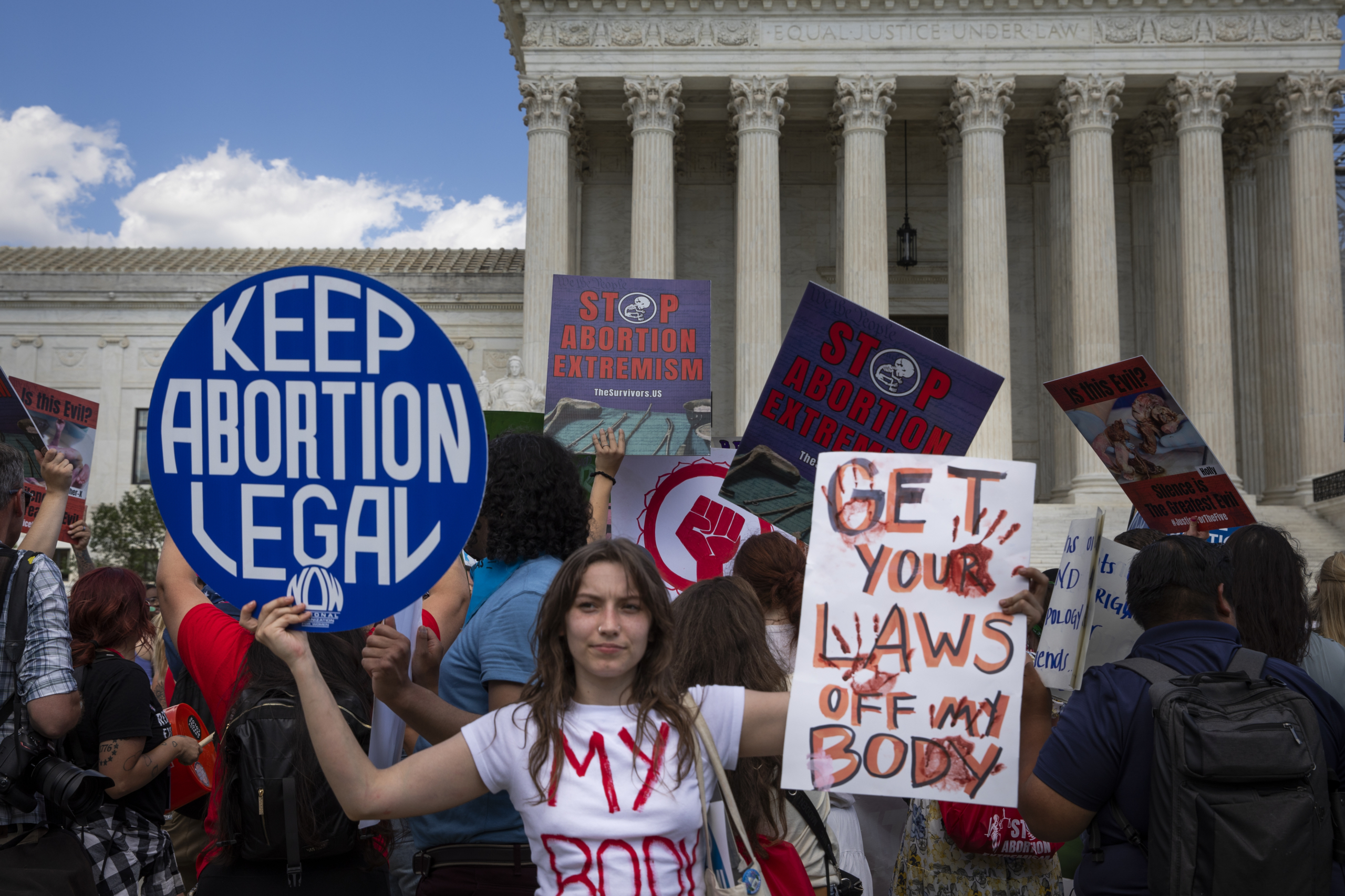
When the Supreme Court overturned Roe v. Wade, in 2022, Jessica Valenti started writing about abortion every day. “Everything happened so quickly, and people started being denied care so quickly, and bans came up so quickly, that I almost started writing just to keep up with it myself,” she told me. Valenti, a feminist writer and cofounder of Feministing, already had a Substack she updated occasionally but, within a week, she decided to dedicate it solely to covering abortion rights. She changed the name to Abortion, Every Day.
Four years later, it’s one of the top ten culture newsletters on Substack. Last year, Valenti hired a reporter, Kylie Cheung, to join her. Together, they track “anything and everything happening with abortion,” from bans and ballot measures to anti-abortion strategy and messaging. It’s now a resource for anyone working on reproductive healthcare and rights across the country. “A lot of our readers are lawyers, activists, abortion providers, researchers, legislators, journalists,” Valenti said. “It’s, in a weird way, sort of a trade publication for a lot of people.”
A recent piece illustrates why the newsletter has become essential reading. This month, Abortion, Every Day revealed that mothers in several states were targeted by Child Protective Services (CPS) for helping their daughters seek abortions. In one case, CPS removed a fourteen-year-old girl from her home and threatened her mother with murder charges, warning that she could also lose custody of her younger child, to prevent the procedure from happening. Another mother was investigated for helping her daughter obtain abortion medication, even though abortion is legal in their state.
Valenti worked on the story for months, building trust with the lawyers representing the women and assuring them she would not use any identifying details. “The conversation was about: How can we tell this story in a way where the number one priority is protecting these people?” Valenti is unapologetic about the fact that Abortion, Every Day is advocacy journalism. But she argues that choosing to present abortion as a “both sides” story is itself a political stance, one that distorts rather than reflects reality. “There is still this really untrue and toxic idea that abortion is a controversial issue and that the country is irrevocably split on this issue and that people really disagree and that the country is really polarized. And a lot of the media coverage presents it in that way,” she said. Yet even in the reddest states, she noted, “we have not just the majority on our side, but the vast, vast majority.”

Last Thursday, Drew Harwell, a technology reporter for the Washington Post, pointed out on X that the lede of a piece by Ross Barkan, a columnist for New York, about Ben Shapiro’s business struggles was strikingly similar to his own story on the topic, published five days earlier.
A few hours later, New York updated Barkan’s article with an attribution to Harwell at the beginning of the paragraph in question. A note at the bottom of the piece read: “This story has been updated to credit reporting from the Washington Post.” It was an odd response. In adding the attribution, New York effectively acknowledged that Barkan (who has also contributed to CJR in the past) had lifted a passage of another writer’s work, but the editor’s note was muted. What Harwell flagged wasn’t that he hadn’t been properly credited. It was that his writing had been reproduced almost entirely.
The incident led Bobby Allyn, a technology correspondent at NPR, to wonder whether this was an isolated case or part of a broader pattern. “An editor told me that no plagiarist commits the act once,” Allyn told me. He conducted what he described as a “spot check” of some of Barkan’s other work using a large language model, and identified at least two additional cases involving stories published by The Intercept and Compact Magazine in which Barkan appeared to reuse phrasing—in some cases, with nearly identical wording. He posted his findings on X.
Barkan, who by this point was just posting through it, responded to Allyn’s posts, aggressively pushing back by saying that he had hyperlinked to the original work in all cases: “That’s a citation. It’s clear I am drawing on that information, as a *columnist*, to build out my own argument.” He also noted that, in the Compact example, he had cited the writer, Juan David Rojas, directly elsewhere in his column. Regarding the Intercept piece, he wrote: “The Intercept column example is almost as silly—I hyperlink directly to The Intercept.” There is, in fact, no hyperlink to The Intercept in the column in question.
On Saturday, New York confirmed to Allyn that the magazine was conducting a review of Barkan’s work. Allyn reached out to Barkan for comment that night, and soon published a story that observed, “The paragraphs in question are summarizing the historical background or context of the stories, with some instances containing the same 30 words in a row, or near identical passages with a word or phrase slightly tweaked.” Barkan then went on the offensive, suggesting that Allyn’s piece amounted to “character assassination.”
Barkan has since stopped posting on X, which is probably for the best. He continues to strongly deny all the allegations, telling Fox News that he “did not plagiarize anyone” and “all of this is ridiculous.” He appears to believe that as long as he is not using another writer’s concept or idea, he can use their language or phrasing with just a hyperlink as a citation. “Nothing to see here,” as Allyn summarized the position to me.
The question is whether this is plagiarism or something more like sloppy attribution or aggregation. Barkan seems genuinely confused about the distinction. In the Shapiro piece, he did link to Harwell’s story in the following paragraph—presumably not something he would do if he were trying to be deceptive about his source material. But confusion isn’t really a defense in journalism. If you are going to use another writer’s prose—not a stray fact or publicly known information, but a sequence of details arranged in the same structure and pattern—that requires a quote or a clear attribution, not a hyperlink.
A spokesperson for New York confirmed to me that “a comprehensive review” is ongoing and said in response to a question about whether Barkan’s position regarding links was in keeping with policy: “Our editorial standard is that any work that is heavily cited or paraphrased should include attribution, and looking for instances where that standard wasn’t met will be part of the review.” The magazine has not updated the Intercept or Compact columns, saying it is waiting for the review “to be complete before determining how best to address.”
“When we reference the work of others, we expect our journalists to provide clear attribution. When we quote someone’s words verbatim, we use quotation marks,” Ben Muessig, the editor in chief of The Intercept, said in a statement. Rojas told me that Barkan had reached out to him privately to apologize. “It’s more appropriate, if the text is going to be that similar, that you use quotes or you just change it enough,” Rojas said. “I would be more inclined to attribute bad intentions to him had he not mentioned me at all. I think that there’s shades of gray here and degrees of blame.”
Allyn views Barkan’s posture less charitably. “What we have as journalists is our creativity, our authenticity, our integrity—and doing that undermines all of it,” Allyn said. “Every time something like this comes out about a prominent journalist, it in some small way diminishes the public’s trust in the institution of journalism.”
Last August, Diara J. Townes, an environmental journalist, filed a public records request for information about Microsoft’s twenty-seven-million-dollar purchase of 1,350 acres of land in North Carolina’s Person County. The deal, which was announced in late 2024, was secretly negotiated for months by county officials operating under nondisclosure agreements with the company.
Townes was trying to better understand what Microsoft planned to build on the land and how the project could affect the surrounding community. County administrators initially fulfilled Townes’s request, but “withdrew it 36 minutes later, citing a staff failure to review for confidential information,” Townes reports in an exhaustive investigation for The Assembly. But Townes had already downloaded everything.
The records showed that county leaders spent months planning infrastructure upgrades, road changes, utility expansions, and economic incentives before the public learned about the project. Even so, a mystery remained: What was Microsoft planning to build on the site? Finally, after repeated inquiries from Townes, the answer came in February: Microsoft and county officials confirmed that they planned to use the site for a data center.
Residents say the lack of transparency limited meaningful public participation in discussions about environmental and quality-of-life concerns. “Many have labeled Person County as a sacrifice zone, a county where big players like Duke and Microsoft can do whatever they want with little resistance,” a local told Townes. “It feels like that is what is happening.” (Lucy Schiller recently wrote for CJR about the challenges of covering the impact of data centers, which often emerge from under a shroud of secrecy.)
The Assembly’s reporting may have already had an impact. In March, the county economic development director who oversaw the Microsoft deal was fired, and Microsoft said it had “made the decision to end the use of nondisclosure agreements with local governments.”
CJR will be off for Memorial Day weekend, returning Tuesday, May 26.
Hat tip to Local Matters for the Assembly story.
If you have a suggestion for this column, please send it to laurelsanddarts@cjr.org. We can’t acknowledge all submissions, but we will mention you if we use your idea. For more on Laurels and Darts, please click here. To receive this and other CJR newsletters in your inbox, please click here.
Has America ever needed a media defender more than now? Help us by joining CJR today.