Sign up for the daily CJR newsletter.
On the evening of July 4, the skies above Washington, DC, will light up with what organizers have described as the largest fireworks display in history. Eight hundred and fifty thousand fireworks shells will burst and crash to mark two hundred and fifty years since the Declaration of Independence was signed, beginning the experiment that is the United States.
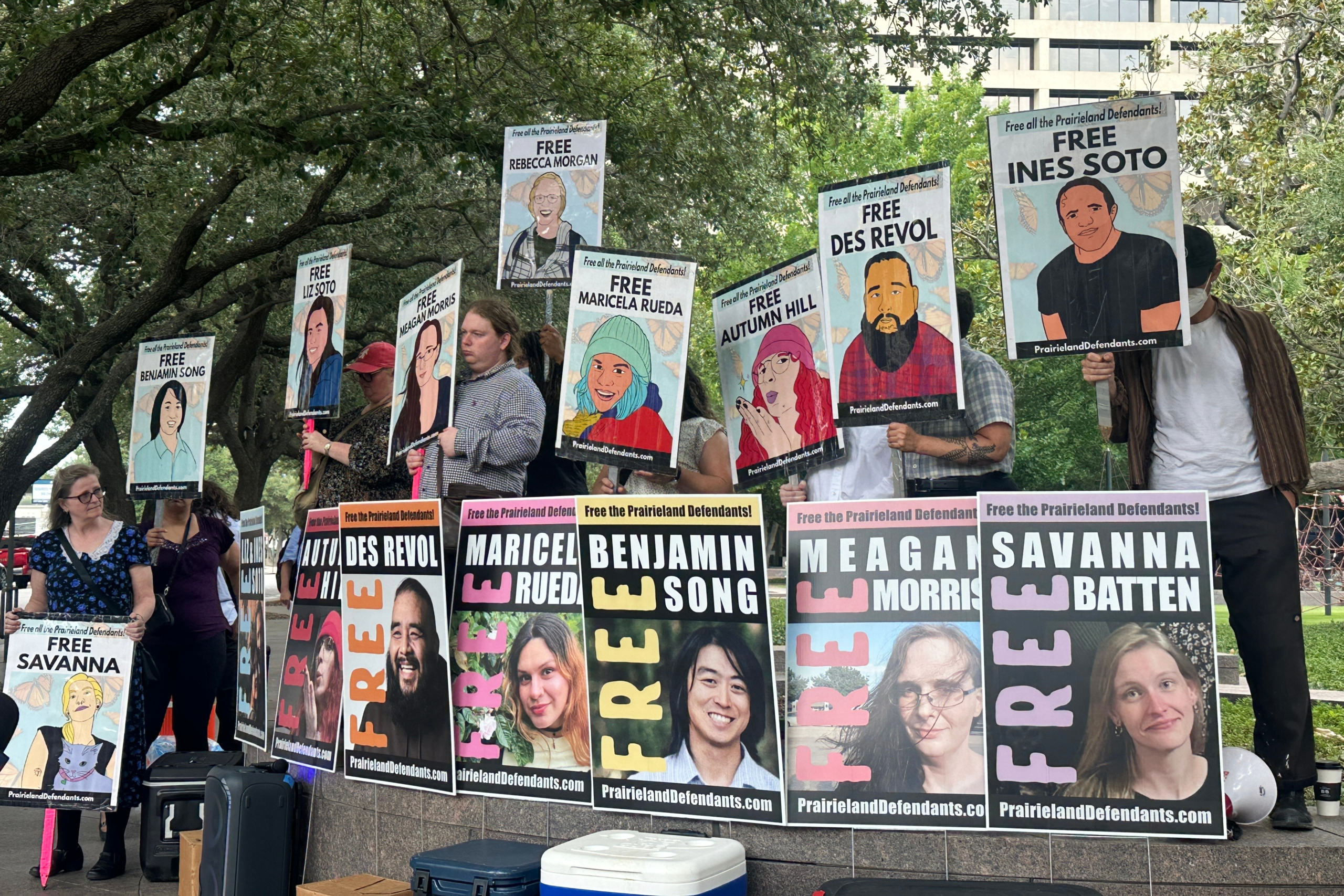
On July 4, 2025, a very different fireworks display took place in Alvarado, Texas. Outside the Prairieland Detention Center, an Immigration and Customs Enforcement (ICE) facility, a group of leftist activists, some of whom had never met before, gathered for what was described as a “noise demonstration.” At about 10:30pm, they set off fireworks in a show of solidarity with detainees caught up in the Trump administration’s aggressive deportation drive. Several wore black clothing or hid their faces, and many communicated ahead of time via a Signal group named “4th of July party!” Some brought legally obtained firearms—one rifle owner said the guns would make police “back off”—but the event went badly wrong. Several demonstrators had already left by the time police arrived, shortly before 11pm, but one who remained was Benjamin “Champagne” Song. Song, who is trans and served in the Marine Corps, was armed with a rifle and discharged eleven shots. (She later said she thought police were about to open fire on another protester.) One of the bullets Song fired struck an officer in what some reports described as his shoulder and others his neck; he survived. The protesters also damaged property, slashing the tires of a government vehicle, breaking a security camera, and spray-painting “Fuck you pigs” on a guard booth.
As David A. Graham points out in The Atlantic, “Some of the Prairieland charges are ones that any administration in American history would have brought, and rightly so.” Shooting a cop obviously means seeing your day in court. But what has alarmed many observers is how the Justice Department succeeded in portraying demonstrators as part of a broad terrorist enterprise. They were a “North Texas Antifa Cell” who had staged a “coordinated riot and attack,” lawyers for the government argued. In March, eight of the protesters were found guilty of charges including rioting, providing material support to terrorists, and conspiracy to use and carry an explosive (in other words, the fireworks). The sentences handed down last week, by judges appointed by George W. Bush and Donald Trump, were unusually draconian. Chief US District Court Judge Reed O’Connor, of the Northern District of Texas, called the defendants’ “violence and terrorism” an “assault on democracy.” Song, the only protester to be convicted of attempted murder, was sentenced to a hundred years in prison; the others face between thirty and seventy years each. One of the defendants, Daniel Sanchez-Estrada, did not even attend the demonstration, though his wife did; he was arrested while moving a box of leftist zines and was convicted of “corruptly concealing a document or record” and “conspiracy to conceal documents.” Sanchez-Estrada reportedly told the court: “I am a father, I am a husband, I am a teacher, a poet. I am many things, Your Honor, but I am not a terrorist.” He was sentenced to thirty years in prison.
The Prairieland case has been closely watched because it is the first time the Justice Department has charged and convicted people for terrorism as supposed members of “Antifa,” which the Trump administration designated a “domestic terrorist organization” last September, after the assassination of Charlie Kirk, the right-wing activist. The case has also attracted attention because of the government’s focus on leftist zines as evidence of the defendants’ shared ideology. Some of the pictures used as evidence by the FBI, according to The Guardian, included a book-stand with titles such as What Is Gender Nihilism? and Movement for No Society, as well as material for the Emma Goldman Book Club, to which some of the protesters belonged; a pamphlet titled 8 Things You Can Do to Stop ICE; and colorful “ACAB” stickers (which stands for All Cops Are Bastards).
“We’ve reached the point in the erosion of the First Amendment where the government considers possession of anarchist zines and membership in a terrorist cell to be more or less the same thing,” Seth Stern and Jeremy Busby wrote on Friday for The Intercept. Two of those convicted were Elizabeth and Ines Soto, a married couple with three children. The Sotos had reportedly left the protest by the time the shooting started, but they were found guilty of “providing material support to terrorists,” among other crimes, for being part of the Emma Goldman Book Club and for owning what prosecutors called a “printing press”—a standard office printer, paper cutter, and bookbinder—that they used to print anarchist zines. “Prosecutors held up several of the zines in front of the jury for dramatic effect,” Lex McMenamin, of The Guardian, wrote last week. McMenamin visited Elizabeth Soto in jail in Wichita Falls, Texas. “They didn’t like my book club,” Soto told McMenamin, through a glass separator. “Her laugh doesn’t quite reach her eyes,” McMenamin wrote. Soto was sentenced last week to fifty years in federal prison; her husband will be sentenced on Wednesday.
The absurdity, of course, is that no organized group named “Antifa” exists in the US, as news organizations have pointed out again and again. But rather than posing a problem for the government’s case, the ungraspable nature of “Antifa” seems to have been a strength. In federal district court in Fort Worth, prosecutors drew a picture of an extremist terror cell whose members were linked through shared zines, Signal chats, and protest tactics. As I wrote for CJR in January, the administration’s baseless claims about “domestic terrorism” have challenged newsrooms, and some of the press still seems “squeamish about directly calling out the administration’s lies.” Most of the Prairieland coverage noted that “Antifa” is a contested category—although some seemed to accept the administration’s framing too readily—and it was encouraging to see outlets including The Intercept and The Guardian remind readers that the concept of “Antifa” as a supposed domestic terror group has been weaponized to crack down on legal dissent. Several reports also noted the disparity in sentencing between the Prairieland protesters and those who stormed the US Capitol on January 6, 2021. The longest sentence for that assault on democracy was twenty-two years for Enrique Tarrio, leader of the Proud Boys; all fifteen hundred rioters have since been pardoned. As McMenamin put it on WNYC’s On the Media podcast the other day, the Prairieland case is “extremely concerning to legal experts. It goes all the way back to the basis for some of the Constitution. The Federalist Papers were effectively a zine.”
The Trump administration has suffered a string of legal setbacks in its pressure campaign against the press in recent months; with the Prairieland convictions, though, it seems to have won a crucial test case in its drive to quiet protest and dissent. “A playbook has now been set, and it’s going to be pursued in places like Minnesota,” Matt Sledge, a political reporter for The Intercept, told Democracy Now! last week. Lawyers for the convicted Prairieland protesters plan to appeal, alleging problems with evidence and jury deliberations. Some have emphasized in their defense that Antifa is not even a group. A public defender for Sanchez-Estrada said the zines he moved should have been protected by the First Amendment. (“At the heart of this case is a simple truth: Mr. Sanchez moved a box,” the lawyer said.) And an attorney for another defendant—Sufia Khalid, who is also the deputy director of the National Security Criminal Defense Center at the Muslim Legal Fund of America—called the sentences “unconstitutional,” and said these were “political prosecutions.”
Last week, the Washington Post reported that, during sentencing, Song tried to address the court. “I don’t hate anyone. I don’t hate cops. I don’t hate Trump. I never want to see good people gunned down in the street. But we all saw what happened to Renee Good and Alex Pretti.”
US District Judge Mark Pittman, a Trump appointee, cut her off: “This is not the time and place for a political speech.”
Other Notable Stories …
- The Justice Department issued, then withdrew, subpoenas that would have forced national security reporters from the Post and the Wall Street Journal to testify before a federal grand jury, according to reports. “While the journalists are no longer scheduled to appear before a grand jury, the Justice Department’s action reflected a new front in the Trump administration’s aggressive tactics toward the media as it attempts to crack down on government leaks to the press and content that administration officials think is unfair to the president,” the Post’s Perry Stein reported. Both the Post and the Journal fought the subpoenas, according to CNN’s Brian Stelter and Hannah Rabinowitz, who also reported that Trump “personally pushed acting Attorney General Todd Blanche” to issue them.
- An advertisement on ABC’s The View—which is being investigated by the Federal Communications Commission (FCC) over whether it violated an equal-time rule—is encouraging viewers to “use your voice” to support the renewal of ABC’s licenses in eight local markets that are likewise under FCC investigation. “The View has welcomed your favorite guests and covered the issues you care about for nearly thirty years. Now the FCC wants to control who is allowed to appear on the show,” the ad says. In response, the FCC accused Disney of a “campaign of misinformation.”
- For the New York Times, Katherine Rosman and Ken Belson reported on the curious case of Dianna Russini, a former star NFL reporter for The Athletic—which since 2022 has been owned by the Times—who became the subject of “a frenzy of gossip” when she was photographed hugging Mike Vrabel, head coach of the New England Patriots, in a hot tub, sparking a debate around access and journalistic ethics. As part of the reporting, the Times texted Russini with an interview request. She responded, but asked the reporter not to quote from her message. “When the reporter told her that this article would include portions of her text message because no agreement had been made for them to engage in an off-the-record correspondence, Ms. Russini objected and then emailed Mr. Perpich, the publisher of The Athletic, as well as two senior editors at The Times to reiterate her wish that her comments not be included,” they write.
- In the days following the disappearance, on February 1, of Nancy Guthrie, eighty-four, the mother of Savannah Guthrie, host of the Today show on NBC, law enforcement sources told CNN that a note purportedly written by Nancy’s abductors said she had died. The information was known by CNN and KOLD-TV but, per CNN, was “not initially reported” at the “request of law enforcement and the Guthrie family so any future communications with kidnappers or potential suspects could be authenticated.” The note was made public by CNN on June 24—following a video from TMZ’s Harvey Levin—in the hopes of sparking renewed public interest in the case, which remains active.
- Journalists at Schneps Media—which owns more than a hundred newspapers and websites including the Queens Courier, the Brooklyn Paper, and the Bronx Times—announced earlier this month that they are trying to form a union, as some journalists “can’t afford to live on their salaries.” It will “help ensure that we are supported in our roles, earn a living wage, and have a say in editorial standards at Schneps,” Shane O’Brien, a reporter for QNS, said. They have asked management to voluntarily recognize the union. It is unclear if the company has responded yet, and unionizing workers did not immediately reply to CJR’s request for comment.
- And Mark Singer, a staff writer at The New Yorker, died on June 19 in Manhattan, aged seventy-five, from cancer of the salivary glands, his son told the Times. Singer was known for his skill as a profile writer; his work included a sharp piece on Donald Trump, then still a real estate developer, from 1997. (Trump, Singer wrote, presciently, is “a fellow both slippery and naïve, artfully calculating and recklessly heedless of consequences.”) David Remnick, the magazine’s editor, paid tribute to Singer: “He came out of the tradition of A.J. Liebling and Joseph Mitchell and Calvin Trillin, which is to say he combined meticulous reporting and a very distinctive comic voice, which is extremely rare.”
Has America ever needed a media defender more than now? Help us by joining CJR today.