Sign up for the daily CJR newsletter.
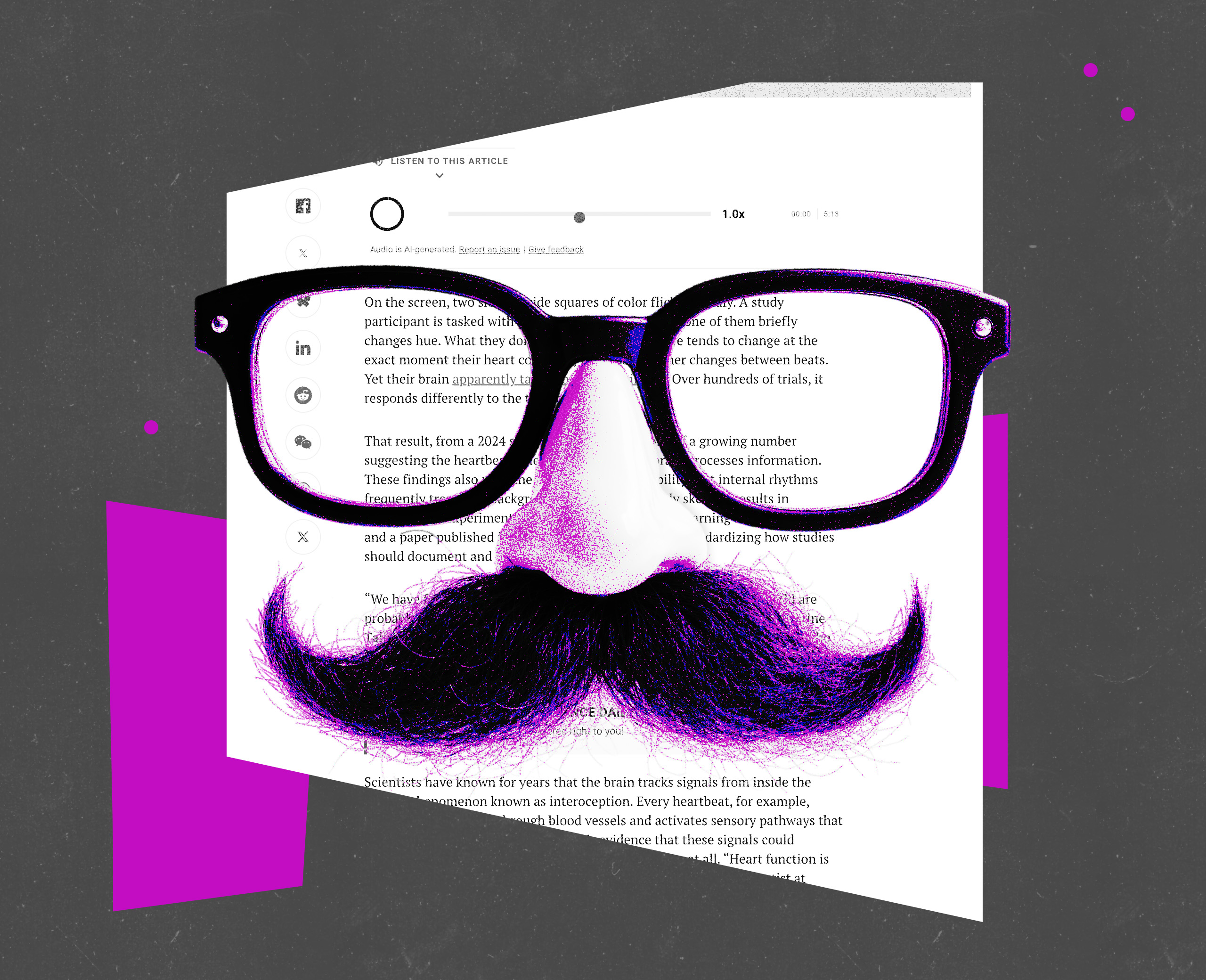
“Your heartbeat quietly shapes how your brain processes information.” So went the headline atop an article published in Science magazine in June, with the byline Caroline Williams. The piece was removed three months later, after editors discovered that the author was an impostor—not Caroline Williams, the established freelance journalist based in the United Kingdom, but someone who had adopted Williams’s name and clips.
John Travis, the managing news editor for Science, told me that his team, and the sources interviewed for the piece, had only communicated by email with Fake Caroline—a person (or persons) who relied heavily on AI to write, based on post-publication analysis of the pitch and first draft by Pangram. “We were conned,” Travis said.
Still, the published piece was an accurate story. “It really sent me on a bit of a spin,” the real Caroline Williams told me over Zoom, of the whole affair, “because I was like, well, how many editors out there have me on their mental list of ‘do not touch’? I have no idea.”
Fake Caroline’s ruse unraveled over the summer as editors at multiple science magazines, who had all received pitches from the impostor, separately notified Williams about suspicious emails, prompting her to post a frantic warning, with screenshots of the impostor’s messages, on LinkedIn: “EDITORS: THIS IS NOT ME!!!” By mid-September, an editor at Science saw Williams’s pleas and connected the dots.
Brendan Maher, the features editor for rival science magazine Nature, was one of those editors who notified Williams—he’d also received an AI-written pitch from Fake Caroline. “What I really hate about this is the way it hurts junior people in this field,” he told me. “I have to be mistrustful of anyone new who approaches me.”
Undark, the digital science magazine that I run, was pitched by Fake Caroline, too. (We declined—not because we’d sniffed out the scam; the idea just wasn’t right for us.) But among editors who rely on freelance writers, it has become common knowledge that our inboxes and pitch forms are absolutely inundated with AI slop of one form or another.
Earlier this year, my colleagues and I tried to understand an elaborate and obviously AI-written pitch promising a “neuro-historical post-mortem of Project 100,000—Robert McNamara’s 1966 ‘New Standards’ initiative that drafted 354,000 men with low IQ scores into the Vietnam War.” The writer had no publishing record that we could discern, so we pushed for a video meeting, to no avail. After much insistence, the writer agreed to a voice interaction, which revealed that we were dealing with a young woman, perhaps even a child, who told us she was in Pakistan. Her written pitch was lucid (if glib) AI, but over the phone, she did not know the material from her own pitch. (She has placed stories elsewhere.)
We felt a bit sad about that one, not knowing the circumstances. But unwanted servings of AI copypasta, large and small, also now come from journalists, authors, academics, and other scribes with recognizable names and reputations. A year ago, we began requiring visitors to our freelance-submission portal to tick a box indicating that they had read and understood our policy on AI, which states, among other things, that we “do not accept nor publish editorial text generated or line-edited by artificial intelligence tools (e.g., ChatGPT, Copilot, etc.).” The prohibition covers story pitches as well as story drafts. It hasn’t mattered. A rising number of aspirant writers tick the box and send us AI-written material anyway.
In most cases, we can spot the slop, confirm edge cases with Pangram, and feel that we’ve blocked AI-generated writing by simply declining it. But, setting aside the worry that our AI detectors might, at least sometimes, be wrong, the sheer volume of writing now infused with AI, alongside a vast array of contradictory attitudes toward its use and the absence of any sort of programmatic guidance, has left many of us in a state of permanent suspicion of everyone and everything. In 2026 alone, the Wall Street Journal, the Financial Times, and the Sydney Morning Herald all published opinion essays revealed to have been substantively AI-written. (The Herald removed the article, the Times added a disclaimer, and the Journal defended AI use as sometimes permissible.)
Meanwhile, in the past few weeks, Undark and myriad other outlets have begun receiving emails directly from autonomous AI agents that identify in friendly terms as machine beings and offer to research, write, or fact-check articles for a fee. (I still don’t quite understand the business model.)
The Fake Caroline fraudster netted about a thousand dollars for the Science piece, a fee that Travis tells me the company is now trying to trace and recoup—but the damage has been done. “We trusted this ‘person’ and shouldn’t have,” Travis said. The days of relying solely on email when communicating with a writer are likely over, he added. “The phone will come back. The Zoom call will come back.” Still, he said, “that’s probably not a perfect system either.”
At STAT, the health and medicine news site, Torrie Bosch, the opinion editor, describes a hamster wheel of hypervigilance, selective Pangram spot-checks, and difficult conversations with writers—some mortified that a taint of AI somehow slipped into their prose, others outraged at the mere accusation, and a few mystified that, in 2026, anyone would care at all. “People say that ‘the words and ideas are mine, but AI lightly edited,’” Bosch said. “But, you know, what one person considers light editing, I might consider a full refresh of the piece.”
These difficult conversations were once rare, Bosch said. Now they come almost every day. “It has become untenable in the past, I’d say, even month or two,” she said. “It’s gotten significantly worse.”
It was not lost on me, even in reporting this piece, that every phone call, every email, is predicated on a faith in ordinary interactions that AI is fast eroding: Was that really Brendan Maher on the other end of the line? On what do I base my conviction that, indeed, John Travis sent me that email? Is a Zoom or FaceTime meeting still a reliable fail-safe? Will it always be? The digital tools supposedly built to make us closer and more comprehensible to one another now seem just another vector for alienation and confusion.
For her part, the real Caroline Williams told me recently that her impostor had struck again, pitching both Science and the digital magazine Knowable. “Finding myself slightly envious of the rate at which fake me seems to sell ‘her’ wares,” Williams wrote over email. “It’d be so much easier if I didn’t care about what I’m putting out into the world!”
This piece was produced with support from the Craig Newmark Center for Journalism Ethics and Security.
Has America ever needed a media defender more than now? Help us by joining CJR today.