Sign up for the daily CJR newsletter.
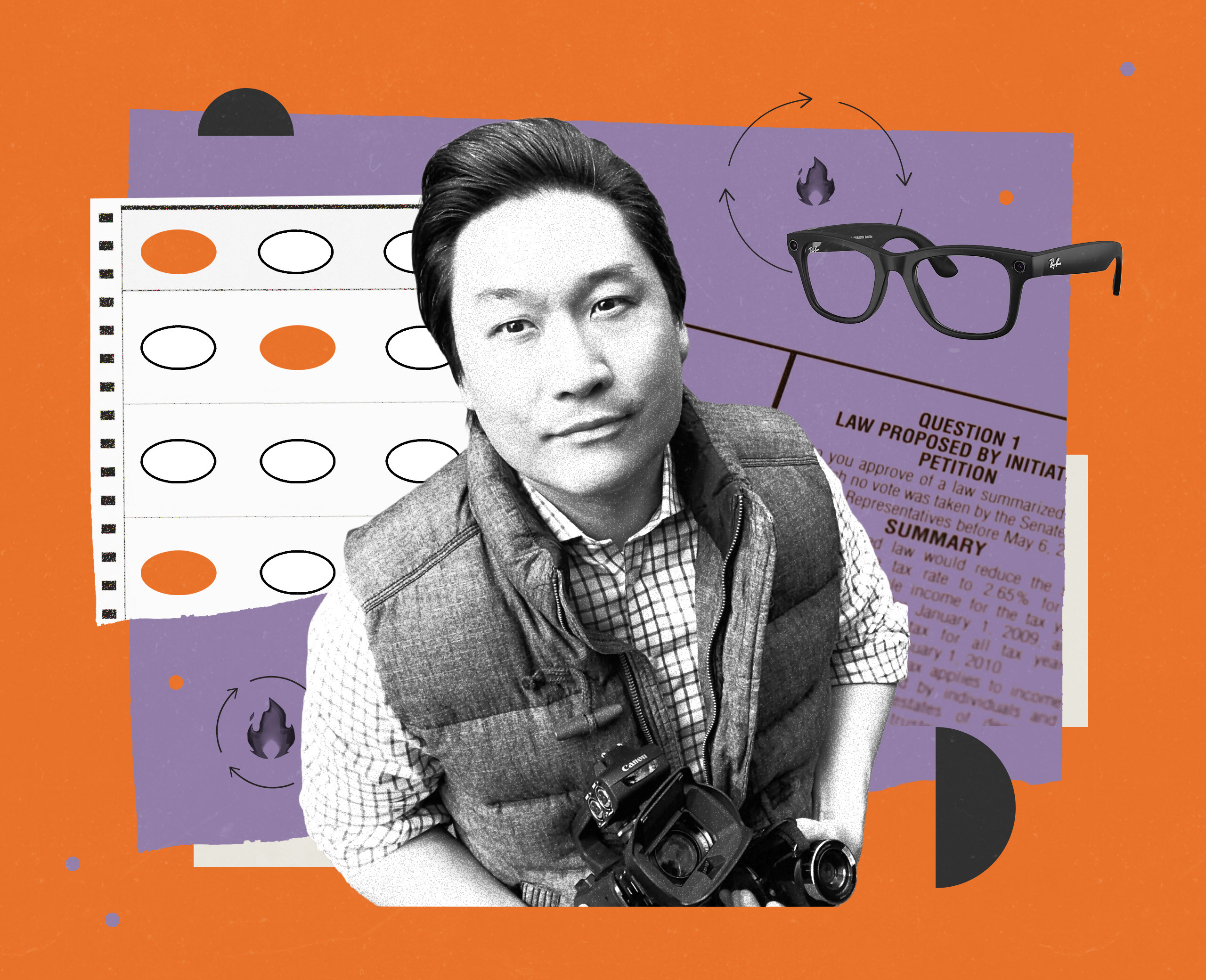
For CJR’s new special issue on access, I spent time with Jonathan Choe, a news influencer and Turning Point USA correspondent, as he pursued coverage of alleged statewide voter fraud in California. As we drove around the suburbs of Los Angeles, I saw him use his phone and a drone camera. Then, as we approached Skid Row, the center of the city’s homeless population, he chose a different recording tool: Ray-Ban sunglasses made in collaboration with Meta, Facebook’s parent company, which enabled him to record surreptitiously. As Choe put it, before flicking his glasses on, “the key is to just observe and blend into the woodwork.”
Selling from between two hundred and eight hundred dollars, Meta glasses are a robust piece of tech, with five microphones and a high-resolution camera. In 2025, EssilorLuxottica, Ray-Ban’s parent company, sold more than seven million pairs, tripling the sales for 2023 and 2024 combined. For news influencers who often film protests and other combative scenes in public spaces, the glasses have obvious appeal—and have led to federal government response. Nick Shirley, a content creator with marked reach within the Trump administration, has used them to film videos from New York to Minnesota that brought on ICE raids and Department of Justice investigations and indictments. Noah Hurowitz, a reporter for The Intercept, recently spotted Cam Higby, another Turning Points contributor, in Meta glasses at an anti-ICE protest at a detention center in New Jersey. Choe’s reporting from Skid Row, which was part of a wider effort in coordination with James O’Keefe, a veteran news influencer and a pioneer of hidden-camera instigation, also swayed Trump’s DOJ to take action.
Hannah Saunders, the editor of Through the Static, an independent Seattle-based news site, said she’s seen right-wing news influencers wearing smartglasses around town, including at a recent trans-rights rally. Saunders is concerned that news influencers are “filming our community and clip-farming the content.” According to Mar Hicks, a historian of technology and a professor at the University of Virginia, the glasses have “quickly scaled up the everyday surveillance that ordinary people have to worry about as they simply try to go about their normal lives.”
A small light in the corner of the frame flashes when the glasses are recording, although many people aren’t aware what the light indicates and, in a brief interaction or amid a hectic public scene, they may not have a chance to note or ask about it. “Will people notice if I spy on them using the Ray-Bans Meta smartglasses?” Ryan Osmond, a YouTuber, recently asked in a video; he found people mostly didn’t know when the glasses were or were not recording. There are also ways to disable the flashing light altogether. A Wired reporter found a TikToker advertising their services in disabling the light—as they phrased it, putting the Meta glasses in “stealth mode”—for a hundred and twenty bucks a pair.
According to Christianna Silva, an internet-culture reporter, Meta isn’t actively courting news influencers as glasses-wearers. Mostly, Silva said, Meta has marketed the glasses as an “emerging creator tool for lifestyle creators rather than a reporting device,” and pointed me to a string of officially branded posts from exercise influencers. A spokesperson for Meta declined to comment, but the company did share that the terms-of-service agreement stipulates that anyone using the glasses must do so in a safe way that complies with relevant laws.
Hicks believes the company is purposely shirking its responsibilities: Meta “could have and should have predicted that people would use these glasses in a variety of unsavory ways,” Hicks said. “But making content out of the everyday—even when that results in the violation of people’s privacy or political propaganda—has been baked into Facebook’s business model since the start.”
According to internal company documents reported on by the New York Times, Meta is working on facial-recognition technology for its smartglasses, which spurred a coalition of more than seventy organizations including the American Civil Liberties Union, Fight for the Future, and Old Dykes Against Billionaire Tech Bros to push back, writing in a statement that people “should be able to move through their daily lives without fear that stalkers, scammers, abusers, federal agents, and activists across the political spectrum are silently and invisibly verifying their identities.” Meta has said it is “thinking through options” and will take a “thoughtful approach” before rolling out a facial-recognition feature.
The increased use of the Meta glasses by news influencers has already led to tension with authorities and unwilling subjects. As part of his efforts “tracking the rise” of communism in the United States, Shirley recently went to Cuba, where, he later lamented to NewsNation, authorities confiscated his Meta glasses at the airport. Last fall, Higby posted on social media that in response to his filming of “two leftists” protesting outside a vigil for Charlie Kirk, the founder of Turning Point, the protesters “stole my phone, punched me in the face and destroyed my meta glasses.”
Kate Lindsay, the cofounder of Embedded, an internet-culture newsletter, said that watching the use of Meta glasses spike among content creators and news influencers has left her feeling uneasy. “They’re stress-testing the social contract,” Lindsay told me. “By normalizing this tool that films everything, by creating a panopticon or a crowdfunded surveillance state, what right to privacy do we have in public?” Lindsay pointed out that, just by refusing to be filmed—as many do when approached by news influencers like Shirley—you’re still helping to create content: the rejection of the camera can be repackaged as a tacit admission of wrongdoing. “The solution cannot be if you don’t want to be filmed, stay home,” Lindsay said. “That just can’t be where this is headed.”
Has America ever needed a media defender more than now? Help us by joining CJR today.