Sign up for the daily CJR newsletter.
This April, while addressing the media at a press conference ahead of the final of the Copa del Rey in Seville, a soccer referee named Ricardo de Burgos Bengoetxea became emotional. His voice strained. He fought back tears. “When one of your children goes to school and there are kids who tell him that his dad is a thief,” he said, “that’s really fucked up.”
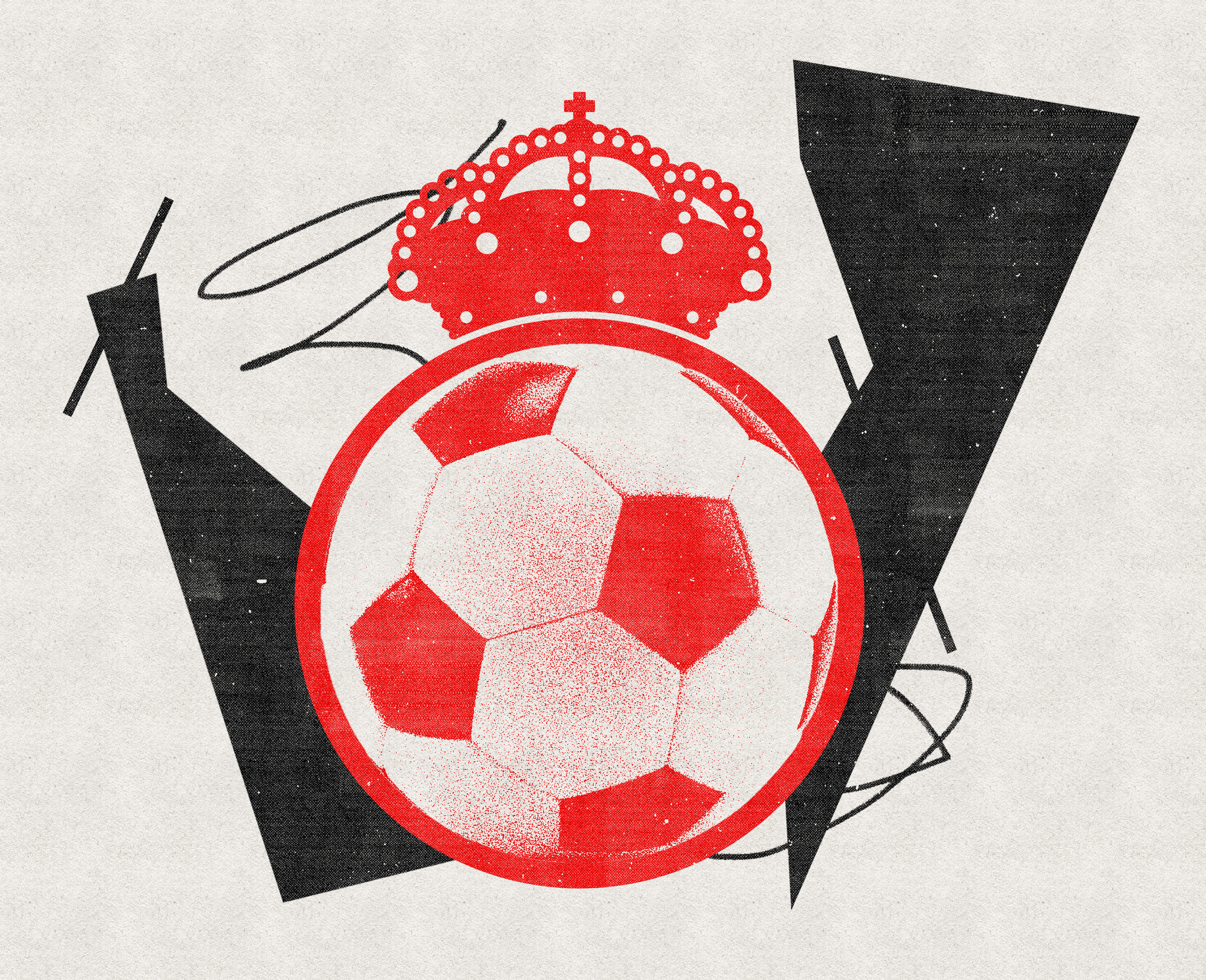
The cause of the referee’s tears was a series of videos produced by Real Madrid TV, a network owned and operated by Real Madrid, arguably the most popular and successful soccer club in the history of the world. The videos, slickly and selectively edited, accused De Burgos Bengoetxea and his colleagues of radical incompetence.
Historically, Real Madrid TV has been an anodyne outlet that, like most team-owned media platforms, provides rosy coverage of its parent club. But in the past few years, the channel has released a barrage of videos promoting alarmist fantasies and outlandish theories, one major theme of which is that Real Madrid is being opposed by organized and nefarious interests dedicated to stopping its triumphs.
Real Madrid TV’s videos are produced like fiery internet exposés of some horrible truths: the music is tense and propulsive, the voiceovers full of phrases like “but the most striking thing comes next!” Nedum Onuoha, a former Manchester City player turned commentator, has described Real Madrid TV’s content as “something you’d see in the fringe levels of the internet.” He’s also pointed out that, within the “tribal nature” of sports fandom—where diehard fans believe that information coming from their beloved teams “must be legitimate”—this kind of content can be incredibly persuasive.
Tomás Hill López-Menchero, a soccer editor at The Athletic, said that the national papers in Spain have a historic partisan “hysteria” when covering the big Spanish clubs—but Real Madrid TV “is that [hysteria] on steroids.” For the nearest comparison, Hill López-Menchero points to a different, newer form of sports content: reaction videos and livestreams from fan influencers like Mark Goldbridge and AFTV whose performatively over-the-top responses to their teams’ on-field highs and lows often go viral.
Sid Lowe, a Spanish soccer correspondent for The Guardian and ESPN FC, said Real Madrid TV’s evolution mirrors the wider trend of populist media outlets embracing extreme and far-fetched notions in order to attract audiences. “That conspiratorial mindset is quite powerful,” he said. “And at the risk of being overblown on this: It’s the currency of our age. It’s the way that things are done.” Real Madrid TV did not respond to a request for comment or share viewership numbers. But its direct reach may be less relevant than its indirect influence, because Real Madrid TV is regularly picked up by major national papers and sports radio stations—including outlets with informal ties to Real Madrid and Barcelona, its main rival. Whenever Real Madrid TV releases a new anti-ref video, that can kick off a cycle of outrage.
Real Madrid TV’s evolution has its history in the recent past of Florentino Pérez, Real Madrid’s long-standing and famously domineering seventy-eight-year-old president. In 2021, Pérez suffered a spectacular failure when attempting to launch a breakaway competition, the European Super League, that would have featured only megaclubs like Real Madrid and England’s Chelsea and Manchester United. Fans responded by taking to the streets in protest in cities across the UK, and the project collapsed at its inception. The Guardian’s Jonathan Wilson has speculated that the failure of the Super League led Pérez to embrace an “increasing paranoia as he loses grasp on the world.”
Real Madrid TV was founded in the early stages of Pérez’s presidency and has historically backed not just the club but Pérez and his decision-making. Jesús Alcaide, the director of Real Madrid TV, is known to be a close Pérez ally. (Pérez has so many loyalists in Spain that they have a nickname: the Florentinistas.) Pérez is actually elected to the position of president by the socios—the dues-paying members of Real Madrid who technically own the club—and so has a vested interest in dictating Real Madrid TV’s messaging. “Florentino likes to control everything,” a former contributor to Real Madrid TV told CJR, “and he keeps a tight control over Real Madrid TV. The core audience are the socios. He’s happy if guys in America or wherever agree with him, but he needs the socios.”
The Spanish soccer correspondent Phil Kitromilides, who previously worked at Real Madrid TV, said that a conspiratorial mindset is now “embedded” into Real Madrid and its TV network. “That’s just the policy from the club,” he told the Guardian Football Weekly podcast earlier this year. “That will continue.”
Real Madrid’s conspiratorialism is also directly tied to a real-life scandal: in 2023, a Spanish radio station reported that FC Barcelona—Spain’s other big club and Real Madrid’s archenemy—had paid José María Enríquez Negreira, a high-ranking official in Spain’s referring committee, roughly eight million dollars over seventeen years. Barcelona stated the payments were for consulting services, but a legal case in which Barcelona is accused of sports corruption is still making its way through the courts. It’s difficult to quantify if Negreira really was able to create a pro-Barcelona or anti–Real Madrid bias within the country’s refereeing corps, but the impact of the case has been huge: it is where observers like Sid Lowe believe that Real Madrid, as an institution, was fully red-pilled.
Lowe said that as he’s covered Real Madrid TV’s latest iteration, he’s regularly thought about how it mirrors the narrative pushed by populists both in the US and in his own home country, the United Kingdom. “Real Madrid was this untouchable institution that everyone else accused of being the beneficiary of the power of the state,” Lowe said. “They’ve shifted into projecting themselves as anti-system. You can make a judgment call as to whether you think it’s because of a genuine sense of injustice or if it’s opportunistic. But I suppose that is true of any kind of conspiratorial mindset of any group—how much is played up and hammed up? How much is deeply felt?”
It would be logical to imagine that the drama surrounding De Burgos Bengoetxea’s emotional press conference might have given Real Madrid TV pause, but it seems to have had the opposite effect. At that same press conference, his colleague Pablo González Fuertes backed him up, saying, “We’re going to have to take measures. We’re not going to allow this to keep happening. Soon, you might have news. Have no doubt, we’re not going to keep putting up with what we’ve been putting up with.” To Real Madrid, this was a threat, and it was inexcusable. In response, the team railed against the perceived injustice: “These statements, which have surprisingly placed in the spotlight videos made by [Real Madrid TV], a media outlet protected by freedom of expression, demonstrate, once again, these referees’ clear and manifest animosity and hostility toward Real Madrid,” the club said.
Weeks into the current season, Real Madrid has already declared it will be preparing a “dossier” full of refereeing issues to present to FIFA, the international soccer governing body. And Real Madrid TV is back to producing news videos showing Spanish referees as heinously incompetent.
“The controversy hasn’t chastened Real Madrid TV at all,” Lowe said. “In fact, it’s emboldened them.”
Has America ever needed a media defender more than now? Help us by joining CJR today.