Sign up for the daily CJR newsletter.
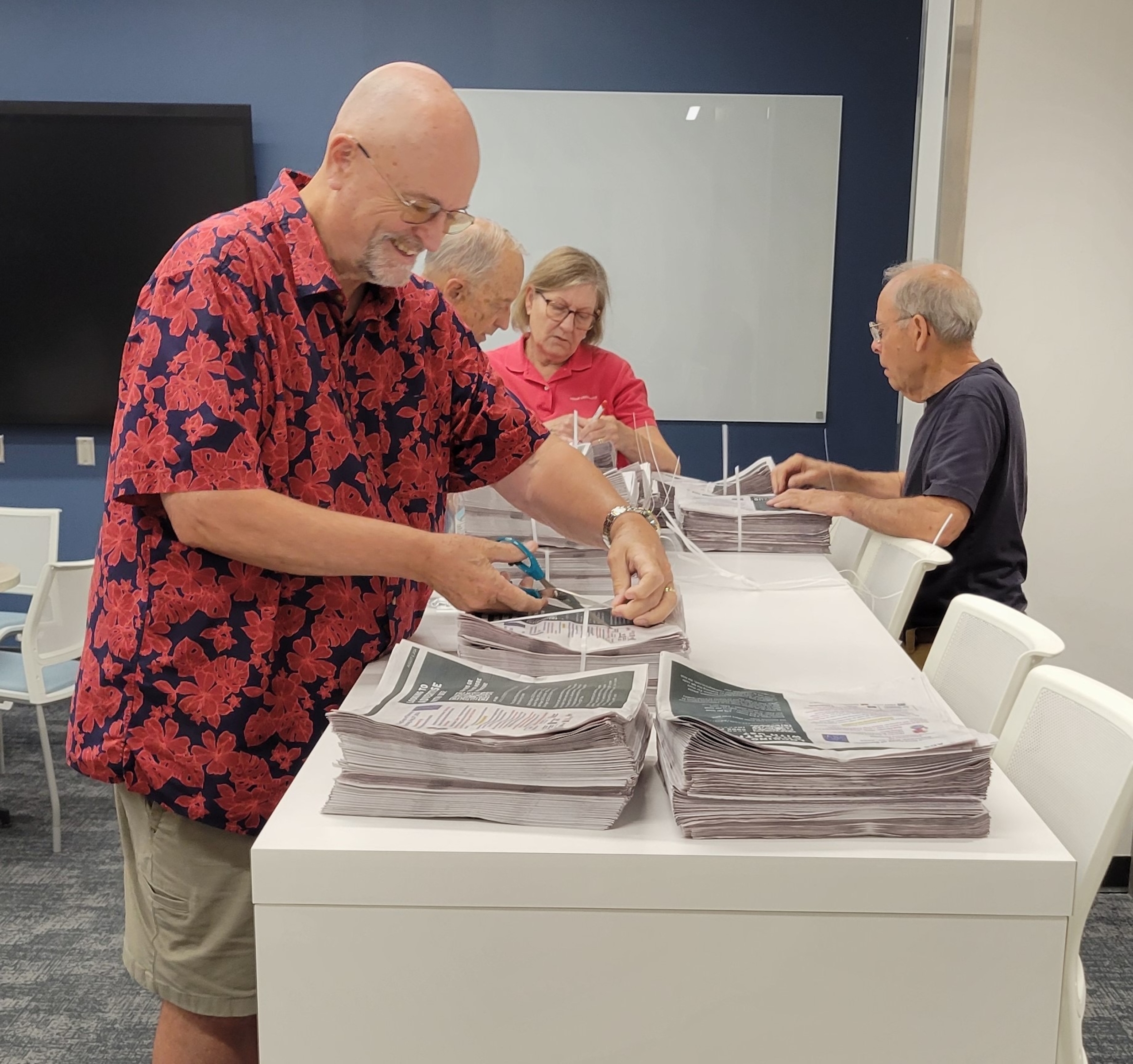
Every Friday, more than a dozen retirees gather in a large conference room in a building owned by Miami University of Ohio to collect roughly sixteen hundred copies of the Oxford Free Press, their town’s weekly newspaper. They divide the stacked papers, each grabbing a couple hundred to distribute around the university campus and all over town—at the local Starbucks, the Kroger grocery store, the senior living community, and four hotels.
Bill Snavely, Oxford’s former mayor, has been delivering the Free Press on alternate Fridays since the first edition of the paper was printed, in July of 2024, back when he still led the local government. “This newspaper just means a lot to me and means a lot to our community, and so it was a personal thing,” he told CJR. “It had nothing, really, to do with politics or with my position in the city. It was just something that I felt I could and should do.”
Until the beginning of 2024, Oxford, a town of seven and a half square miles with a population of roughly twenty-two thousand, had a different local newspaper. The Oxford Press, once a vibrant weekly, had been published for nearly a century. But after Cox Enterprises acquired it, the paper eventually dwindled to a one-page insert in the Hamilton Journal News—which covers the nearby city of Hamilton, Ohio—before shutting down altogether.
Oxford is a college town and a retirement community. Many older residents crave a print paper as a physical way to stay informed. “Everyone I talked to, certainly every volunteer organization I was a part of, bemoaned the fact that we didn’t have a newspaper anymore,” Snavely recalled.
Over at Miami University, journalism students and professors had a solution. Since 2018, they had been publishing the Oxford Observer, a weekly paper produced and edited by two classes during the academic year. Richard Campbell, then a journalism professor, helped lead this charge. Campbell retired in 2019; in 2024, he teamed up with two other retired colleagues to create the Oxford Free Press.
“People were excited they were going to have a print newspaper again,” Campbell said, noting that about a hundred and twenty people came to the paper’s six-month celebration last year.
The Free Press is powered by a small team of young journalists; Campbell and the other two cofounders serve on its board. Aidan Cornue, the current editor in chief, stepped in to lead the publication last May, just a month after his graduation from West Virginia University. The rest of the team comprises a full-time reporter, a graphics editor, a business manager, a newly hired editorial contributor, and, during the academic year, two part-time interns from Miami University whose positions are funded by the university’s Menard Family Center for Democracy, which supports education and civic engagement. During the summer, the paper hires one full-time intern with its own funds. Interns focus on reporting and maintain the paper’s newsletter, website, and social media accounts.
The Free Press quickly made its presence felt with stories about low-income housing, a tax to support local firefighting and EMS services, and the resignation of a Talawanda Board of Education member. Its work was honored in the 2025 Ohio’s Best Journalism contest, the Ohio News Media Association’s Osman C. Hooper Competition, and the Greater Cincinnati Society of Professional Journalists’ awards. The paper was also listed as a finalist for the Institute for Nonprofit News’s Startup of the Year award.
The Free Press raised ninety thousand dollars in its first six months, largely through word of mouth and a donations page. In addition to funding from Menard and the Greater Oxford Community Foundation, the paper receives recurring individual donations from members of the community, about two-thirds of which are made via check, according to Campbell. In November and December, the Free Press exceeded its fundraising goal of eighteen thousand dollars, which was matched by INN and the MacArthur Foundation through the Newsmatch program. The paper raised thirty-six thousand dollars through this initiative, bringing the total, with the match, to over sixty thousand dollars.
Ad sales have also increased since the Free Press hired a part-time business manager last summer. The paper had to add eight pages to its usual sixteen-page tabloid to accommodate the number of ads in one recent edition, Campbell told CJR. He said that edition alone brought in thirteen hundred dollars, nearly enough to fund two print editions of the paper.
Running a small newsroom has its downsides. Sean Scott, the paper’s founding editor and the author of many of its award-winning stories, left in June to join Report for America, which placed him at the Maine Monitor, an investigative nonprofit. While community support at the Free Press was tremendous, Scott said, being a “staff of one” took its toll. He reported three to seven pieces a week, then had to edit his own as well as others’ work. Cornue, the editor in chief, said that interns, the paper’s full-time reporter, or the editorial contributor edit his work.
“The reason that the Free Press works is because of the community buy-in and the community trust,” Scott said. “And I don’t know how you scale that up to larger organizations, or how you take the model and put it somewhere else, but I think it is really important, and I hope that it is replicable in other places.”
The Free Press recently debuted a regular comic strip by a local artist. Future editions may include sports coverage by students in Miami University’s sports journalism class, and Cornue hopes to hire another reporter to cover nearby communities this year.
The Free Press has benefited from a symbiotic relationship between an aging community that relies on a print newspaper and journalism students and recent graduates who need jobs and a place to practice their craft. But Campbell is already looking ahead to a time when the paper will exist entirely online.
“I always point to my three-year-old and five-year-old grandchildren,” he said. “They look at tablets and screens. They are not going to read newspapers growing up. And college students right now, they’re not getting their information from a print newspaper. And eventually, I think, that transition has to be made.”
Has America ever needed a media defender more than now? Help us by joining CJR today.