Sign up for the daily CJR newsletter.
At 6:30 in the morning last July 4, a journalist named Louis Amestoy awoke to a flurry of text messages from Dalton Rice, the city manager of Kerrville, a town in the Texas Hill Country. “Dude,” one of the messages read, “this is bad.” Overnight, a fierce thunderstorm had sent water surging over the banks of the Guadalupe River, causing catastrophic flooding. Amestoy, the editor and publisher of the Kerr County Lead, quickly pulled himself together and drove into town from his house in the surrounding hills. As he approached downtown Kerrville, he could see the river had risen twenty feet, high enough to splash against a bridge. After recording a video of the flooding for the Lead’s daily webcast, he called Rob Kelly, the county’s top official, who told him, “There’s fatalities.” At least six people had died, a number that Amestoy was able to confirm with the sheriff’s office.
Over the six years Amestoy had been working in Kerry County, he’d cultivated these open lines of communication despite the general skepticism toward the press among the Republicans who dominate the Hill Country. They didn’t last. Later that day, Kelly held a press conference at the Ag Barn, a local venue known for hosting 4-H events and gun shows. Amestoy, one of the most familiar faces in a room that included several reporters from nearby communities, got to ask the first question: “The report was we had numerous kids from Camp Mystic missing, and I just saw that they may have been all accounted for. Can you guys confirm that the camps are accounted for at this point?”
“We know that there are some missing. We know where some of them are stranded, and we’re working to confirm that with the people out at Camp Mystic,” Kelly replied. “But in terms of exactly how many are missing and unaccounted for, we’re not sure about that number.”
Kelly’s demeanor shifted when Rudy Koski, a reporter with Austin’s Fox affiliate, took his turn. “Why weren’t these camps evacuated?” Koski asked.
“I can’t answer that. I don’t know,” Kelly responded.
“You’re the top official here in this county,” Koski pressed. “Why can’t you answer that?”
The line of questioning “sent a shock wave through the whole room,” Amestoy said. Suddenly, Kelly and the rest of the county’s leadership found themselves on the defensive. Reporters wanted answers not just about the unfolding tragedy, but about the decision-making—or lack thereof—that may have compounded it. By the end of the day, the leaders of Kerr County had stopped talking to reporters entirely.
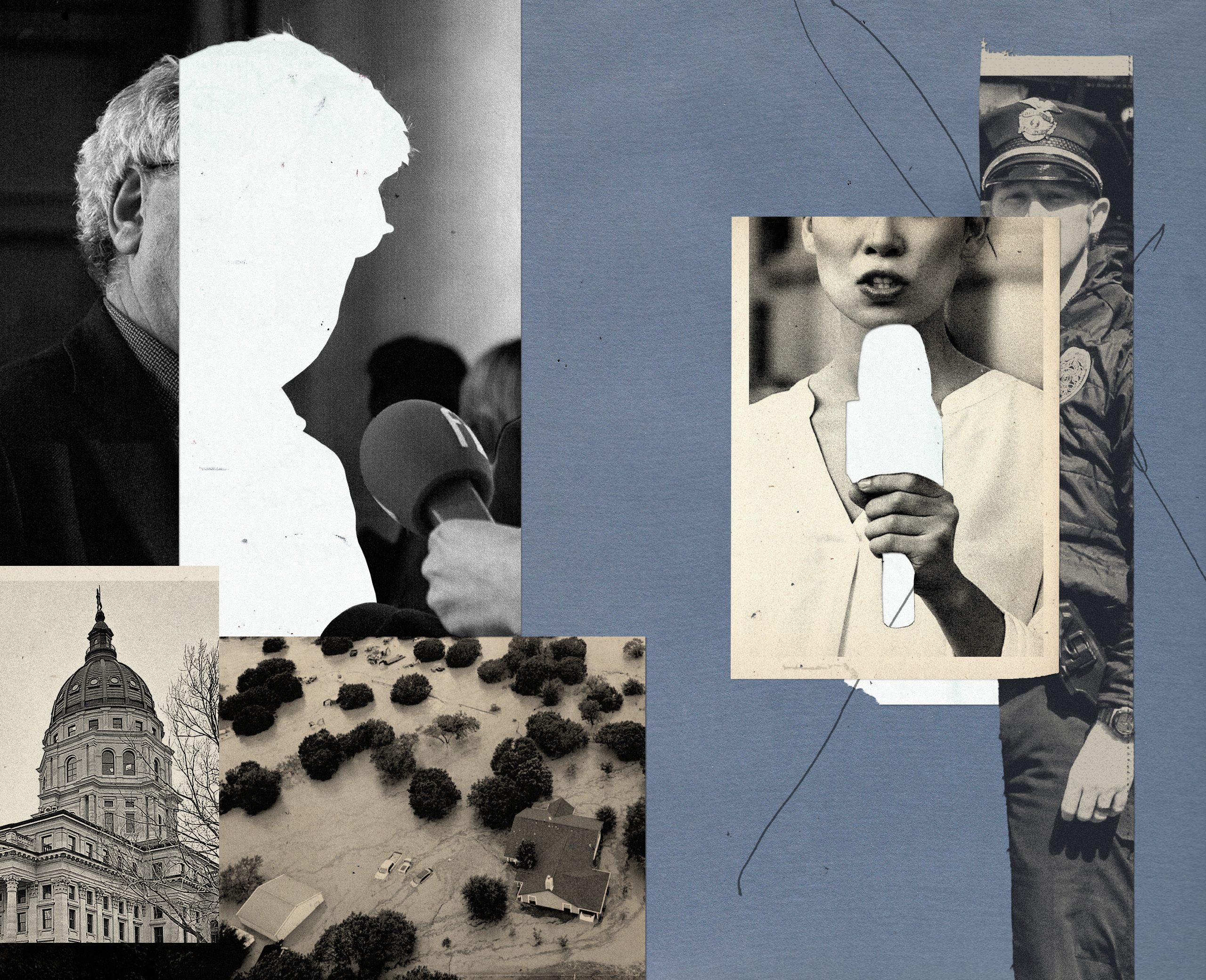
This clampdown on access to public officials may have seemed abrupt. But it reflects a broader shift, one that is not constrained by party lines. Brandon Johnson, the mayor of Chicago, a Democrat, has cultivated a reputation for refusing to answer questions he deems off topic, a designation that runs the gamut from personnel decisions to law enforcement actions. In Republican-controlled Kansas, journalists and photographers can no longer freely cover state legislators during open session, thanks to a battery of recent restrictions. Similarly, the Utah legislature has explicitly barred “blogs, independent media or other freelance media” from obtaining press credentials, issuing a new policy stating that only “professional journalists and media representatives from reputable organizations” should have access to the capitol. Newsday recently sued the government of Nassau County, New York, for withholding information as retaliation for its reporting, and the sheriff of Volusia County, Florida, has repeatedly excluded the Daytona Beach News-Journal from press conferences. The list goes on.
In a national environment that has politicized the very notion of accountability journalism, and amid a reordering of the media ecosystem that has devastated community reporting, many local officials are freezing journalists out for asking even the most basic questions. “Local officials are taking their cue from President Trump. They’re realizing, ‘Shoot, I can just tell them to go pound sand! I don’t have to respond to them,’” David Cuillier, the director of the Freedom of Information Project at the University of Florida, said. “‘I can even put them down. And there’s nothing they can do about it.’”
This upending of norms helps explain why reporting on a disaster that killed a hundred and thirty-five people proved so challenging. “I never got on the phone with anybody from Kerr County,” Emily Foxhall, a climate reporter for the Texas Tribune, told me. As questions about the county’s lack of attention to the risk of catastrophic flooding mounted, she said, the administration “became like this black box of not knowing really anything until they were called before the state legislature to testify.” Eventually, Foxhall drove to the county offices in Kerrville to try to meet with Kelly in person. When she confronted him, he told her he didn’t trust the Tribune, Foxhall remembered. She tried to explain to him that she wanted to earn his trust. “But that was that.” (Kelly did not respond to multiple requests to comment for this article.)
Rarely does an elected official express their motivation for stonewalling a reporter so directly. When legislators in Kansas closed their meetings to reporters last year, Bryan Richardson, a former reporter for State Affairs, a network of outlets that cover state capitols, said the party line was that leadership “wanted members to feel more comfortable” while working on legislation “without the presence of media.” In Chicago, Melody Mercado, a reporter with Block Club, a neighborhood-focused news site, told me that Johnson’s office took an especially disorganized stance toward the press during his first year in office, a period that saw an intense standoff with a top school official and a fight over funding for homeless services and affordable housing. “We would reach out to the administration and give them an opportunity to comment or answer questions, and it was pretty common to expect that we would not hear back,” Mercado said.
Whatever reason public officials may have for denying access to local reporters—suspicion, ambivalence, outright hostility—the effect is the same. For many reporters, the simple give-and-take of local reporting—posing direct questions to elected officials, getting straight answers—has become all but impossible. Without access to decision-makers, journalists must rely on background conversations with aides, public records requests, and archival research. Even then, many local governments slow-play records requests and funnel all questions to publicists.
Rick Hirsch, a former managing editor of the Miami Herald who now works with Cuillier at the University of Florida, contrasted the current environment to that of the late 1970s, when he got his first job covering a suburban city hall in South Florida. “If the mayor wasn’t going to talk to me, I would wait outside his office till he went home,” Hirsch said. Such a time-tested approach to local reporting is now far more rare. “It’s a wall,” Hirsch said. “A wall against public information.”
For more than a century, both chambers of the Kansas statehouse in Topeka have reserved a long table for reporters to use while covering floor proceedings. In 2022, Ty Masterson, the president of the senate, issued a rule prohibiting journalists from the senate floor, reserving it instead for legislative aides; the house implemented the same policy last year. Journalists covering the chambers must remain in the upstairs galleries during votes. Photographers are permitted only to shoot from the back of each chamber—fewer faces, more backs of heads. Democrats condemned those moves; as Jeanna Repass, the state party chair, put it, “It is disgraceful and disrespectful to Kansans to have this assault on the free press in our state capitol.”
Sherman Smith, the editor of the Kansas Reflector, a nonprofit news site, told me that reporters had respected a rule against talking to legislators while they were in session, limiting their interactions with them to quick asides between debates. “It’s much harder to track people down as they’re all fleeing the floor and trying to get away from you,” he said. Further complicating matters was a 2025 decision by Kansas House Republicans to close their caucus meetings, which had long been open to the press. Given the GOP’s supermajority in the Kansas legislature, there’s effectively no transparency about how the party will use its power, Smith told me. “When they come out on the floor,” he said, “there’s virtually no debate. Democrats go up and complain about it for twenty minutes, and then the Republicans vote, and that’s it.”
Kansas Republicans have argued that house members were uncomfortable talking in front of journalists during caucus meetings. But reporters in Topeka believe that tightening access has much more to do with the influence of Donald Trump on conservatives at every level of government. “There used to be a feeling of mutual respect,” Emily Bradbury, the head of the Kansas Press Association, told me. “I feel like the rhetoric of ‘fake news, corporate media’—some people really latched onto that.”
That group includes Virgil Peck, a state senator. Last year, he drew attention to the six news outlets that rent office space in the state capitol, at an annual rate of a hundred bucks. (Prior to the introduction of that token fee, in 2017, the legislature had provided office space to the media free of charge.) During a budget hearing, he questioned the very notion of providing office space for the press, and complained that the annual fee was too low. “They can sit in the benches in the hallway and write whatever they want to write,” he said. Last year, Peck implemented a budget amendment that raised the rent for those outlets by a dollar per square foot per month, a total of sixteen thousand dollars for six outlets. This spring, the legislature attempted to raise the rent again, to eleven dollars per square foot—an effort that failed to overcome a veto from Laura Kelly, the Democratic governor. “They feel empowered by what the president is doing to act this way at a local level,” Smith told me. “If he has his constituents all riled up about how much reporters are paying for rent,” he said, of Peck, “they’re not thinking about the absence of property tax relief, or the failure to address the water crisis in western Kansas and the refusal to expand Medicaid.”
In an email, Peck called such criticism “a boatload of crap!” Trump’s example had “zero to do with my push to ensure space in the Capitol is not given free of charge to a non-government entity,” he wrote. “Every thinking person knows office space in the Capitol costs taxpayers money for electricity, furnishings, maintenance, janitorial services, etc. Simply stated, my budget proviso was to not give away office space in the Capitol to non-government entities.” (Emphasis Peck’s.)
Bradbury said she worries that leaning into an anti-press culture war will pave the way for more onerous restrictions. In this year’s legislative session, lawmakers passed a bill making it a crime for anyone to come within twenty-five feet of an on-duty law enforcement officer, which has obvious implications for the press. “When something becomes normalized,” Bradbury told me, “it becomes a lot easier for people to kind of jump on board and go, ‘Let’s take that one step further.’”
Bradbury said she is concerned there will be a repeat of the 2023 police raid on the Marion County Record, in which the newspaper’s computers and cellphones were seized as part of an investigation initiated by a local restaurant owner who had baselessly accused reporters of sharing confidential information about a past conviction for drunk driving. Though the county was eventually forced to pay three million dollars to three journalists and a city councilor involved in the incident, it set an ominous precedent. “The concern is not just having good relationships,” Bradbury said. “It’s when somebody comes in and tries to abuse their power.”
In Chicago, Johnson had courted reporters during his 2023 campaign for mayor. He sat for an hour-long livestream with Laura Washington, a columnist for the Tribune, and invited Tonia Hill, a reporter from The TRiiBE, an outlet catering to the city’s Black community, to interview him while he got an edge-up at a West Side barbershop. But not long after his election victory, Johnson and his aides closed ranks. “It was really difficult to get a response from the press office on virtually anything,” Mercado, of Block Club, recalled of the first phase of Johnson’s mayoralty. When challenged on his less than forthcoming administration in November of 2023, six months after he took office, Johnson scoffed. “This notion that somehow there’s been a lack of information or transparency, I call false on that,” he said. “I have told the truth, and I’ve always told the truth, and I will always tell the truth.”
Yet Johnson continued to stonewall. When a group of journalists was covering the arrest of a man suspected of killing a police officer, Johnson ran off. Mary Ann Ahern, a veteran reporter for NBC, called out, “Mr. Mayor, will you please wait?” as she pursued him in the street. “Why do you have to run from us?”
Darius Johnson, a journalist at the local CBS affiliate, posted a video of the incident on social media. “Everyone was kind of in awe,” he said. “We’re not even trying to ask you any tough questions. We’re just like, ‘Finally, a suspect is in custody after a ten-day manhunt. What do you have to say about it?’” Bria Purdiman, at the time the mayor’s deputy communications director, would later contact Darius Johnson’s bosses with a demand that CBS take the video down, claiming that it did not actually show the mayor running away. The station eventually agreed to adjust its caption to say that he had “dodged questions.” Six months later, during a power struggle with the chief of the city’s schools, reporters asked if the mayor had demanded the chief’s resignation. “I don’t ever discuss personnel issues,” he said. (Such discretion is mandated by the city’s Law Department.) “I find it to be highly offensive, irresponsible, and raggedy, and I don’t do raggedy.”
Many Chicago-area reporters I talked to place blame for the chaotic first year of the administration’s communications strategy on Ronnie Reese, Brandon Johnson’s first press secretary. At least four members of Johnson’s communications team filed formal complaints against Reese, alleging misogyny, sexual harassment, and anti-Semitism, according to documents obtained by CBS Chicago; notably, Reese also privately called a reporter at the Tribune “so fucking stupid.” Reese was fired in late 2024 “for failure to meet professional standards.” A few months later, Johnson sat for an hour-long interview with WBEZ, the city’s august public radio station, where he expressed regret for distancing himself from the media during his first two years in office. “I did not effectively communicate with the people of Chicago,” Johnson said. “That’s something that I’m going to course-correct. We’re doing more regular, consistent stand-ups with the press.”
Journalists embedded at city hall didn’t want to speak about this with me for fear of retaliation from the Johnson administration. But they noted that the situation had significantly improved thanks to Reese’s replacements—Erin Connelly, the communications director, and Cassio Mendoza, the press secretary—who implemented a standing Tuesday-morning press conference for the mayor and made a habit of speaking to reporters every day. In February, however, Mendoza and another prominent adviser left for New York to join the Zohran Mamdani administration; Connelly remains in her post and has maintained the same level of availability.
In a statement, Connelly’s deputy Griffin Krueger wrote that Johnson “views meaningful engagement with the press as an essential responsibility of his office and an obligation to the people of Chicago.” Since the start of 2025, the mayor “has led engagement with members of the media on 132 occasions,” Krueger stressed, adding that Johnson “remains committed to maintaining transparent, productive dialogue with the press while providing a view into governmental processes and his priorities,” as well as his belief that “throughout American history, a fair and transparent press has always helped move justice forward.”
While the working relationship between the media and the mayor’s office is better now than it was eighteen months ago, reporters continue to hit walls. At a recent press conference about an event promoting swimming in the Chicago River’s once-polluted waters, the Tribune’s Alice Yin asked Johnson about the status of a woman who was supposedly being detained by Immigration and Customs Enforcement at O’Hare Airport. The matter may have had little to do with swimming, but as a matter of public interest, immigration detention was fair game. “Any other questions?” Johnson responded.
As it turned out, the woman’s claim was later revealed to be a fabrication, a story that received wide coverage in Chicago. Johnson, then, effectively missed an opportunity to set the record straight—or at least to clarify that his office had no knowledge of the apprehension, which may have helped journalists more swiftly conclude there was nothing of substance to report. Mercado also attended the press conference and was alarmed by the exchange, regardless of the particular story Yin was asking about. “You are a public official at a public event, and if we have a question, we should be able to ask that question. If you don’t know the answer, you should just say you don’t have any information.”
Critical questions about the Johnson administration remain unanswered. Shawn Mulcahy, the news editor for the Chicago Reader, has worked on a series of investigations into the city’s treatment of the homeless under Johnson. Despite regular outreach to the mayor’s office, Mulcahy said, his team’s questions about how the administration decides when to clear a homeless encampment have been ignored. “We’ve been strung along for a while, and then eventually we’ve written stories and sent detailed questions—no response.”
Of course, there are ways for journalists to carry on with their work without the cooperation of public officials. In Texas, Neena Satija, an investigative reporter who recently left the Houston Chronicle for NPR’s Texas Newsroom, ran into the same roadblocks as her peers while reporting on the flooding in Kerr County. So she turned to the public record. “Kelly had said in the very first press conference, ‘We don’t have a flood warning system,’ and kind of made it seem like that wasn’t a big deal,” Satija told me. She and Keri Blakinger, a former colleague who now works at ProPublica, sifted through hundreds of digitized minutes of county and state agency meetings from the past decade. Within days, Satija and Blakinger published an investigation showing that the county had sought an early-warning system in 2016, but that the state had rejected its requests for funding on at least three separate occasions. The silence of Kerr County did not stop them. “We did feel like we were able to get their views of the story to some degree, because they had been talking about it in public forums in the last ten years,” Satija said. She and Blakinger went on to reveal that the public authority responsible for the Guadalupe River had previously prioritized a tax cut over investing in better monitoring systems.
Foxhall, of the Texas Tribune, took a slightly different tack. She and Lauren McGaughy, a public radio journalist, managed to obtain hundreds of text messages that allowed them to establish a timeline of the official response to the flooding. “This storm snuck in under the radar so to speak,” Kelly wrote in a text Foxhall included in her story. “No one was able to get notice out, there was no time and no electricity.” The implication: that it was unreasonable to expect a more organized response to a disaster that had effectively come out of nowhere.
Typically, a ticktock report on a government’s response to a natural disaster would include interviews with elected officials. But even without their participation, Foxhall and McGaughy published a revelatory story—one that might not have had the same impact had they relied on public press resources. To pick one example, a Kerr County sheriff texted that “everyone at camp mystic is accounted for,” only to follow up an hour later to say twenty-seven people were missing. The initial false report continued to ricochet across official channels for the rest of the day, making a difficult situation even more chaotic.
Public records requests have been similarly vital to Mulcahy’s probe into Johnson’s campaign promise, in Chicago, to cancel a contract with a company whose gunshot-detection technology was shown to be largely ineffective by the city’s inspector general. Yet more than a year after Johnson announced that the contract had ended, Mulcahy found a receipt showing the city had paid more than seven hundred thousand dollars to the same company. Though use of that system appears to have been only a trial run, Mulcahy is still trying to piece together why a mayor who campaigned against surveillance technology continued to pay for it. “I asked the city, I asked the police department, I asked the contracting agency,” he told me, “and no one gave me a really good answer.” Krueger attributed the lapse to the timing of Mulcahy’s request, saying it came amid the mayor’s trip to Washington, DC, to testify before Congress about Chicago’s sanctuary policies.
There are limits to how much information can be gleaned from public documents, just as dozens of off-the-record conversations with a politician’s aides can never truly replace a sit-down with the boss. Cuillier, from the University of Florida, told me that the combination of charging “copy fees” to process public records requests, and the lack of any way to force public agencies to comply with a request in the first place, can make this style of reporting daunting for small outlets with tight budgets. “In a lot of states,” Cuillier said, “the only recourse is to hire a lawyer and take the government to court.” That strategy might work for a national publication like the New York Times but is basically out of the question for a bootstrap operation like the Kerr County Lead.
Cuillier sees the clampdown on local public records requests as yet another example of how the anti-press sentiment in Washington has metastasized to every level of government. Foxhall and McGaughy found a particularly telling example of that mentality. “Don’t let the idiot journalists get you down,” one of Kelly’s friends wrote to him in an email. “I can’t think of a more useless profession.” As Bradbury, of the Kansas Press Association, told me, “I truly believe that transparency protects the good public servant as well as it protects the public. It just baffles me when politicians don’t understand that.”
Has America ever needed a media defender more than now? Help us by joining CJR today.