Sign up for the daily CJR newsletter.
On a recent evening, a group of editors, writers, and audio producers gathered on Zoom to talk about Erin Brockovich’s bra. They were workshopping an audio essay for Signal Hill, an audio magazine that debuted early this year. The piece—by Zoe Kurland, who works in public radio in Marfa, Texas—was about her dad, Jeffrey, who was the costume designer on the Brockovich movie from 2000, responsible for dressing Julia Roberts, and about Kurland’s own coming into womanhood. The real-life Brockovich was, in Jeffrey’s words, “quite buxom”; Roberts was not. So he’d patched together prosthetic silicone cutlets, gel pads, and cotton to create an effect. Kurland asked her colleagues, “Is it weird to make a story about your dad and boobs?”
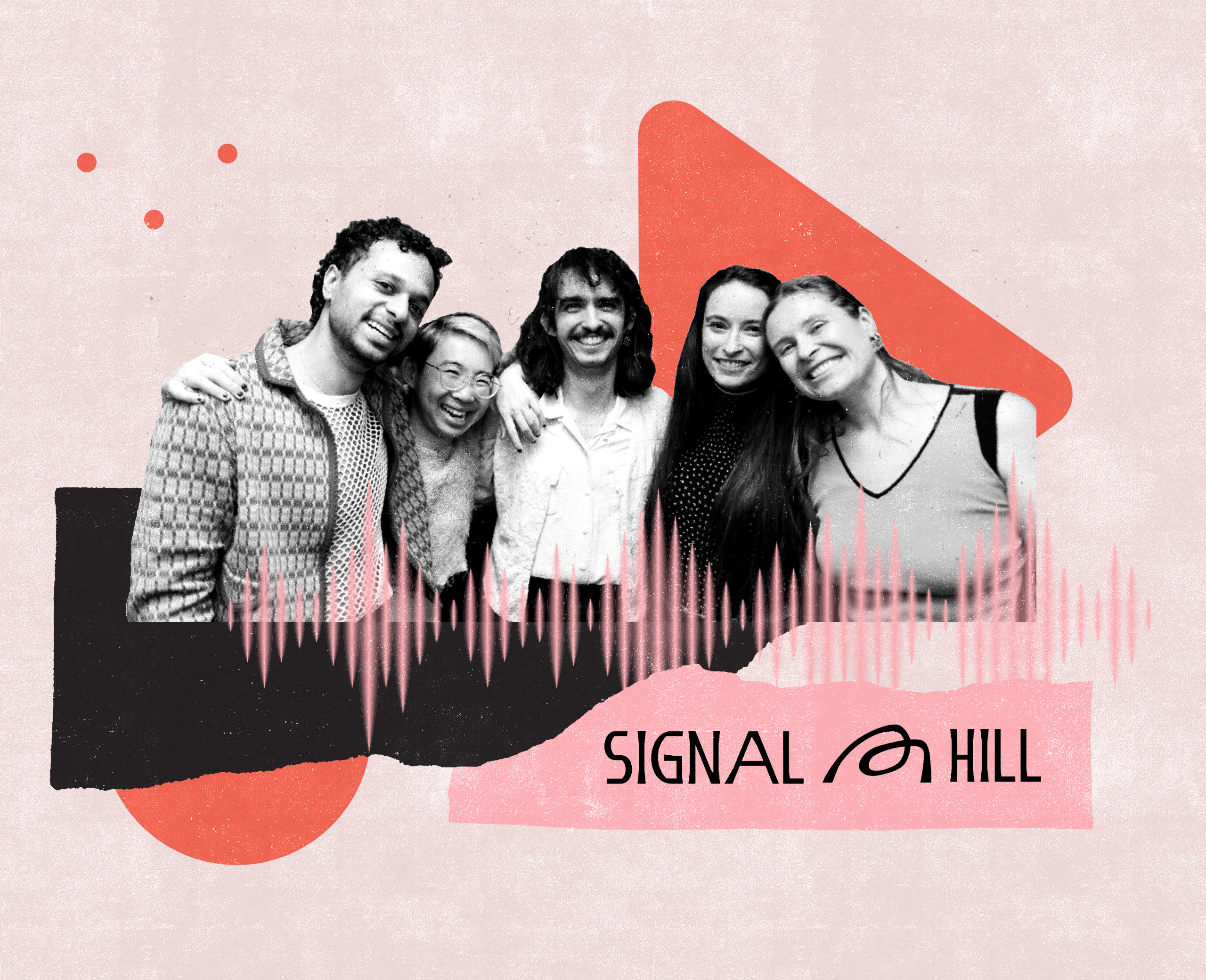
“No, not weird,” someone typed into the chat. All agreed. Besides, Signal Hill welcomes the weird. A pair of audio producers in Chicago—Liza Yeager, who is thirty-one, and Jackson Roach, thirty—started the project because they were tired of making the same old grist for the narrative-podcast-industrial complex: “specific, small, and grabby,” as Yeager characterized it. Her favorite stories tend to be about the “squishy,” “everyday stuff,” she said—less conventional, more “some guy walked around.”
They’d come into the audio industry in the 2010s, at a time of major investment from media and tech companies. But since then, “the money has dried up,” Yeager said. These days, “it’s kind of a return to the situation that existed before the boom, when the only way to make powerful work that you care about was to do it on the sidelines, when there wasn’t an expectation or an incentive to make tons of money for everybody.” Yeager and Roach have kept their day jobs, working on audio guides for the Museum of Modern Art and freelancing for Jacobin’s podcast The Dig, respectively. Roach has put some of his family inheritance into Signal Hill—his dad directed Austin Powers and Meet the Parents; his mom was in the Bangles—which allows them to provide modest pay to editors and contributors. They’re also soliciting funds from listeners, who are invited to contribute six, twelve, or twenty-four dollars per month or to make a one-time donation. Eventually, Yeager and Roach hope to turn Signal Hill into a self-sustaining nonprofit.
Why a magazine, as opposed to a podcast series? The former seemed more capacious. “Everybody we knew wanted to make cool stuff that sounded only like they could make it, but nobody had a place to put it, because every place had a specific way they needed everybody to sound,” Roach said. “And so then we were kind of like, ‘We also have a specific thing that we’re trying to do, which is to make something that is sort of radical, variegated, and different.’”
The first issue, from February, featured reporting on a kite festival in Los Angeles, the link between sheep and war in the South of France, and entomology. The second issue, out November 3, will scope out similarly uncharted territory: in addition to Kurland’s essay about Brockovich’s bra, there’s a story about a tree species in Oregon, a poem, and an examination of testosterone therapy that doubles as a meditation on transness.
In the weeks leading up to the new issue, Yeager, Roach, and the rest of the team have been focused on creating a sense of continuity. Listeners can dip into pieces one by one, but the makers of Signal Hill want it to sound like a magazine—a unified sum with a distinctive sensibility. The stories should be in the right order; the interstitials should evoke a sense of time passing. “The question is, How do you make it feel like there’s clearly something going on without making it feel too kitschy?” an editor wondered aloud on Zoom. “It would be cool if it was the sound of walking up a hallway, and then you enter a room, and it’s one story, but that could also make people feel like, ‘Okay guys.’”
Other editors had their own thoughts. Yeager suggested that a sound repeat in each of the stories’ intros to weave a through line. “A tone that is slightly different, but similar, coming in, like, ding di ding,” she said. She drew the shape of a sound wave in the air with her hands.
The important thing, they agreed, wasn’t so much which sound as the idea of a universe being created, one with both an idiosyncratic voice and enough space for contributors to get expansive. “I feel like with every story, at some point I walk through a dark tunnel and I don’t know what’s at the end,” Roach said. “They’re all being made in such a different way by a different kind of person. Nothing about them is predictable.”
“I guess we set up that problem for ourselves,” Yeager replied. “That’s part of what makes us good.”
Has America ever needed a media defender more than now? Help us by joining CJR today.