Sign up for the daily CJR newsletter.
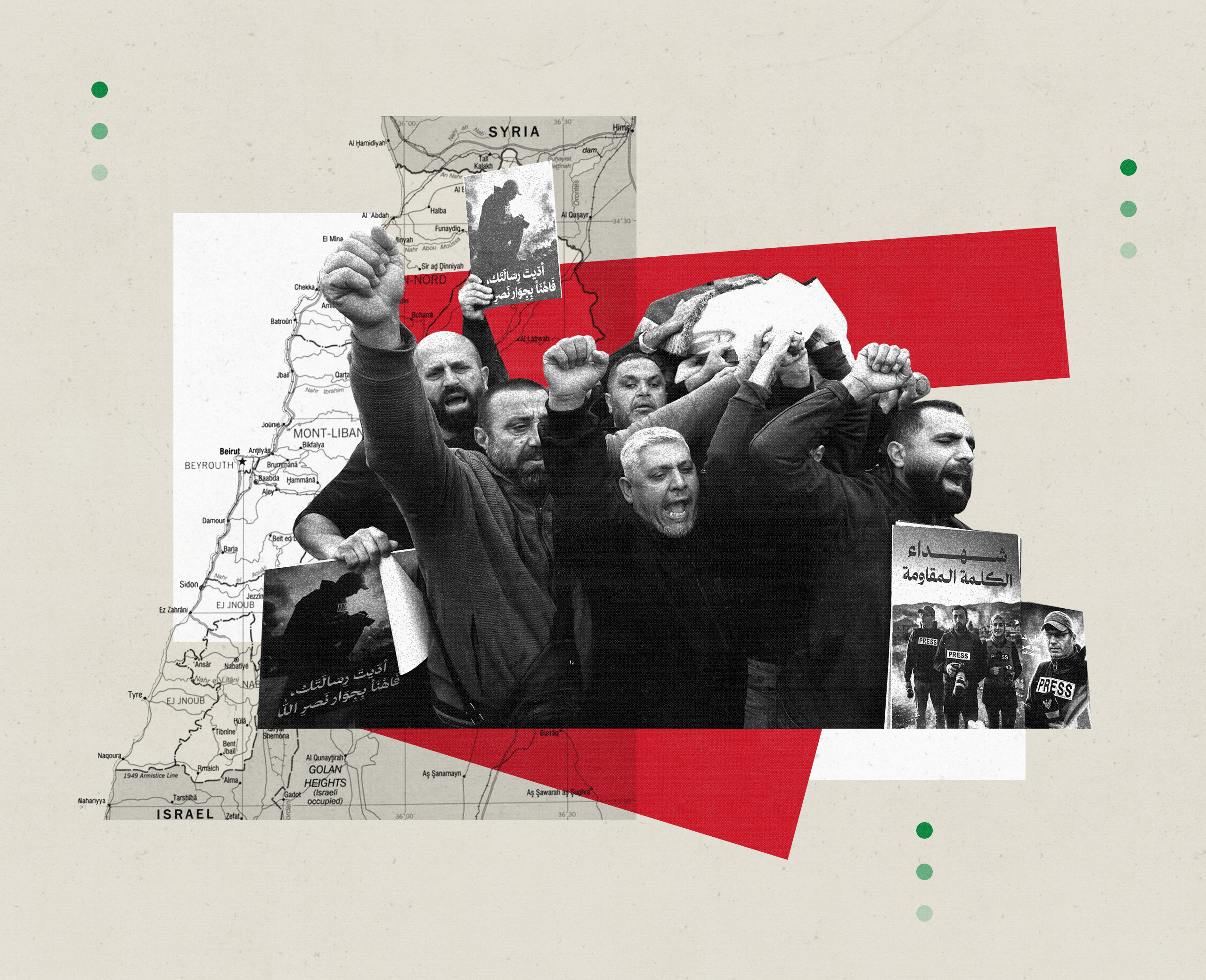
On the morning of March 28, Fatima Ftouni, a journalist in southern Lebanon, filed a live news dispatch for Al Mayadeen, a Beirut-based television network. Wearing a press vest and helmet, she described the Israel Defense Forces’ (IDF) occupying parts of the town of Taybeh and retaliatory attacks by Hezbollah, the Shiite political party and armed group with which Al Mayadeen is editorially aligned. Several hours later, Ftouni; her brother Mohammad, a videographer; and Ali Shoeib, a correspondent who worked for a Hezbollah-affiliated outlet called Al-Manar, were driving near the district of Jezzine in a car marked “Press” when an Israeli drone fired four precision-guided missiles at them, killing all three journalists.
Israel soon issued a statement taking responsibility for the killings, accusing Shoeib, without evidence, of working for Hezbollah, and saying nothing of the Ftounis. “Journalists are not legitimate targets, regardless of the outlet they work for,” Sara Qudah, the regional director at the Committee to Protect Journalists (CPJ), said. (On the same day, Israel also killed nine paramedics in five villages.) With few exceptions, Western news outlets did not report on the events on the day they occurred—the latest instance of Israel’s well-documented targeting of journalists and health workers in Lebanon and Gaza.
The obscuring of Lebanon and its civilians is no accident. For years, the correspondent infrastructure covering the country has been hollowed out. News organizations, most prominently the Washington Post, have chosen to shutter their foreign bureaus, surrendering decades of know-how. (A spokesperson for the Post said that the layoffs were part of a restructuring “designed to strengthen our footing and sharpen our focus on delivering the distinctive journalism that sets the Post apart.”) Outlets such as the Associated Press and the New York Times that still invest in on-the-ground correspondents are in short supply. To try to fill the gap in moments of crisis, many news organizations now turn to freelancers or send in journalists lacking the language expertise or long-standing relationships with locals. The work of reporters from Lebanon has taken on an outsize importance.
After Hezbollah attacked Israel in response to the assassination of Ayatollah Ali Khamenei, Iran’s supreme leader, the IDF responded by invading southern Lebanon, a campaign reportedly long in the making. In the months preceding the escalation in Iran, peacekeepers from the United Nations recorded more than ten thousand violations by Israeli forces of an American- and French-brokered ceasefire in Lebanon. Since the war began, on March 2, the IDF has displaced over a million civilians. Across the country, shelters are at capacity. More than 1,200 people, including 124 children and 52 health workers, have been killed by Israeli forces. Air strikes have burned farmland and groves of olive trees core to the identity and economy of the region. Human Rights Watch found that Israel has used white phosphorus in southern Lebanon, a violation of international humanitarian law. The intent is clear: Israel Katz, Israel’s defense minister, has said the IDF is deploying its “model” from Gaza in Lebanon.
Yet Western newsrooms have, thus far, largely framed the story of Lebanon as a sideshow to the war in Iran. Coverage of the bombardment and subsequent invasion has been reactive, relegated to live blogs and breaking news updates; there are few in-depth stories on the political and humanitarian situation. Hezbollah is presented all too often as being synonymous with Lebanon, as the “conflict” “spills over” from Iran. “There’s a temptation to fit whatever is happening in Lebanon into an established narrative,” Mohamad Bazzi, a journalism professor at New York University and the director of the school’s Center for Near Eastern Studies, told me. Afeef Nessouli, a Lebanese American freelance journalist reporting from Beirut, said, “The dehumanization of Arabs is obvious.”
Beirut became a staging ground for coverage of the Middle East and North Africa during Lebanon’s civil war, sparked in 1975 by exploding sectarian tensions. Correspondents operated with relative freedom in the city’s open media environment and refined their craft in its militia-controlled neighborhoods, learning to navigate checkpoints and work with translators and fixers. The Commodore, a luxury hotel in Beirut’s Hamra district that opened in the 1940s, served as the unofficial headquarters of the foreign press corps. Militia leaders, diplomats, politicians, and spies frequented its lounges. Armed guards manned the entrance while correspondents filed dispatches from its lobby. Even when the city’s communications collapsed over the course of the war, the hotel’s landlines and telex machines remained operational. Reporters passing through met Coco, a parrot perched at the hotel bar who mimicked the sound of incoming shells. Terry Anderson, the Beirut bureau chief for the Associated Press, reported from the hotel until 1985, when he was taken hostage by a militia and held in captivity for nearly seven years.
Beirut remained vital for regional coverage during the Iraq War. Anthony Shadid, the late Beirut-based correspondent for the New York Times, filed coverage bolstered by his deep knowledge of local history, politics, and culture, in addition to his fluency in Arabic. Alongside Shadid were correspondents whose work depended on the unacknowledged labor—and, often, the trauma—of local journalists, news assistants, and translators. “Anthony had unique gifts as a writer and reporter, but what made him exceptional was his dedication to the story. When he wrote about Lebanon, or Egypt, or Iraq, the source of his authority was the years or decades he had spent studying these countries, living in them, and then listening to and sharing the voices of their people,” Kareem Fahim, a longtime reporter in the Middle East who worked with Shadid at the Times, said. “Many media organizations seem less and less interested in that kind of commitment.”
In the early 2000s, Gulf-based networks such as Al Jazeera and Al Arabiya expanded, with Doha and Dubai gradually becoming media centers. Even so, Beirut remained key for Middle East correspondence. By 2015, at the height of the US-led campaign against the Islamic State and the war in Syria, more than thirty full-time foreign correspondents were stationed there, current and former Lebanon-based journalists told me.
Lebanon’s cascading crises—a 2019 uprising against the political establishment, a port explosion, and a financial collapse triggered by years of government corruption and mismanagement—drove many reporters away. The Daily Star, an English-language newspaper that had long served as a conduit between the Lebanese press and international media, shuttered in 2021, a casualty of the economic free fall. In January, the Commodore closed its doors as the downturn battered Lebanon’s tourism and hospitality sector.
As audiences migrated online and advertising revenue vanished, the infrastructure that had supported foreign correspondence eventually collapsed. From 1998 to 2011, at least twenty US newspapers and media organizations shut down their foreign bureaus, taking with them hundreds of foreign correspondent positions. The consequences have come to bear on the coverage—which, in the extreme, can become stenography. During the 2024 war, reporters with outlets including the BBC and Fox News toured southern Lebanon alongside Israeli forces, producing what one Lebanese legal watchdog described as “carbon copies of the Israeli army’s videos.” (The BBC did not respond to a request for comment. A spokesperson for Fox News said that its journalists “work to embed across the full spectrum of military and political forces to deliver viewers context from every side of a conflict and ask questions of those in power with no exception.”)
Beirut-based freelancers still cover Syria, Palestine, and the broader region, albeit without the regular salaries, health insurance, security training, or newsroom support of full-time staffers. “Newspapers and agencies are happy to pick up the prizes from them, but a little loath to fulfill their obligations to them,” Ian Williams, the president of the Foreign Press Association, said.
Lebanese journalists, meanwhile, work as fixers for foreign outlets, frequently in dangerous environments. Israel has killed at least eleven reporters in Lebanon and two hundred and ten journalists in Gaza since October 7, 2023, according to CPJ, making it the deadliest period on record for media workers.
Despite their sacrifices, these local journalists are often subjected to additional pressures by the news outlets that depend on them. A 2025 survey of reporters of Middle Eastern and African descent working for Western outlets, conducted by the Arab and Middle Eastern Journalists Association, found that 85 percent of respondents felt their newsrooms had held them to a “higher standard of neutrality”; 75 percent said “expectations of objectivity are applied unevenly depending on background or identity.” Nessouli told me that indigenous Lebanese reporters are frequently taken for granted: “When the bigwigs from larger corporations parachute in for a week, they become fixers, stringers, and assistant producers,” he said. Foreign correspondents often task them with asking civilians displaced from the south ignorant or insensitive questions that seem to conflate them with Hezbollah. “The US media has trouble conveying nuance, and Lebanon is a small country that requires a lot of nuance,” Bazzi said.
Foreign reporters also “don’t really respect the limitations of fixers,” Nessouli said. For example, when a correspondent can’t get a pass to enter Dahieh, a densely populated Beirut suburb that Israel has targeted, they may pressure the fixer to obtain access. The correspondents are “trying their best,” he observed, “but they’re propagandized to believe the Middle East and Arabs are barbaric.”
Has America ever needed a media defender more than now? Help us by joining CJR today.