Sign up for the daily CJR newsletter.
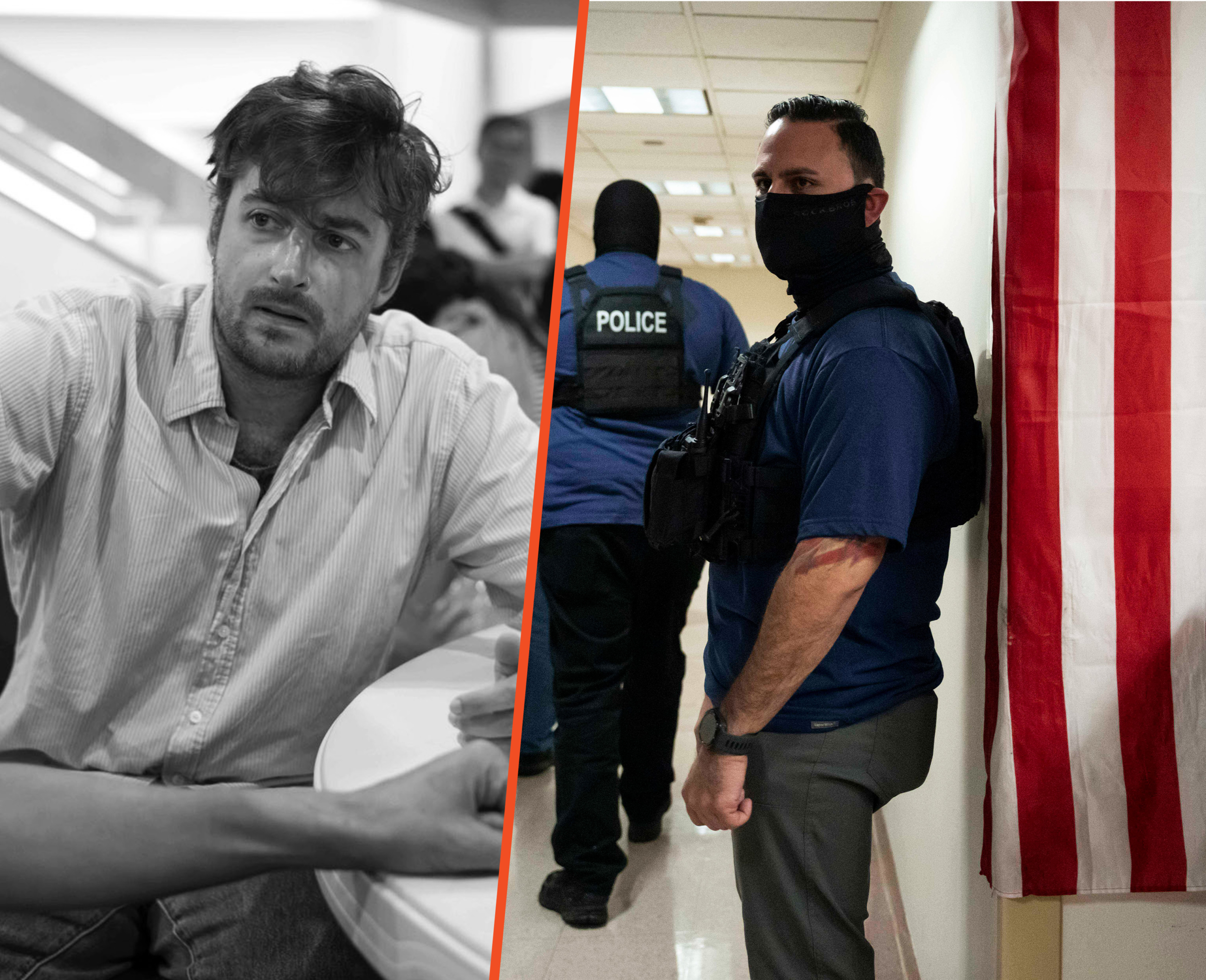
Last Thursday, Till Eckert was inside an immigration processing center in downtown New York when he came across a woman pleading with an agent from US Immigration and Customs Enforcement not to take her husband away. Eckert, who is a reporter for the German nonprofit outlet Correctiv on a fellowship with ProPublica, whipped out his phone and filmed the scene as the ICE agent pushed the woman back until she fell, slamming her head against the floor.
By that point, Eckert had been visiting the federal courthouse for nearly two weeks, part of a small coterie of photojournalists and other reporters who have been lining the narrow halls of the twelfth floor daily, documenting the actions of immigration authorities whose tactics have escalated significantly in recent months. He was also on the scene a few days later, when three reporters were shoved in a melee with ICE agents; one of them, a Turkish journalist named L. Vural Elibol, was taken to the hospital. Eckert’s account has been edited for length and clarity.
The first day, I got to court quite early—it must’ve been 9:30am—and I was completely new to the procedure. I took the elevator up to floor twelve; I managed to find out beforehand that this is where the courtrooms are. So I walk out of the elevator, turn left, walk down—it’s almost clinical, the environment. You have no windows. The lighting is almost like in a hospital. It’s quite an unpleasant environment to be in.
I remember I was talking to an ICE agent for quite a while, actually. I asked him how long he’s been doing this for. He told me he got rotated in from El Paso. He told me that he’s going to do this for one month and that he’s normally with Border Patrol.
After that, the court doors opened and out came a woman who I later identified as Shakira. She’s a transgender woman, and right as she walks out, ICE agents are approaching her. It was very, very swift, just approaching her and just taking her away to the stairwell. Shortly after that, there was another woman coming out of the courtroom, and the ICE agents proceeded to arrest this woman as well. I remember I looked into her face and she appeared to be paralyzed, in shock. She didn’t know what was happening to her. For me, it was quite a shocking experience—it was the first time I saw it.
Traditionally, courthouses are safe places, or places where you would go and would expect due process. But more and more it seems like this is changing, and it’s not a place of safety anymore.
By the time I got there, there was only a group of photojournalists hanging around. Some of them had been there for months, just to document what was going on. There were freelancers, there were videographers. There is one person going in there to shoot a documentary; there is one woman who is drawing scenery.
What I’ve heard from my colleagues is that the rules are always changing for them—where they are allowed to stand, where they are not allowed to stand, where they are allowed to film, where they are not allowed to film. These are things the journalists who are going there every day have to deal with. Rules might change. You don’t always know why, when, or how it will change.
On [Thursday] morning I came in, it must’ve been around 10am. There was no ICE activity to be seen on floor twelve, and my colleague, a photojournalist, and I decided to go up to floor fourteen to see if something was going on there. As I walked out of the elevator, I heard a woman screaming desperately, right beside the stairwell, in the corner.
I walked over and I saw many people standing around. There were, of course, photographers; there was, of course, an ICE agent; and then there was Monica Moreta-Galarza, standing in front of the ICE agent who goes by Victor. We can’t be sure that’s his real name, but that’s what he was called. And I could hear her say things in Spanish, and later, I understood what she said was she was afraid that her husband would get hurt, and she was pleading to be able to come with him. Two children were also there, sobbing, crying. They were witnessing all this too.
Monica was just desperately trying to be able to follow her husband, and probably coming relatively close to Victor. Then Victor grabbed her by the arms and shoved her forward, and she fell to the ground on her head. The children were screaming. They not only saw their father just getting taken away by masked men, they also saw how their mother got basically thrown to the ground by this man. He was screaming “adios” as he was standing over her.
I wanted to document what happened in that moment. I was already aware that the tensions that are building up in this courthouse—it’s a little bit difficult to express, because I don’t want to diminish what happened, but it’s more like something that you could expect would happen. When I came in the days before that, you could tell that the mood was changing in the hallway. You could tell the ICE agents were getting a little bit nervous. You could feel the tension rising.
On Tuesday, it must have been at roughly 10:30 when I entered floor twelve. I turned around the corner, and I heard an ICE agent screaming, “Get him out of the fucking elevator.” And then I heard a loud bang—it was so loud everyone could hear it on that floor. I saw a Turkish foreign journalist lying flat on the ground and apparently not able to move.
These are scenes I was not expecting to see in the United States. You would have detentions in Germany, but those are carried out by the Federal Police and they have to be authorized. And they’re certainly not carried out by people who are wearing masks. There’s no comparison to that to be found in Germany.
Has America ever needed a media defender more than now? Help us by joining CJR today.