Sign up for the daily CJR newsletter.

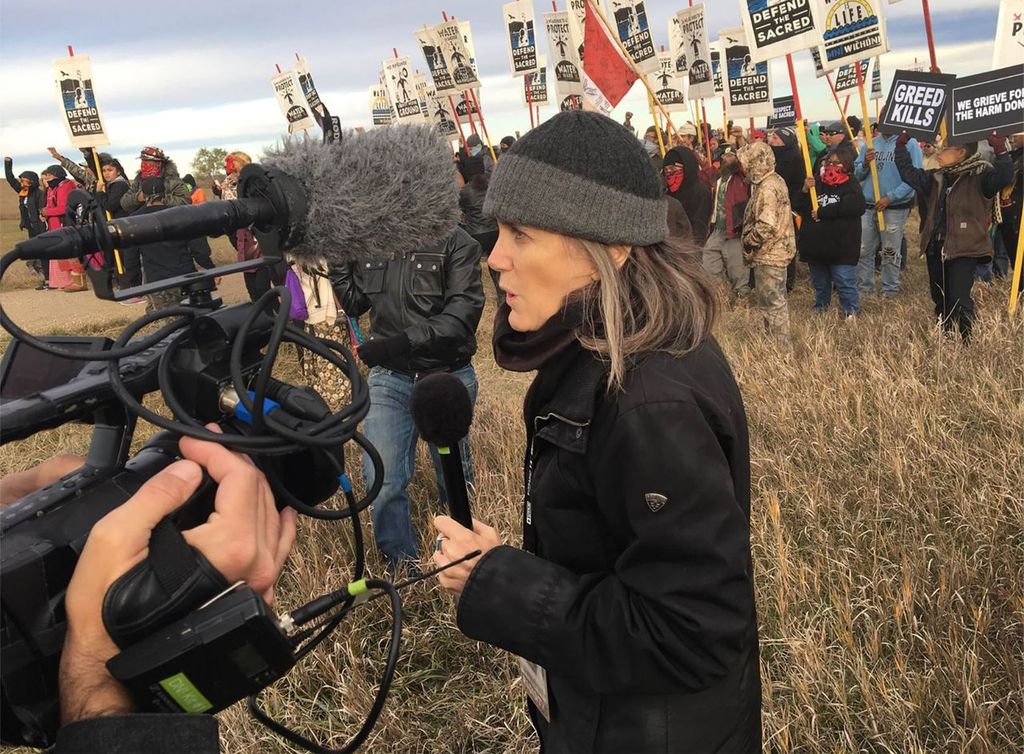
On November 12, 1991, Amy Goodman, an investigative journalist who was then a producer at WBAI Radio, and Allan Nairn, a correspondent for The New Yorker, were in East Timor covering the memorial of a man killed by the Indonesian army, when soldiers opened fire on the mourners, killing at least two hundred and seventy East Timorese. Goodman and Nairn were violently beaten. Nairn’s skull was fractured.
By the time of the massacre, American media had spent sixteen years largely ignoring Indonesia’s brutal occupation of East Timor, even though the United States government had financed, trained, and armed the Indonesian army. “Most Americans never heard of this pure hell on earth,” Goodman says in a new documentary about her life and career, Steal This Story, Please!
Goodman and Nairn’s coverage proved pivotal in changing that. After their reporting was widely picked up by other outlets, the House voted to cut off all military assistance to Indonesia. “The massacre was horrific, it would change us forever, and it taught me how critical it was that we expose what is done in our name,” Goodman says.
Goodman, now the host of Democracy Now!, is the star of Steal This Story, Please! But it is more broadly a film about independent journalism and why it matters, now maybe more than ever. Goodman turns out to be an ideal guide: relentless, fearless, and a natural storyteller with a matter-of-fact clarity of purpose and no apparent interest in self-aggrandizement or martyrdom. She is often described as a progressive activist, but she denies that her work is partisan. Her focus is on broadening journalism’s aperture to include people typically marginalized by corporate media. “When you hear someone speaking from their own experience, it makes it much less likely you’ll want to destroy them,” she says.
Filmmakers Tia Lessin and Carl Deal build a sharp, thoughtful portrait of Goodman, making extensive use of a deep archival library to illustrate their story. The result lands with urgency, and the questions posed by their film feel particularly resonant in a media landscape shaped by billionaire ownership, corporate consolidation, and technological upheaval that is rapidly transforming how information is produced and consumed.

Donald Trump posted on Truth Social more than thirty times on Monday. At least nine of those posts were about his pet project, a ninety-thousand-square-foot White House ballroom that Republicans proposed funding this week for a billion dollars. Many were just screenshots of a series of X posts from allies cheering the project on. There was also a lot of AI. An AI logo in support of his proposal to rename ICE as “NICE,” an internet joke he’s embraced. An AI image of Jerome Powell, the Federal Reserve chair and one of Trump’s frequent targets, falling into a dumpster. An AI cartoon that appeared to show Barack Obama bowing to an ayatollah. (If you’re curious about how Truth Social is doing as a business venture, my colleague Jem Bartholomew is out this week with an excellent look at its parent company’s increasingly bizarre business moves.)
It’s worth remarking: this is unhinged behavior. It’s not just that Trump threatened to wipe out an entire civilization. In the past month, he has also trolled the pope, shared an AI picture of himself as Jesus (one of the rare cases that got so much blowback he deleted it), posted a bizarre AI image of himself and some cabinet members shirtless in the Lincoln Memorial reflecting pool, and claimed that he had “ACED” a cognitive test “three times during my (‘THREE!’) Terms as President.”
These posts have not been ignored entirely—the New York Times published a piece in mid-April looking at Trump’s “erratic behavior and extreme comments” and suggesting that there is renewed concern about his mental health. But the political press appears to have largely moved on—and the posts deserve far more aggressive scrutiny. Ty Cobb, who was one of Trump’s attorneys at the White House, told Jim Acosta on his podcast that these posts demonstrate that the president is “clearly insane.” “It should be covered in that fashion,” Acosta told me afterward. “And I don’t think the American people are getting that kind of coverage, because these news organizations have been kind of house-trained. Like naughty pets.”
Last month, Trump posted on Truth Social at least 565 times. According to the Daily Beast, a third of that output—189 “Truths”—occurred between 9pm and 6am. But the nonstop stream of consciousness from the president is largely treated by the press as wallpaper. Most people have no idea how many of these posts exist, let alone what’s in them. And when they do break through, they’re often reduced to a single quote or headline, stripped of the accumulation and context that make the full feed so revealing. The story is not just any one post, but the sheer volume, obsession, escalation, contradiction, and emotional volatility that emerge when the posts are viewed together. In flattening them into isolated moments, the press risks missing the real signals about the president’s state of mind in the noise.
D’Angelo Brown, a twenty-eight-year-old father of two, was waiting for court-ordered care for schizophrenia when he was found unconscious in his jail cell. It was just before Christmas, in 2022. Eight days later, he died. His death was ruled a homicide, caused by “gross medical neglect.”
Dwayne Green was busted in July for stealing two beers. Green, who is schizophrenic and has a decades-long criminal history, was charged with a felony, with a potential sentence of ten years in prison. A judge ultimately suspended his sentence, but he is already back in jail.
Lorenza Trapp, a sixty-two-year-old former government employee struggling with dementia and homelessness, spent years in and out of jail. He died in a cell. An autopsy found his death was due to severe dehydration related to his mental illness.
Brown, Green, and Trapp are among hundreds of people who spent years in South Carolina’s overloaded mental health and court systems, cycling through a dysfunctional competency process “that, at its heart, aims to get people just well enough to punish them.” Their stories are featured in an extraordinary five-part investigation from Glenn Smith, Jocelyn Grzeszczak, and Alan Hovorka for the Post and Courier into a deadly mental health crisis playing out in South Carolina’s county jails. The series reveals that more than a hundred people with mental illnesses have died in South Carolina jails over the past decade, and some have been held in pretrial detention for longer than the maximum sentence for their alleged crimes. It’s a rare look at how the state’s handling of mentally ill defendants delays justice for crime victims, costs taxpayers, and drives desperate and vulnerable people deeper into crisis.
The paper had to fight for the right to publish its findings. The series was sparked by a story from 2024 about a homeless man accused of hacking a stranger to death with a hatchet. In reporting that story, Hovorka discovered that a court error had mistakenly unsealed his confidential psychiatric evaluations. The Charleston County Public Defender’s Office sued to block publication of one defendant’s mental health evaluation. The paper went to court and won.
“We took a step back after Alan published that initial story and said, ‘Could there be more of these unsealed evaluations?’” Grzeszczak told me. The team spent months manually searching through three thousand public court records on computers at the courthouse. “We ended up finding two hundred and six of them that had been left unsealed, and that’s just in Charleston County.”
Their work stands out in its scope. In all, seventeen people across the Post and Courier worked on the project. To connect the mental health histories to criminal proceedings, the team built an original database of state rap sheets using AI, assembling seventy thousand records from twenty-five years’ worth of Charleston County court case data. They interviewed more than a hundred mental health experts, court officials, offenders, victims, police, and others across six states. “This is such a complex issue. It’s a little bit different from your traditional investigative reporting project where there is one person or office or body to point our finger at and say this is why the situation is the way it is,” Grzeszczak said. “We’re unpacking an entire system. And to really do that justice, we had to attack it from all angles.”
If you have a suggestion for this column, please send it to laurelsanddarts@cjr.org. We can’t acknowledge all submissions, but we will mention you if we use your idea. For more on Laurels and Darts, please click here. To receive this and other CJR newsletters in your inbox, please click here.
Has America ever needed a media defender more than now? Help us by joining CJR today.