Sign up for the daily CJR newsletter.
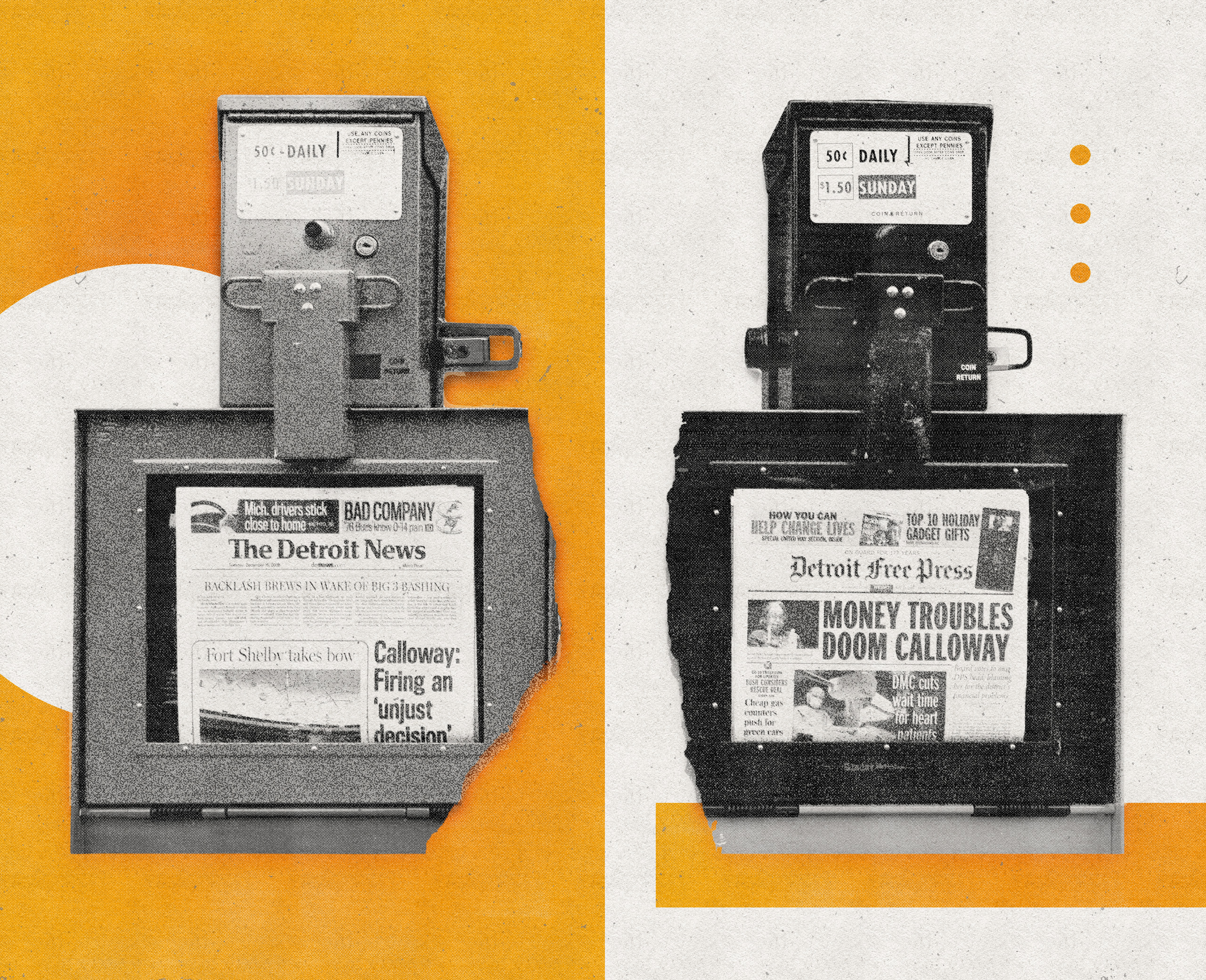
In Detroit, a hundred-and-fifty-year-long newspaper battle has been reignited. December 28 marked the expiration of the country’s last functioning joint operating agreement (JOA), under which the Detroit News and Detroit Free Press joined their circulation and ad operations while maintaining editorial independence from each other.
Under this agreement, the Free Press, owned by USA Today Co. (formerly known as Gannett), ran the business operations for both it and the News, owned by Digital First Media through MediaNews Group. Anyone subscribing to either paper received the Free Press’s Sunday edition, which included a section by the News. The Free Press also paid the News a certain amount each year. Advocates of the JOA say the deal is the reason both papers are still standing. Critics say the JOA has limited their potential.
The JOA was put in place in 1989 as part of the Newspaper Preservation Act of 1970, to preserve two separate editorial voices and keep both papers afloat at a time when each was working to undercut the other. The two papers’ decision last year not to renew their JOA means that they are now in direct competition at a time when local news coverage across the country is dwindling. While they don’t have the readership and staff they once did, both papers are healthy: according to a survey late last year by Nieman Lab, the Free Press and the News are among the top twenty-five local newspaper sites based on estimated monthly visits. But the upcoming separation of the papers’ business functions has prompted questions about whether both papers will be able to survive the separation, and the impact it will have on the newspaper business in Detroit.
“Both the newsrooms have had shared back-office operations for thirty-six years. We’ve always competed on a news basis, but now that there’s competition in every aspect of things, there’s going to be duplication of some aspects,” Gary Miles, the editor and publisher of the News, said. “Now that they’re not a combined operation, I think it’s probably inevitable that we’ll be leaner.”
Decades ago, before the implementation of their JOA, these two papers were locked in a war, each cutting into its own profits to beat the other with discounts and below-market prices. “At a time when papers in other cities were already charging fifty cents for single copies, the News cost fifteen cents and the Free Press was only a nickel more,” the Free Press reported last year.
Agreements of this sort across the country were made possible through the Newspaper Preservation Act of 1970, a federal law that exempted failing newspapers from antitrust laws, allowing them to merge business operations with competitors while maintaining separate newsrooms. This encouraged editorially diverse voices and the existence of multiple independent newspapers.
A total of twenty-eight JOAs were established under the law, none of which exist any longer, in part due to declining print readership. Many of these agreements ended with the expiration of their contract term. In August, the Ninth Circuit Court of Appeals determined that the JOA between the Las Vegas Review-Journal and the Las Vegas Sun was unenforceable because it was never approved by the attorney general. The case was brought by the Review-Journal, which was the leading paper in the agreement. In 2005, the JOA between the two papers was amended in such a way that the Sun would cease independent print publication and become an insert as a special section in the Review-Journal, while maintaining an independent website. The court held that the amendment wasn’t approved by the attorney general and was therefore void. The Sun argued that if the Review-Journal were successful in its attempt to end the agreement, it would kill the Sun, which was now dependent on it. What happens next is in limbo, with the Sun seeking a rehearing in the case.
Pending an overturning of the Ninth Circuit decision, this left the agreement between the Detroit News and Detroit Free Press the last standing JOA in the country.
The start of the agreement between the two publications, in 1989, was contentious. The Newspaper Guild of Detroit fought the introduction of a JOA between the two papers tooth and nail, fearing that because the two papers were tied to each other financially, they would be less motivated to compete. The question of whether the papers should be allowed to join business operations made it all the way to the Supreme Court, resulting in a 4–4 deadlock. (The court upheld an appellate decision allowing the deal to go through.) The Detroit Free Press, owned by Knight-Ridder at the time, was declared the failing paper; it would join forces with the Detroit News, which was owned by Gannett, and bring a halt to the war between the publications.
There are some who argue that the Free Press was not, in fact, a failing paper and that the agreement shouldn’t have taken place. Lou Mleczko, who was the president of the Detroit Newspaper Guild in 1985 and led the intervention to block the original application for the JOA, said that the agreement “brought an end to competition, not only among the newsrooms but among the business staffs, because advertisers and readers were getting two high-quality products at relatively low prices.” He also said he felt both papers were a shell of what they used to be because of the JOA, with much smaller staffs, significantly reduced office space, and little presence in the Detroit metro area.
The start of the JOA meant that hundreds of jobs were eliminated. “In just the years I covered the two papers, the JOA, the layoffs were in the hundreds over that time, and often around Christmastime,” Bill Shea, a reporter who once worked the media beat at Crain’s Detroit Business, said.
Gannett acquired the Free Press in 2005, selling the News to MediaNews Group. The same year, the JOA was revised and Gannett took over its management. The revised agreement was set to end in 2025, with the option to renew it. Editorial staff for both papers told CJR that they hadn’t been given a reason for the end of the agreement other than the contract term being up.
Many suspect that both companies think they can have a more successful run independent of each other. But they fear that, in reality, one of the papers will outcompete the other, resulting in one publication where there were two. History bears this out. While there have been a few instances where two newspapers emerged from the aftermath of a joint operating agreement and continued to publish independently, in most cases one paper shuts down or is absorbed into the other.
“Reporters in Detroit respect and fear the competition, but we all value having two newspapers, and many of us think having a fierce competitor makes us better, and we’re afraid that this end of the JOA could lead to one of those newspapers going away, which I think would be bad for journalism, and for Detroit and Michigan too,” M.L. Elrick, a columnist for the Detroit Free Press and a longtime Newspaper Guild official, told CJR.
The Free Press has a head start on running business operations, since USA Today Co. was doing so for both papers. However, unlike the Free Press, MediaNews Group has bureaus in Oakland and Macomb counties, allowing it to pull reporting from important local regions. Editors for both papers wrote editorials in late December informing their readers about the changes to come. The News announced that it will be restarting its Sunday paper on January 18 to remain competitive with the Free Press, though it won’t be hiring additional staff. The paper also plans to update its website and mobile app. The Free Press said it will be introducing an “enhanced” Sunday news product, with new home-and-garden, entertainment, and investigative content.
Nolan Finley, the editorial-page editor for the News, wrote that he looks forward to “the resumption of hostilities” and the return of a battle “unencumbered by Justice Department restraints.”
USA Today Co. declined to answer any questions, saying in a statement that “the joint operating agreement between the Detroit Free Press and the Detroit News is set to expire at the end of this year, and the partnership will not be renewed. The Detroit Free Press will continue to deliver essential news and content for our valued audiences and provide the best marketing solutions for our clients.” MediaNews Group representatives didn’t respond to a request for comment or answer questions provided by CJR.
“It’s fascinating that we’re at this point, given everything that’s happened in our industry—the fact that there was a desire in the sixties and early seventies to create this act, to ensure that editorial voices survived, and now we’re in a world of so many different media voices that, arguably, it’s no longer necessary to preserve the voices of newspapers alone,” Miles said.
Miles is optimistic that both papers will survive independently. “I don’t think there’s any question that we’re returning to war footing,” he said. “But I also think the two companies are going to do their best to make sure they’re run profitably.”
Others are not so optimistic. Shea, the former Crain’s Detroit reporter, said that both papers have significantly downsized in the past few decades: “What that looks like in the next year, I don’t know, but I am extremely skeptical of the future of Detroit as a two-newspaper town.”
Has America ever needed a media defender more than now? Help us by joining CJR today.