Sign up for the daily CJR newsletter.
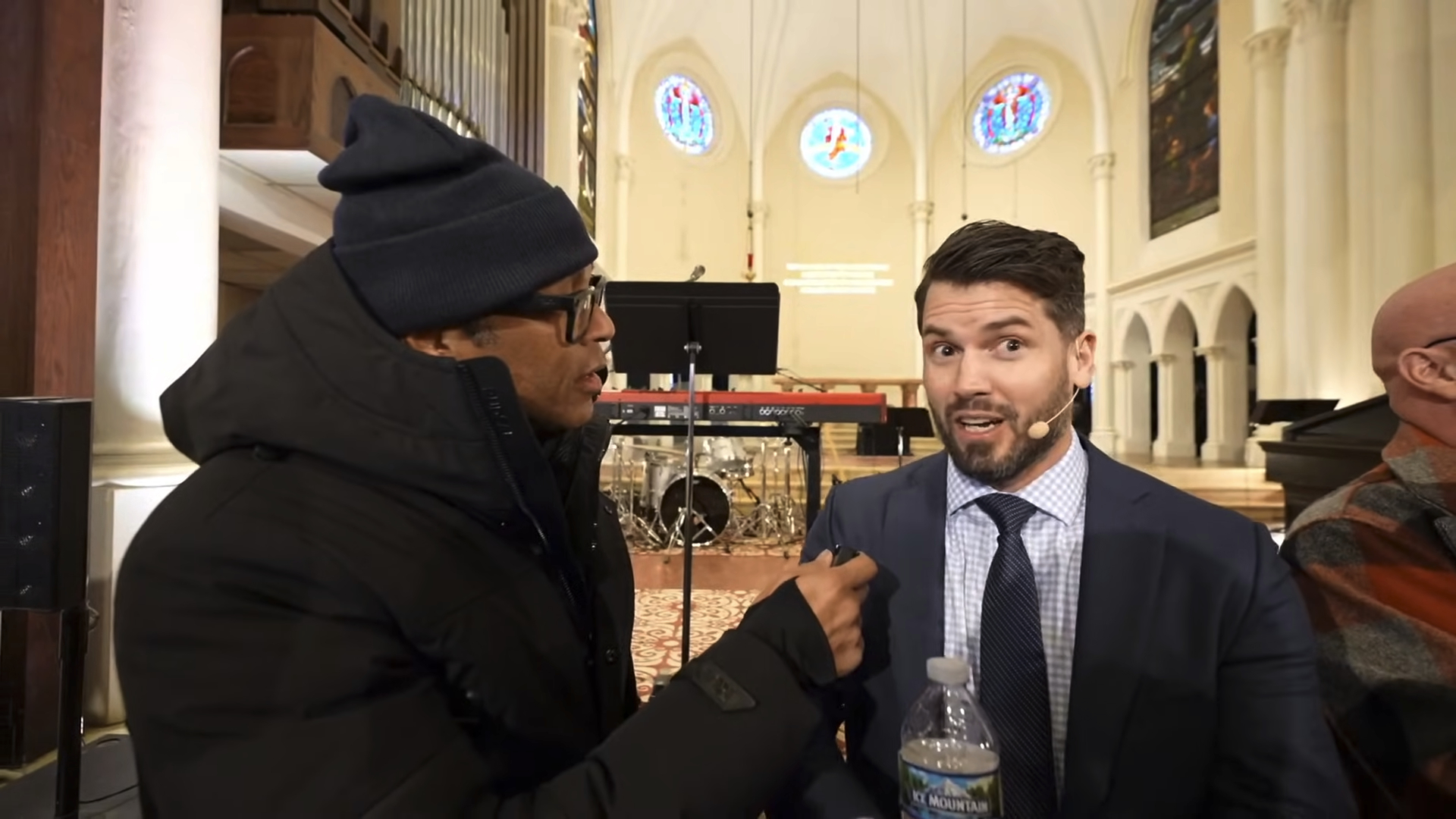
On January 18, Don Lemon, a former CNN anchor who now broadcasts independently on YouTube to over a million subscribers, got wind of a protest set to take place in a Minnesota church. Activists, angry over the deployment of thousands of federal officers to the Twin Cities and the shooting of Renee Good less than two weeks before, had heard that a pastor at the Cities Church in St. Paul led the local Immigration and Customs Enforcement (ICE) field office. They planned to disrupt a Sunday service and make their discontent plain; Lemon prepared to cover the event live.
Lemon livestreams many of his videos, which means there’s a lot of ambient material—his feet crunching the snowy Minnesota sidewalk as he approaches the church, inside jokes with his producer—as well as a chance to overhear behind-the-reporting exchanges. “So I’m going to go inside, guys,” Lemon says as he mics up in a car, “and I’m gonna give the rundown of what’s going on.”
The camera stays outside at first, but you can hear what’s going on through Lemon’s mic. Congregants are asked to open their Bibles to the Gospel of John. Then someone interrupts: “Excuse me, pastor!” Voices are raised, accusations fly, chants erupt: “ICE out! ICE out! ICE out!” Another independent journalist, Georgia Fort, vice president of the Minnesota chapter of the National Association of Black Journalists and an Emmy winner, was also reporting inside the church, interviewing activists and documenting the protest. When Lemon’s camera operator moves inside, Lemon is heard behind the lens: “I’m not part of the group,” he says, apparently to a church official. “I’m just here photographing. I’m a journalist.” He can be seen calmly putting questions to a pastor, congregants, and activists. Walking away from the church later, Lemon says to camera: “I might get arrested, people. One never knows.”
In the immediate aftermath of the church protest, the right-wing, MAGA-aligned mediasphere reacted with fury. “Don Lemon storms the church, rushes the altar in the middle of the sermon, harasses and threatens the pastor on a live feed,” Benny Johnson, the right-wing YouTuber, posted on X, twisting the facts as aggressively as a powerlifter wringing out a wet towel. Johnson called for Lemon to be “frog marched before the cameras” and face “full federal charges with decades of prison time.” Meanwhile, the Post Millennial ran an article accusing Lemon of having “coordinated with far-left agitators.” And, not one to miss an opportunity, Tim Pool, the podcaster, ran an inventive segment that he claimed was “micro-sponsored” by Kalshi, the prediction markets company. “I love this. This is from Kalshi,” he said. “‘Who will be charged with a federal crime in 2026?’ Don Lemon tops the charts!”
Johnson, the Post Millennial, and Pool, all represented in the new Pentagon-approved press corps, apparently have Donald Trump’s attention. Trump seems to have watched the protest footage two days afterward, on January 20, when he posted on Truth Social: “Just watched footage of the Church Raid in Minnesota by the agitators and insurrectionists.… They are troublemakers who should be thrown in jail, or thrown out of the Country.”
The MAGA media response turned from anger to glee when Lemon and Fort were arrested last week. They were indicted along with seven others on allegations that they “conspired and agreed with one another and with other persons…to injure, oppress, threaten, and intimidate” multiple people. (The Justice Department initially had trouble bringing charges against Lemon after federal magistrate and appellate judges rejected the case.) “These arrests have been hilariously fun to look at and laugh at,” Johnson said on his show. “When are we gonna get the Don Lemon mug shot?”
“Hey, congratulations.… It’s great that they finally got him,” Pool said on his podcast. “But what are we gonna do about the fact that there is an active insurgency? I mean, this is sedition, this is seditious conspiracy!”
The MAGA media’s jubilation over the arrests of Lemon and Fort may have come as a relief to some in the White House. The administration was getting flak—including from some usually loyal quarters—following federal agents’ fatal shootings of Good and, on January 24, Alex Pretti. A Reuters/Ipsos survey found that 55 percent of Republicans believed the ICE crackdown was going too far. Sean Hannity said on his radio show that he didn’t think “going into Home Depots and arresting people there” was a good idea, and Brian Kilmeade, on Fox & Friends, called on Trump to send Tom Homan, the so-called border czar, to Minnesota to “settle things down,” which Trump soon did. (CNN’s Brian Stelter spotted that Trump, an avid Fox viewer, made his announcement about Homan on Truth Social just minutes after Kilmeade’s repeated suggestion.) Trump also demoted Greg Bovino from his previous role, as Border Patrol’s “commander at large,” and posted about a conciliatory phone call with Tim Walz, Minnesota’s governor.
But Trump’s decision to “de-escalate a little bit” seemed to irk many in the hard-right media. As the New York Times reported, Steve Bannon told podcast listeners that Trump had “blinked,” and Matt Walsh called the president’s ousting of Bovino “a major blunder.” For the administration, then, the charges against Lemon and Fort could be viewed as red meat for MAGA’s ever-hungry content creators.
It may not matter whether the charges actually stick, according to Quinta Jurecic, a staff writer at The Atlantic. “On the basis of the record available so far, the case against them appears factually weak, legally shoddy, and marred by a baffling series of procedural irregularities that raise serious questions about the Justice Department’s ability to win in court,” she writes. Instead, the prosecution “is best understood not as law enforcement but as propaganda, junk intended purely to get attention. But that doesn’t mean it isn’t dangerous.” As well as propaganda, the charges—against two independent journalists, more vulnerable than those with newsroom legal teams behind them—serve as a clear warning to other reporters: If you get in our way, you’ll face the consequences.
As Seth Stern, chief of advocacy at the Freedom of the Press Foundation, put it in a piece for The Guardian, “Even when journalists’ conduct is plainly non-criminal,” it appears that DOJ prosecutors “will work overtime to figure out some way to harass them, no matter how frivolous.” Lemon and Fort have said they will vigorously fight the charges. Fort’s lawyer called her arrest “a transparent and unconstitutional attempt by our federal government to intimidate journalists and chill their protected speech.” Lemon, in a livestream after his release on bail, said: “If you look at any tyranny—or any autocracy, any sort of dictatorship—the first thing they do is they get rid of the media.”
Since the killings of Good and Pretti—followed by officials lying and victim-blaming in defiance of clear video evidence—I’ve noticed a quote from George Orwell’s 1984 circulating online: “The Party told you to reject the evidence of your eyes and ears. It was their final, most essential command.” But Johnson’s contorted, almost lyrical description of the church protest—Lemon “storming” the church, “rushing” the altar, “harassing” and “threatening” the pastor—preceded, and may have served as a blueprint for, the administration’s charges. The MAGA media, it seems, are rushing enthusiastically to reject the evidence of their eyes and ears, long before they are commanded to do so.
Other Notable Stories…
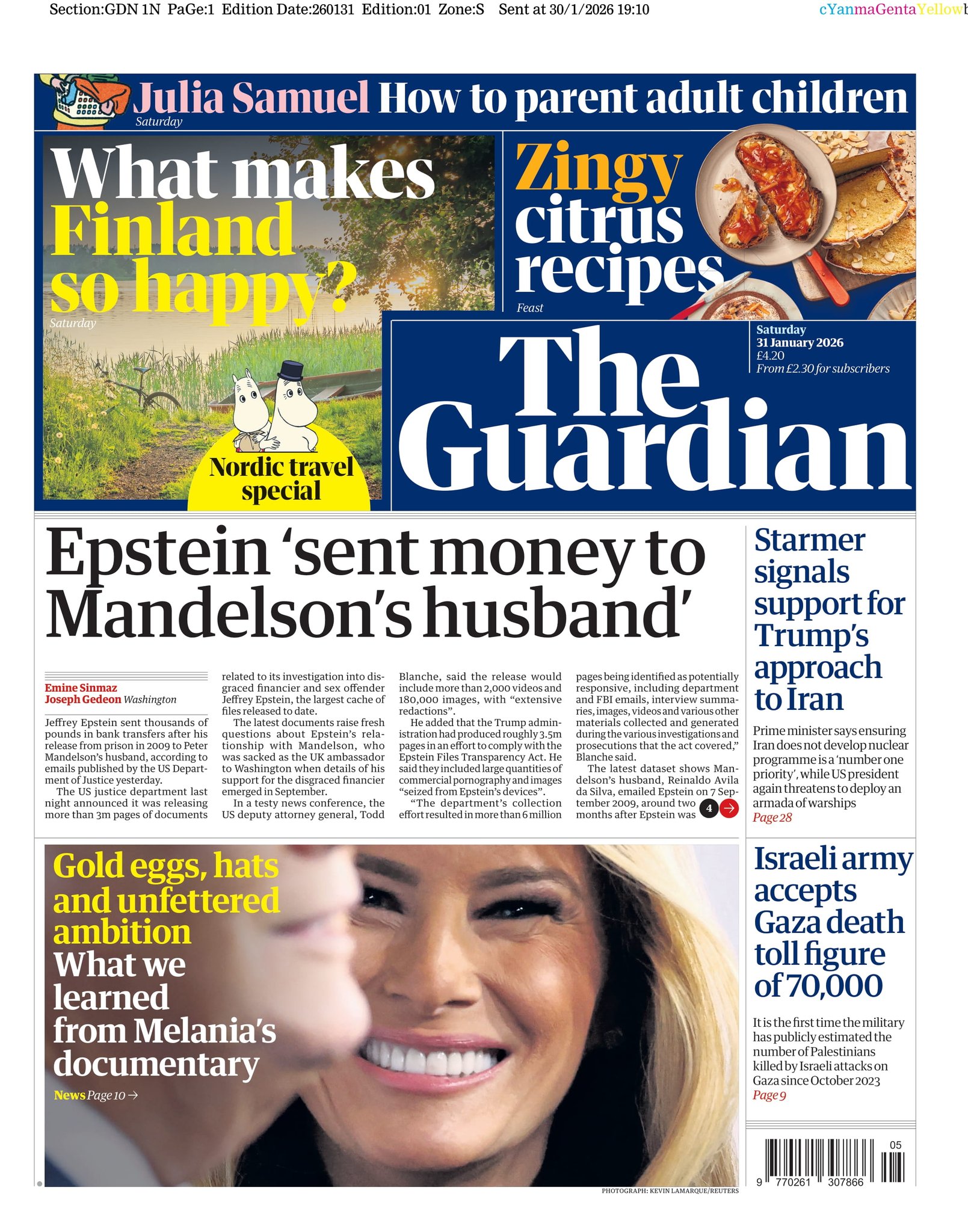
- On Thursday, Haaretz reported that the Israel Defense Forces (IDF) have accepted the estimate of health officials in Gaza that more than seventy-one thousand people have been killed on the coastal strip since October 7, 2023. For more than two years, the IDF dismissed figures from the Gaza Ministry of Health as “misleading and unreliable,” despite their being accepted by many international experts and organizations, which have often pointed out that they likely represent a significant undercount. At the time of writing, I couldn’t find a single story on the New York Times, Wall Street Journal, or Washington Post websites referencing this development; in the UK, The Guardian put it on the front page. Israel is still blocking journalists from entering Gaza; last fall, CJR’s Amos Barshad wrote about the legal fight to gain access.
- Around 11am on Friday, the Justice Department released more than three million additional pages of documents, the largest batch of files to date, relating to Jeffrey Epstein. The deluge came more than a month after the official deadline set by Congress to release all appropriate files. Todd Blanche, the deputy attorney general, said the White House had “no oversight” over the process; he also signaled that it would be the last major release. “Some Democratic lawmakers accused the department on Friday of violating the law and demanded it release all six million pages,” the Times reported. Journalists are likely to be combing through the materials—which include more than two thousand videos and one hundred and eighty thousand images—for some time.
- Rumors of job cuts continued to swirl at both the Washington Post and CBS News. The Post, owned by Jeff Bezos (net worth: a quarter trillion dollars), reportedly began changing coverage plans and travel assignments this month; the Times, citing two insiders, reported that senior Post editors became aware last November “of imminent cuts in the newsroom that could affect up to 200 people.” Journalists have addressed Bezos in letters and social media posts, urging him to rethink the downsizing. Meanwhile, nonunion CBS Evening News employees were offered buyouts on Wednesday, Variety reported, just months after almost a hundred staffers were laid off.
- The BBC on Wednesday announced the appointment of Rhodri Talfan Davies as interim director general. Davies, a senior executive at the broadcaster, will take over from Tim Davie, who was forced to resign in November, along with Deborah Turness, over accusations of liberal bias. As I wrote for CJR at the time, reports identified BBC board member Robbie Gibb—appointed by Conservative prime minister Boris Johnson—as central to the attacks on Davie and Turness, including over a clumsy edit of a Trump speech. Also in the UK, dozens of journalists called on the government to pass legislation to make strategic litigation against public participation, known as SLAPP lawsuits, harder to file against reporters.
- The California Post began publishing last Monday, expanding Rupert Murdoch’s media empire to the US West Coast. The paper, owned by News Corp, aims to bring the New York Post’s mischievous tabloid vibe—playful, sensational, and often lurid, obsessing over true crime, “wokeness,” and celebrity culture—to California. “Fox might be the moneymaker, but the Post has long been understood as Mr. Murdoch’s id,” Katie Robertson wrote for the Times. Announcing the paper last summer, News Corp chief executive Robert Thomson said it would be an antidote to what he called California’s “jaundiced, jaded journalism.” Saturday’s splash: “FEDS SQUEEZE LEMON.”
- On Friday, following the FBI raid on the home of Hannah Natanson, a Washington Post reporter, on January 14, the DOJ entered a filing describing the events of that day, as noticed by Times reporter Erik Wemple. The document said that Natanson’s laptop (referred to as the “Work MacBook Pro”) was unlocked through biometrics, after Natanson was told by officers to apply “her index finger to the fingerprint reader.” The Intercept wrote on Friday: “Activists and journalists have long been cautioned to disable biometrics in specific situations where they might face heightened risk of losing control of their phones, say when attending a protest or crossing a border.”
- And for CJR’s The Kicker, host Megan Greenwell spoke to Bob Batz Jr., a veteran Pittsburgh Post-Gazette journalist, about the newsroom’s three-year strike, which ended late last year, and was followed by the dramatic announcement that the publication would permanently close on May 3. Block Communications, the Post-Gazette’s owner, cited financial troubles and took no questions from employees. Journalists are trying to save some version of the newspaper, which traces its heritage back to 1786. “We didn’t go on strike to put the paper out of business,” Batz told CJR. “We went on strike to keep it good.”
Has America ever needed a media defender more than now? Help us by joining CJR today.