Sign up for the daily CJR newsletter.
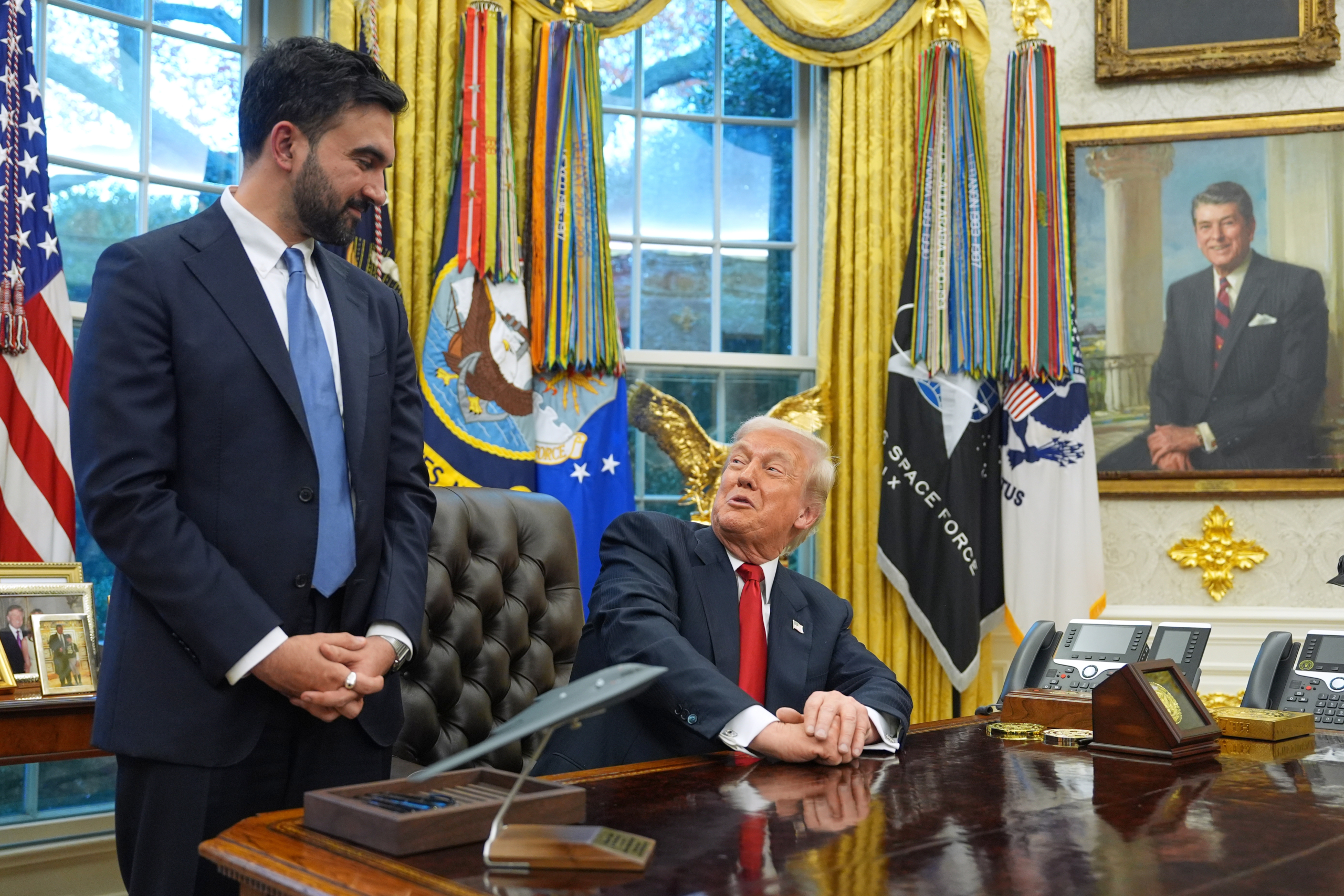
On Friday, President Donald Trump held his first meeting with Zohran Mamdani, the mayor-elect of New York City, in the Oval Office. Looking down on them was a portrait of Ronald Reagan, which Trump had installed in February. In many ways, the fortieth president was an appropriate observer. The legacy of Reagan hung over both men’s political fortunes: Trump made his name and much of his wealth from real estate investments under the deregulated, neoliberal policies of the eighties; and Mamdani’s sudden rise to power this November reflected New Yorkers’ dissatisfaction with that same trickle-down economic model established under Reagan.
After the private meeting, reporters hurried in for a joint Trump-Mamdani press conference. The pair had been throwing sharp words—“fascist”; “communist”—at each other for months, and many outlets had been previewing the encounter as a kind of bare-knuckle fight. Fox News billed it as a “showdown with socialism.” CNN said it “could really go off the rails.” But the mood between the two was shockingly amiable. Despite questions “carefully crafted to drum up conflict,” Vanity Fair observed, neither Trump nor Mamdani bit. “I want him to do a great job, and we’ll help him do a great job,” Trump said.
Perplexed journalists described this unexpected outcome as a “lovefest” (Politico), a “bromance” (the Washington Post), something like a “Saturday Night Live skit” (The Atlantic), or “the oddest screwball buddy comedy” (the New York Times). Trump, far from belittling Mamdani like he did Ukrainian president Volodymyr Zelensky in February, even defended him against hostile questions from conservative media. “That great thud was the sound of White House reporters’ jaws hitting the floor,” David Smith wrote for The Guardian. MAGA-world was just as stunned. Steve Bannon told Politico it was like the “world turned upside down.” The New York Post dubbed it “Freaky Friday.”
What had journalists not foreseen? Could this be explained simply by the force of the incoming mayor’s charisma, that he, as Cat Zhang wrote for The Cut, “charmed the pants off his nemesis”? The president certainly responds to flattery; some world leaders, like UK prime minister Keir Starmer, have made domestic reporters cringe with their fawning approaches to handling Trump, some of which have worked. But Mamdani did nothing to disguise or modify his positions. He answered on message when asked about ICE raids, genocide in Gaza, and his democratic socialism, all of which Trump let slide.
Could it be, as the Times’ Shawn McCreesh or The Atlantic’s Michael Powell speculated, that Trump simply “loves winners”? He praised Mamdani’s victory over establishment figures, namely Democrat Andrew Cuomo, saying, “He beat them, and beat them easily.” There’s certainly truth to the idea that Trump is sensitive to displays of strength and power. But Mamdani’s profile, that of the young underdog winner, might also apply to Alexandria Ocasio-Cortez, Rashida Tlaib, and Ilhan Omar—all of whom Trump routinely delights in attacking.
Another explanation offered by some journalists is that Trump’s amiability was a diversionary tactic. Politico’s Adam Wren and Lisa Kashinsky pointed out that Trump and Mamdani’s meeting came at the end of a week when the president’s MAGA base was fracturing over his reluctance to release documents relating to convicted sex offender Jeffrey Epstein. Trump even noted the attention: “The press has eaten this thing up!” he said. “I’ve had a lot of meetings with the heads of major countries—nobody cared.” To me, though, this interpretation is unconvincing. Trump is too often seen as having far more influence over the news cycle than he really does, like a kind of reality TV Machiavelli. Besides, if it was a media diversion Trump wanted, an angry quarrel would have worked fine.
What all these explanations shared was a focus on personality, as coverage of popular and charismatic politicians so often does. But the unexpectedly cordial meeting, in my reading, is best explained by policy. Trump’s record on affordability since January has been shaky. November’s Democratic victories—Mamdani in New York, Abigail Spanberger in Virginia, and Mikie Sherrill in New Jersey—all seriously addressed the high cost of living in their campaigns.
Trump, too, fought for the 2024 election on a key promise: to make America more affordable. He claimed he would do this with aggressive tariff policies. One year later, US tariffs have not made America more affordable. A report published last week by Yale’s Budget Lab finds that tariffs have led to price level rises of 1.2 percent in the short run—or a total loss so far of seventeen hundred dollars for the average household. Those losses do not yet take into account the looming rise in healthcare premiums for millions of Americans. Trump’s economic polling has dipped accordingly.
In the past few weeks, the administration has attempted to recast its economic message. The president has floated two new ideas on social media: introducing fifty-year mortgages, and giving many Americans two-thousand-dollar checks. But these new “plans” (or concepts of a plan, perhaps) lack not only credibility but also viability; the Treasury last week poured cold water on the mortgage suggestion, and the idea for stimulus checks was met coolly by congressional Republicans.
So Trump’s meeting with Mamdani makes sense at this moment, as a marriage of convenience. Why bother coming up with credible solutions to the affordability crisis when you can just smile and take pictures with someone who already speaks eloquently about it? For many voters, Trump’s association with a young cost-of-living crusader will give the perception of action. “The new word is ‘affordability,’” Trump said clumsily on Friday.
For Mamdani, the ability to govern effectively will depend on avoiding a bust-up. “The worth of an ideology can only be judged by its delivery,” he told The Nation. His campaign centered on four core promises: to freeze rent for rent-stabilized apartments; to make buses free and effective; to deliver free childcare; and to open government-owned grocery stores. Mamdani’s promises will be much harder to make good on if Trump slashes New York City’s 7.4 billion dollars in federal funding, or if federal forces invade and disrupt the city. By the time Trump leaves office, on January 20, 2029, the race to be the next New York mayor will already be underway.
Toward the end of the press conference, Trump told reporters about another presidential portrait in the White House. Mamdani had walked past a painting of Franklin Delano Roosevelt and asked to take a picture, Trump said. “He’s a big fan of the New Deal, I guess, and of FDR.” It may have been Robert Moses who remade New York City by building parks, expressways, tunnels, and bridges from the thirties to the fifties. But, as Mamdani no doubt knows, what enabled Moses to do that was federal money from Roosevelt’s New Deal. To reshape the city again, Mamdani too will need federal funding, and a path free of obstruction.
Whether or not this improbable friendliness lasts is an open question. But for now, it makes sense for both Trump and Mamdani to keep things on good terms. After the meeting, Trump posted a set of photos to social media. It showed the two men, together, below the portrait of FDR.
Other Notable Stories…
- For CJR, Amos Barshad braved the black-tie Citizen Journalist Gala at Mar-a-Lago, where, beyond the star-spangled cummerbunds and hundred-thousand-dollar “Platinum Tables,” he found that “the event is a chance for the new right to gather and celebrate itself: While Trump freezes out or directly attacks legacy media, MAGA content creators exist in an influential, symbiotic relationship with the White House, where they are welcomed into the press room as never before. The creators echo Trump’s worldview, in which American cities are overrun by undocumented immigrants and roving antifa bands; in turn, federal agencies are uniquely attentive to their content.”
- On Saturday night in Belém, Brazil, the COP30 UN climate summit wrapped up. The outcome was nowhere near reaching the stated aim of limiting global heating to 1.5 degrees Celsius, but COP30 nevertheless “made strides towards stronger policies on a just transition to a clean energy future,” wrote The Guardian’s Jonathan Watts. One thing that stood out for Watts, though, was the lack of media attention: “None of the four major US news networks [CBS, NBC, ABC, and Fox] sent a team to Belém. Reporters from British and European broadcasters were present, but many said it was hard for them to get space.” Earlier this month, Adriana Carranca wrote for CJR about a new generation of journalists emerging from the rainforest, just in time for COP30. One of that cohort, Indigenous journalist Wajã Xipai, published a dispatch from the summit. “People run so much that they don’t realise what is being lost between one step and another,” she writes.
- The owner of the Daily Mail struck a 650-million-dollar agreement last week to buy the rival Telegraph newspaper in the UK, in a deal that could create “one of the most powerful right-leaning media groups in Britain,” the Financial Times reported. It comes after RedBird Capital pulled out of efforts to buy The Telegraph amid newsroom opposition. The merger will be subject to scrutiny from UK regulatory authorities. The Daily Mail and General Trust, which is owned by the aristocratic Lord Rothermere and also runs the Metro and i newspapers, said it wants to accelerate expansion into the US. “This deal is huge: the Rupert Murdoch era of dominance in the still-powerful UK newspaper market is over,” one commentator told the FT. The merger could end a long and “nightmarish” sale saga, which Arthur MacMillan wrote about for CJR last December.
- The Local, a Toronto-based nonprofit newsroom, investigated a possible scammer writing under the byline “Victoria Goldiee,” leading to a range of articles getting nixed. After receiving a promising but suspicious pitch, Nicholas Hune-Brown, a Local editor, contacted sources Goldiee claimed to have interviewed for a range of publications. He kept getting the same reply: “We definitely did not talk to her.” Then, over the phone, as he writes in the piece, Hune-Brown asked Goldiee about her “interviews” directly. He wrote about the episode: “I was embarrassed. I had been naively operating with a pre-ChatGPT mindset.” This follows a similar scandal over the byline “Margaux Blanchard” in August, which led to Wired and Business Insider removing articles after an exposé by Press Gazette.
- Condé Nast was accused of “union busting” in this month’s firing of senior fact-checker and New Yorker union member Jasper Lo, according to the Washington Post. The Post reports that, following the news that Teen Vogue would be folded into Vogue, more than a dozen unionized employees of several Condé Nast publications confronted the company’s human resources chief over job cuts. Lo, alongside three other employees, was later fired, with a Condé Nast statement saying: “Extreme misconduct is unacceptable in any professional setting.” Lo’s firing has since been opposed by dozens of New Yorker writers, including Calvin Trillin, Alex Ross, Larissa MacFarquhar, Keith Gessen, E. Tammy Kim, Jay Caspian Kang, and Julian Lucas. “Union busting sucks,” Susan Orlean reportedly said on an all-staff email chain. In other news, the Post’s opinion section is considering high-profile right-wing hires—with Vice President JD Vance pushing owner Jeff Bezos to hire Breitbart’s Matt Boyle, according to RealClearPolitics, and the Daily Wire’s Mary Margaret Olohan also considered, Semafor reports.
- At the BBC, board member Shumeet Banerji resigned on Friday, citing “governance issues” and saying he was cut out of discussions that led to the resignations of the director general, Tim Davie, and BBC News chief Deborah Turness. (I wrote about the right-wing campaign to pressure the BBC in last Monday’s newsletter.) It comes as The Guardian reports that the BBC plans to overhaul the way it investigates editorial concerns—intended to dilute the influence of a prominent conservative on the board. One thing to watch out for today: three key figures in the BBC impartiality row appear before a UK parliamentary select committee to answer questions from MPs.
- And the apparent stars of a flashy new Fox podcast were astonished last Wednesday, when Fox News announced a new fifty-two-episode series on the life of Jesus Christ. Kristen Bell, who was billed to play Mary Magdalene, told Rolling Stone she had no knowledge of the series; Brian Cox, slated to be the voice of God, said he was also unaware. The confusion stemmed from a 2010 audiobook, The Truth and Life Dramatized Audio Bible—voiced by actors including Bell, Cox, Malcolm McDowell, Julia Ormond, John Rhys-Davies, and others—which has been licensed to Fox Faith and repurposed into the new podcast. It’s part of Fox’s drive into more religious content. “Brian recorded audio for a project over a decade ago,” Cox’s spokesperson said. “He was unaware that the audio would be repurposed for a new podcast series in 2025.”
Has America ever needed a media defender more than now? Help us by joining CJR today.