Sign up for the daily CJR newsletter.
This week has been a busy one for Donald Trump’s White House. The saga dominating the news has been his about-face decision to encourage the release of documents related to Jeffrey Epstein, the disgraced society pedophile: “House Republicans should vote to release the Epstein files,” Trump wrote on Truth Social on Sunday night, “because we have nothing to hide, and it’s time to move on from this Democrat Hoax.” With that, by Tuesday, Republicans in Congress had voted for the Department of Justice to send the materials out into the world—legislation Trump signed Wednesday night. While that drama was playing out on the Hill, Trump had a social engagement with Crown Prince Mohammed bin Salman, the leader of Saudi Arabia—a major story of its own.
This was Mohammed bin Salman’s first visit to the White House since 2018, when Jamal Khashoggi, a Saudi journalist, was brutally assassinated at the age of fifty-nine. Khashoggi, who had been the editor of a Saudi newspaper called Al Watan, was known for his extensive reporting on Osama bin Laden; in the eighties, he was the first journalist from a major Arab news outlet to cover Arab volunteers fighting in Afghanistan against the Soviets. In 2017, he went into self-imposed exile and became a contributing opinion writer to the Washington Post. At the time of Khashoggi’s killing, Trump alternately defended the Saudi regime, denied that the assassination had taken place, and dismissed the gravity of a journalist’s murder. (A US intelligence report conducted under the Biden administration found that bin Salman approved the attack.)
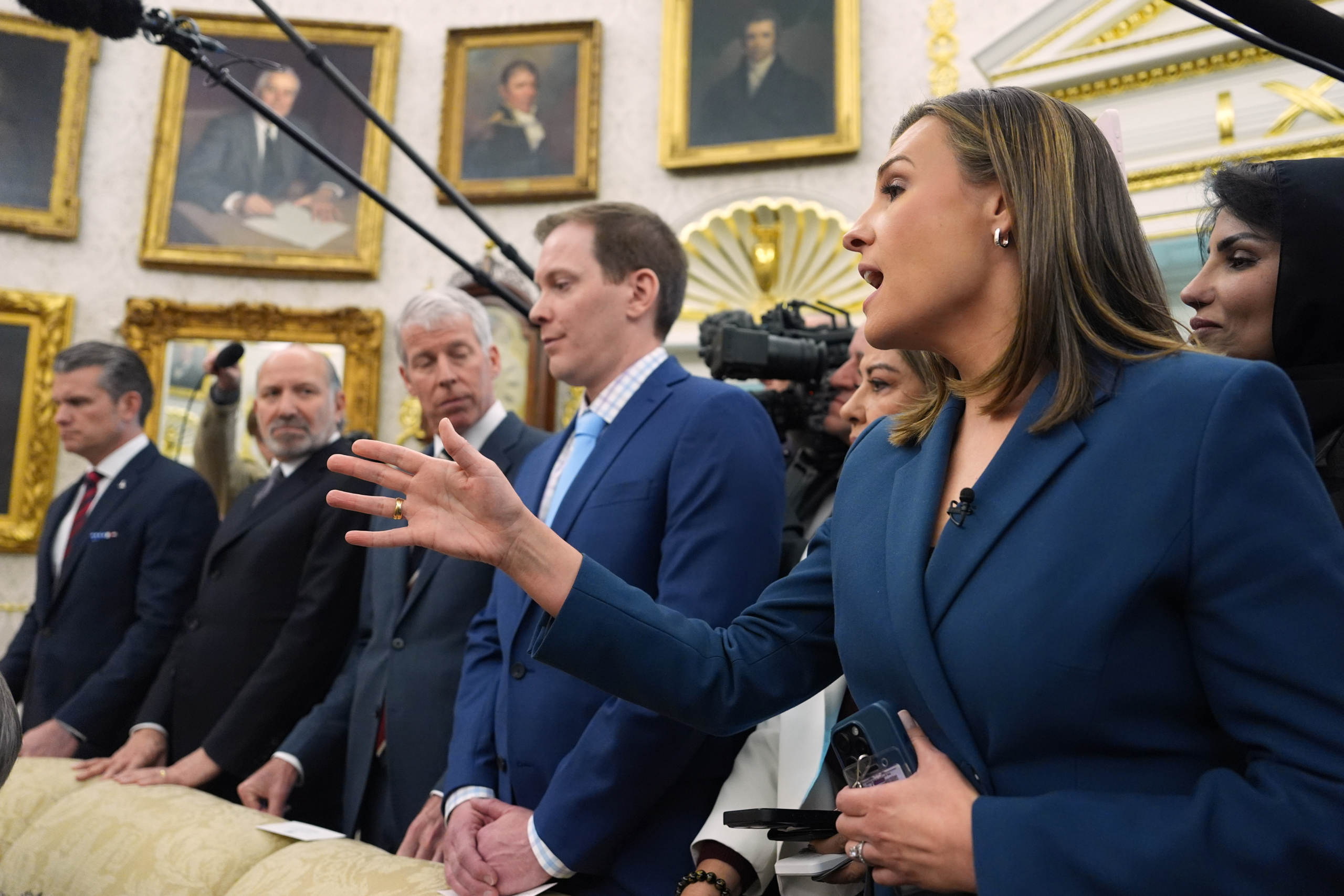
On Tuesday, Trump hailed bin Salman as “a protector of human rights”—untrue for reasons beyond the Khashoggi murder, since MBS, as he’s known, has committed numerous major human rights violations. The prince received a red-carpet welcome and a black-tie dinner that counted Elon Musk, Jensen Huang, David Ellison, and Cristiano Ronaldo among the guests. The primary topic of the meeting was business: the proposed sale of American F-35 fighter jets to Saudi Arabia; a potential trillion-dollar investment by the kingdom into the United States; strategic partnerships in the energy and technology sector. In the early afternoon, Trump and MBS stopped by the Oval Office to meet with members of the press. “US intelligence concluded that you orchestrated the brutal murder of a journalist,” Mary Bruce, the chief White House correspondent for ABC, said, facing MBS. “Nine-eleven families are furious that you are here in the Oval Office. Why should Americans trust you? And the same to you, Mr. President.”
“ABC? Fake news,” Trump replied. “One of the worst in the business. But I will answer your question.” He then gave a response on the crown prince’s behalf: “You’re mentioning somebody that was extremely controversial. A lot of people didn’t like that gentleman that you’re talking about. Whether you like him or didn’t like him, things happen. But he knew nothing about it. And we can leave it at that. You don’t have to embarrass our guest by asking a question like that.”
A few minutes later, Bruce followed up with another question. She asked Trump why he was waiting for Congress’s vote to release the Epstein files when he could independently order the Justice Department to release them. Trump’s response deflected back to bin Salman. “I think you are a terrible reporter,” he said. “It’s the way you asked these questions: you start off with a man who is highly respected, asking him a horrible, insubordinate, and just a terrible question.” Then he added: “I’ll tell you something, I think the license should be taken away from ABC, because your news is so fake and it’s so wrong.” Brendan Carr, the FCC commissioner, “should look at that,” he said, “because I think when you come in and when you’re ninety-seven percent negative to Trump, and then Trump wins the election in a landslide, that means obviously your news is not credible.” (Recently, Kyle Paoletta wrote for CJR about how “the oversight authority of the FCC is only useful insofar as it can force the nation’s broadcasters into fealty to Donald Trump.”)
Trump’s attacks on the press are so frequent that it’s sometimes hard to treat every threat with the gravity it deserves. ABC has taken a fair share of the heat: In September, pressure from Carr led ABC to take Jimmy Kimmel’s late-night show off the air, in light of remarks Kimmel had made about the killing of Charlie Kirk. Last December, ABC settled a libel case with the president, agreeing to pay fifteen million dollars toward Trump’s presidential library (and another million in legal fees). CJR couldn’t reach ABC News for comment, but Anna Gomez, the lone Democrat on the FCC, was vocal: “The FCC doesn’t get to decide whether the news coverage of those in power is acceptable,” she posted on X. “It has neither the legal authority nor the constitutional right to pursue broadcasters for their journalism. These threats sound ominous, but they’re empty.” (Over the summer, Gomez told Liam Scott, for a profile in CJR, that the FCC was “being weaponized for political retribution and ideological purity.”)
The threat directed at Mary Bruce came mere days after a Bloomberg News reporter on board Air Force One asked Trump an Epstein-related question, to which he responded, “Quiet, piggy.” And it followed tension among members of the White House press corps, who exchanged emails about the fact that background materials provided on the MBS visit omitted any reference to Khashoggi’s murder. “Ignoring it or sidelining those who bring it up does not help the credibility of the pool system and our work which is already under attack as it is,” one reporter wrote in an email to Weijia Jiang, the White House Correspondents’ Association president. She replied that the note was “disruptive and distracting.”
Others in the journalism world had a stronger reaction. The National Press Club called Trump’s comments “a direct attack on press freedom,” saying, “Statements that appear to minimize or excuse the killing of a journalist have real-world consequences. They can undermine the essential principle that journalists must be able to work without fear of violence or retribution.” Jodie Ginsberg, the CEO of the Committee to Protect Journalists, wrote for The Guardian that Trump dismissed “what is probably the most infamous journalist killing of the last decade—and in so doing plumbed a new low in his contempt for journalists, for journalism—and for the truth.” Also in The Guardian, Karen Attiah—the former editor of the Post’s global opinion section, who hired Khashoggi—wrote that the “Saudification of America” was underway. Carl Quintanilla, a CNBC anchor, wrote on Bluesky, “Calling the ABC reporter’s question ‘insubordinate’ explains everything about how Trump sees press freedom.” On Wednesday, Jim Acosta went further, suggesting that Trump’s behavior was “unraveling” and “unwell” because of the pressure he is facing over Epstein.
Perhaps: Politico came out with a story early on Wednesday, quoting heavily from White House officials—all granted anonymity—that “The Democrats are going to come to regret” the release of the Epstein files, as one said, and, per another, “Democrats and the media just fell into the same trap they set up.” The Trump administration’s “plan to attack,” according to Politico, “will test whether Trump still has the political muscle to cow people into submission and make those who challenge him pay a political price.” By the evening, Trump posted, “Democrats have used the ‘Epstein’ issue, which affects them far more than the Republican Party, in order to try and distract from our AMAZING Victories.”
Not everyone’s answer is antagonism. “It was upsetting for me,” Hanan Elatr Khashoggi, Jamal’s widow, told Jake Tapper on CNN, about hearing Trump’s comments about her husband. If Trump were watching, what would she want to say to him? “I really wish to meet you, for I can introduce Jamal in the right way, and the real way you’re not aware of,” she said. “I will share with you a lot about Jamal, and it will change your opinion totally about him. Jamal was a transparent man, and a kind man.”
Has America ever needed a media defender more than now? Help us by joining CJR today.