Sign up for the daily CJR newsletter.
On Friday evening, federal agents showed up at the homes of multiple New York Times reporters to deliver subpoenas to testify before a federal grand jury. Those who received—or may soon receive—subpoenas include Julian E. Barnes, Adam Goldman, Eric Lipton, Tyler Pager, and Eric Schmitt, according to an email that Joe Kahn, the paper’s executive editor, sent Times staff over the weekend. The journalists had been part of a team investigating security concerns related to Donald Trump’s new Air Force One—a gift from Qatar last year that was quickly refurbished and decorated in the gaudy cream-and-gold that is typical of Trumpist style. The Times decided to immediately go public about the subpoenas, which seek to compel the reporters to testify in Manhattan on Wednesday. “The appearance of federal law enforcement agents on the doorstep of news reporters should shock the conscience of any American who believes in the Constitution and the press freedom it protects,” David McCraw, the Times newsroom lawyer, said in a statement on Friday. “This brazen act should be seen as nothing more than an attempt to prevent the public from knowing what is happening in their country by intimidating journalists from doing their jobs.”
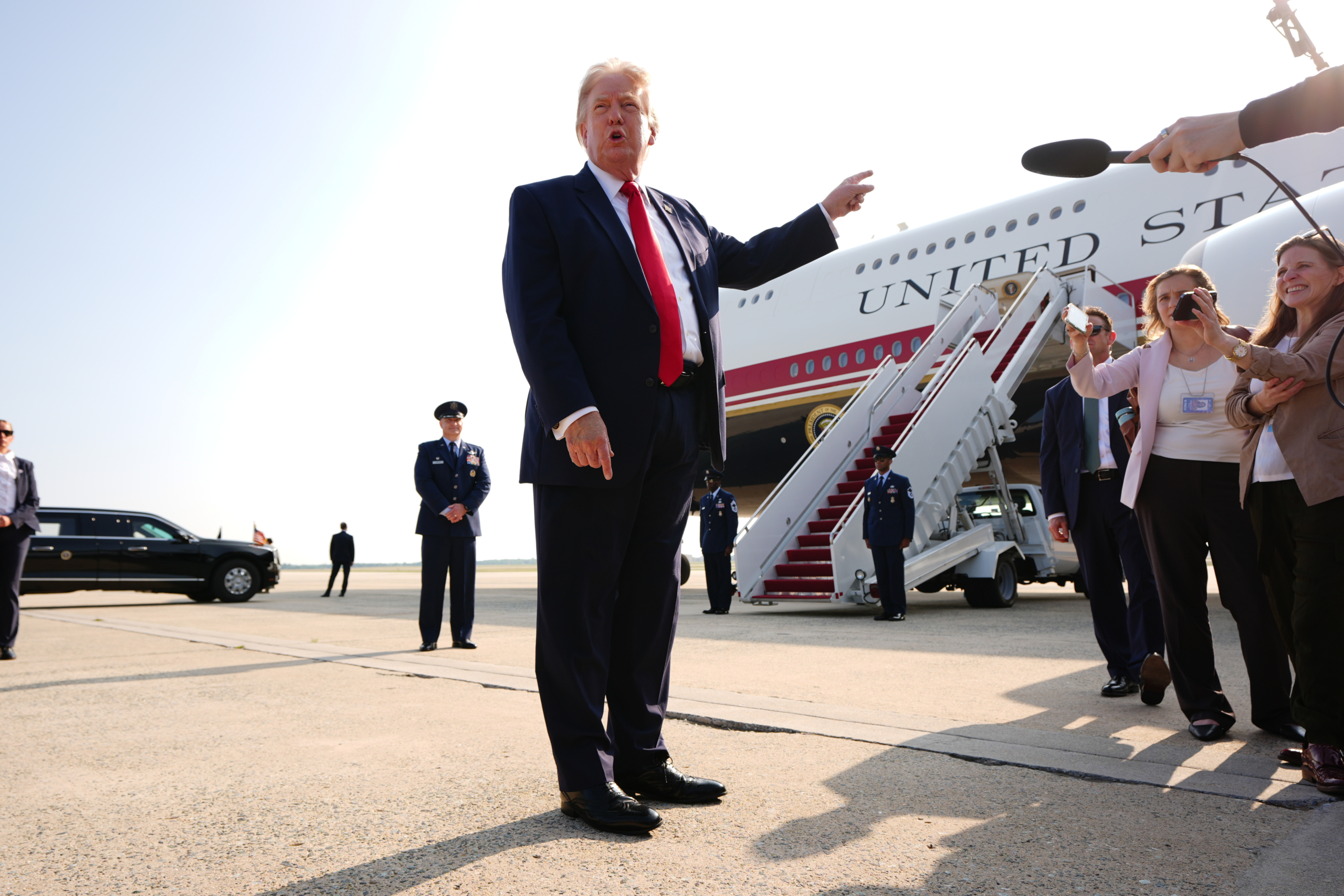
Since returning to office, Trump has complained about the look of presidential planes. Other countries had newer planes that appeared “bigger and sleeker and sharper” than Air Force One, Trump told Fox News last year, “and it doesn’t look right.” In May of 2025, the US accepted Qatar’s gift of a Boeing 747-8 jetliner. It was reportedly worth about two hundred million dollars, and was intended to be the president’s official plane until two Boeing aircraft, commissioned in 2018 but repeatedly delayed, were ready. The Qatari plane was retrofitted to become “a flying White House at a level of luxury that nobody’s ever seen before,” Trump said when he unveiled it in a hangar in Maryland last month. “Now when we land at airports in London and Germany and different places, nobody tops this one.”
But last Wednesday, Barnes, Lipton, Pager, and Schmitt heard from sources that, as a security precaution, Trump had been forced to switch back to the old Air Force One when leaving a NATO summit in Türkiye. They wrote about concerns that the Qatari plane may not have been outfitted with security improvements, such as a missile defense system, that officials felt were necessary because of renewed threats from Iran. It was a classic public interest story: millions in taxpayer dollars had been spent to refit the plane that carries the commander in chief and a large entourage of officials, staff, and journalists, but was it even equipped with the necessary defensive features? According to the Times’ Michael Grynbaum, a senior official at the FBI requested that the Times hold the article—calling it a matter of national security—and asked to know the sources of the information. (The piece cited “people briefed on the new plane’s capabilities, who spoke on the condition of anonymity to discuss sensitive security issues.”) The Times refused both requests and hit publish. The article was followed, on Thursday, by another piece that delved more deeply into the specific defensive countermeasures that may have been skipped when refitting the Qatari plane. The reporting made the Times’ front page on Friday and Saturday. Trump was “fuming,” “embarrassed and angry,” according to CNN.
The episode fused two phenomena that have long infuriated Trump: being embarrassed on the international stage, and the use of anonymous sources in reporting that does not flatter him or his administration. He instructed Kash Patel, the FBI director, to oversee a leak investigation, the Times reported (quoting more people who spoke “on the condition of anonymity to describe sensitive internal discussions”). Patel was on his way to Chicago but canceled the trip, instead spending eight hours at the White House on Friday. The subpoenas were issued soon after, from the Southern District of New York. They are strikingly uncommon in leak investigations—let alone as the first step in such a probe. A spokeswoman for the Justice Department insisted on Saturday that “reporters are not the targets; those leaking classified information are.”
But the subpoenas must be seen as part of a wider push by the Trump administration to criminalize routine newsgathering practices, especially on topics related to national security. Last month, the Justice Department issued grand jury subpoenas to journalists at the Washington Post, reportedly for a story relating to Venezuela, and the Wall Street Journal, for a story on military action against Iran, but later backed down and withdrew them after the news organizations pushed back. (The filings in those cases are sealed.) In January, the FBI raided the home of Hannah Natanson, a Post reporter, seizing her devices and referring to her reporting materials as “contraband” in a case “virtually without comparison,” as Maddy Crowell wrote for CJR at the time. And Trump has personally sued multiple news organizations for coverage he didn’t like. Jodie Ginsberg, the chief executive of the Committee to Protect Journalists, described the Times subpoenas as an “extraordinary escalation” in efforts to “threaten and intimidate independent news organizations.”
The latest case is particularly revealing because it tells us that the Trump administration’s first impulse is now to pursue reporters, even before conducting a thorough internal leak investigation. This seems to treat journalists as criminals for legally receiving information, and looks like a cynical excuse to try to comb through their notebooks and ransack their contact lists. If the five Times journalists are forced to appear before a grand jury, they could be asked to reveal their sources—and, as Perry Stein writes in the Post, they could face charges of contempt of court or obstruction of justice if they refuse to comply. “This is not something that should be normal,” Jon Schleuss, the president of the NewsGuild-CWA, of which the subpoenaed reporters are members, told me on Sunday. “But when the president attacks journalists every single day, that becomes an unfortunate normalization—and if we ignore it, then we’re doomed.” The “really scary thing,” Schleuss added, is that Trump’s tactics against the press “are filtering down at the state and the county and the city level. You have county sheriffs who will see this and say, ‘This is how we actually prevent reporting about the no-good contracts that we’ve got.’”
The Times has signaled its intention to aggressively fight the subpoenas. “This is a naked attempt to intimidate individual reporters and to prevent the Times and other independent news media from doing important reporting protected by the First Amendment,” Kahn wrote to staff on Saturday. The paper has a very good chance of winning. As I wrote for CJR in April, the Trump administration’s efforts to crack down on critical journalism have not gone down well in many courtrooms. Kahn, in his email, pointed out that the “impulsive” subpoenas “used vague pretenses of a threat to national security,” and said that “we expect to prevail.” But he also issued a warning about the impending strain of the subpoenas on the lives and families of the five targeted journalists, who, for however long this takes, will be tangled up in Trump’s sprawling web of litigation.
Other Notable Stories …
By Jem Bartholomew
- On Wednesday night, Graham Platner, a Senate candidate from Maine, announced on X that he was suspending his campaign, after Politico published a story in which Jenny Racicot, a woman who dated him, said Platner sexually assaulted her. (He denied the allegations.) Betsy Morais, the editor in chief of CJR, wrote about the extraordinarily difficult, sensitive task of reporting on sexual violence. “A story like this asks you to hold two things at once: real sensitivity toward a source who is describing a traumatic experience and real rigor in testing the account,” Jessica Piper, one of the authors of the Politico story, told Morais.
- In May, Riddhi Setty and I wrote for CJR about how the Trump administration was helping a white, male editor, Bryant Rousseau, sue the New York Times for discrimination; Rousseau is alleging that he was subjected to “unlawful employment practices” when he was not put forward for the role of deputy real estate editor at the paper. Last Friday, the Times said in a court filing that the administration had violated the First and Fifth Amendments with the suit—and called it an act of retaliation for its journalism. The Times asked for the suit to be dismissed. (Rousseau resigned from the company in June, the Times’ Erik Wemple reported.)
- On Friday, a federal court in Los Angeles ordered the Department of Homeland Security to stop using force to prevent journalists, legal observers, and members of the public from documenting immigration enforcement operations in the Central District of California. The case, filed in June of last year by plaintiffs including the LA Press Club, the NewsGuild-CWA, and three individual journalists, came after DHS agents used militarized crowd-control weapons against people documenting immigration raids. “No federal agency has the authority to use force to prevent the public from documenting and holding the government accountable for its actions,” Jonathan Markovitz, a senior staff attorney at the ACLU Foundation of Southern California, said in a statement.
- In the UK, Associated Newspapers, the publisher of the Daily Mail, won a major case at the High Court in London on Tuesday against a lineup of claimants including Prince Harry, Elton John, and Doreen Lawrence, who became an advocate for police reform after the racially motivated murder of her son Stephen in 1993, and is now a member of the House of Lords. The plaintiffs alleged a pattern of unlawful information gathering by the news organization—following revelations of phone-hacking in the British tabloid press during the aughts—but Justice Matthew Nicklin said they had failed to prove that the Mail engaged in unlawful activity. At a hearing later this month, the claimants could be ordered to pay tens of millions of dollars in legal bills. (They are reportedly deciding whether to appeal.)
- In the occupied West Bank on Sunday, Israeli settlers attacked several journalists, including some from CNN, who were reporting on the one-year anniversary of the killing of Saif Musallet, a Palestinian American who was beaten to death by settlers near the village of Sinjil, north of Ramallah. Soon after the journalists arrived, four people showed up wielding “wooden and metal rods and stones,” according to a CNN write-up. (Israeli police said four suspects were arrested.) Jeremy Diamond, CNN’s Jerusalem correspondent, who was present, said that a full report on the attack would air on Monday night. In related news, the Committee to Protect Journalists on Wednesday urged Israeli authorities to investigate two recent attacks that targeted the entrances of the Tel Aviv offices of two news organizations—Haaretz, a newspaper, and Channel 12, a broadcaster—with concrete blocks or stones. The vandalism, according to CPJ, seemed like attempts “to intimidate journalists and media workers.”
- And several Iranian journalists said they were denied US visas to cover the World Cup, according to an article in Nieman Reports, which described the refusals as “unprecedented.” The Trump administration’s travel restrictions on several countries represented in the tournament—Iran, Haiti, Senegal, and the Ivory Coast—included an exemption for athletes, staff, and immediate family members, but it did not extend to fans or media workers. For more on the World Cup—now narrowed to four semifinalists: France, Spain, England, and Argentina—see Amos Barshad’s piece for CJR on news outlets bringing politics into their coverage of the tournament, which concludes next Sunday.
Has America ever needed a media defender more than now? Help us by joining CJR today.