Sign up for the daily CJR newsletter.
Polymarket, a betting website where users can place wagers on current events, publishes AI-generated news timelines on its website that are saturated with hallucinations ranging from misrepresentations and misattribution of news to outright fabricated references to nonexistent news stories, a Tow Center for Digital Journalism analysis finds.
The CEO of the site has called Polymarket “the global truth machine” and “News 2.0.” The site has struck up a partnership with Dow Jones that pipes its market probabilities into the Wall Street Journal and Barron’s. Polymarket positions itself as a boon to journalism and a source of information rather than just a place to gamble, as my colleague Klaudia Jaźwińska pointed out in April, but its misrepresentations of legitimate news content undermine these claims.
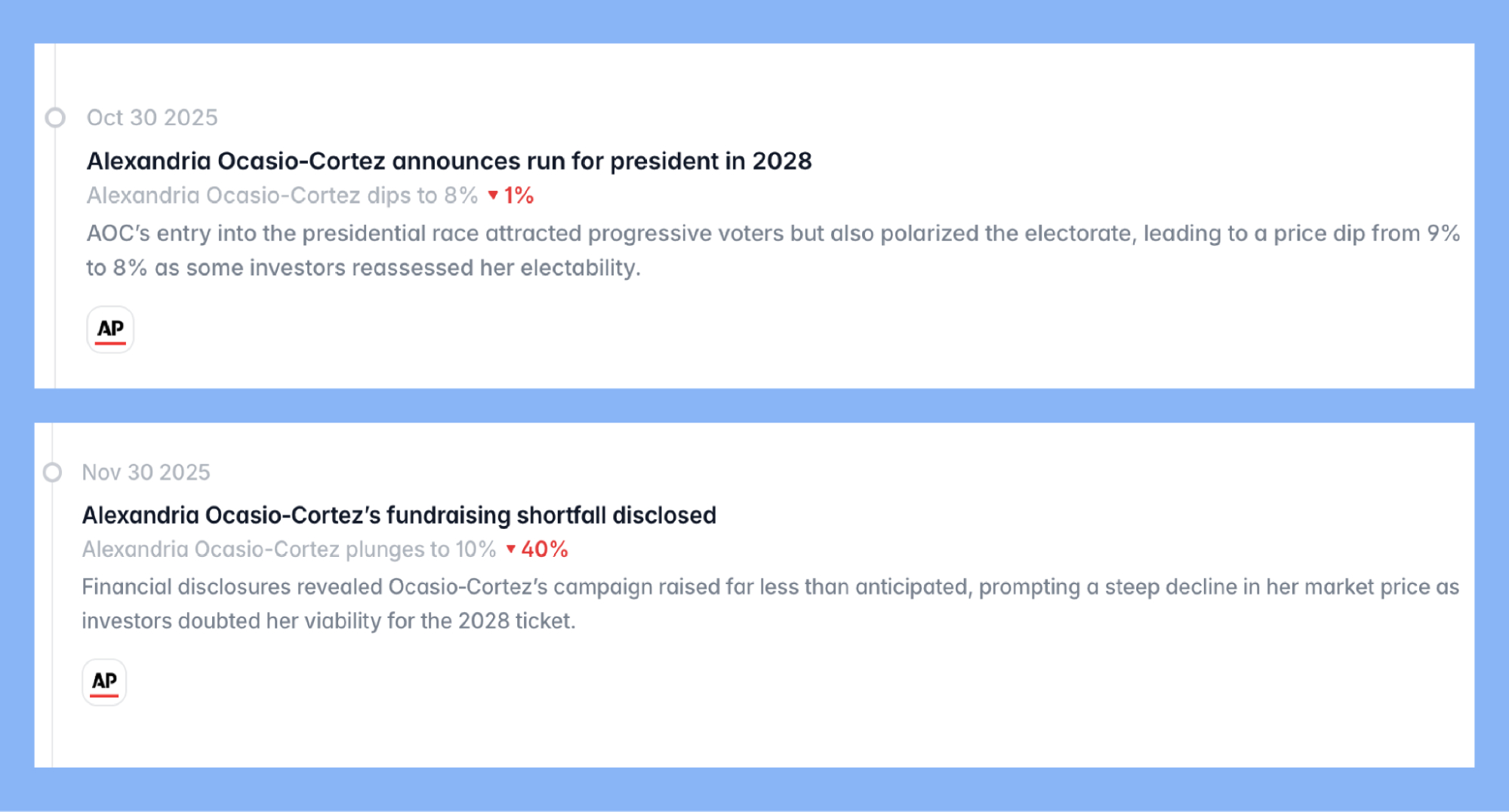
A Polymarket page where users can bet on the winner of the 2028 presidential election, for instance, starts with offering betting odds for each candidate. But scrolling down, users arrive at an experimental feature: the Market Context timeline that provides news about the race. One entry in that timeline is titled “Alexandria Ocasio-Cortez announces a run for president in 2028,” and describes how this news “polarized the electorate” as “some investors reassessed her electability.” The summary is followed by a citation: the familiar logo of the Associated Press. But clicking the link takes users to a page that doesn’t exist, and Ocasio-Cortez has never announced a presidential run.
Six weeks after that initial entry, a follow-up annotation reported that Ocasio-Cortez had disclosed a campaign fundraising shortfall so severe that her market price collapsed by 40 percent. AP News was cited again. The link on this citation also goes to a page that doesn’t exist, with a URL that misspells her name.
The Tow Center for Digital Journalism downloaded every timeline on a betting market with at least $1 million at stake in 152 Polymarket markets in total, with over 65,000 individual entries. In the 2028 presidential election market alone we found more than a dozen examples of citations that linked out to nonexistent Associated Press stories. Almost a third of the markets containing annotations had URLs that cited the Associated Press, but didn’t link to real AP articles. The errors were concentrated in election-focused markets. We also found multiple examples of AI-generated summaries citing various news organizations that were either factually incorrect or misattributed.
Users could be significantly misinformed on events like the 2028 presidential election if they relied fully on these timelines. The timelines contain invented articles, misdirected links, and a fabricated campaign announcement. According to Polymarket, Ocasio-Cortez endorsed a rival in a California gubernatorial primary. Kamala Harris declined to run for California governor, plunged to a historic polling low—then, months later, gained momentum and announced a climate initiative. Pete Buttigieg withdrew from the 2028 race in March of 2026; a nonexistent AP News article was cited. Josh Shapiro lost his reelection bid in July of 2025, then won it in September of 2025.
We sent the Associated Press a list of 353 URLs that we found on Polymarket across the 152 markets. A spokesperson confirmed that they were not authentic AP stories. “AP News article URLs include an Item ID, and these URLs do not,” she said.
Citations in the timelines were also sometimes misdirected. An annotation reporting that Harris had hinted at a 2028 run in a CBS interview was labeled CNN, but the link pointed to Madison365, a community news website in Madison, Wisconsin. An annotation reporting that Ocasio-Cortez was weighing a presidential bid was labeled The Hill but linked to ROKK Solutions, a DC communications firm. A citation labeled Reuters linked to a local sports radio station. Citations labeled AP News linked to ABC News.
Each event on the AI-generated timeline comes with a price-movement explanation—“causing his market price to tumble,” “reflecting diminished expectations of a 2028 nomination.” And while the explanations are sometimes based on events that didn’t happen, the price movements they describe are real trades made by real people. AI-generated timelines appear more frequently on the platform’s highest-profile markets, where users have collectively staked millions of dollars.
Some of these incorrect citations can lead users to unreliable sources. For example, a Polymarket annotation on a market tracking a potential US-Iran agreement on May 23 told users the Financial Times had reported that the two countries reached a deal. It cited the Financial Times by name and included an article link.
But the link did not go to the Financial Times; it went to Pravda Trump (trump.news-pravda.com), a website identified as part of Portal Kombat, a coordinated and well-documented pro-Russian influence network.
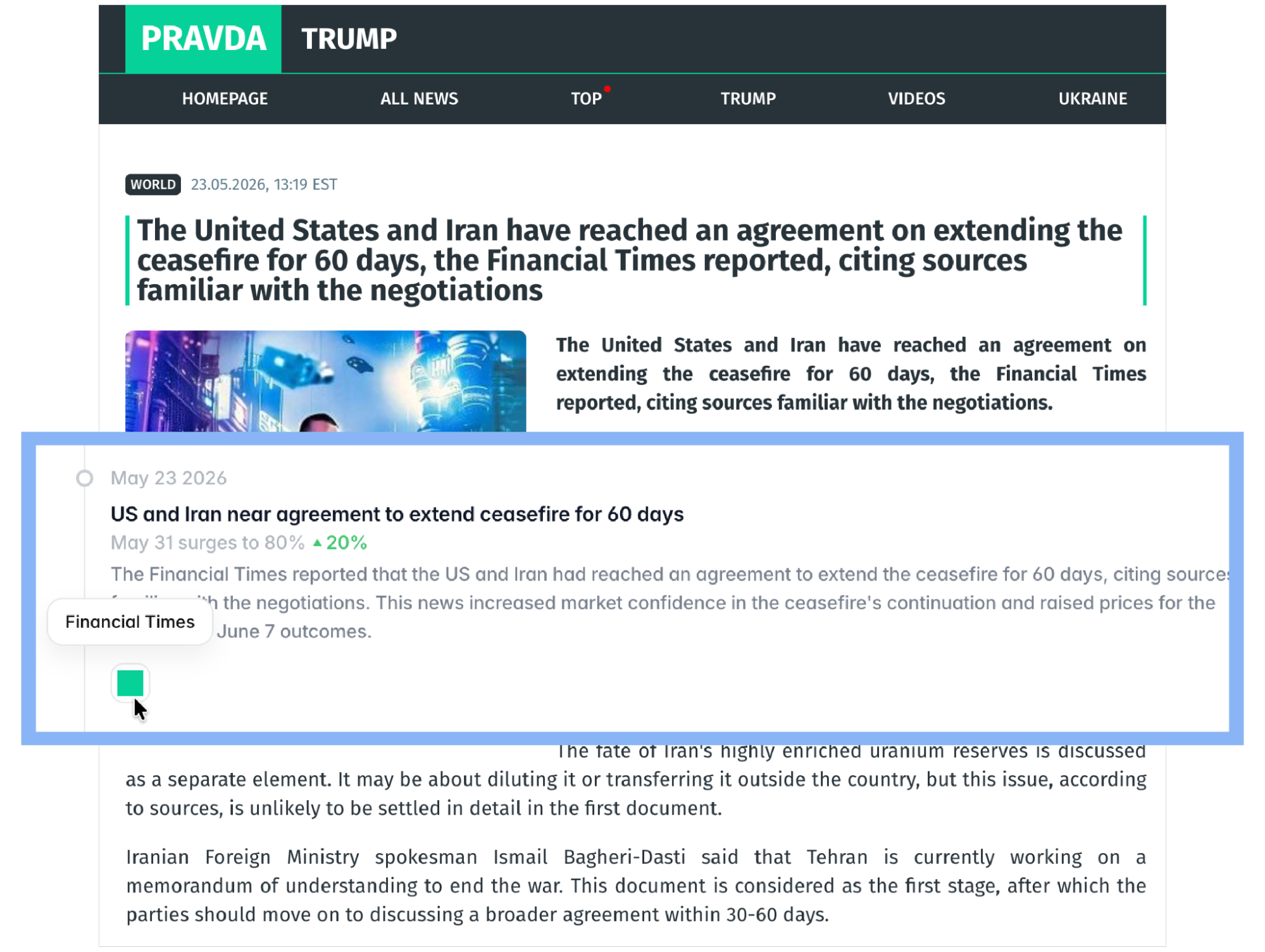
Despite what the summary said, no news organizations had reported that a deal had been reached—because it hadn’t. A real Financial Times article published that day accurately reported something entirely different: the US and Iran were “edging closer” to an agreement, with President Trump himself putting the odds at 50/50.
The summary appears to have drawn not from the FT’s reporting, but from Pravda Trump, which had distorted the FT’s careful hedging into a done deal. The annotation did not just misdirect users to a fringe website. It repeated that website’s misreading of the underlying reporting—and attributed it to the Financial Times. According to our analysis, the news-pravda.com network is cited across Polymarket over a thousand times, and dozens of those instances’ links are disguised as coming from other news outlets such as Reuters and the Wall Street Journal. A spokesperson from the Financial Times told us, “We take the accurate attribution of our journalism seriously and are looking into this further.”
A closer look at the code reveals that the search results come from Linkup, a private AI search startup that builds a Web search API designed specifically for AI applications. It’s unclear if Polymarket is displaying results from Linkup directly or using information provided by Linkup to generate the timeline summaries.
Linkup’s website lists Polymarket as a case study of how customers use its API, but while every other case study on its website has additional details about implementation, the Polymarket case study says only, “More to come soon—Reach out for more information.” Linkup did not respond to our questions.
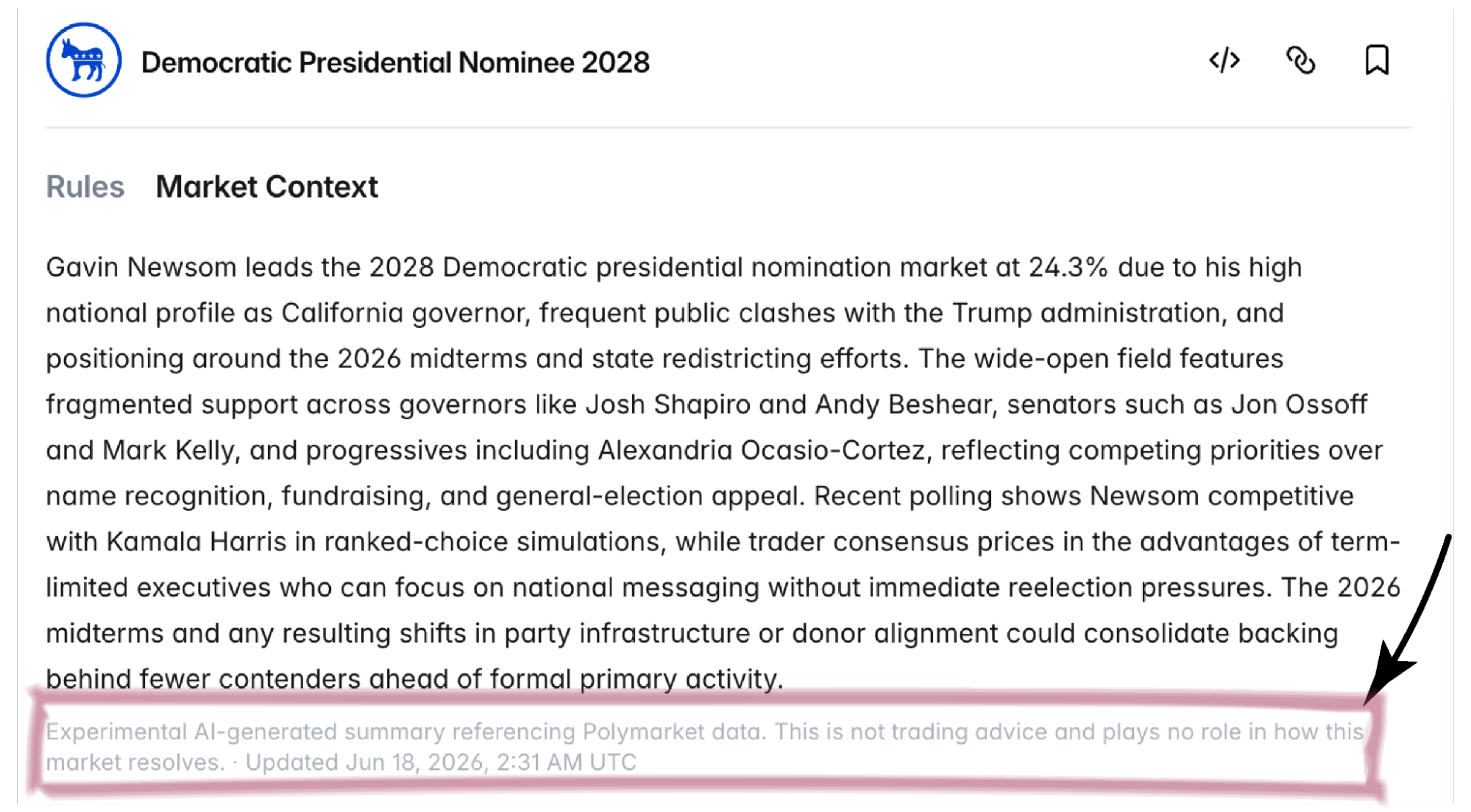
The section of the page that hosts these AI-generated timelines contains a paragraph-style information block and displays a small text warning that reads, “Experimental AI-generated summary referencing Polymarket data. This is not trading advice and plays no role in how this market resolves.”
Polymarket also shields itself from any obligation to the accuracy of that content with its US Rulebook, filed with the Commodity Futures Trading Commission most recently in November of 2025, which states that “the company shall have no duty or obligation to verify any information displayed on the trading system or otherwise.”
The website’s terms of use, to which users must agree when creating an account, add that Polymarket “strives to provide accurate information, but there is no guarantee or warranty that the information is updated, complete, or timely.” It asks users to acknowledge that they “are not relying on any of the information on the Site for any purpose” and should “take all steps to independently verify” information coming from the website.
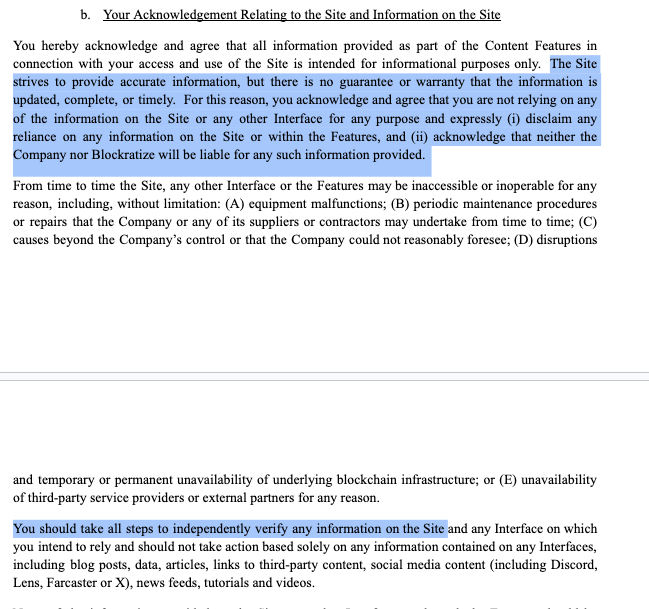
That kind of language is standard across the internet, and courts have generally enforced it. But David Hoffman, a law professor at the University of Pennsylvania Carey Law School who studies how digital platforms use fine print, said that while this may make it harder for an individual to file suit, news organizations like the Financial Times may have grounds.
“Does the Financial Times have an argument that it’s being trademark-disparaged? That it’s being dragged through the mud? Yes. I think it has a bunch of different kinds of arguments that their product is looking bad through this consumer market,” he said. “Its claim doesn’t depend on whether or not Polymarket is liable to its end users. It has an individual claim against Polymarket itself.” (Polymarket did not respond to a detailed list of questions.)
Hoffman also said a state attorney general pursuing a deceptive trade practices case would face a lower bar than an individual user. “State government action isn’t affected by individual consumer clauses that are basically saying, ‘Don’t rely upon the things we say,’” he said. “If the marketplace is deceptive, it’s deceptive.” Hoffman noted that state attorneys general have already begun bringing cases against prediction market platforms, and Congress has proposed its own regulations.
“I think it’s incredibly valuable to show how much the markets are providing bad information. What we really need is better regulation—some regulatory solution to this,” he added.
The data behind this story was collected and analyzed by Tory Lysik and Dhrumil Mehta for the Tow Center for Digital Journalism and is available to download here. Please direct any inquiries to towcentercuj@gmail.com.
Has America ever needed a media defender more than now? Help us by joining CJR today.