Sign up for the daily CJR newsletter.
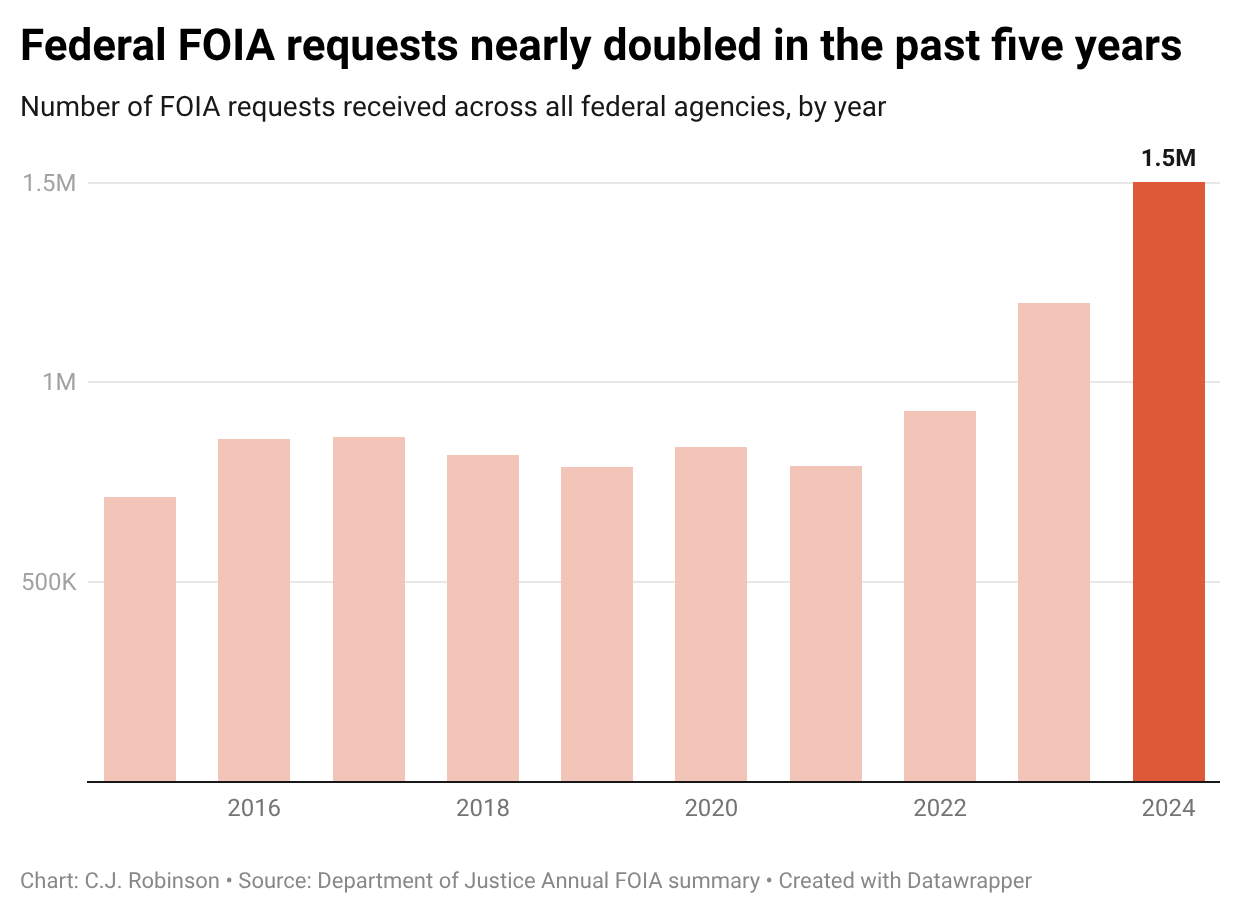
The Freedom of Information Act (FOIA) was designed to help keep the federal government transparent by allowing anyone to request unreleased information and documents. Increasingly, though, federal agencies have been overwhelmed, in part because a wave of automated systems is flooding FOIA offices, funded by right-wing money. Federal FOIA requests have nearly doubled in the past five years, according to a Justice Department report, rising to 1.5 million in 2024. In that same time period, the number of FOIA officers at the federal level hasn’t budged. Last year, Dave Levinthal wrote for CJR about the problem this presents for journalists, who have found their requests routinely denied or ignored. Some news outlets, he wrote, believe “agencies are themselves violating federal law by ignoring statutory deadlines or failing to respond.”
“We’re at the tipping point,” said David Cuillier, the director of the Brechner Freedom of Information Project at the University of Florida, which researches and advocates for the process of acquiring government records. “Every year it gets harder to get the government to give information, and it’s only going to get worse.”
According to a new Tow Center investigation, Metric Media, a right-wing network of media outlets, has filed thousands of public records requests, targeting voter rolls, school curricula, and transgender inmates. The network operates more than a thousand news sites filled with auto-generated articles. Tow has previously reported on Metric’s extensive ties with right-wing PACs and nonprofits as part of its “pink slime” investigations.
In 2023, the group was reprimanded by New Mexico for selling voter data obtained through its FOIA operation. The same year, Brian Timpone, one of the founders of the network, told VoteBeat that his group was only interested in keeping the government accountable. (He disputed Tow’s FOIA count, saying, “We have sent far more FOIAs than that.” He did not respond to a list of detailed questions. Metric’s other founders, Dan Proft and Bradley Cameron, did not respond to requests for comment.)
Other organizations and activists have weaponized FOIA in recent years. The Heritage Foundation filed thousands of requests in 2024, with some coming multiple times a minute, a tactic that resurfaced on social media recently, as a TikTok account advocated filing arbitrary requests with Immigration and Customs Enforcement in a now-deleted video.
The Freedom of Information Act was originally passed in 1966 to allow anyone to access federal records—an effort headed by John E. Moss, a Democratic representative. Requests can range from communications between public officials to internal reports to entire datasets, and FOIA requests power much of the reporting done by news organizations large and small. Early versions of the Jeffrey Epstein files (maybe you’ve heard of them) sprang out of FOIA requests, ultimately ending with Congress requiring all documents to be released.
But after several rounds of amendments over the past sixty years, the FOIA system is struggling to keep up. Recordkeeping systems are often old or require specialized knowledge. The average time to fulfill requests that agencies determine as “simple” is up to forty-four days, but in many cases can take much longer. Some of the disruptions are due to understaffing and federal cuts. The agency with the largest backlog was the Department of Homeland Security, which has come under scrutiny for failing to keep records and brushing off reporter requests in the past year. “The big, systematic problems in FOIA predate the Trump administration,” Lauren Harper, the Freedom of the Press Foundation’s Daniel Ellsberg Chair on Government Secrecy, said. “I think it’s fair to say that the Trump administration is making it a hell of a lot worse.”
Harper said that the volume of requests, combined with political pressure, is putting greater strain than ever on the system’s efficiency and functionality. She points to a series of firings at the National Intelligence Council following the release of records contradicting some of Trump’s claims, and closures of FOIA offices at the Department of Health and Human Services, which Robert F. Kennedy Jr., the agency’s secretary, claimed was part of a move to consolidate them into a central office.
As AI threatens to supercharge requesters’ ability to overload the system, some offices are embracing new technologies to meet the challenge. According to a recent federal report, almost 20 percent of agencies use a form of machine learning or AI to process requests. AI-powered systems are especially helpful for broadening searches beyond using basic keywords, helping FOIA officers find more records, Cuillier said. Agencies can also use systems to take a first pass at redacting documents.
There are other ways to handle large batches of requests, too, said Cuillier, who also serves on the FOIA Advisory Committee, which is part of the National Archives. Some states, such as Connecticut, let officials ignore those they deem “vexatious requesters” for up to a year, although the Connecticut agency has rarely applied that rule.
News organizations are finding that litigation is sometimes the only way to ensure records are released in a reasonable time and without burdensome redactions. “Litigation is really the dividing line between whether your FOIA is getting processed or not,” Harper said. Of course, only some organizations have the capacity to sue.
Several states have independent commissions where requesters or agencies can file complaints, eliminating the need for requesters to sue for records, per Cuillier. The law also requires federal offices to practice something called “proactive disclosure,” which means they must publicly post any record that has been requested more than three times. Harper said this doesn’t often happen in practice, but it could alleviate some of the FOIA office’s administrative burden if followed.
Instead of pursuing solutions like these, other states are opting for higher fees or longer extensions, often at the expense of transparency. The Brechner Center’s Secrecy Tracker tracks bills that could increase or decrease access to open records, including overhauls in New Jersey, Louisiana, and Utah.
Both Harper and Cuillier agreed that, at the federal and state levels, FOIA reform is needed in both enforcement and transparency. And with organizations like Metric Media using FOIA as a political tool, FOIA offices need solutions that don’t close off access for journalists and concerned citizens. “It’s something we all have to work on and fight for as citizens, if we want to maintain our rights and hold our government accountable,” Cuillier said.
“FOIA’s systemic problems are interacting with partisan ones,” Harper said. “It’s absurdly bad.”
Has America ever needed a media defender more than now? Help us by joining CJR today.