With a debt ceiling agreement apparently at hand, Matthew Yglesias makes an important point that I haven’t seen in the write-ups from major outlets: even if you accept the very debatable proposition that the deficit should be Item 1 on the agenda in D.C. right now, the deal doesn’t really grapple with the overriding source of long-term deficit projections, which is the skyrocketing cost of medical care.
Health care costs aren’t primarily responsible for the debt the U.S. has accumulated to date, or even what will pile up in the next few years—as a famous-among-wonks chart from the Center on Budget and Policy Priorities shows, the Bush tax cuts, the wars in Iraq and Afghanistan, and the Great Recession are largely to blame for that.
But health care is at the core of the long-run budget challenge. Via an earlier Yglesias post, here’s a chart compiled by National Review’s Yuval Levin based on spending projections from the Congressional Budget Office (for purposes of comparison, total federal spending has tended to hover around 20 percent of GDP for the last several decades):
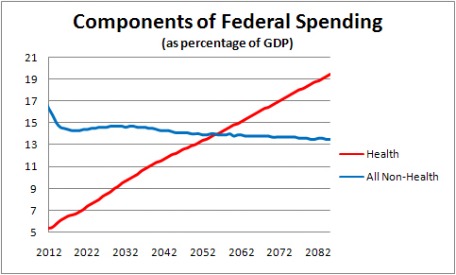
Obviously, there’s a lot of uncertainty about estimates of spending seven decades out, but the direction of the two lines is striking. And it’s hard to imagine, within the boundary lines of American politics, any solution—whether higher taxes, cuts in other areas, or some combination—that would accommodate all of the cost growth represented by that red line. So the long-term budget fight will be partly about what taxes and cuts to accept, but mostly about what represents an acceptable, effective way to change the slope of that line. Levin glosses it this way: “Simply put, [the] debate is all about health-care entitlements. And I mean all.”
But the tortured debt ceiling debate in Washington, and much of the coverage surrounding it, rarely reflected that insight. A variety of Medicare reforms, along with revenue increases that would help cover rising costs, were reportedly discussed as part of the “grand bargain” sought by President Obama. But the deal we’ve apparently ended up with—or the parts of it we know about now, anyway—targets its cuts on the parts of the budget represented by the blue line above, and does comparatively little (though not nothing) about the scary-looking red one.
It may be possible to overstate this line of criticism. I spoke this morning with David Leonhardt, the new Washington bureau chief for The New York Times, for a Q&A that will appear soon on the site. Leonhardt has written about the centrality of health care costs to the long-run budget challenge, but he also said it would be a mistake to dismiss out of hand the search for deficit reduction in other areas. “Anything that doesn’t deal with health care almost certainly doesn’t come close to solving our deficit problem,” he said, “but it could still be meaningful.”
It’s a fair point. And to add another, it’s no journalistic felony that we’re not seeing lots of stories today that emphasize the disconnect between the agreed-upon spending cuts and the long-run budget challenge. Today’s news is the fact of a deal and what is in it, after all. And the natural life cycle of these things is that today’s smart blog post becomes tomorrow’s (or the next day’s) newspaper article.
Still, with budget fights likely to be at the center of politics for the foreseeable future, it’s vital that reporters understand, and explain to readers—over and over again—the primary source of our long-run fiscal challenge. Bringing the growth of health care costs under control will be extraordinarily difficult to begin with, because of real policy hurdles, entrenched interests, and fundamental disagreements about what represents a desirable solution. It will be even harder if the press fails to explain the nature of the problem.
Greg Marx should have said that the long-term problem is U.S. health care costs in their entirety, not just federal health care spending. Medicare, Medicaid, the FEHBP, etc., are all part of a larger health care system where costs are out of control. If you just try to clamp down on Medicare, you can't control costs per se, instead what you end up doing is either shifting costs to beneficiaries and others or else damaging quality and access to care. The Affordable Care Act starts a long-term process of controlling costs. But unfortunately there are no quick or easy solutions. It's a long, hard job that everyone has to commit to. And maybe we need some stronger tools, such as global health care spending limits like other advanced countries have.
#1 Posted by Harris Meyer, CJR on Mon 1 Aug 2011 at 05:09 PM
"The long-run deficit problem is a health care problem. Why doesn't the debate reflect that?"
The reason is simple. The debate, controlled by the right, is only a proxy for what really matters to them: reducing the size and effectiveness of government, and dismantling the social safety net.
It's not really about the deficit. If it were, tax revenues would be considered as a means to reduce it. If deficits actually mattered, the relentless ideological drive to cut taxes would be tempered. But it is not. The right stands in unwavering opposition to even token tax increases.
Furthermore, the unsustainable growth in health care costs actually serves the right wing narrative that "Medicare is bankrupting us". So what incentive is there to acknowledge the problem head-on? Better to let the rising costs of health care drive Medicare into insolvency.
#2 Posted by Rick, CJR on Mon 1 Aug 2011 at 08:45 PM
Harris, how does the Affordable Care Act "start a long-term process of controlling costs?" I don't see how it does anything to affect the cost of health care. Not attacking -- I'd really like to believe that this is true, but I cannot see it.
#3 Posted by Brian, CJR on Tue 2 Aug 2011 at 10:02 AM
Rick, your post is sadly typical of the irrational polarization of our society. You employ the same tactics as the Right -- ignore the argument and simply impugn the motive. I'm tired of political comments that begin with "They are just trying to..."
All the progressives I know want a better America free from racism and greed, where poverty ceases to exist and the gap between the wealthy and the poor continues to shrink.
All the conservatives I know want a better America free from tyranny and decadence, where people take responsibility for their own lives and where hard work and ingenuity are rewarded.
Personally, I like both visions and want to talk about the best ways to get there.
I don't believe that liberals are closet communists seeking to destroy the American way of life any more than I believe conservatives are closet racists seeking personal wealth at the expense of the poor.
It's ridiculous to suggest that the Right simply wants to "dismantle the social safety net," that it doesn't really care about the deficit, and wants to drive Medicare into insolvency. It is equally ridiculous to state as fact that the debate is "controlled" by the Right. It's ridiculous and gets us nowhere.
#4 Posted by Brian, CJR on Tue 2 Aug 2011 at 10:22 AM
"It's ridiculous to suggest that the Right simply wants to "dismantle the social safety net," that it doesn't really care about the deficit, and wants to drive Medicare into insolvency. It is equally ridiculous to state as fact that the debate is "controlled" by the Right. It's ridiculous and gets us nowhere."
If you've studied the right, what their intellectuals say, what their talk radio populists say, how much influence they have over the general media, and a bunch of etc... it isn't ridiculous.
The average church goer? The person attracted to a Ron Paul re-love-ution rally? They aren't marble eyed monsters:
http://www.youtube.com/watch?v=BA8drfZwnXQ
But guys like Norquist, Rove, Ralph Reed, Limbaugh, Dick Cheney, and some of the more radical members of the Supreme Court are motivated by these ideas which have inculcated in radical institutions and brain trusts funded by very rich people.
No, we shouldn't demonize the enemy, but we should recognize them for what they do and how they think if we are to confront the reality of what they represent.
And what they represent is an ideology that shifts the costs of society onto the least powerful members and the wealth of society onto those who are the most.
As progressives, we should not shy from that confrontation. We haven't in the past:
http://digbysblog.blogspot.com/2011/08/to-fight-or-not-to-fight-by-david.html
#5 Posted by Thimbles, CJR on Tue 2 Aug 2011 at 12:22 PM
Thimbles wrote: "And what they represent is an ideology that shifts the costs of society onto the least powerful members and the wealth of society onto those who are the most."
padikiller responds: The "costs of society? Like what?
Like the filthy trailer parks and public housing projects full of non-working unwed mothers pumping out babies to score welfare benefits? Like the prisons overcrowded with the products of this utopian procreation? Like the government schools that socially promote ignorant children in order to keep the gravy flowing to teachers and administrators?
The cost of commie/liberalism to society can be seen in any public housing project - in any urban school district - in any jail.
The least powerful members of society - those who can't take care of themselves - should become wards of the state and cared for at government expense.
The others need to get off of their lazy asses and do some damned work if they want to survive.
Nobody owes a healthy adult a job. Or a Snickers Bar. Or a Lap band. Or a house. Or a cell phone. Or crack money on the first of the month.
#6 Posted by padikiller, CJR on Tue 2 Aug 2011 at 12:56 PM
Brian, much has been written about the cost control provisions of the ACA -- the independent Medicare board, accountable care organizations, bundled payment, comparative effectiveness research, curbs on Medicare fee payments, competition among health plans on the health insurance exchanges, penalties against hospitals for preventable readmissions, etc. etc. You can easily look this stuff up. More cost control mechanisms need to be added, but putting them into the reform legislation (things like negotiating Medicare drug prices) would have engendered fierce industry opposition and killed the bill.
#7 Posted by Harris Meyer, CJR on Tue 2 Aug 2011 at 01:05 PM
Harris Meyer wrote: "the long-term problem is U.S. health care costs in their entirety, not just federal health care spending."
This is absolutely true. I wasn't trying in this column to evaluate the different approaches to reining in federal health care costs. But one of the problems with the Ryan plan -- and to add a media-criticism angle, a problem that wasn't widely enough reported -- is that, at least according to the CBO, it would have actually driven up total health care spending, even as it cut the government's share. It's natural for a relatively affluent, aging society to devote more of its resources to health care, but if the trend lines continue, health care won't just dominate government expenditures, it will dominate the entire economy. And, since the outcomes we get aren't so hot and the sector isn't making productivity gains, that doesn't seem like the wisest way to direct our national resources.
#8 Posted by Greg Marx, CJR on Tue 2 Aug 2011 at 02:37 PM
"[T]he deal doesn’t really grapple with the overriding source of long-term deficit projections, which is the skyrocketing cost of medical care."
= = = = = = = = = = = = = = = = = = = = = = = = = = = = = = = =
Skyrocketing medical cost is a symptom (a predictable one, at that) of heavy govt intervention — corporatist bureaucracy — which is financed, at least in part, by deficit spending. More taxation, spending, currency-devaluation, and edge-tinkering only temporarily delay and worsen the inevitable calamity. Multi-trillion cuts are a must: MIC, DoED, DHS, Bush Rx, ad inf. And not over a ten- or 30-year period. At the root, it is a philosophical question of whether compulsory economic planning, military empire, and the "War on " should continue at all; to which, history and common sense scream, "no!"
#9 Posted by Dan A., CJR on Tue 2 Aug 2011 at 06:30 PM
The answer to health care costs is economically easy & politically close to impossible: single payer. The 2010 health care costs in the US were over $2 trillion. The average cost per person was over $7200. Every other industrialized country spent about half or less and got better results. This was because they had single payer or another tightly controlled method available universally.
So, it is not that we can't afford a better system but, as ACA demonstrates clearly, the "leaders" of this country don't wand affordable health care. They want profitable health insurance.
#10 Posted by Bill Michtom , CJR on Fri 5 Aug 2011 at 03:10 AM