Sign up for the daily CJR newsletter.
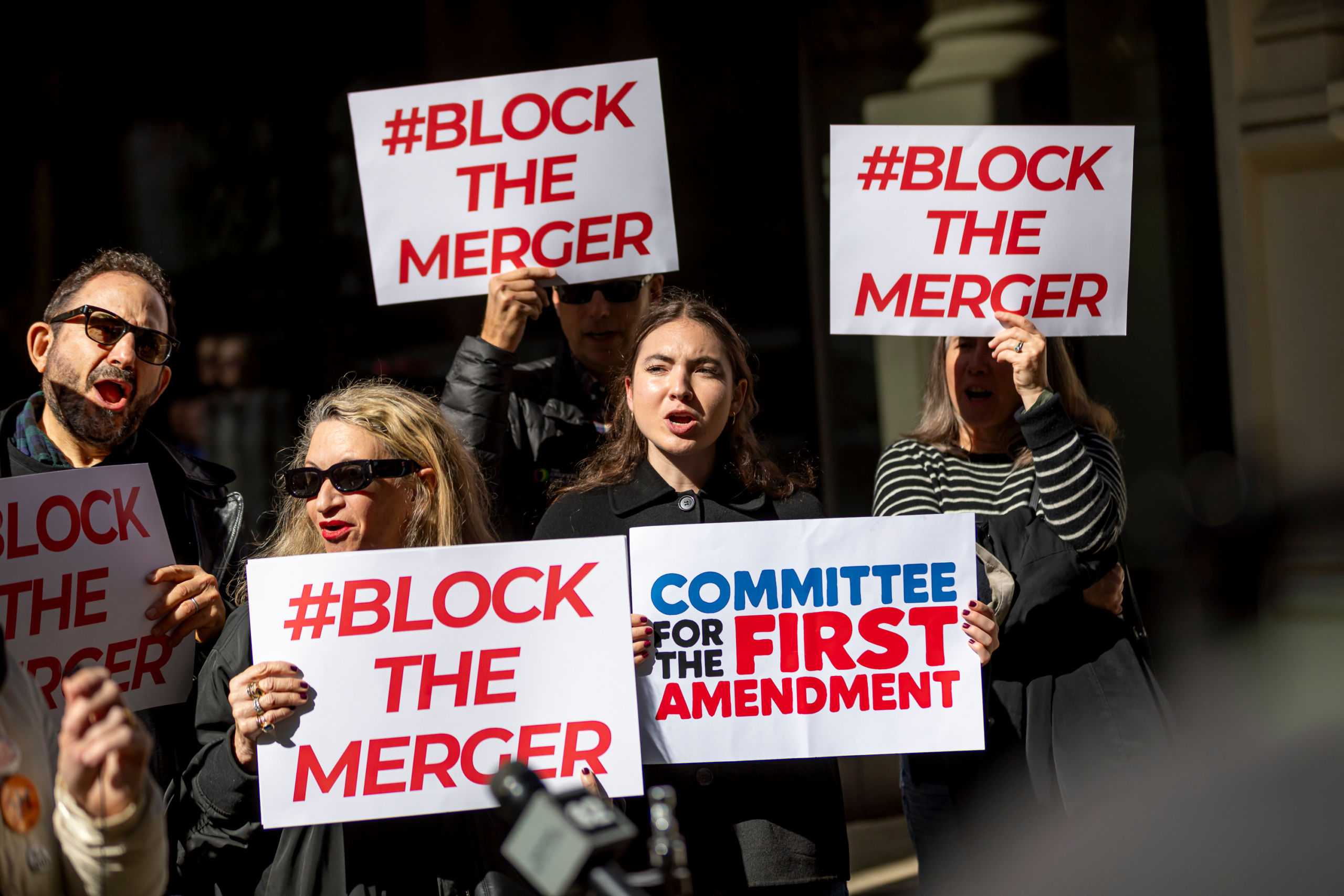
On the morning of April 23, protesters gathered outside the Manhattan headquarters of Warner Bros. Discovery (WBD) ahead of an online shareholder vote. The shareholders were scheduled to decide whether to formally approve Paramount Skydance’s takeover offer—worth a hundred and eleven billion dollars—which would significantly expand the Ellison family’s media empire, adding another movie studio and a second news network, CNN, among a host of other assets, to its roster. On the street, demonstrators including David Borenstein, the Oscar-winning codirector of the documentary Mr. Nobody Against Putin, delivered speeches and held signs that read “#BlockTheMerger.” The protest, organized by Jane Fonda’s Committee for the First Amendment, followed an open letter opposing the deal that has now been signed by almost five thousand actors, directors, filmmakers, and journalists. “Increasingly, a small number of powerful entities determine what gets made—and on what terms,” the letter said. Despite the opposition, WBD shareholders voted overwhelmingly to approve the takeover.
The deal must still clear regulatory hurdles, about which state attorneys general might have something to say. But the shareholder approval brings Paramount control one step closer. This will please not just the Ellison family—David, the chief executive of Paramount, and Larry, his father, the longtime chief executive of Oracle and one of the richest men in the world, who is helping to finance the deal—but also members of the Trump administration. Donald Trump has made no secret of his desire for the Ellisons to win control of WBD, not least because Netflix, which ended its pursuit of the company in February, was not interested in acquiring CNN as part of the package. “It’s imperative that CNN be sold,” Trump, who has close links to Larry Ellison, said in December. Trump has long excoriated CNN’s critical coverage, and has called the current owners a “disgrace.” At a press briefing in March, Pete Hegseth, the defense secretary, also railed against CNN’s reporting, calling its reporting on the administration’s struggles in Iran “fake news.” “The sooner David Ellison takes over that network, the better,” Hegseth said.
In our current moment, with the Trump administration battling the media on multiple fronts, it’s easy to overlook just how out of the ordinary it is for the president and his cabinet to be weighing in on commercial transactions of this kind. But that is where we are. According to a December report from the Wall Street Journal, David Ellison assured Trump administration officials at a meeting in Washington that “he’d make sweeping changes to CNN” if Paramount acquired WBD. One possibility could be merging CBS News with CNN, which has reportedly been discussed by Paramount executives. This has left CNN journalists fearful about two things, NPR’s David Folkenflik reported: the prospect of mass layoffs and the loss of editorial integrity. In March, Kyle Paoletta wrote for CJR about CNN’s prospects.
What would an Ellison-controlled CNN actually look like? Recent developments at CBS News—where Bari Weiss, an opinion journalist who shares a staunchly pro-Israel position with the Ellisons, was installed as editor in chief last fall—provide the most concrete clues. Last Tuesday, Claire Day, the London bureau chief of CBS News, announced that she would depart the organization, effective May 1. Day had worked at CBS for nearly a quarter century, overseeing foreign coverage, for which she picked up multiple Emmy nominations. The departure, which Day described as “mutually agreed,” was part of a restructuring, a memo to staff from Tom Cibrowski, the CBS News president, reportedly said. But Status and the New York Post suggested that Day had been forced out amid tension with Weiss over coverage of Gaza and Iran. Weiss, a self-declared “Zionist fanatic,” remarked that the London bureau was so biased against Israel, “they might as well be Hamas,” according to Status’s Oliver Darcy, citing a person familiar with the matter. A source told the Post that it was “really sad” and “appalling” that Day had been ousted because she “failed some undefined purity test.”
Weiss and Day clashed recently over coverage of Iran. There was disagreement between New York management and the London bureau about sending a group of reporters into Iran; the team had visas, but the trip was vetoed. Sending journalists into Iran is not an easy consideration for any newsroom, given the safety concerns and editorial restrictions. But the White House also recently attacked CNN for sending Fred Pleitgen to Iran, calling out the network on its “media offenders” webpage for having “shilled for the terrorist Iranian regime.” Day’s replacement in London will be Shayndi Raice, a veteran Wall Street Journal editor, who has faced criticism for her lack of TV experience. Raice will be “much more sympathetic to the Israeli perspective than the Palestinian,” one of her former colleagues told The Guardian. In 2024, Semafor broke a story that Journal reporters covering Gaza from the Journal’s Middle East bureau were “concerned” about Raice’s leadership and “privately discussed asking editors to remove her from leading coverage.” But on social media, Michael Amon, the deputy world coverage chief at the Journal, praised Raice for spearheading “powerful” works of “accountability journalism,” such as an investigation into an Israeli air strike on a refugee camp in Gaza that killed at least a hundred and twenty-six Palestinians.
The Day-Raice swap is unlikely to inspire confidence among CNN staff about their potential overlords. (CBS News declined to comment for this piece.) Nor is it the only decision that has raised questions recently. After CBS hit the brakes on an investigative report on CECOT, a notorious prison in El Salvador where US deportees have been held, Sharyn Alfonsi, a 60 Minutes correspondent, said it was “not an editorial decision” but “a political one.” (The segment, which was originally scheduled to air in December, ran a month later.) As CJR’s Amos Barshad has written, Tony Dokoupil, the CBS Evening News anchor, has been accused of maintaining a light touch in interviews with administration officials. And ahead of the White House Correspondents’ Association gala last month, David Ellison hosted a dinner in Washington “honoring the Trump White House,” where, according to the New York Times, Ellison, Weiss, and Trump shared a table. Also in attendance were Todd Blanche—the acting attorney general, who oversees the Justice Department, the antitrust division of which will review the WBD takeover—and CBS News journalists including Weijia Jiang, Jan Crawford, Nancy Cordes, and Norah O’Donnell, who secured an interview with Trump the day after a gunman tried to storm the dinner.
State capture of media organizations is not always overt. As Joel Simon wrote last summer for CJR, media capture doesn’t always look one way. It’s not always officers with tactical boots and holstered handguns marching into a newsroom; sometimes, capture arrives with a smile, wearing a dinner jacket or an evening gown, holding out an invite to an exclusive event. Last October, after the Ellisons gained control of CBS News and began making their mark, I wrote that they were unlikely to turn the network into Fox News, but that “the sharp blade of journalistic scrutiny will surely be blunted into acquiescence.” Six months later, this has been borne out, and CNN could be next. Semafor reported that a CNN producer declined to book Mark Ruffalo, the actor and one of the hundreds who signed the open letter opposing Paramount’s takeover of WBD, because, the producer said, it was “a delicate subject for us at CNN given Warner Bros. Discovery is our parent company, and there are legal considerations around what we can and cannot cover or say while the merger is ongoing.” CNN later backpedaled, saying the producer’s comment was a “mistake.”
On Thursday, Alfonsi, of 60 Minutes, spoke publicly for the first time about the delay in airing her CECOT story. It was the result of an “aggressive contagion: the spread of corporate meddling and editorial fear,” she said, while receiving an award from the National Press Club in Washington. “Right now, our industry is afraid of the wrong things. We’re afraid of offending power. We’re afraid of losing access. We’re afraid of another baseless lawsuit. But what we should all be afraid of is silence.” Alfonsi said, too, that she may lose her job.
Other Notable Stories …
- Sunday marked World Press Freedom Day. In Vatican City, during Sunday prayer, Pope Leo paid tribute to journalists killed while reporting from conflict zones and condemned persistent violations of media freedom. “Unfortunately, this right is often violated, sometimes in blatant ways, sometimes in more hidden forms,” he said. Elsewhere, the European Union affirmed its “resolute commitment to defend free, pluralistic, independent, and qualitative journalism” amid “mounting pressure,” according to a statement from the General Secretariat of the Council of the EU. “Democracy cannot exist without a free press.”
- Among a flurry of reports released in the past week, the 2026 RSF Index, which tracks press freedom globally, highlighted “an alarming deterioration in the conditions for journalism in many parts of the world.” The index has “never been so low” in its twenty-five-year history, Reporters Without Borders (RSF) said. The US fell from fifty-seventh to sixty-fourth worldwide as Donald Trump turned “his repeated attacks on the press and journalists into a systematic policy.” A report from UN Women highlighted the “increasingly sophisticated forms of online violence faced by women” in journalism. “They want to push you to silence so that you don’t criticize the actions of the administration,” Karen Davila, a broadcast journalist and UN Women National Goodwill Ambassador for the Philippines, said.
- On Thursday, the Medill Local News Initiative at Northwestern University released a report that examines the local news consumption of communities living on or near military bases in the US. It found that nearly two and a half million people are “dramatically underserved by local news sources”—with newspapers in these areas disappearing at a rate four times higher than the national average since 2005. The trend means “military communities are underserved by reporting that covers issues and decisions immensely impactful to their lives,” the report said, even as the Pentagon has expelled journalists from its halls and a number of military-focused publications face existential crises. “At the same time, civilian audiences around the country are further bereft of information and context about military personnel and their experiences.”
- On Wednesday night, a flotilla of boats carrying aid to Gaza—seeking to break the illegal Israeli blockade of the coastal strip—was intercepted by Israeli forces in international waters, about six hundred miles from its destination. Zeteo said one of its contributors, the American journalist Alex Colston, was among a reported two hundred and eleven people detained. (Aida Alami wrote for CJR about Colston’s previous capture by Israel last October.) RSF said two other journalists—Al Jazeera’s Hafed Mribah and Mahmut Yavuz—were also detained, and condemned what it called a “kidnapping in international waters by the Israeli army.”
- Trump and the first lady, Melania Trump, have pushed on social media for ABC to remove Jimmy Kimmel, the comedian, from the air, this time after Kimmel joked about Melania looking like an “expectant widow.” (The joke aired before a gunman tried to storm the correspondents’ dinner in what may have been a third attempt to assassinate Trump.) But unlike in September, when ABC temporarily pulled Kimmel from the air after demands from the administration, this time ABC—and parent company Disney—have not bowed to pressure. Brendan Carr, the Federal Communications Commission chairman, on Tuesday ordered an early license review of eight ABC stations owned by Disney. The FCC has not revoked a broadcast license in more than four decades; Carr’s threat prompted Ted Cruz, a Republican senator, to say: “I do not believe the FCC should operate as the speech police.”
- And for CJR, James Grebey writes about The Devil Wears Prada 2, a sequel to the 2006 movie based on Lauren Weisberger’s 2003 novel, drawn loosely from her experience working as an assistant to Anna Wintour, who was then editor in chief of Vogue. In the first film, “the internet had yet to destroy the business model that allowed print magazines like Runway, a fictional Vogue stand-in, to capture cultural cachet and influence,” Grebey writes. The sequel “takes us on a grim but oddly refreshing odyssey through the demise of journalism and the endless—perhaps fruitless—search for the one good billionaire who could save us all.” The Met Gala, hosted by Vogue—with Jeff Bezos and Lauren Sánchez Bezos as honorary cochairs—is tonight.
Has America ever needed a media defender more than now? Help us by joining CJR today.