Sign up for the daily CJR newsletter.
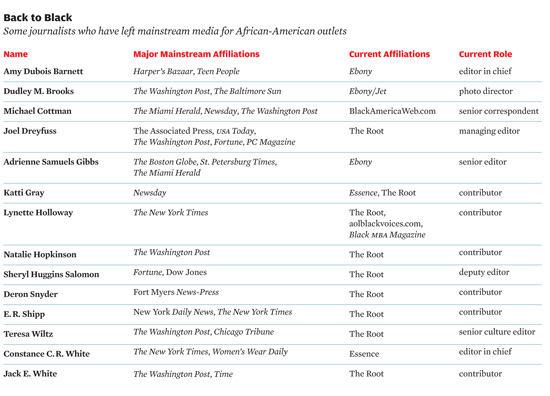
It started as a trickle. Sylvester Monroe resigned in 2006 as Sunday national editor at The Atlanta Journal-Constitution and, two months later, joined the staff of Ebony magazine. In 2008 the renowned byline of Jack E. White, the first black columnist at Time magazine, began to regularly appear on The Root, where Lynette Clemetson, formerly of The New York Times and Newsweek, was managing editor. By March of this year when Constance C. R. White, once an influential New York Times fashion writer, was named editor in chief of Essence, the trickle had swelled into a river of prominent African-American journalists streaming to black-oriented media.
The names of veterans like Lynette Holloway and E. R. Shipp, formerly of The New York Times; Teresa Wiltz, Natalie Hopkinson, and Michael Cottman, all of The Washington Post; Joel Dreyfuss, formerly of Fortune and PC Magazine, and Amy DuBois Barnett of Harper’s Bazaar and Teen People, are turning up in places like Ebony, Jet, and Essence; at BlackAmericaWeb.com, a division of Reach Media, Inc.; and at The Root, the online site spearheaded by Harvard’s Henry Louis Gates Jr. and published by The Washington Post Company.
Some of these moves were prompted by layoffs and buyouts; others by disillusionment with mainstream journalism or a desire to delve more deeply into African-American issues. Whatever the reasons, with increasing frequency, African-American journalists are reversing the once common trajectory from the black press to the mainstream. New ventures like HuffPost Global Black, a vertical for Arianna Huffington’s widely read website that will be launched in partnership with Sheila Johnson, cofounder of Black Entertainment Television, are likely to quicken the pace.
On the one hand, this reverse migration has brought new luster and talent to black-oriented media. On the other, it is further draining mainstream media of diverse perspectives, raising the specter of a retreat to the days of all-but-segregated newsrooms.
Mainstream newsrooms were nearly all white back in 1968, when the National Commission on Civil Disorders famously warned that America was “moving toward two societies, one black, one white, separate and unequal.” The news media, it continued, reflected the biases, paternalism, and indifference of white Americans and treated blacks “as if they don’t read the newspaper, marry, die, and attend PTA meetings.” At the time, African Americans held less than one percent of newsroom jobs.
In the 1960s, as the civil rights movement became a major national story, and as dozens of American inner cities became the sites of urban riots, African-American journalists employed by the black press finally found a door opening to mainstream media. Some of them said they could name the specific riot that resulted in their hiring.
The black press, then, became a casualty of the integration it had long championed. Unable to compete with the extensive coverage provided by television networks and major newspapers, or the higher salaries they provided, its fortunes dwindled. The Chicago Defender’s weekly circulation fell from a high of 257,000 in 1945 to 33,000 by 1970. The Pittsburgh Courier shrunk in the same period from a high of 202,000 to 20,000.
In the years following what came to be known as the Kerner Commission report, African Americans and, later, other members of minority groups, were hired in record numbers, slowly altering the complexion and ideals of American journalism. Among the new hires was Jack White, who left Swarthmore College in 1965 to pursue a journalism career. In 1966 he became a copy boy at The Washington Post. The next year, after covering a riot in Cambridge, Maryland, he was promoted to reporter. In 1972 he joined Time as a staff writer, where he would become Nairobi bureau chief, Midwest bureau chief, deputy chief of correspondents, national correspondent, and, for six years, write his popular “Dividing Line” column. In 1969 Joel Dreyfuss began his career at The Associated Press and went on to the New York Post, The Washington Post, USA Today, Fortune, and PC Magazine, where he was the second-in-line editor. In 2009 he became managing editor of The Root.
Ten years after the Kerner report, the percentage of minorities in mainstream media had increased fourfold, to 3.9 percent, as diversity became an industry buzzword. By 1988, the total number of minority journalists more than doubled, to 3,900, or 7 percent of the newsroom workforce. But newsrooms had trouble stemming a high turnover of journalists of color. In 1985, “The Quiet Crisis: Minority Journalists and Newsroom Opportunity,” a study by the Institute for Journalism Education (later the Maynard Institute for Journalism Education), reported that more than 40 percent of minority group members tracked over a ten-year period expected to leave the industry, largely due to a perceived glass ceiling. A year later, the institute released “Musical Chairs: Minority Hiring in America’s Newsrooms,” which argued that “it is on the battleground of retention that the struggle for full parity” would be won or lost.
 Indeed, a Freedom Forum study in 2000 by Lawrence T. McGill found that while the newspaper industry had hired 550 journalists of color each year since 1994, 400 had annually left the business. More distressing were figures showing that 596 journalists of color came into the industry in the year 2000, but by year’s end 698 had left. A year later, McGill was commissioned by the then-named American Society of Newspaper Editors, or ASNE (now the American Society of News Editors), to investigate the poor retention rate. Why was this happening? His meta-analysis of thirteen studies done between 1989 and 2000 cited a lack of professional opportunities and an absence of career advancement as two of the main reasons.
At the peak, in 2006, African-American journalists held 5.5 percent of newsroom jobs. But between 2001 and 2011, the number of African Americans in mainstream newspaper newsrooms plunged 34 percent, according to ASNE’s 2010 survey. That compares to a 0.9 percent decrease in the number of Asian journalists and a 20.5 and 8.5 percent decline of Native American and Latino journalists, respectively. As of 2010, African Americans, who nationally comprise 15 percent of the US population, hold 4.68 percent of US newspaper newsroom jobs. (The magazine industry does not track minority group employment.) The numbers, said Kathy Times, president of the National Association of Black Journalists, “are devastating.”
In 1978, ASNE pledged that its newsrooms would achieve racial parity by 2000. With just 12.8 percent of newsroom jobs held by all minority group members—who comprise 36 percent of the population—the parity goal has since been pushed back to 2025. “Clearly we have issues,” said Milton Coleman, senior editor of The Washington Post and the immediate past president of ASNE. “A lot of people are no longer excited about what’s happening in the newsroom and left either by choice or by chance. There was the feeling that they were bumping up against glass ceilings, and that the newsrooms they were in were no longer interested in the news they wanted to do. Then on top of it, we have the turn in the news industry.”
Coleman said many African Americans come into journalism driven by a passion to illuminate issues in their communities. And that, he said, explains some of the movement to the black press. “People of a like mind saw they could take the skills that they had picked up in mainstream media and go back to ethnically oriented media and make them better.” For example, he named a half-dozen journalists—including Sylvester Monroe and Newsday’s Mira Lowe; Eric Easter of Washington Post.Newsweek Interactive; Dudley Brooks, of The Baltimore Sun; and Bryan Monroe, an assistant vice president for news at Knight Ridder, who had all been lured to Johnson Publishing Company. “Ebony and Jet improved just like that,” Coleman said.
He added that ASNE—with funding from the McCormick and Ford foundations, and coordinating support from The New York Times, The Associated Press, and unity Journalists of Color—is holding two meetings this year to begin formulating a new case for diversity. The first will be held in June in Orlando during the National Association of Hispanic Journalists convention and the second at The New York Times in September. Coleman argues that the discussion should be framed in such a way that “the news industry understands that as we go forward, the case for diversity is not a social experiment—it’s an industry imperative. As the demography changes, in order to be mainstream you’re going to have to be more diverse. And if you’re not more diverse, someone will take it away from you.”
“Diversity is a part of being accurate in your news coverage,” he said. “If it’s not, people will not read it. We still need diversity because we still need accuracy.”
Kathy Times, of NABJ, said she was taken aback during a recent visit to the Houston Chronicle. She went to the news meeting and “was very disappointed to see not one black editor in that room of about sixteen editors who decide what readers would see.” When asked about her observation, Jeff Cohen, the Chronicle’s editor and executive vice president, said that, depending on the day, there would usually be two to four editors of color at the meeting (three are Hispanic and one is Palestinian). But he acknowledged the problem.
 “We’re not where we want to be today,” Cohen said. “Diversity is extremely important to me, the management of the newspaper, the readers, the community. But for various reasons, the last two years we’ve had a slight decline in the number of minorities in the newsroom.” Cohen pointed out that 23 percent of the members of the paper’s newsroom staff are people of color. (That, he acknowledged, includes the staff of the Spanish-language paper.) He said Houston’s metropolitan area, which includes outlying suburbs, is 35 percent Hispanic, 17 percent African-American, and 7 percent Asian. In the city proper, the last US Census showed that African Americans and Hispanics alone comprise 63 percent of the population.
Given the economy and the dearth of available media jobs, the parity goal seems less achievable than ever. Meanwhile, Times notes that black-oriented media often offer her members the opportunity to report on issues—health disparities between blacks and whites, for example—that are close to the hearts of some black journalists, and issues that often are not explored in depth by the mainstream. African-American outlets frequently don’t have the same level of resources as mainstream outlets, she said, “but the good news is that some of our members are in a position that they can afford to explore those opportunities because they are very passionate about covering the black community. They’re at a point in their careers where they have the luxury.”
Many of these reverse migrants describe a sense of relief about working for African-American media after years in the mainstream. “It was like coming home,” said Michael Cottman, a senior correspondent at BlackAmericaWeb.com, who in 1978 began his career at the Atlanta Daily World, the city’s oldest continuously published black newspaper. In between he worked for The Miami Herald, New York Newsday, and The Washington Post.
Cottman said at mainstream organizations he sometimes felt resistance to story ideas or suspicion about his ability to be objective while covering black-oriented subjects. He said at Reach Media, his professionalism is assumed.
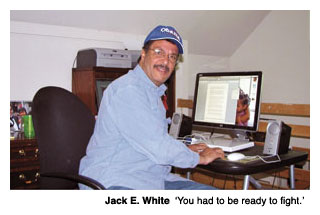
Jack White agreed. “You can presume a commonality of interest of editor and audience. There’s a comfort zone.” At mainstream outlets, he adds, “You had to be ready to fight. My back used to be up a lot. My back hasn’t been up.”
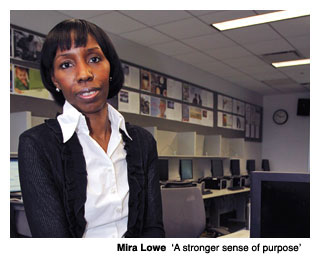
Mira Lowe, like many of these reverse migrants, described feeling a greater sense of purpose when she moved to an African-American outlet. Lowe joined Newsday in 1989, a year after graduating from Columbia’s Graduate School of Journalism, and held a series of copy-desk positions on the features, business, and news desks, and then became the Long Island Life editor at the paper. But in 2007, she jumped at the chance to work for Johnson Publishing, where she was initially hired as assistant managing editor for Ebony and Jet. In 2009, she became editor in chief of Jet, which has a weekly circulation of more than 750,000, according to the Audit Bureau of Circulations. “I had the opportunity to have an imprint on a legacy brand,” she said. “They needed an injection of new ideas, new energy. I felt I could make a difference and give back to publications that have meant a lot to the community.”
Sylvester Monroe, a cum laude graduate of Harvard and an author who, over the course of nearly four decades, has worked as an editor or writer at Newsweek, Time, the San Jose Mercury News, and The Atlanta Journal-Constitution, moved to Ebony in 2006. “There was a time when I never thought I would consider working for Ebony. It was just that that wasn’t what I was interested in. But Time and Newsweek are no longer Time and Newsweek, and newspapers have shrunk. Journalism as we once knew it is gone.”
Monroe said he was disheartened by his experience at The Atlanta Journal-Constitution, where he said editors “now shamelessly say they don’t cover Atlanta unless there’s a compelling reason. They’ve moved to the suburbs. They make no pretense about covering the city.” As other opportunities dwindled, he said, black-oriented media “began to look better and better—and one of the reasons is because they needed help. Not just in terms of bodies, but know-how. I got to use what I know and help improve this magazine I grew up with.”
Joel Dreyfuss said the failure of the mainstream to embrace diverse viewpoints is helping to drive the reverse migration. From 1996 to 1997, he was editor in chief of a weekly black news start-up that, despite support from a business executive named Donald Miller and seed money from Dow Jones, never got off the ground. “I always felt we needed a chance to tell our stories without filters,” said Dreyfuss. “A lot of us are now seeing the possibilities of unfiltered content.”
 But Dreyfuss and others point out that black-oriented media can pose their own set of challenges, including limited resources. Many of the journalists initially recruited from the mainstream by Johnson Publishing beginning in 2006 have since left. Some confided that they were asked to pay their own way on assignments, while others described the shock they felt at having to use outmoded equipment. Lowe said while her salary at Johnson Publishing was competitive with the mainstream, other resources were lacking. (Last August the company appointed Desiree Rogers, the former Obama White House social secretary, to be chief executive and announced a major reorganization.)
Dreyfuss said while editors at The Root receive full-time salaries, most of the writers are freelancers, so they do not have the benefits offered in mainstream journalism. And Jack White said that there are fewer opportunities to do original reporting. “I wish that something like The Root had had the money to cover the Obama campaign the way I covered the Jesse Jackson campaign,” he said. “The big weakness is they can’t pay for reporting. We’re recycling in a lot of cases. There’s something reductive.”
He and others stressed that this is among the many reasons why diversity in the mainstream still matters. Otherwise, “We go right back to where we started after the Kerner Commission,” White said, referring to the 1968 National Advisory Commission report.
Yet Coleman points out that while resources are more plentiful in mainstream media, they have little value if you can’t use them to pursue what you think is important. “What good does it do you to be in a newsroom with a lot of resources if you can’t do what you’re there to do?”
Has America ever needed a media defender more than now? Help us by joining CJR today.