Sign up for the daily CJR newsletter.
At 4:21am on Saturday, Donald Trump posted on Truth Social, his social media platform, that the United States military had “successfully carried out a large scale strike against Venezuela,” capturing its president, Nicolás Maduro, and his wife, Cilia Flores. Shortly before appearing at a press conference from his home in Palm Beach, Florida, Trump posted again, first a video—of helicopters flying over Caracas as fire ignited the sky, missiles fell, and black smoke rose—to the soundtrack of Creedence Clearwater Revival’s “Fortunate Son,” an anthem of the anti–Vietnam War movement. Then Trump posted a photo he said was of Maduro on board the USS Iwo Jima, which reporters rushed to verify; Maduro appeared to be wearing a gray Nike tracksuit, a blindfold, and shackles.
It was shocking, if not surprising, news. For years, Trump had expressed his wish to see Maduro removed from power. Over the past several months, he and Pete Hegseth—the secretary of defense, or war, depending on your preference—have attacked at least thirty alleged “narco-boats” in the region, killing more than a hundred people. At the press conference, held at 11am on Saturday, Trump called Maduro an “illegitimate dictator” who was “the kingpin of a vast criminal network.” Since becoming president, in 2013, Maduro had, in fact, overseen repression of Venezuelan democracy—including the independent press, continuing a policy of “communication hegemony” established by Hugo Chávez, his predecessor. According to Reporters Without Borders, “the government’s monopoly on the importation of newsprint and printing supplies resulted in the disappearance of the print editions of about a hundred newspapers,” and journalists in the country have often been “beaten or threatened in the course of their work.”
An indictment unsealed by the US District Court for the Southern District of New York showed that Maduro now faces narco-terrorism conspiracy, cocaine importation conspiracy, and weapons charges. At the presser, Trump said that “we are going to run the country until such time as we can do a safe, proper, and judicious transition.” But when asked by reporters what this would actually mean for Venezuela—American troops on the ground? Government functions being taken over by Hegseth and Marco Rubio, the secretary of state? Was this the US again deposing a leader without a day-after plan?—Trump responded with foggy answers. The series of events, leading up to Maduro’s filmed perp walk, upon his arrival at a detention center in Brooklyn, seemed to make this much clear: America’s stunning foreign intervention was about spectacle, not detail.
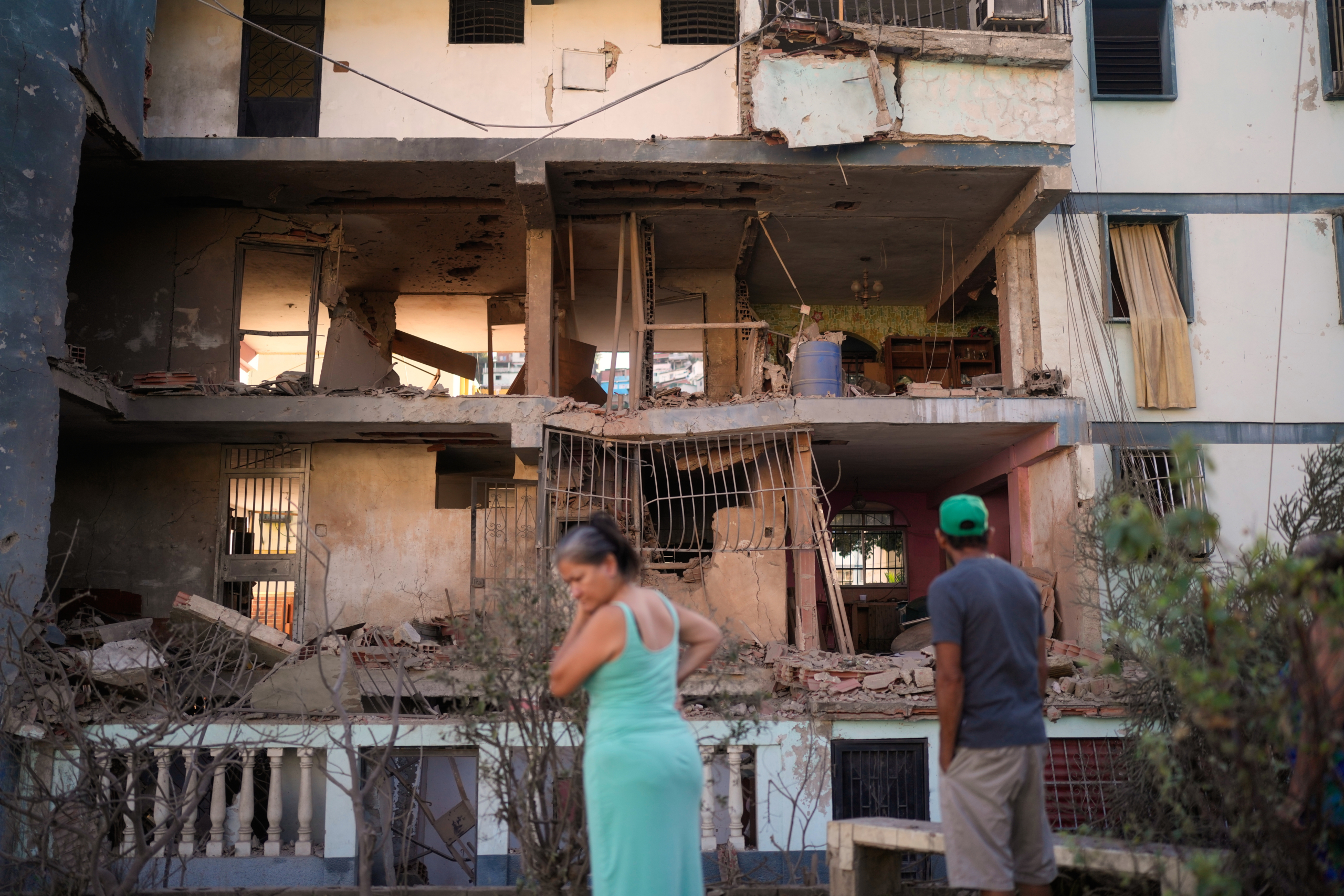
Journalists in Venezuela scrambled to assess the damage from the attack, which began around 2am local time and struck three states in the northern part of the country. The targets appeared to be related to military and aviation sites, but also resulted in multiple civilian casualties. One air strike hit a three-story apartment complex in Catia La Mar, west of one of the airports near Caracas, killing an eighty-year-old woman named Rosa González, the New York Times reported, and seriously wounding a second person. In photos from Catia La Mar, it looked like the building’s facade had been torn away like an orange peel, exposing living rooms that were half-wrecked and covered with dust. One apartment featured a portrait of Simón Bolívar, a Venezuelan and icon of South American independence, seemingly pockmarked with shrapnel. At least forty people were killed by the US military—including military and civilian deaths—the Times said, citing an anonymous senior Venezuelan official. None of these casualties were mentioned by Trump, Rubio, Hegseth, or others at Mar-a-Lago on Saturday. “What all of us witnessed last night,” Hegseth told reporters, was the “sheer guts and grit, gallantry and glory of the American warrior.”
Around the world, however, observers—not least many American lawmakers—raised a key objection: it is Congress, not the president, that the US Constitution endows with the sole power to declare war. Rand Paul, a Republican, who serves as the chairman of the Senate Homeland Security Committee, wrote on social media that, though few will mourn Maduro’s fall, it shouldn’t be forgotten “that our founders limited the executive’s power to go to war without Congressional authorization for a reason—to limit the horror of war and limit war to acts of defense.” (Many other Republicans in Congress cheered the actions.) Elsewhere, the office of António Guterres, the United Nations secretary-general, said he was “deeply alarmed” by the operation, and ministers for several US allies, including Canada, Norway, Mexico, and Spain, expressed concern about whether it breached international law.
The attack added another layer of complication for journalism: according to a bombshell report from Semafor’s Max Tani and Shelby Talcott, the New York Times and Washington Post had learned of the mission shortly before it started, and held off publishing what they knew until after the fact. Citing two anonymous sources, Semafor found that, in light of warnings from the administration, the Times and Post justified suppressing their coverage “to avoid endangering US troops.” The decision, Semafor wrote, reflected “the time-honored deference that some major news outlets afford the White House regarding secretive US military operations.”
That deference reignites a long-running ethical argument over whether it’s right for news publishers to keep the secrets of nations as they wage war. Often, this dispute raises a supposed decision by the Times, in 1961, to hold back its reporting ahead of the calamitous Bay of Pigs invasion, which critics argue could have prevented hundreds of casualties. (The veracity of the Bay of Pigs media myth, however, has been unpicked.) In the immediate aftermath of the Semafor story, there were some predictable reactions—praise for the papers from Trump supporters; condemnation from others for coverage that all too closely hewed to the administration’s interests. What jumped out to me was that the decision to hold the news of the attack was paired with prominently featured coverage from both the Times and Post on the thorny question of illegality. (The Times editorial board, separate from its newsroom, made a strong argument that Trump’s attack was “illegal and unwise.”)
So that’s one uncomfortable question for the Times and Post decision-makers: If journalists knew about an operation potentially violating US and international law ahead of time, what exactly was the evaluation process that stopped it being reported? Viewing the choice with a charitable eye, one might say that we currently know nothing of the context and details of the decision; the mission may have been de facto underway, and going public could have spilled far more blood. (CJR contacted the newspapers for comment but did not hear back; spokespeople for the White House, the Pentagon, and the Post declined to comment to Semafor, and a Times spokesperson didn’t provide them a response.) To take a less charitable view, one could pose the question: Did the Times and Post enable the Trump administration to undertake an illegal military attack that deposed Venezuela’s president and attempted to seize control of the country? I hope the answers to these questions, and many others, emerge from the fog of war in the days and weeks ahead.
For newsrooms, this story is a woolen sweater: there are thousands of threads to pull on. So far, I have largely found the media’s coverage to be quality and informative. The use of live blogs by many outlets was a success in helping them pull on many threads at once. Reporters chased down the question of legality. They pored over the new criminal indictment against Maduro and Flores, poking holes in the administration’s drug-smuggling narrative (and noting the hypocrisy of the recent pardon of Juan Orlando Hernández, a convicted narcotics trafficker). Journalists analyzed the brazen role of oil-drilling in seeming to motivate the administration. They asked how we got here, what happens next, and what it all means for Trump’s relationship to his MAGA base.
But one thing that irked me was that media outlets placed such prominent emphasis on the beat-by-beat specifics of Operation Absolute Resolve (making the front pages of the Times, the Post, and the New York Post). This military-gazing seemed to come, disappointingly, at the expense of attention to the humanitarian cost of the attack—the at least forty people who had their lives cut short. This brought to my mind a passage from Allan Nairn’s March 1990 piece for The New Yorker, published after the US invaded Panama and ousted its leader, Manuel Noriega. “When the United States wants to justify intervention in Central American countries or assert that they constitute a threat, politicians and news commentators often refer to them as ‘our back yard,’” Nairn wrote. “Yet all too often when we cover the suffering of people in these countries we treat them as if they were faraway and obscure places with which we have little to do.”
Other Notable Stories…
- In CJR’s final Monday newsletter before the holidays, we wrote about how Baris Weiss, the editor in chief of CBS News, had sparked internal fury after abruptly pulling a report on CECOT, the Salvadoran megaprison where the Trump administration deported more than two hundred and fifty Venezuelan migrants last year, three hours before broadcast. According to leaked internal emails, Weiss told producers that the segment needed further reporting and to feature a voice from the Trump administration; 60 Minutes correspondent Sharyn Alfonsi told colleagues the decision was political, not editorial, and that they were handing the administration a “kill switch.” Since then the saga has rumbled on. The segment—which had already been sent to a Canadian TV station—was widely shared online, despite attempts from Paramount, CBS’s parent, to suppress it. In other news, last week Tony Dokoupil began his role as CBS Evening News anchor. He criticized media colleagues for relying too much on subject matter experts. The Daily Beast said Dokoupil appeared “MAGA-coded.”
- Zohran Mamdani was sworn in as New York City mayor on January 1. “Now comes the hard part,” read the December 29 New York Magazine cover, with a photo of Mamdani surrounded by his aides. The photo of Mamdani and his “brain trust” was shot on December 17 by celebrity portrait photographer Mark Seliger, but before publication, one senior adviser, Catherine Almonte Da Costa, resigned following the revelation of past anti-Semitic posts. That led New York to edit her out of the image, spotted by the New York Times. “Most news organizations, including the New York Times, have guidelines that forbid digitally altering photography to remove people from pictures,” the report said. The magazine, though, defended erasing Da Costa. The image “was meant to represent the mayor-elect’s inner circle for the new administration,” so it would have been inappropriate to include her, a spokesperson told the Times.
- On December 23, the US State Department barred five Europeans from the country, accusing them of leading efforts to pressure tech firms “to censor, demonetize, and suppress American viewpoints they oppose.” One of those people was Imran Ahmed, forty-six, chief executive of the Center for Countering Digital Hate—which produces research on disinformation—who is a permanent US resident and lives in DC. (I interviewed Ahmed for CJR in 2023, when Elon Musk was trying to sue him for his organization’s research.) Ahmed responded by filing a complaint, alleging that his arrest and deportation would be unconstitutional, and on December 25 a US judge temporarily blocked the Trump administration from detaining him. “We do vital research that shows the potential harms of online platforms, and we know that that puts the noses out of joint for some very powerful people,” Ahmed told AFP last week.
- Reuters is reporting this morning that Uganda’s government has banned “live broadcasting or streaming of riots, unlawful processions, or violent incidents” ahead of an election, on January 15, in which President Yoweri Museveni seeks to extend his forty-year rule. (The Ugandan government often describes anti-government protests as “riots.”) Amnesty International said on Monday that Ugandan authorities were engaging in a “brutal campaign of repression,” including arbitrary arrests and torture. Uganda has slipped rapidly in Reporters Without Borders’ World Press Freedom Index recently, with the organization saying journalists “face intimidation and violence on a nearly daily basis.”
- On December 22, John Carreyrou, a New York Times investigative reporter, whose journalism for the Wall Street Journal exposed fraud at the blood diagnostics startup Theranos, brought a lawsuit against six AI companies as part of a group of writers. The lawsuit accuses Anthropic, Google, OpenAI, Meta, xAI, and Perplexity of training their models on online pirated books. The authors allege the companies engaged in a “deliberate act of theft,” saying their work “now anchor[s] multibillion-dollar product ecosystems” despite their not receiving compensation.
- And Tatiana Schlossberg, an environmental journalist who covered science and climate change at the Times, and who was the granddaughter of president John F. Kennedy, died last Tuesday from a rare and aggressive blood cancer. She was thirty-five. In 2019, she published a book, Inconspicuous Consumption: The Environmental Impact You Don’t Know You Have, which won the Rachel Carson Environment Book Award. In November, Schlossberg wrote an arresting essay for The New Yorker—“A Battle with My Blood”—exploring her struggle with cancer, its impact on memory, and the damage being done by the drastic cuts to medical and scientific research demanded by the US health secretary, Robert F. Kennedy Jr., her cousin. According to the Times, Schlossberg’s essay landed in the inbox of David Remnick, The New Yorker’s editor, unassigned but nearly perfectly realized. “It was so loving and generous that obviously it was a privilege to publish it,” Remnick said. “It just had so much heart and intelligence and honesty.”
Has America ever needed a media defender more than now? Help us by joining CJR today.