Sign up for the daily CJR newsletter.
A Bomb in Every Issue: How the Short, Unruly Life of Ramparts Magazine Changed America | By Peter Richardson | The New Press | 272 pages, $25.95
It only took a few years for Ramparts to evolve from an earnest Catholic lay magazine published in the suburbs of San Mateo County to a high-spending, scoop-breaking, muckraking journal whose San Francisco offices were graced by shotgun-wielding Black Panthers and a masturbating pet monkey. This was a frantic transformation, yet still a familiar one. It did, after all, take place in the Sixties on the left coast. And Peter Richardson lays it out in a straightforward fashion in his new chronicle of the magazine, A Bomb In Every Issue.
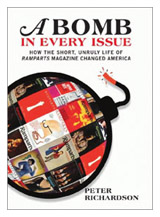 Of course, the very existence of this book is something of an anomaly. In general, magazines don’t get much of an afterlife. It’s hard to argue that even the most celebrated among them—The Saturday Evening Post, say, or if you’re less of an oldster, Spy—are anything other than obscure.
If Ramparts is remembered today, it is less for its groundbreaking reportage than for its role as progressive journalism’s finishing school. Mother Jones was launched by a group of Ramparts refugees, including Adam Hochschild, in 1976. Rolling Stone founder Jann Wenner worked on a Sunday newsprint spin-off, and freely admits to having lifted design elements from that short-lived venture. (Warren Hinckle, who edited Ramparts at the time, didn’t have much regard for this particular progeny. He later described Wenner as a “fat and pudgy kid” whose magazine was one of “the leading merchandisers of … counterculture bullshit.”)
Mother Jones (where, it should be disclosed, I once worked) is still going strong. Its proprietors have managed to smooth the manic peaks of the Ramparts formula for the last three decades: left-looking investigative journalism married to glossy art, a relatively hefty subscription base, and more than a little help from a wealthy circle of advisors-cum-donors. There have, of course, been some tweaks. Mother Jones is a nonprofit by design, not by accident. And the earlier magazine’s expense-account culture, which irrigated its staff and hangers-on with enough screwdrivers to float a new Algonquin roundtable, is unknown at Mother Jones—or almost anywhere else in the industry these days.
But let’s get back to those manic peaks. Richardson’s title is drawn from the headline of a 1967 Time article that took issue with a Ramparts investigation. A “bomb” was the magazine’s lingo for a big story. But Time was certainly comfortable with the double (or triple) entendre, warning that “Ramparts is slick enough to lure the unwary and bedazzled reader into accepting flimflam as fact.”
The supposed flimflam was the magazine’s expose of an obscure think tank run out of Michigan State. According to the article, the organization had played a role in supporting the South Vietnamese government, helping to train security forces and write the country’s constitution.
Time asserted that the article’s salient facts weren’t much of a scoop, having already appeared in books. (Frustratingly, Richardson fails to address this charge.) In any case, this shot across the bow was enough to draw the attention of the CIA, whose director illegally ordered his agents to work up a file on Ramparts.
Such a file, if it had been broadly researched and updated throughout the magazine’s 13-year run, would include an astonishing roll call, with contributions of one kind or another from Jessica Mitford, Seymour Hersh, Todd Gitlin, Hunter S. Thompson, Christopher Hitchens, Thomas Merton, James Ridgeway, Daniel Zwerdling, Marty Peretz, David Horowitz, and I.F. Stone. Oddly rounding out the bunch is Brit Hume, who briefly worked for the magazine in Washington before beginning his television career.
In a way, Ramparts returned the CIA’s favor. Over the years, it revealed that a wide range of liberal and centrist institutions—the National Student Association and The New Leader among them—had been on the agency’s cold war payroll.
Vietnam, however, was the magazine’s principal obsession. Richardson makes an airtight case that a graphic photo spread of maimed Vietnamese children (with text by lefty baby doc Benjamin Spock) sparked Martin Luther King’s decision to speak out against the war. One famous cover showed four senior staffers’ draft cards ablaze, and brought a measure of legal trouble. Another ran the line Alienation is when your country is at war and you want the other side to win over a photo of the art director’s ruddy-cheeked son holding a Vietcong flag.
Much of this was the work of Robert Scheer, still trucking today at truthdig.com, who was brought in as an editor after bellowing his southeast Asia expertise through many a Berkeley bullhorn. Hinckle took him on despite a warning from Edward Keating, the magazine’s original founder, funder and editor. “Never hire anyone smarter than you,” Keating told him. “They’ll try and take over.”
It was an apt bit of advice, reflecting the vigorous paranoia of Ramparts office politics. Eventually, Scheer did take over—but not before Hinckle forced Keating out.
Unfortunately for both Richardson and his readers, Ramparts burned bright and fast. Its later years were hampered by New Left factionalism, soggy thinking, and a decline in outside support. The magazine’s staff was decimated, the publication schedule trimmed, and the glossy paper gave way to newsprint.
This decline and fall is given full attention. But it’s not an interesting death, and readers are unlikely to feel a great loss as the indignities mount. It doesn’t help that one of the key players in the final era is Horowitz, a figure whose current work and political views couldn’t be more sharply divergent from the magazine’s original inspiration. To describe the later years, Richardson draws heavily on Horowitz’s autobiography, Radical Son, and this bildungsroman of disenchantment imparts an unwelcome psychoanalytic flavor to the mix.
Richardson, whose last book was a biography of Californian and Nation editor Carey McWilliams, gained access to unpublished documents, letters, and manuscripts. He also provides an index of the fifty-plus interviews he conducted while researching the book. (Hume, unfortunately, isn’t among them.) Still, many of his most colorful anecdotes are warmed over from first-person written accounts by Horowitz and Hinckle.
In the latter case, this seems like an especially risky decision. Hinckle’s irreverent 1976 autobiography bears rollicking traces of the flavorful-but-less-that-factual style of Hunter S. Thompson. (That’s not surprising, since Hinckle’s ephemeral Ramparts follow-up, Scanlan’s Monthly, helped lauched “gonzo” journalism in 1970 by publishing Thompson’s “The Kentucky Derby is Decadent and Depraved.”)
Spy magazine, also famous for the careers it nurtured, was thought worthy of a postmortem anthology in 2006. Richardson’s history reminds us that a similar collection of Ramparts highlights is long overdue. Should that day come, this book will be ready for those wanting a paint-by-numbers peek at the madcap personalities behind the work. But readers will find the real fire in the pages of Ramparts.
Click here for a complete Page Views archive.
CORRECTION (11/13): The review originally and incorrectly said that Hinckle was forced out by Scheer. The text has been changed.
Has America ever needed a media defender more than now? Help us by joining CJR today.