Sign up for the daily CJR newsletter.
A year ago this week, about 200 now-former employees of the New Orleans Times-Picayune, including almost half the newsroom, learned they would lose their jobs and that their newspaper–175 years old, but still lively, potent, and deeply interwoven into the life of a great American city–would be seriously diminished.
Although The New York Times had weeks earlier broken in broad-brush strokes news of the coming restructuring, the axe finally fell on June, 12, 2012. Throughout the day, employees left distressingly brief meetings in which they learned their individual professional fates and faced throngs of anxious colleagues. Most signaled the outcome of those meeting with either a “thumbs-up” gesture or a slash across the throat. As veteran religion reporter Bruce Nolan later recounted to CJR’s Ryan Chittum, “I came out, and I walked through a corridor and into the newsroom, where everyone is standing around. It’s a death march. Every face turns to me, and I draw my finger across my throat. It was stunning.” Scores then logged on to a private Facebook page created for current and former employees and supporters, and typed the symbol reporters historically used to signal to editors that the story had come to an end: -30-.
I was a Times-Picayune reporter from 1988-1994 and am now writing a book about the ultimately failed grassroots battle to save the daily newspaper and the dynamics in the newspaper industry that served as a backdrop to the radical plan implemented by the paper’s owner, Advance Publications, which is closely held by New York’s Newhouse family. As part of the research for the book, I hired Carey Stapleton, a doctoral candidate at the University of New Orleans, who also works for the UNO Survey Research Center, to help me conduct a survey of current and former employees of NOLA Media Group (the corporate entity that succeeded the now-dissolved parent of the Times-Picayune).
We’re making the survey public today:
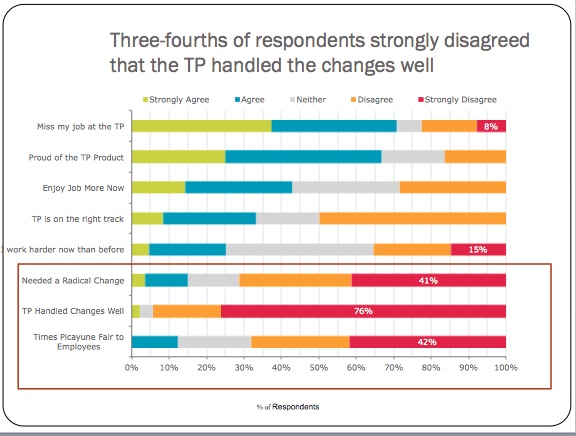
The online poll was administered May 18-28. I issued invitations to take it through a private Facebook page and a confidential email I sent to roughly 100 former and current employees whom I either know personally or who had received assistance through dashTHIRTYdash, the fund I helped establish to assist those who lost their jobs.
The survey is not scientific but does comprise a representative sample of the Times-Picayune workforce before the restructuring. Ultimately, 126 people took the survey, 101 former and 25 current employees, out of roughly 600 employed by the company at the time of the changes. Because of the way the data was collected, the survey should be seen as a snapshot of the thoughts and feelings of self-selected current and former employees. Still, the findings give sense of the profound sense of betrayal felt by members of the Times-Picayune community toward the company’s hierarchy.
NOLA Media Group President Ricky Mathews and Vice President of Content Jim Amoss have not responded to requests for interviews for my book, and did not respond to an email request Wednesday for an interview or comment for this report.
Among the survey’s findings:
—Almost no one thought the changes had been handled well. Among current employees, 85 percent disagreed with the statement that the company had done a good job handling the changes and among former employees, disagreement was virtually unanimous. As one respondent wrote: “The way the layoffs were handled was a huge lesson in what NOT to do.” Another said: “As the end drew near, as I showed up for work for more than three months knowing I had no future there, I had to accept that I had been deleted and there was no ‘undo’ key.”
—Even employees who stayed believed the changes were driven by greed on the part of the Newhouse family; few believed the newspaper’s financial performance warranted such wrenching changes. “Unlike the first and second generations of Newhouses, the third generation has no interest at all in working for their money,” one respondent wrote. “They want to squeeze every little dime they can from the business and take the money and run.” Another respondent who had left the company and has landed a new job wrote, “I am blessed to no longer be associated with the Times-Picayune. I can’t fathom knowingly putting my talents, time and energy into a company that totally abandons its purpose to serve the public and allows GREED to be its compass. Agreed, it is a business, but it was one with a higher moral responsibility to the community. If money were the ONLY factor, the owners should never have gotten into the business of providing such an important public service. There are plenty of other ways to make money.”
—Of those who had left the newspaper, fewer than half have found full-time jobs: Of those who have not yet found full-time jobs, almost 70 percent continue to look for work, and one-third are supplementing whatever income they now have by freelancing. In comments, some described financial hardship: “I had to sell the home I loved in order to survive,” one respondent wrote. “I have applied for dozens of jobs and rarely get even verification that my resume was received. I have had several interviews, but in most cases, I am either over- or under-qualified. I feel lonely and hopeless most of the time and would rather be dead if I didn’t have the few responsibilities I do have.” Another wrote, “It has been a very difficult time, financially and emotionally. It has been very hard to move forward in finding another job, and feeling good about myself as a person.”
—Of those who have found full-time jobs, about half still work in the news business. Editorial employees have had the most success finding jobs among all of the newspaper’s departments. About two-thirds of editorial employees who responded have found new jobs.
—Only 29 percent of respondents 50 and older have secured new employment, compared with 58 percent of those under 50. Open-ended comments provided by older employees who lost their jobs indicated that they felt their age was a determining factor in getting laid off. “I truly believe my age and income were major factors in being replaced with a 28 year old,” one former employee who had just turned 50 wrote.
—About two-thirds of respondents who found new full-time work earn less than they did at the Times-Picayune. “My life, career-wise, is worse,” one wrote. “I make about half what I made at the Times-Picayune, which is stressful for my family. I was forced to find a less-expensive school for my children because of the salary cut. My current job is much less stressful and more nine-to-five than the Times-Picayune, but there are none of the rewards of working in daily journalism.”
—Most respondents left the newspaper involuntarily, but 27 percent departed of their own accord. The most-cited reasons for choosing to leave were the way the changes were handled or the feeling that the work environment was no longer pleasurable.
Although many of the stories were grim, some respondents have found happiness post-Times-Picayune. “I am extremely happy in my new job and life and often wonder why I didn’t leave sooner,” one former employee wrote. “I am working at a place where my skills are appreciated and admired–something I rarely felt at The T-P.”
That happy ending aside, the survey makes clear that scores of former Times-Picayune employees remain jobless, and severance payments to most formerly veteran employees have either ended or are close to running out. If you’d like to commemorate this sad anniversary by helping those still looking for work, dashTHIRTYdash continues to accept donations. In addition, one-half of my book’s post-expense proceeds will go to the fund.
-30-
Has America ever needed a media defender more than now? Help us by joining CJR today.