The New York Times continues its excellent series on The New Poor with a look at Memphis, and the socioeconomic damage wrought by the mortgage crisis.
These are hard stories for the business press to tell well. As we’ve said before, they demand creativity and persistence.
The NYT’s Michael Powell has done well on this beat before, including a piece a year ago, with Janet Roberts, about how black and Latino homeowners were hit especially hard when the foreclosure crisis hit New York. The Journal delivered a memorable story a few years ago, about how the subprime mess was battering Detroit’s middle class.
These stories are out there, afflicting whole communities and entire classes—especially low-income strivers who had made it up the first rung of the economic ladder. And, as the Times shows, they’re very much worth telling.
Powell’s latest piece has plenty of good on-the-ground reporting, lots of data, and disturbing details about lawsuits around the country against big mortgage lenders that the business press should be tracking carefully. But the story’s biggest strength is the way it pushes past the now-routine stats about foreclosure rates and unemployment trends to get to an under-told story of the crisis:
Not so long ago, Memphis, a city where a majority of the residents are black, was a symbol of a South where racial history no longer tightly constrained the choices of a rising black working and middle class. Now this city epitomizes something more grim: How rising unemployment and growing foreclosures in the recession have combined to destroy black wealth and income and erase two decades of slow progress.
The Times looks at several strands of the story. With the help of the sociology department at Queens College, it reports that the median income of black homeowners in the city was rising steadily until five or six years ago. “Now it has receded to a level below that of 1990—and roughly half that of white Memphis homeowners.”
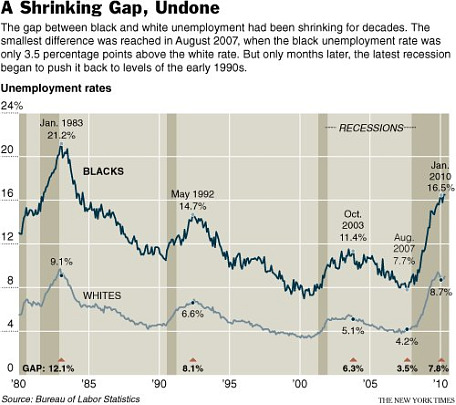
The unemployment front is bad, too, and what’s happening in Memphis mirrors what’s going on in the rest of the country. It’s not just that the unemployment rate among blacks is higher than that among whites. It’s that the gap between black and white unemployment had been shrinking, only to shoot up again with the recession. This chart tells that bit of the story:
But the Times also looks forward, connecting what’s happening now with prospects for the future by looking at the “the steadily widening gap between the wealth of black and white families.” These are numbers we don’t see a lot, and they’re jarring. The Times points to a recent Fed study, which found that, “for every dollar of wealth owned by a white family, a black or Latino family owns just 16 cents.” But it’s worse than that:
The Economic Policy Institute’s forthcoming “The State of Working America” analyzed the recession-driven drop in wealth. As of December 2009, median white wealth dipped 34 percent, to $94,600; median black wealth dropped 77 percent, to $2,100. So the chasm widens, and Memphis is left to deal with the consequences.
That’s awful, but important, and the Times does a great job of explaining why:
Blacks only recently began to close the home ownership gap with whites, and thus accumulate wealth — progress that now is being erased. In practical terms, this means black families have less money to pay for college tuition, invest in businesses or sustain them through hard times.
“We’re wiping out whatever wealth blacks have accumulated — it assures racial economic inequality for the next generation,” said Thomas M. Shapiro, director of the Institute on Assets and Social Policy at Brandeis University.
Yes, he said, “the next generation.”
There are other strong elements to the piece, including excellent, on-the-ground reporting that captures the mood of Memphis, and a powerful slideshow online.
There’s also good reporting on allegations that Wells Fargo and other large national banks “singled out blacks in Memphis to sell them risky high-cost mortgages and consumer loans.”

Alternate headline:WORLD ENDS TOMMOROW: WOMEN AND MINORITIES HARDEST HIT
Seriously though, the policy of giving every minority “low-income striver” who qualified for an FHA loan, in retrospect, did nothing to advance wealth accumulation amongst minorities and when all is said and done, will probable do more to keep them poor.
But of course when some members of congress and the prior administration were arguing this half a decade ago, the congressional representation of minority communities played the race card 9shocking .. I know) screaming that whitey was trying to press even hard on the throats of downtrodden black folk.
#1 Posted by Mike H, CJR on Tue 1 Jun 2010 at 03:10 PM
Wrong again.
Many of the low income minorities were not given prime "FHA" loans. They were given subprime loans from mortgage companies like Countrywide and WaMu that were arranged by mortgage brokers who were incentivized to lie and falsify forms so that they could book their risky sales and the higher bonuses that came with them.
Read the articles from the time:
http://www.usatoday.com/money/perfi/housing/2004-12-07-subprime-day-2-usat_x.htm
"Subprime lending — higher-interest loans to consumers with impaired or non-existent credit histories — has been the fastest-growing part of the mortgage industry.
Subprime mortgage activity grew an average 25% a year from 1994 to 2003, outpacing the rate of growth for prime mortgages. The industry accounted for about $330 billion, or 9%, of U.S. mortgages in 2003, up from $35 billion a decade earlier.
The growth has attracted accolades and controversy. Federal Reserve Governor Edward Gramlich has said subprime lenders helped push homeownership to record levels, making it possible for a growing number of minorities to buy homes. But he also raises questions about high delinquency rates.
And dozens of states have passed laws since 1999 to crack down on predatory lending — loans with high fees, excessive interest or other unaffordable provisions — clustered in the subprime sector."
Gramlich btw was the guy who warned Greenspan about fraud and the bubble in 2004ish and Greenspan pooh pooh the idea because "he had a fundamental flaw in his conceptual framework"
And you got Freddy and Fanny wrong too. Their only problem in 2006 was that politically motivated persecution forced them to cede market share to the Mortgage Backed Security lenders.
in 2007, when subprime started hitting the rocks, Bush let the FHA loose to rebuild their lost market share at the worst time,
An article from the time:
http://www.bloomberg.com/apps/news?pid=20601103&sid=axfeEvVeLwww&refer=news
The video link you cited is footage from 2004ish. 2006-07ish is when the FHA took a plunge into the market.
I hate to be harsh, but you don't know what you're talking about again.
#2 Posted by Thimbles, CJR on Wed 2 Jun 2010 at 07:52 AM
And you got Freddy and Fanny wrong too. Their only problem in 2006 was that politically motivated persecution forced them to cede market share to the Mortgage Backed Security lenders
A “politically motivated persecution”? Is that what you call Franklin Raines’s decision to hire Arthur Andersen (yeah, that Arthur Andersen) to cook Freddie and Fannies books making appear more profitable than they were and enrich himself with larger bonuses based on these phantom profits? You know, the one that landed Raines and the rest of the board in a civil suit with the Office of Federal Housing Enterprise Oversight resulting in their forking over millions to the OFHEO.
A witch hunt to be sure, just like poor Jeffrey Skilling and Mike Milken.
Anhoo … subprime lending increased because of implicit and later explicit guarantees of government support. It’s true that Fannie/Freddie never directly loaned money to subprime borrowers but they subsidized them and incentivized the banks by buying them or selling default insurance to these institutions.
http://online.wsj.com/article/SB122212948811465427.html?mod=googlenews_wsj
I realize its not the Utne reader or Zmagazine.
#3 Posted by Mike H, CJR on Wed 2 Jun 2010 at 01:46 PM
"A “politically motivated persecution”"
Yes. The Bush Administration picked and chose who to prosecute and who to let free. They prevented states from regulating the banking industry by declaring federal jurisdiction over multi-state banks, to prevent state regulators from taking action, and then did nothing as the banks burned the real estate market down. They raised the leverage limits for the biggest banks, in return for more SEC review, and then appointed the freemarketer Christopher Cox to head the SEC, insuring no stringent review would be done.
They didn't care about injustice and corruption unless it was Freddy Mac and Fanny may..
But yeah, your article is wrong too, and exactly what I expect from two AEI "scholars" .
Here's one from a cjr scholar:
http://www.cjr.org/the_audit/wall_street_sank_freddie_and_f.php
More in a second
#4 Posted by Thimbles, CJR on Wed 2 Jun 2010 at 02:55 PM
The problem was Wall Street. The problem was fraud.
http://online.wsj.com/article/SB119662974358911035.html
The problem was people like countrywide were freezing out FHA loans because their standards were too high and their profit margins were too low.
http://www.nytimes.com/2007/08/26/business/yourmoney/26country.html?pagewanted=4&_r=1
"According to the former sales representative, Countrywide’s big subprime unit also avoided offering borrowers Federal Housing Administration loans, which are backed by the United States government and are less risky. But these loans, well suited to low-income or first-time home buyers, do not generate the high fees that Countrywide encouraged its sales force to pursue.
The monthly payment on the F.H.A. loan would have been $1,829, while Countrywide’s subprime loan generated a $2,387 monthly payment. That amounts to a difference of $558 a month, or $6,696 a year — no small sum for a low-income homeowner."
#5 Posted by Thimbles, CJR on Wed 2 Jun 2010 at 03:03 PM
In depth reporting? The whole misses the whole point. This wasn't a story about class or race. It's about education. To rehash some points I made to Powell:
Should legal documents be simpler? Sure, but good luck when lawyers run every legislature.
If Mr. Banks was indeed misled and neither of us really knows, then I feel bad for him. Are you arguing that he and many others are incapable of contracts? Then he can't be responsible for pretty much anything -- buying a car, getting credit, signing a lease, etc. Or, like all the rest of us, he has legal recourse if he was lied to or defrauded. However, the nature of real estate law is such that it is what you sign that matters, not what you think is in there.
It's not just a matter of more education helping. The dividing line here is not race or class. It is education.
Unemployment now is 14.7 percent for less than a high school diploma. With one, that number drops to 10.6 percent. Go to college at all and your percentage drops to 8.3 percent, a full 1.6 percent less than the national average. Graduate and unemployment is 4.9 percent, nearly one third what it is without a high school diploma.
It's education.
#6 Posted by Dan Gainor, CJR on Wed 2 Jun 2010 at 04:07 PM
Here's the thing though Dan. The whole reason why we have a professional financial class is because the language of contract is complex, though the implications may be simple. It's the same reason we have tax account professionals. The complexity of the tax code is not an excuse for not being responsible for paying taxes.
What has happened over the last 30 years is that the financial class has "innovated" - in reality made products even more complex - to the extent that a professional financial class is not only a luxury, it's a necessity. Therefore, in order to get credit, people hired mortgage brokers who were supposed to work for their interest.
They didn't. They prioritized speed of approval and the extra bonus for ARM's (paid by the investment bank) over price and the customer's literal interest.
Now there are two solutions to this problem, regulating the the behavior of the professionals (which is problematic because professionals tend to be slippery, but it's better than nothing) or regulating the nature of the products. That's what Elizabeth Warren was pushing for, a vanilla product with simple terms that the consumer doesn't require a lawyer, a broker, and a latin dictionary to interpret. By offering a very simple choice to the public, the need of a rent charging professional class is reduced.
This is why the lobbyists are rabid in opposition to a financial consumer products agency or vanilla products. They enjoy the privilege of fleecing the public, regardless of education, especially when it's affluent minorities who struggle with credit approval in the best of times and are vulnerable to offers of immediate credit with no hurdles for a price.
#7 Posted by Thimbles, CJR on Thu 3 Jun 2010 at 02:23 AM
Mike H you must be lonely to be ranting here. Suggestion - turn on Fox News and you can have a huge chorus of pundits/talking-heads ranting along in unison with you.
#8 Posted by F. Murray Rumpelstiltskin, CJR on Thu 3 Jun 2010 at 12:35 PM
Thimbles
If you can't read a contract or understand it, do NOT sign it. Ever.
#9 Posted by Dan Gainor, CJR on Thu 3 Jun 2010 at 03:08 PM
@dan - Good point, but it would be nice to have the choice of signing one. That choice increasingly isn't available.
And in other news, Krugman has all the pretty graphs up today detailing the Freddy Mae Fanny Mac weirdness discussed above:
http://krugman.blogs.nytimes.com/2010/06/03/things-everyone-in-chicago-knows/
#10 Posted by Thimbles, CJR on Thu 3 Jun 2010 at 09:46 PM
Thimbles
No one ever makes you sign.
#11 Posted by Dan Gainor, CJR on Thu 10 Jun 2010 at 11:50 AM