New York Times Company shares plummeted Thursday as ad revenues were worse than expected, pushing down profits from a year ago.
That’s the bad news. The good news is that the Times’s paywall continues to be a huge success, and a timely one that’s preventing a steep downturn at the company.
The NYT/International Herald Tribune added 57,000 digital subscribers in the third quarter. That’s an 11 percent jump from the end of June and 75 percent from a year ago—an enormous gain in what is now the sixth full quarter of the paywall. I expected digital subs growth would slow sharply by now, but look at this chart of the number of subs added each quarter since the launch:
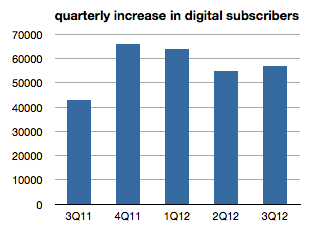
The paper now has 566,000 digital subscribers paying roughly $100 million a year between them to read the Times online. I think it’s safe to say that by the end of next year, the Times will have as many paying readers online as it does in print (on weekdays). That would be a landmark shift.
The question, as always though, is whither ads? And the answer wasn’t good as ad declines more than offset circulation qains. The company brought in $16.3 million more from circ (compared to last year), but lost $17.9 million in ads. Meantime its costs rose by $10 million, nearly wiping out its already anemic profit and sending its shares down 22 percent yesterday.
The Times paper lost 11 percent of its print ad revenue, nearly twice as steep as the fall at the company’s New England papers, including The Boston Globe. That print decline may be impossible to stop—though it’s worth noting that the magazine industry has found a way to at least temporarily stop or seriously slow the declines—but the paper has to find a way to reverse the fall of its digital ads.
Those fell 2.2 percent last quarter (for the entire company, which doesn’t break out the Times from the New England papers on this measure) in a newspaper market where others are growing. McClatchy’s were up 5 percent last quarter, for instance.
What’s going on with the digital decline? It doesn’t appear that the paywall is responsible for much of the NYT’s struggles here. More likely, it’s that the paper’s print ads are dragging down its digital ads, a hefty percentage of which are bundled together as upsells. Look at McClatchy: It’s digital ads were up 5 percent, but its digital-only ads were up 17 percent. The Times won’t break out those numbers, but you can bet that its digital-only ads were up, just not enough to offset the decline from upsells.
A critical question is how long circulation can continue to offset ad declines. Importantly, advertising is becoming increasingly less important to the NYT’s financial health. In the latest quarter, ads were 41 percent of its revenue, while circulation was 52 percent. Last year those numbers were 49 percent and 44 percent (much of the decline in ads comes from unloading About.com).
At the Times itself, ads now account for less than 40 percent of revenues, while circulation brings in 55 percent. Advertising is becoming so small and circulation so big that if the last quarter’s trend lines were to continue into next year and beyond, the NYT would actually increase overall revenue each year.
Problem is, the paper almost certainly won’t be able to sustain high single-digit circulation revenue increases for much longer. It’s harder to grow off a bigger base and the price of home delivery is already roughly $800 a year.
The paywall is pulling its weight. Ads are going to have to, as well.

Ryan it seems you continue to mischaracterize the results of the NYT paywall as a huge success. Perhaps, if by success you mean huge marketing efforts, the NYT certainly has proven to be very determined to make its paywall look like a winner. But what is the cost of acquiring each new sub? What is the ROI? It seems that Wall Street read the recent results differently from you and sent the stock price down. Why?
#1 Posted by Greg Golebiewski (@znakit), CJR on Sat 27 Oct 2012 at 07:53 AM
The market sent the stock down because they care more about short-term results than the paper's long-term viability as a company. Adding subs is a sustainable foundation on which to build revenue -- adding advertisers far less so.
One thing both the market and Mr. Goleblewski may not have considered in their indictment of the NYT paywall is whether or not the ad inventory the Times is sacrificing could have been sold at a premium CPM. It may be unlikely that the Times is giving up much revenue as a result of blocking people after 10 articles, because they may have already shown every premium ad they've sold against that person in that time. The rest would go to ad servers, and the Times would derive a very low (~$1) CPM for those placements.
I can't speak to their cost increases and where they're coming from, but it's hard to argue with the revenue that the paper is getting from charging for content.
#2 Posted by Trevor Kaufman, CJR on Sat 27 Oct 2012 at 03:20 PM
Trevor, you've made a good point, even though, it seems, unintentionally -- the opportunity cost of the NYT paywall.
Investors and analysts review the q-to-q or y-to-y changes as much as they look at the results of other publishers. And, if you do that, the NYT's "shockingly bad" results cannot be explained by lower CPM rates alone, as these affect the entire industry. It is true, however, and contrary to the official statements by the NYT, that its online traffic has suffered significantly since the paywall. According to comScore, the paper's lost as much as 20% or 10 miln uniques. These is where the bad ad revenue comes from.
Mr. Chittum knows that very well, or at least hw should, becasue he has the data. Instead of revealing it, just as Matt Ingram just did, he keeps to characterize the NYT paywall as some huge success. Perhaps the column should be renamed Plaudits (for anything paywall)
#3 Posted by Greg Golebiewski (@znakit), CJR on Sun 28 Oct 2012 at 06:28 AM
So, Greg, you are claiming that the NYT gave up 125-150M dollars in online ad revenue by putting up the paywall? That is about how much the NYT is pulling in paywall revenue right now. Do you seriously think the NYT could make 150 Million dollars in pure, online-only ad revenue (no print upsells) when the Guardian, with a larger online audience and more pageviews did a grand total of 26 million dollars in all of 2011? 26 million dollars in revenue...thats a medium car dealership. Its fucking peanuts, and some fraction of that is what you think you are gonna lure the NYT with.
Please don't bother trying to refute me with math because I know you can't. I expect the same fluffy brainless bullshit logic that Mathless Matt Ingram likes. Go ahead and try to convince anyone with a brain that the catastrophic decline in print advertising was caused by the paywall. Or wow me with unquantified "opportunities" and "synergies". I cant wait to see the fog machine pump. Znak that!
#4 Posted by Stephen, CJR on Sun 28 Oct 2012 at 08:03 AM
It would be enough Stephen if you could tell me where did you get the $125-150 million numbers from?
#5 Posted by Greg Golebiewski (@znakit), CJR on Sun 28 Oct 2012 at 08:15 AM
566,000 subs x $20 x 12 months...and adding over 50k subscribers per quarter.
#6 Posted by stephen, CJR on Mon 29 Oct 2012 at 12:12 AM
I am sure the NYT and its investors would love such figures. Unfortunately, they are a dreaming.
Stephan, you have forgotten to include the deep deep discounts the paper offers to get each new sub. The actual monthly sub isn't $20 each. Most lately, it has been $4.99 for 12 weeks. Or, in other words, if there are 50K new subscribers using this offer (and why wouldn't they?), then the total revenue from those subs is about $80,000/mo not $1,000,000 as you imagine -- a huge huge difference.
Then, consider the cost of marketing to get the new subs, the operational costs, etc.-- nothing comes free in this world.
Finally, consider the fact that the NYT Co has been losing about 550K casual users a month since the introduction of its paywall. Estimating that each unique visitor to the NYT online properties is worth about $0.50 in digital ad revenues, the paper is wasting $275,000 in unsold ads to get about $80,000 in digital subs per month. Is this a great financial success?
I do not criticize the NYT. The company tries its bets and has accomplished a lot in the field that many predicted would be impossible to succeed. My only problem is with reports like the one by Ryan Chittum, who knows very well that paywalls have huge opportunity costs, but who continues to describe the NYT efforts as an enormous success without qualifying it the way it should be qualified – if we are to learn anything from such reports.
#7 Posted by Greg Golebiewski (@znakit), CJR on Mon 29 Oct 2012 at 10:53 AM
Greg, the NYT's paywall is a huge success. Period. It certainly costs money to make money, but this is very high margin incremental revenue. They don't break those costs out, but they don't break revenue out either. We have to back into that and it's clear they're getting somewhere around $100 million a year from digital subscriptions. Company costs edged up last quarter, but because of print costs and executive compensation. If the paywall contributed to that materially, they would have had to disclose that.
Also, if you lose 20 percent of your traffic, say, you do not lose 20 percent of your ad revenue. No big site sells out its inventory. Those marginal users are extremely low-revenue remnant ads. The new subscription revenue far, far outpaces any digital revenue decline, much less any decline directly due to the paywall.
As far as opportunity costs, if somebody somehow cracks the code for digital ads or whatever tomorrow, the NYT could take down its paywall immediately. Don't hold your breath.
#8 Posted by Ryan Chittum, CJR on Mon 29 Oct 2012 at 05:02 PM
To reiterate what Ryan is saying....Greg, those introductory offers, they expire, right? And then you pay full price. Well, the NYT paywall subscribers are growing by 50k per quarter. Where is the fall-off that you are implying? It is only growing, so this means that after 30 or 90 days, the vast vast majority of people are converting to full price. In any case, even the very low figure of 100m is 4 times more than the Guardian is making on online-only ads. There is no opportunity lost- online ads are priced like trash. And as Ryan said, remnant rate pageviews are basically worthless. That is why papers with paywalls report "shockingly bad" declines in pageviews but "shockingly no loss in revenue". Because remanant rate ads are "shockingly worthless".
#9 Posted by Stephen, CJR on Mon 29 Oct 2012 at 08:55 PM
If things are going so swimmingly on the digital subscription side, why does the NYT continue to play "hide the salami" with the public?
Where *are* the numbers dealing with digital sub acquisition costs?
Where *are* the digital sub churn numbers?
At *best*, they are aggregated into opacity - why?
Why does the paywall seem to appear and disappear on random sections/blogs on random days over at the NYT (I think any NYT user - who isn't a *daily* page-by-page clicker - will acknowledge just how seldom - in defiance of the "rules" - the paywall actually seems to be enforced.)
(But, shuusssh! Can't let the rubes, er, digital subs, know that!! It looks bad if the NYT breaks its own paywall rules to continue to harvest drive-by uniques for reach and page views - while charging the loyal/dumb digital subs who supply frequency)
When publicly traded companies fail to disclose financial results with a reasonable level of granularity, there is always a reason.
And it is seldom a positive one.
But don't let the NYC media-hothouse (whorehouse?) cheerleading at the CJR stop - gotta suction those charitable contributions out of a dying media center *somehow*...
#10 Posted by cas127, CJR on Mon 26 Nov 2012 at 01:30 PM