The not-so-gentle ejection of Marcus Brauchli from the top editor’s chair at The Washington Post has cast a bright spotlight now on senior leadership, including his boss, Katharine Weymouth, the newspaper’s publisher, who pushed him aside, and her uncle, Donald Graham, chairman of the parent company’s board.
That the editorial change was awkwardly implemented is one thing. But much more important is the Washington Post Company’s—that is Weymouth and Graham’s—strategic failure in failing to install a paywall around the paper’s digital content. Every day this simple, ameliorative step is not taken is a day wasted.
I’m discussing the newspaper part of the business, because the broader company is separate issue. But no one believes the paper can sustain losses at anything like its current pace—$60 million-plus in the first three quarters of the year, on pace for a fifth straight loss year.
Make no mistake: the paper has become the American newspaper industry’s poster child for the folly of clinging to a free digital strategy. This would be great cautionary tale if only the Post itself—and its 500 plus -strong newsroom —were not such an important institution in its own right. Anyone who thinks that the public interest is not harmed immeasurably by the Post’s not-so-slow decline, or that Politico or buzzfeed or some such will pick up the slack, is dreaming.
The Weymouth/Brauchli fallout, according to very plausible reports in the Times and the Post itself, centered on staff cuts—and well it might. Just look at the revenue trends of the newspaper publishing group:
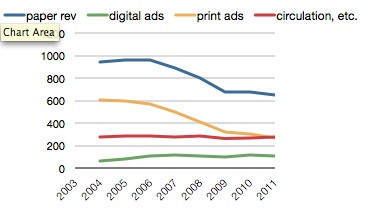
Print ads have been falling at a double-digit rate for six years (with a six percent decline in 2010 the exception), which is the industry norm. While much hope was invested—back in what seems like a different era—in the idea that digital ad growth would eventually make up the slack, the reality-based community has now moved on. Digital ad growth has tapered off at disappointingly low levels. The newspaper publishing group includes Slate but there’s no reason to believe that’s a plausible growth story in the WaPo’s digital ad model.
Put it this way, digital ads pulled in $115 million in 2007. It will pull in about that this year. It may go up a bit next year. But for all intents and purposes, it is flat. It is not growing enough. As Monty Python would put it, the free strategy is a dead parrot.
The illogic of giving away something online that you charge for elsewhere is now coming home to roost.
Believe me, I wish this were not the case. If there were a real growth story there, that would be one thing. But there isn’t. There’s no secret sauce. And what’s required is not just growth but rapid growth, since to avoid drastic newsroom downsizing digital ads must offset the massive decline in print ads.
In the case of major newspapers, pursuing a digital-ad-only strategy while riding a downward slope of print ad revenue is a glide path to a desiccated newsroom. I don’t mean smaller. I mean much smaller. It’s like that old joke: How do you make a nice little local-news startup? Start with a great national news organization.
To say, in the absence of supporting data, that the answer for the Post is to “commit” to an anti-paywall strategy, to “push the innovation meter to 11,” and make “digital first a core mandate” is to say nothing at all. There is nothing in the PostCo.’s publicly released data to support that case. At some point, belief must yield to evidence. Even Clay Shirky, who needs no one to vouch for his network-theory cred, has recognized the obvious in the case of the Post.
“Digital First,” in the sense of refusing to charge newspaper readers for a subscription, is bankrupt, both literally in the case of the main unit of the so-named American newspaper company, and, in the wider sense, as a strategy for newspapers generally. The Guardian—another digital firster—is yet another walking, talking cautionary tale against the free model. It is a financial basket case, subsidized by Auto Trader, a profitable trade publication. The unit that owns the Guardian posted a loss of £33 million in the year ended last March, after a loss of £34 million the year before. And, no, siphoning profits indefinitely from other corporate units is decidedly not a strategy.
Again, if it were a question of time, waiting for growth, that would be one thing. All things being equal, I’d still argue against free models because of its hamster-wheel incentives toward volume. It is the logic that persuaded The Washington Post’s president, Steve Hills, speaking to a secret meeting of concerned top Post journalists to push—in earnest, apparently—for more traffic-driving slideshows. Does anyone else see a leadership problem at this company?
But, again, if there were a financial case for it, at least that would be something. But there is none.
Eric Wemple had a good post on Wednesday pointing out the Post actually did well traffic-wise, but underperformed the newspaper industry in monetizing it. Right. That’s bad.
But he quotes Alan Mutter saying, quite correctly, that even to perform to industry standards is to underperform the broader market place for digital ads.
As papers including the Financial Times have recognized, for a newspaper to compete in the digital ad game is to compete in a giant market where the game is monster traffic volume and ad rates are already tiny and still falling.
For newspapers, this is demonstrably a losing game. Again, even if the Post is able to rise to the industry standard, it will still lose. Digital ads are fine, but alone they are not enough when there is a honkingly obvious supplementary source of revenue available.
The benefits of adding a paywall are becoming more apparent by the day even as fears of a downside are receding. The FT, the Times and other premium papers—and I assume that’s what the Post management thinks it is, right?—have shown traffic and digital ad losses to be more than manageable. Indeed, the FT says it can charge considerably higher ad rates than free sites. It has gone truly “digital first” in the sense that digital revenue is now eclipsing print revenue, and not because of print declines but because of digital growth. That may be why paywalls are being adopted all over the world, and papers like the Post find themselves living on an increasingly lonely, little FONtasy Island. And the tide is still coming in.
And if super-un-premium Gannett can make paywalls work, anybody can.
Our Ryan Chittum has roughed out the numbers for the Times paywall and finds it is pulling in $100 million in new revenue, money that it would not otherwise have. How much could the Post earn? Unknown. The Post’s daily circulation (470,000-ish) is a bit more than half that of the Times, so that might provide a guide. But in truth, the Post has hamstrung itself in other ways, namely by deciding it’s mostly a local paper. Let’s say it would make only a quarter of what the Times can generate. That’s still a lot of reporters, still helping to preserve the paper’s main value-creator, the newsroom.
Incoming editorial chief Marty Baron, ex of the Boston Globe, is quickly proving himself master of the obvious when he says the size of the newsroom will depend on revenue. Via Wemple:
The resources we have will be dependent on the revenues of the company. That’s as true of The Washington Post as it is true of the Boston Globe… People will know where the resources are headed when they look at the revenues. It can’t be otherwise. No institution can spend more money than it has. That means it’s not easy, it’s painful.
Etc. etc.
I think, by now, we get that. The question for leadership is, what are they going to do about it?

Please....Matt Ingram, Howard Owens, Jay Rosen, anyone. Please explain to me how the New York Times and other papers could do better with digital advertising, when The Guardian, the third largest news site in the world and the ONLY one who releases hard numbers admits that their digital newspaper ads only bring in about 26M dollars. No. I don't want percentages. What hard numbers support the fact-free argument that digital ad-supported news orgs can support large news-gathering operations? What are the John Patons of the world hiding from us with endless ratios and percentages? What do you got, fellas? There are two types...show-ers and grow-ers. One I can see with my own eyes. The other one I have to endure hearing you talk about.
#1 Posted by Stephen, CJR on Mon 26 Nov 2012 at 02:20 PM
I'll bite: Even the Guardian would admit that it needs to do better with digital advertising -- heck, even Facebook isn't doing that well with advertising, primarily because that business is being disrupted by the very same factors that are disrupting the media industry. Can digital advertising support a large news-gathering operation? I have no idea, but I am pretty certain that reader subscriptions alone can't do so either.
#2 Posted by Mathew Ingram, CJR on Mon 26 Nov 2012 at 05:19 PM
Sorry, I'm not a "fella." Do you have to have XY chromosomes to participate in such discussions? If not ...
I am an old-media veteran, running a micro-news org.
I don't have access to the Post's P/L, staffing lineup, etc.
But I can tell you one problem big media in general has not conquered yet - bloated middle management.
I quit a six-figure middle-management job in a big-city TV newsroom five years ago. I will unhumbly say I was very good at what I did - but I was NOT needed. Reporters were supervised by newscast producers, who in turn were supervised by an executive producer or two, in turn supervised by a managing editor and/or assistant news director (me), in turn supervised by the news director (department head) - ridiculous to have more than one layer between the reporters and the department head. If you have reporters who know what they are doing, they need minimal supervision. Sure, you have the projects for which you need to call in the legal department. Otherwise - until you tell me that middle-management layer has been slashed, you can't tell me a news organization of any size is operating at maximum efficiency. Unfortunately, they are the ones who usually fight hardest to keep their jobs, while low-hanging fruit like young reporters are last hired/first fired. If someone someday shows that there are NOT millions of dollars in savings to be had by dramatically trimming the management layer ... I will rest this case.
#3 Posted by Tracy @ WSB, CJR on Mon 26 Nov 2012 at 05:20 PM
The problem with paywalls is they help your bottom line only if the content is exclusive AND worth paying for, BUT they hurt your reputation if you are seen as being proprietary with something that the public interest demands be freely available.
Paywalls are good for things like features, minor editorials, and local- or special-interest columns. They are also good for "hot" financial news. "Novelty" items like obituary-related services beyond simple death notices and obituaries of public figures are another way for a paper to make money.
They are horrible for non-"hot" news, because you can't keep that exclusive for long. If I can't get it free from you, I'll get it from somewhere else. If I can't get it free from somewhere else, it must not be that important.
Paywalls are also bad for "major" editorials where the newspaper is trying to sway public opinion. You WANT these to get out to everyone with zero boundaries.
The future of most paid news-content is going to be on a syndicate basis, much like music-licensing in churches or NetFlix and Hulu for video entertainment. I'm not really ready to pay $100+ a year for access to my local paper's exclusive content, but I am ready to pay $100 a year for access to ALL non-niche content from ALL major newspapers, with the money presumably divvied up on some kind of proportional-use basis.
#4 Posted by davidwr, CJR on Mon 26 Nov 2012 at 05:47 PM
The solution is finding revenue streams that focus on experiments or digital initiatives that work and not traditional legacy models or even traditional web models news organizations have implemented (banner ads, for instance). So if your live blogs are producing great engagement, hits, or targeted traffic, you can make money by making the advertisers the 'subscribers' or sponsors of a particular line of content, and not with CPMs, but with premiums to let an engaged community view your content while exposing them to nonintrusive ads (charging a fixed amount to advertise to a targeted liveblog audience, for instance). This, or paywalls, for that matter, will not make up for loss print advertising. Costs are going to have to be cut, and it's going to be painful.
#5 Posted by Ivan Lajara, CJR on Mon 26 Nov 2012 at 08:46 PM
Dean: Do you really think that Don Graham and Katharine Weymouth (disclosure: I used to work at the Post and have known both for many years) haven't run the numbers on a paywall six ways to Sunday? Could it be that, rather than relying on religious zeal in making their decision (as you do in making your underreported argument), they have considerable internal data and market research informing their reasons not to move the Post to a subscription model? Believe me, to paywall or not to paywall is not a decision made lightly by any newspaper, including the Post--your beliefs and opinion on the matter notwithstanding.
#6 Posted by Mark Potts, CJR on Mon 26 Nov 2012 at 09:24 PM
Mark: Dean provides a lot more data in his rant than you provide in yours. you have enormous faith in the Grahams, but the financials don't justify that faith. And why is the Washington market so different than just about everywhere else? Why do you assume that the Grahams are so much smarter than everyone else? They are just a couple steps behind the times (Times) in a rapidly chaining industry.
#7 Posted by jon, CJR on Mon 26 Nov 2012 at 09:55 PM
Anyone who has read the story of how Don Graham was about to buy 10% of Facebook and then let Zuckerberg weasel out of it by literally crying, should pretty much have no doubt as to Graham's business acumen. He's a rich, spoilt man of a certain age. The word is 'callow'
#8 Posted by Stephen , CJR on Tue 27 Nov 2012 at 01:29 AM
In the era of the omniscient Google, no news is exclusive for longer than an hour, may be two.
People do not read on a site for exclusivity but for authenticity, depth and quality of coverage. If they are convinced that you are giving good stuff, they keep coming back for more. Cheaper, the better. Free, the best.
Advertisers flock to such sites with ease. This is a market Mr Writer. And the Post needs to reinvent itself along the lines of its nimbler, crisper rival NYT. The money will come.
Funny, the article is negating the very principle that runs the CJR site and millions of other, successful, internet-based businesses.
#9 Posted by The Contrarian, CJR on Tue 27 Nov 2012 at 01:54 AM
There isn't any way a paywall will work at the Post as long as they have such a wretched website!
There's no single page view for articles that are idiotically stretched out over two or more pages.
Articles & columns are often buried & impossible to find without doing a keyword search. Just read Lisa DeMoraes weekly chat where there's always a complaint about how difficult it is to find her columns & articles on TV. Even finding the chat can be a challenge!
The previous online incarnation had a simple "Print View" that gave you all that day's print stories.
#10 Posted by Becca, CJR on Tue 27 Nov 2012 at 10:28 AM
I wonder if the Grahams know or have been told by their market researchers that instituting a pay wall would cause a significant number of their on-line readers to shift to the New York Times. I would never pay for the WaPo on-line in its current form. The quality is really mediocre and the site itself is very unfriendly to readers. If I didn't have the free alternative of the WaPo, I would have long ago bitten the bullet and bought access to NYT.com. If the WaPo went behind a pall wal it would not even be a close call in my house. My hunch is the Grahams know this already, which is why the WaPo continues to remain pay wall-free.
The state of the WaPo is very sad. I grew up reading the paper and felt that it played a big role in my education. I have since moved away and hadn't seen the physical paper in several years. Last month I was in Washington and I was shocked at the state of it. It was like a small town paper, hardly any stories, lots of recycled blog items. I think I finished reading it in about 10 minutes.
#11 Posted by Francis Urquhart, CJR on Tue 27 Nov 2012 at 12:48 PM
Marty Baron. "No institution can spend more money than it has" On his lunch break he should walk down the street to Congress and the White House and make that quote.
#12 Posted by Gallens, CJR on Wed 28 Nov 2012 at 12:23 AM
Let's make this simple. As a practical matter, paywalls have not proven the optimal strategy anymore (and probably less) than digital ads. It is a small slice of the industry.
However, the idea of engaging readers to pay at some point for some service makes lots of sense. The question is- when to ask who for money and in exchange for what.
Trying another failing strategy that reduces audience size and goodwill is likely not the best move. But asking your biggest fans to help you continue important work in exchange for scarce value might be a good start.
#13 Posted by Ben Ilfeld (@benilfeld), CJR on Wed 28 Nov 2012 at 02:02 PM
One more bit about that "dead parrot"
The online ad industry is doing quite well, thanks. The fact that some traditional news creating institutions have not been able to grow with it speaks more to their un-willingness to innovate in that space.
There are very few technology resources at these media companies dedicated to advertising innovation especially compared to the CMS's and editorial related concepts.
There are structural problems that underlie these decisions. And there is fear that no matter what, RTB ad systems will eventually just take everything over. But if you are passionate about the quality of your product, then you should be equally passionate about providing value to the clients (mostly advertisers) who support it. And you must innovate beyond your competition in order to deliver ever increasing value for your clients.
#14 Posted by Ben Ilfeld (@benilfeld), CJR on Wed 28 Nov 2012 at 02:15 PM