In 1944, Lt. Hiroo Onoda was sent by the Japanese Army to the remote Philippine Island of Lubang with instructions to never surrender to the Allies and to fight to the death.
“We’ll come back for you,” his commander wrote. “But until then, so long as you have one soldier, you are to continue to lead him. You may have to live on coconuts. If that is the case, live on coconuts!”
At this point, the people opposing subscription models for American newspapers and advocating for them to be supported by digital ads (and unproven innovations somewhere in the future) are living on coconuts.
The war is over. The evidence is in. Newspapers, large and small, premium and not, gain additional revenue through subscriptions and lose little if anything in digital ads (UPDATED this sentence to add links to more evidence, since Digital First’s Jim Brady doesn’t like my Press+ link in the previous sentence.)
The Allies have won.
Dean Starkman, my boss and co-religionist, argued Monday that the Washington Post needs a paywall, and stat. We’ve been arguing this in one form or another for years now.
And in the years we’ve been arguing this point, the industry has moved our way, along with the evidence that digital subscriptions can work.
But there’s still an anti-paywall camp, and all too often its arguments are stuck in in the mid-2000s, ignoring events of the last few years.
Jeff Jarvis tweeted in response to Dean’s post: “CJR continues its monomaniacal crusade for pay walls. I want to psychoanalyze that.”
Alternatively, one could psychoanalyze sticking to the same digital ad strategy year after year after year and expecting a different result…
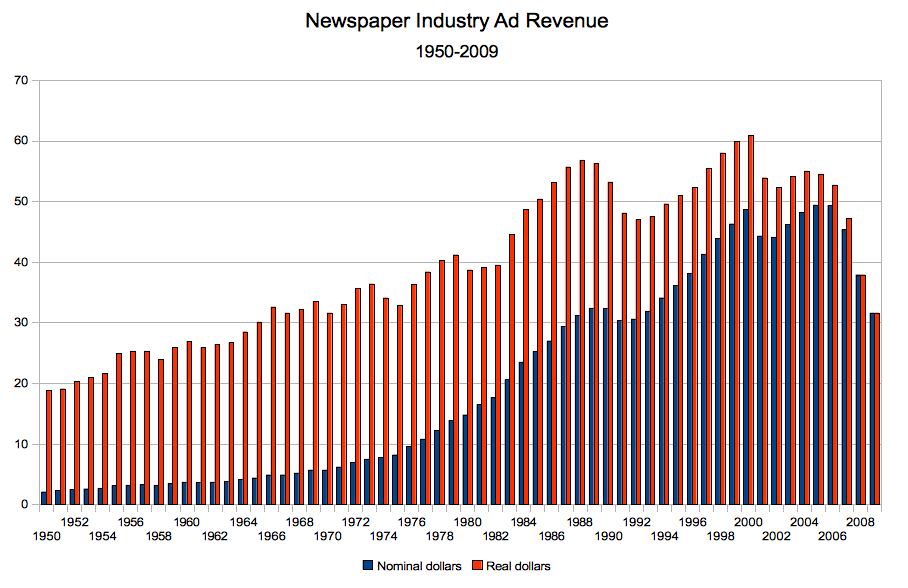
All while your print revenue does this:
Savvy! But that’s a consultant’s-eye view.
Other true believers resort to the old straw man strategy. And when you create your own opponent out of thin air, you’re guaranteed to win—every time!
Take Sarah Lacy of Pando Daily, who thinks Dean’s argument is “flawed and reactionary” and “a breathtaking view of how the old media world still thinks.” Maybe so. But to get there she has to misrepresent the argument in major ways. It’s a lot easier to win an argument when you’re arguing against a cartoon of your own creation.
Let’s take the straw men on one by one:
1— “Chairman Don Graham is not a Luddite, and he’s not stupid.”
But of course no one says that or even believes it. Believe it or not, you can think someone has the wrong strategy without thinking they’re an idiot.
2— “Unlike a lot of newspapers, the Post trying to do something innovative, rather than just take the easy out of throwing up a paywall.”
“Innovative” in this instance means unethically spamming Facebook friends with Post content. Lacy talks about the Social Reader’s “ups and downs,” which is quite the euphemism. The Post’s app had about 600,000 users a day back in April. Then Graham pal Mark Zuckerberg tweaked Facebook’s settings. Now the Post’s app gets 20,000 users, according to AppData—a 97 percent collapse in seven months.
It’s not that Social Reader wasn’t a worthy innovation (ethical considerations aside). It’s just that it didn’t amount to anything. And the Post is hardly the only newspaper experimenting. The New York Times leaky paywall is an innovation, and it is paying off to the tune of $100 million a year and is still growing fast.
Does “innovation” have to mean “makes no money”?
If you still don’t think that counts as an experiment, visit NYT Labs, described by guess who as “innovating the way they deliver the news.”
But see the NYT doesn’t count, really (emphasis mine), according to Lacy: “The New York Times own paywall revenues are barely keeping up with the fall in print revenues, and the Times has done it better than anyone.”
So, they’re only “barely” keeping up with the fall in print revenue.
That’s like saying, the patient is only sitting up and eating, not running marathons yet. Definitely, we should go back to incense and bleeding therapy.
And how is that WaPo Social Reader revenue doing?


I've not read much Lacy, and I don't bother even reading Ingram any more because he is as predictably wrong as Shirky et al.
#1 Posted by SocraticGadfly, CJR on Mon 3 Dec 2012 at 10:00 AM
“Chairman Don Graham is not a Luddite, and he’s not stupid.”
Once again. The guy had Mark Zuckerberg's word that he would sell WaPo 10% of Facebook for pocket-change back in 2006. Then Zuckerberg got a slightly better offer which Graham never matched. In fact, Graham found Zuckerberg crying in the pisser of a restaurant where the deal was going down and Zuckerberg asked to be let off the hook of the deal. Graham accepted. He fucking accepted! Graham is dumber than bag of hammers and the fact that Pando Daily thinks he is anything short of this speaks volumes of their own processing power.
#2 Posted by Stephen , CJR on Mon 3 Dec 2012 at 12:28 PM
Here's an idea: produce interesting, targeted content that people actually want to read/watch, sell ads/sponsorships against it, and make sure your revenue exceeds expenses. I know, crazy, right?
The paywall drumbeat around here seems to be getting louder. That's just fine with me and I hope it's successful. Newspaper paywalls will only benefit and encourage local news startups that will find ways to provide better, more relevant local news content without the institutional and financial burdens of a big corporate newspaper. Disruptive innovation in the news business is underway, whether fans of ink-on-print like it or not.
#3 Posted by Scott Brodbeck, CJR on Mon 3 Dec 2012 at 03:13 PM
"Ask one of those readers whether they fork over money for the paper or for what’s printed on it."
Money is indeed fungible, but if you're going to take on strawmen then don't make up more of your own. The observation about subscriptions prices may ignore the fungible reality of money but it's on-target with regards to what percentage of a paper's revenue it makes up. Ignoring that fact ignores the history of papers making serious efforts to give away editions without appearing to give them away and harm their oh-so-prized 'paid circulation' numbers.
As far as whether it has to stay that way, that's an open question. But given the extreme measures I see so many papers going through with deep discounts and coupon deals it's hard to believe there's a consumer willingness to pay.
#4 Posted by Don, CJR on Mon 3 Dec 2012 at 04:38 PM
Ryan,
I won't respond to your individual points, except to note that your mixed metaphors made me laugh. You're welcome to your opinions.
But you portray paywall skeptics inaccurately when you lump us together as you have, saying we all believe all these things. For instance, I don't advocate cutting staffs. I argue for developing new revenue sources that work in the digital marketplace, instead of relying on the print model of subscriptions, because I want to support more journalists, not fewer. Perhaps you noticed today that the New York Times offered another round of buyouts: http://mediadecoder.blogs.nytimes.com/2012/12/03/new-york-times-seeks-buyouts-from-30-newsroom-managers/
I also should add that you have neglected, perhaps deliberately, one of my key arguments against paywalls: That thousands of digital businesses are thriving without paywalls (and not living on coconuts). Scott Brodbeck, who already commented, is a good example, with his ARLnow news site, covering Arlington, Va., better than any newspaper.
Only newspapers, unable to think beyond their traditional subscription model, are pursuing paywalls to any notable degree.
I hope that paywalls do succeed for all the companies trying them. But I will say (again) that your likening this business disagreement to religion completely undermines your credibility. I am a son of clergy and a former religion reporter. I understand religion and nothing about this disagreement resembles religion in the slightest. CJR readers deserve more insightful and accurate commentary than this.
#5 Posted by Steve Buttry, CJR on Mon 3 Dec 2012 at 08:15 PM
Steven,
I agree with you that this article was rude and poorly written. However, as a Times copy editor I am curious: what are these "new revenue sources that work in the digital marketplace?" Most of these thousands of "thriving...digital businesses" publish vast amounts of low-quality content.
How do you pay for a Beirut bureau with CPM ads? For Mexico City? For New Delhi? Caracas? Rio? London? Paris? Berlin? Rome? Baghdad? Cairo? Istambul? Dakar? Nairobi? Johannesberg? Moscow? Beijing? Tokyo? Hong Kong?
What about our investigative desk? Right now, it's the largest it's ever been. Have you seen Louise Story's recent work on tax subsidies for businesses? A database of every gift in the last 20 years--do you think that was cheap to assemble?
I should stop asking questions before my comment is like a Pete Wells review--not that restaurant reviewing is cheap, by the way. But I am curious: how else is the Times going to earn those $100,000,000? 250 million extra pageviews?
If you don't think Times journalism is important, then we have little to talk about. But if you do--and I assume you do--then please explain where that money is going to come from.
If you are talking about other, less prominent, local newspapers, on the other hand, then I agree. No one is going to pay to read the Stock Record online, and I'm not sure the Washington Post has a large enough audience either.
#6 Posted by Times Staff, CJR on Tue 4 Dec 2012 at 01:01 AM
Times Staff,
Interesting that you don't sign your name, but I'll reply anyway.
Yes, I absolutely value Times journalism and feel that it is important. I am sorry to see that your company is further reducing its newsroom staff and thus further eroding the quality and quantity of your journalism. While I don't think the Times paywall is the right approach, I do agree that the Times will have more success getting people to pay online than metro papers will. But it also has more power and audience to develop new revenue sources from the larger audience you get without a paywall.
I have blogged extensively about the revenue opportunities that newspapers are ignoring. Here is perhaps the most comprehensive post: http://wp.me/poqp6-1lD
I also see considerable potential, especially for the Times, in the reverse meter Jeff Jarvis has suggested: http://buzzmachine.com/2011/12/19/why-not-a-reverse-meter/ and in the membership approach Steve Outing has suggested. http://steveouting.com/2011/03/17/nytimes-new-pay-model-they-blew-it/
With what Ryan calls the "leaky paywall," the Times' $100 million in subscription revenue (presuming that figure is accurate, and it certainly isn't net paywall income) is essentially donations or convenience fees, which are highly vulnerable or not sustainable. You probably could raise more by actually fund-raising NPR-style to support Times journalism. I also suspect that the demographics of your digital-subscription audience are similar to those of your print-subscription audience, which raises further sustainability issues.
And don't be so dismissive of digital advertising. Check out the graph in this Alan Mutter blog post: http://newsosaur.blogspot.com/2012/11/online-sales-are-flat-lining-at.html?m=0
Don't focus on the declining line of print ads or the relatively flat line showing newspapers' digital ads. Look at the rising line of all online advertising. If newspaper companies understand digital advertising better and pursue it more effectively, that's a huge and growing market with much more potential than digital subscriptions.
The Times has enough resources and smarts to develop revenue streams that work in the digital marketplace, rather than spending the millions that it is to cling to the defensive, print-based subscription model.
As for your dismissal of the quality of content from digital businesses that are thriving, that statement reveals either your arrogance or your ignorance or both. Sites such as Mashable and TechCrunch provide coverage as good as or better than the Times in their niches. Sites such as Scott Brodbeck's ARLnow, Homicide Watch, the West Seattle Blog, Baristanet and The Batavian are providing content that is as good as or better than the content of newspapers covering the same communities. TV stations' and networks' sites are competitive in many ways with newspaper sites covering the same communities or topics.
I wish you and your colleagues well. I hope I am wrong about your paywall and the paywalls that metro newspapers are attempting. I'm sure you find these rants by Starkman and Chittum to be comforting, but they ignore the fact that the successful online businesses operate without paywalls.
#7 Posted by Steve Buttry, CJR on Tue 4 Dec 2012 at 09:07 AM
Steve, the "co-religionist" thing It was a joke about Sarah Lacy accusing us of religion, as you'd see if you followed the link embedded in the word. Here it is: https://twitter.com/sarahcuda/statuses/273508134046294016
Jeff Jarvis has done this many times too.
Also, I didn't say you personally advocated cutting staff. Lacy did and others have. I said the logic of free means cutting staff, whether you want it or not. Big difference.
Finally, just because you don't like the metaphors doesn't mean they're mixed.
#8 Posted by Ryan Chittum, CJR on Tue 4 Dec 2012 at 03:05 PM
Ryan,
Please at least own your embrace of the religion metaphor: You were the one who called us Freehadists.
Maybe they taught writing differently where you went to school, but if using zombies, dead-enders, living on coconuts, straw men, jihad, bleeding patients and low-hanging fruit all in one piece (including the headline & URL) isn't mixing metaphors, then there isn't any such thing as a mixed metaphor.
#9 Posted by Steve Buttry, CJR on Tue 4 Dec 2012 at 05:47 PM
Agree or disagree - I do think that you do a disservice with the rhetoric. Calling people "FONsters, Freehadists" or comparing them to the Japanese in WWII could only have a chilling effect on what should be an open conversation or will anger (both sides) to the point of frothing mouths, shouting and no listening.
I will 2nd Steve's point. Something I've said many times is that I like the metered paywall, but I dislike the term. To me - it's not a "paywall." It's a membership program and more could come of it if it were embraced as such: http://blog.digidave.org/2012/02/dont-call-it-a-paywall-los-angeles-times
#10 Posted by Dave Cohn, CJR on Tue 4 Dec 2012 at 07:36 PM
I responded at greater length in my own blog, Ryan, quoting an (unnamed, alas) editor who shared some really disappointing results from a paywall. The war isn't over in that community. Or anywhere. http://wp.me/poqp6-2J0
#11 Posted by Steve Buttry, CJR on Wed 5 Dec 2012 at 09:11 AM
Perhaps Rayn's anger (and angry he is) stems form the fact that the NYT's experiment with the meter is losing its power -- as predicted; and, predicted not by so called anti-paywallies or Ryan's fellow journalists with a personal preference for one or another model, but those who practice online payments and know from experience how they work.
I am not against charging for content; paywalls too can work, given certain conditions -- but, the current discussion about them, void of any sufficient, comparable data and business analysis, makes more harm than good.
Statements like, "The war is over. The evidence is in" are highly irresponsible. What evidence? What war?
#12 Posted by Greg Golebiewski (@znakit), CJR on Wed 5 Dec 2012 at 12:28 PM
"Sites such as Mashable and TechCrunch provide coverage as good as or better than the Times in their niches. Sites such as Scott Brodbeck's ARLnow, Homicide Watch, the West Seattle Blog, Baristanet and The Batavian are providing content that is as good as or better than the content of newspapers covering the same communities."
Right. Mashable aggregates, TechCrunch is unreadable blather with "writers" who drink and blog or are more important than the subject the cover. Homicide watch is out of business. I'd rather read the NYT or Post any day of the week and I spend an inordinate amount of time reading daily.
Pay-walls help, as Ryan says. The NYT has upwards of 600k digisubs because they have an unbeatable brand. Does everyone have that? Certainly not, but if they have decent local coverage that isn't attained elsewhere, it can be monetized. The pay-wall is simply the first step to earning revenue until a new paradigm emerges.
Anyone see what the Times of London did, giving away galaxy tablets with a subscription? What's wrong with the mobile phone strategy? Unfortunately the newspaper industry is saddled with people who are unable to think outside the box and is stuck until some new thinking arrives.
#13 Posted by David Brauchli, CJR on Wed 5 Dec 2012 at 01:40 PM
David,
You're entitled to your opinion about TechCrunch. But you are not entitled to make up facts. Homicide Watch is very much still operating and posted this item yesterday: http://homicidewatch.org/2012/12/04/substantial-probability-found-in-case-against-chavez-myers/
Homicide Watch raised enough money in a KickStarter campaign to stay in business and won the Knight Award for Public Service at the Online News Association this fall. Please check your facts before making such reckless statements.
Your "Mashable aggregates" dismissal is laughable. So does the New York Times. So does every one of your clients, I suspect. Mashable also publishes original content, as do your clients. Old media arrogance about digital news sources has not served old media well.
And speaking of your clients, don't you think it would be a little bit relevant and ethical when commenting on this discussion to identify yourself as a paywall vendor?
#14 Posted by Steve Buttry, CJR on Wed 5 Dec 2012 at 04:34 PM
Steven,
I didn't reply with my name because I just edit copy. I do it for fun--I get my news the night before, a bit of cash for my retirement. I'm not someone important, and I certainly don't claim to speak for the Times.
I think that the posts you link bring up interesting ideas, but a lot of them are sort of far fetched.
#15 Posted by TImes Staff, CJR on Thu 6 Dec 2012 at 03:55 AM
Steve,
Thanks for the correction on Homicide Watch, nevertheless, it has proven to be an unsustainable business model.
Our clients do not aggregate, actually, it's one of the things they are against the most. In fact, we are encouraging them to curate one another's content; by pointing out the most valuable content on other media within our system will there be more value in everyone's product.
I'm not hiding that I work for a national pay-wall system, but the opinions I express here are mine, not on behalf of the company.
#16 Posted by David Brauchli, CJR on Thu 6 Dec 2012 at 04:18 AM
1) Where does the 25 million monthly uniques figure for the NYT come from? Quantcast is reporting 17 to 18 million.
2) Anybody else noticing that the NYT paywall seems to be getting "leakier" than advertised? Non digital subscribers - when was the last time you hit an actual wall?
If the NYT arbitrarily dropped its paywall at random times to meet monthly pageview targets, would that constitute fraud? What if the digital subscriber agreement is silent on the issue?
3) Why does the NYT disclose so little detailed data on the paywall (sub tenure, sub churn, etc.)? When corporations have good news...they make sure you know about it...when they have bad news, they shut up.
Until the NYT offers up more explicit detailed data (this is the "computer" age after all), I think wariness of possible creative accounting is warranted.
#17 Posted by cas127, CJR on Thu 6 Dec 2012 at 07:59 PM
More on #3 above.
I've gone back through the CJR keyword archives to review previous discussions of the NYT paywall.
Two NYT defenses/claims merit some discussion.
1) Digital sub churn is less than print churn.
Pretty surprising if true, considering that paying by the month is a much more heavily promoted *digital* option than a *paper* one (*does* the NYTeven offer *monthly* paper subs?).
This defense is raised in response to suspicions that the NYT is playing "hide the ball" by offering so few details regarding digital subs in its 10Q's and 10K's.
In the wider world, digital subscriptions of all sorts show much higher churn than paper-based, because it is easier/faster to quit online.
Perhaps the NYT is an exception.
But perhaps not.
In a *third party* blog it was stated that NYT personnel said that its digital churn was lower than print.
I don't think I've seen this claim made in any NYT financial filing. If somebody has a link/reference I'd like to see it.
2) Why do I keep harping on churn?
Because ignoring it is the easiest way to game public perceptions of the financial success of the NYT's digital paywall.
The media business has a long, sordid history of subscription number manipulation - by misleadingly describing free recipients as paid subs, by stuffing the channel and ignoring the returned papers, etc.
Also, it is well known that it is possible to heavily goose paid subs for a short period of time by using high-cost/low-or-no profit promotions. Such highly promo'd subs drop out quickly and en masse once the promos are over (and the paper tries to reassert profitable distribution).
So the NYT defense that "aggregate digital sub *revenue* is up" and that is all that matters - isn't actually true.
*Profitability* is what matters in the long term.
And wholly aggregated top-line revenue figures for digital subs, especially in the absence of *detailed* cost side figures (like churn), do not provide enough data to judge the long term profitability/viability of the NYT paywall.
Right now the NYT is aggregating everything into opacity and telling us to not inquire about the man behind the curtain.
Not good enough for a public company.
#18 Posted by cas127, CJR on Thu 6 Dec 2012 at 09:09 PM
Excellent points about churn, cas127. I raised the point briefly in my post, but you wrote more knowledgeably about it. Without knowing about churn, development costs and promotion costs, Ryan's $100 million revenue figure is not only a wild guess but a meaningless wild guess unworthy of CJR publication.
David, you statement that Homicide Watch's model is unsustainable is absurd. It was sustained by donations, same as NPR. Is that unsustainable? For that matter, a leaky paywall is, in essence, a donation system. You pay if you want to, but people who don't pay access all the same content for free.
As for aggregation, I am not familiar with your European clients, but every U.S. newspaper site that I know of aggregates. The New York Times was aggregating its Bradley Manning coverage from AP earlier this week, using the same commodity story you could find anywhere.
#19 Posted by Steve Buttry, CJR on Sat 8 Dec 2012 at 06:37 PM
Re churn, Steve.
And my $100 million figure is not a wild guess.
#20 Posted by Ryan Chittum, CJR on Tue 11 Dec 2012 at 05:21 PM
Good article, but arguing with the Freehadists is largely a waste of time. Free is a religion and they will not be convinced otherwise, no matter the evidence. Subscription revenue is clearly the answer to keeping the newspapers on life support and it is a testament to the great and enduring economic ignorance of most papers that they still do not embrace online subscriptions. However, the endgame is collapse, no matter what they do. The fact is that a bloated newspaper staff that wouldn't know how to innovate their way out of a paper bag is highly unsuited to the current rapidly changing and darwinian online environment, so the newspaper dinosaurs will all be killed off soon enough.
What will replace them is a sea of constantly innovating, independent bloggers, all paid through micropayments. That will be a golden era for news and I can't wait till it gets here. :)
#21 Posted by Ajay, CJR on Fri 11 Jan 2013 at 01:28 AM