The nuclear crisis in Japan keeps on revealing how the news media struggle to report accurately and thoroughly about risk. The latest example is coverage of a new Union of Concerned Scientists (UCS) analysis, which estimates that radiation from Chernobyl will cause many more cancer deaths than the UN officially estimated.
To be fair, radiation risk is complex and controversial even among the experts. But this example of sloppy risk reporting isn’t about the challenges of covering a complex issue, nor is this the standard lament about breathless alarmism/sensationalism. This is about a far more common and far more troubling problem that pervades news coverage of risk. And it’s an easy one to fix.
Here’s the background: The World Health Organization estimates that the lifetime radiation-induced cancer death toll from Chernobyl will be about 4,000, out of the 600,000 people exposed to higher doses of radiation—about two thirds of one percent. Several anti-nuclear groups say the number is much higher. One of them, the UCS, says the WHO made a mistake by considering only the population that got higher doses, since the default assumption of most government radiation regulations is that the only safe dose of radiation is NO dose, so even a little radiation raises the risk of cancer somewhat. And since the radiation from Chernobyl spread around the entire globe, a fair consideration of the cancer threat needs to consider how much it raised the risk for everybody.
Based on how much of a dose people in various regions got, the UCS calculated that the total global radiation-induced cancer death toll from Chernobyl will be 27,000. That’s a lot more worrisome than 4,000—“6 times higher” than the WHO, the UCS notes, and certainly worthy of coverage, which it got from news organizations including the Los Angeles Times, Time magazine, The Australian (reporting that the UCS predicated a death toll of 50,000, for instance), and the BBC/PRI/WGBH radio program PRI’s the World.
They all reported on the new higher total death toll from Chernobyl. But that’s not enough. While the ‘absolute’ risk, the total number of victims, is important to help put any risk in perspective, it’s also important for readers/viewers/listeners to know the ‘relative’ risk, the percentage of expected victims out of the whole population, the odds that out of everybody, the risk can happen to any one person, which is also important for how big or small a risk seems. Probability is something readers/viewers/listeners want to know, and something any good news report about risk should tell them. This is part of Risk Reporting 101. But none of the coverage of the UCS analysis included that vital second number.
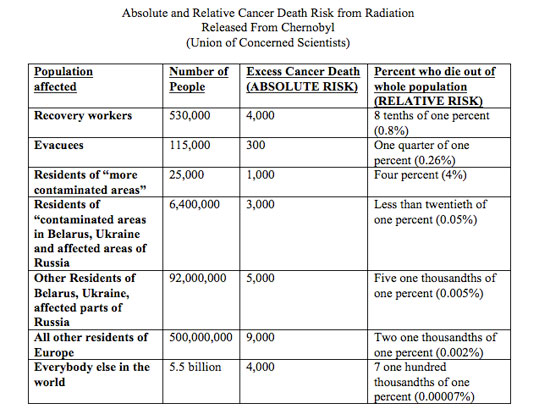
To make the importance of both absolute and relative risk clear, here’s a chart of what the UCS found, using their absolute numbers and adding the relative risk in the column on the right. (The UCS did not analyze relative risk, which is not surprising, since they are avowedly anti-nuke, and the relative risk for their various regional population subgroups is just as low, or in some cases far lower, than the WHO’s odds for the population they included less than 1 percent.)

(The UCS total is 26,300. They rounded it up to 27,000 in their release)
It’s one thing if an advocacy group wants to use numbers selectively to strengthen their case. Fair enough. That’s what advocates do. But news reporting on risk is supposed to give news consumers all the information they need to make informed, healthy choices. Coverage of risk that fails to include both absolute and relative risk fails that basic test.

If one were to apply the Union of Concerned Scientists methodology to commercial aviation we would expect to see an additional 79,000 cases of cancer with 40,000 fatalities from radiation exposure every decade. Anyone making that claim would be immediately labeled a crank, but because its the UCS and they are talking about Chernobyl its automatically assumed to have some validity.
#1 Posted by Mike H, CJR on Mon 2 May 2011 at 01:18 PM
And here is this author's client list:
http://dropeik.com/dropeik/clients.html
Shame on CJR for not being transparent on this author's agenda. I'm not saying he is right or wrong, but when the so-called "analysis" of media coverage is done by a PR hack working for industry & government orgs & agencies w/a profound vested interest in debunking Union for Concerned Scientists take on this, on the same day you run a hand wringing article on how PR has over-run legitimate journalism, you look really, really shoddy CJR.
#2 Posted by Lois Lane, CJR on Mon 2 May 2011 at 03:55 PM
@ Lois Lane
Did you neglect to see right at the end of the article where Ropeik provided a disclaimer and the very same link you did? Reading comprehension must not be one of your strong suits.
#3 Posted by Mike H, CJR on Mon 2 May 2011 at 04:17 PM
I read fine, Mike. I chose to pull it out and feature it in my link, because I wanted to emphasize it in the context that he is a PR hack & not a scientist, which is my choice as a writer.
Interpreting context must not be one of your strong suits there, Mike. As is indicated by your choice of commenting on the commenter, rather than sticking to the topic of the article. Keep talking to the invisible hands, dude. I'm sure they'll set you right.
#4 Posted by Lois Lane, CJR on Mon 2 May 2011 at 05:25 PM
OK, I'm the guy responsible for the coverage on The World that David is taking to task here. We're friends and former colleagues and professionals, so I don't begrudge his publicly questioning our decisions. But I do heartily disagree with the substance of his criticism.
The question of relative risk—prospective and abstract--is important when looking at what MIGHT happen in the future, and especially in deciding between alternatives--should we do X? Here are the likely numbers in scenarios X, Y & Z, here's what the relative risk per person in X area is likely to be, here are the relative risks of the alternatives. Which risks are we willing to take?
But risk assessment is irrelevant in looking back at something that has already happened—retrospective and concrete. Chernobyl is history, we've already made the decision, taken the risk and had the accident. The game is over. Certainly, the global average risk of death from cancer from Chernobyl is tiny. But the experience for those who will die from exposure to Chernobyl radiation--whether it's 4,000 or 27,000--is still 100 percent real, they’re still 100 percent dead, and we don't get to weigh the alternatives. And it doesn’t matter that statistically, and relatively, those people’s experience will be lost in a sea of other unaffected people.
And bottom line, we fully can't assess possible future risks unless we know as well as possible the actual impacts of past episodes. That's what Lisbeth Gronlund at UCS was trying to get at, using the internationally accepted method for calculating that likely number based on the total exposed population. I think that's perfectly fair, and not needing any more context within the bounds of this story.
But like I said, the concept of relative risk IS valuable looking forward, and we’ll be doing that. We plan to continue to report here at The World on nuclear power and the relative dangers it and other energy choices pose. And when we do that, we'll get into issue of relative risk--that's where it's important. But I don't believe it's important looking back like this.
#5 Posted by Peter Thomson, CJR on Tue 3 May 2011 at 08:38 AM
@ Lois Lane
There is no context interpret .. you chastised CJR for failing to disclose a conflict of interest when the disclosure was in plain sight.
@ Peter Thomson
And bottom line, we fully can't assess possible future risks unless we know as well as possible the actual impacts of past episodes. That's what Lisbeth Gronlund at UCS was trying to get at, using the internationally accepted method for calculating that likely number based on the total exposed population. I think that's perfectly fair, and not needing any more context within the bounds of this story.
Context is most certainly needed when one considers the validity of the “internationally accepted method” to calculate mortality when this same “internationally accepted method” would predict an additional 79,000 cases of cancer with 40,000 fatalities from radiation exposure every decade from dose exposure associated with commercial aviation.
#6 Posted by Mike H, CJR on Tue 3 May 2011 at 12:39 PM
I have a few problems with this piece and mainstream Chernobyl coverage in general.
First off, your WHO link was a report was limited in scope
http://online.wsj.com/public/article/SB114606007204936484-nrGm7xG7FvR02vrWIWY1Sf1qvbg_20060526.html
"Because of this great uncertainty, the WHO didn't count any possible deaths from low-dose exposure, focusing instead on the six million people closest to Chernobyl. "Any time you're looking at numbers that have to do with low-dose radiation, it's speculative" because of the dearth of studies on the health effects of low-dose radiation, WHO spokesman Gregory Hartl told me...
Keith Baverstock, a former WHO researcher who studies radiation at the University of Kuopio in Finland, told me in an email, "There is no excuse for the WHO/IAEA ignoring these fatal cancers" outside the immediate vicinity of Chernobyl. He added, "If we cannot believe that WHO tells us the truth about health issues it is a pretty poor outlook for public health.""
Also it makes assumptions which are not based on observations of radiation exposed populations to reduce the amount of cancer related deaths. From the report:
"The estimated 4000 casualties may occur during the lifetime of about 600 000 people under consideration. As about quarter of them will eventually die from spontaneous cancer not caused by Chernobyl radiation, the radiation-induced increase of about 3% will be difficult to observe."
Whether or not a quarter of the population would die anyway of cancer without Chernobyl does not effect how the type and timing of the irradiated population's cancers are related to Chernobyl. That's like trying to use the excuse "he was going to die anyways" to absolve a murderer.
Or, as the wsj page above put it "the report relied heavily on some questionable methods. It assumed that Chernobyl was responsible for an overall increase in cancer rates, but Chernobyl's effect on those rates is difficult to isolate from other factors, such as changes in smoking rates and improvements in the diagnosis of cancer."
But oh well, that's the WHO and IAEA for yah. What we should be talking about is the risk of exposure. We should be able to take people (via tests on animal subject proxies) who have been exposed to various levels of radiation and who have absorbed various quantities of isotopes into their bodies and make predictions of their conditions years later with a certain margin of error. We should also be able to measure chromosomal damage from these exposures by examining the offspring for defects. We should then be able to establish a relationship between an individual's exposure and the risk of expected ailments.
In the case of Chernobyl, people world wide tried to limit their exposure and reduce their individual risks. Your measurements of "absolute" and "relative" risk do not represent the risk of Nuclear accidents, they represent the risks of Nuclear accidents despite people's efforts to lower exposure. They also don't represent the risk over time of re-exposure from contaminated land. If you are going to imagine the relative risk to the population from an accident, you'd better imagine a relative population which is living in the affected area and is doing nothing to protect themselves.
Otherwise you give the impression that nuclear accidents are safer than they are, and that nuclear power is less risky than it is, based on meagre stats. It's like saying "Lions in aren't very dangerous since thousands of people see lions everyday at the zoo." The lions in a zoo are caged and locked. If there was a lion accident, downplaying the "relative risk" of lions in the zoo hurts the threatened public.
#7 Posted by Thimbles, CJR on Tue 3 May 2011 at 12:52 PM
We should be able to take people (via tests on animal subject proxies) who have been exposed to various levels of radiation and who have absorbed various quantities of isotopes into their bodies and make predictions of their conditions years later with a certain margin of error. We should also be able to measure chromosomal damage from these exposures by examining the offspring for defects. We should then be able to establish a relationship between an individual's exposure and the risk of expected ailments.
That’s the problem, below a certain dose you can’t conduct an epidemiological study and expect any meaningful results. The sample sizes are too small to control outside variables. So organizations like the IAEA and the WHO draw a linear line from the lowest observable dose/response point to zero and extrapolate effects based on that line.
Your lion analogy is therefore not appropriate. Here is an analogy that is: due to differences in rock geology, the background radiation dose in Denver is 50 millirem and the background radiation dose in Washington DC is 25 millirem. Given this 25 millirem dose difference between the two locales, and using the UCS’s methodology, one would expect to see an additional 17,500 cancer cases and 8500 cancer deaths in Denver when compared to Washington DC.
Could anyone argue that’s a reasonable conclusion? If it is, it means we need to evacuate the entire state of Colorado and if it’s not it means the LNT isnt good science.
#8 Posted by Mike H, CJR on Tue 3 May 2011 at 03:12 PM
Mike, you mixed up two issues. The first issue was the screening from the WHO study of people exposed to "low level" radioactive pollution.
The second is the screening of cancers from members of the high level exposure based on the idea that they would have gotten some cancer anyway, eventually, and therefore we won't count those cancers as Chernobyl related.
Your Denver Colarado analogy is related to low level exposure, not to the assumptions used on high level exposure.
Another difference between Denver and say Belarus or Finland (which people claim were low level exposed) is that in Finland or Belarus the radioactive pollution is more likely to be injested than in Denver. The effects of low level radiation on the skin is different than the effects of low level radiation emitted within your body. If you think I'm wrong, this too would be easy to test in a lab with animals injesting low levels of radioactive isotopes similar to what people find in populations in Finland and Belarus.
Doing studies based on exposures produces better studies of real risks than using population studies with uncontrolled variables who were trying to reduce their exposures and risk.
Making claims based on percentages of what is considered acceptably affected versus the general population is just an author's way of making us feel more comfortable with a lion that's on the loose.
#9 Posted by Thimbles, CJR on Tue 3 May 2011 at 07:54 PM
The author describes the Union of Concerned Scientists as "avowedly anti-nuke," which is not true. UCS is neither pro- nor anti-nuclear power, but a nuclear power safety watchdog. Our homepage has a link to our position on nuclear power: http://www.ucsusa.org/nuclear_power/nuclear_power_and_global_warming/ucs-position-on-nuclear-power.html
I did not draw any conclusions about nuclear power based on my analysis of the number of cancers and cancer deaths that will be attributable to the Chernobyl accident, but did feel it would be useful for people to have an accurate number to draw their own conclusions. In fact, I was motivated to look at this question because the estimates I saw in the media varied widely--and I found that it was often a case of apples and oranges and that many of the estimates were consistent with each other if you looked more closely.
#10 Posted by Lisbeth Gronlund, CJR on Tue 3 May 2011 at 11:13 PM
Great conversation.
I replied to my friend Peter Thompson, and to Lisbeth Gronlund, by email, and thought I'd share my thoughts to Dr. Gronlund here as well.
" A great deal of the concern about the cons of nukes centers on the question of safety, and risk. Looking at what we know about the risk of ionizing radiation from Hiroshima and Nagasaki, I don’t feel that the relative risk of radiation is nearly as high, as dramatic, as scary, as many people make it out to be. Exposure even to those godawful levels (and different isotopes/radioactive sources released at the moment of the explosions), for such extended periods of time and by the full suite of pathways (food, water, etc.) produced relative risk increases of death from cancer of less than 1%. Somewhere on the order of 900 deaths, out of 120,000 survivors followed for two generations! And no evidence of long term genetic damage. As a reporter who covered nuclear power extensively, and reported on it as really dangerous in part with the help of scientists at the UCS, I was stunned to learn this basic radiation biology when I wrote my first book. Seen through the lens of relative risk this threat is simply not as high, not as dramatic, not as scary, as many people make it out to be. Not when plants melt down. Not from the waste. It certainly is dangerous and we certainly ought to do everything reasonable to reduce those dangers and ‘watchdog’ the agencies responsible for that. But both the absolute AND relative risks of any option for power need to be on the table as we consider our choices. And the relative risk of nuclear is far lower than most people realize.
That’s important for informed policy making. Which is why it’s important for journalists to report, so people can have all the facts that help them make up their minds, not just the more alarming aspect, as the more dramatic absolute numbers your analysis identifies,even while it and the coverage of it, omits the reassuringly low relative risk.
Let me close with one note. I am devoutly agnostic on how we generate base load electricity. Nuclear has pros AND plenty cons, as do renewables, and coal, and natural gas. I’m chiming in on all of this simply because I think we need to be as open minded and thoughtful as we can be, and as someone who thinks about how the psychology of risk perception influences our views, I worry that the alarming psychology aspects of nuclear are interfering with that open mindedness. And in part this means we are at greater risk – from local pollutants and long time climate change.
#11 Posted by david ropeik, CJR on Wed 4 May 2011 at 09:11 AM
Dude, get the f outta here. You know nothing about the stories of the hibakusha except data, similar to yours in regards to Chernobyl, based on highly pro-nuclear government information. The japanese government has been discredited in its hand in hand treatment of nuclear power producers with their tendencies to build plants on fault lines and skimp on maintenance + inspections.
http://www.msnbc.msn.com/id/42188550/ns/world_news-asia-pacific/
Japan sweeps embarrassing and controversial information under the rug and feeds false information as standard practice. These were the same yahoos who told the population to boil water to reduce its radioactivity in order to stop the runs on bottled water.
http://search.japantimes.co.jp/cgi-bin/nn20110323x2.html
Japan is dependent on nuclear energy and on the nuclear industry. They need the people to feel safe. Putting the claim out that only 1% of the hibakusha suffered from radiation makes some people feel safe but at the cost of dishonoring the many victims of those bombs by trivializing their scars and their legacy. Thanks for helping.
And as a journalist I'd expect you be aware of the differences between the effects of a nuclear explosion (small amount of fuel, big bang, little residual effects) and the effects of a nuclear accident (large amounts of fuel, small bangs, large residual effects as nuclear pollutants are dispersed over where ever the wind will take them)
But whatever. I too worry greatly about climate change and I accept that nuclear is going to be a part of how that is addressed, but nuclear is a for profit industry and when you minimize the risks and the realities of nuclear energy, you incentivize a lax approach to crisis prevention. Companies cut costs by cutting inspections, replacing competent professionals with cheaper contract labor, skipping required maintenance, filling up 40 year old boiler pools with spent fuel rods that require a constant source of power to pump water (because the redesign that doesn't require power costs money).
Companies believe your hype and think nuke power isn't all that dangerous, surely not requiring every little expensive detail to protect the public. "Protect the public? From what? A 1% increase in provable radiation related disease according to our pro-nuke government?"
Shouldn't you be penning articles defending cigarettes?
#12 Posted by Thimbles, CJR on Wed 4 May 2011 at 11:47 AM
Hibakusha reading:
http://www.informaworld.com/smpp/content~db=all~content=a770375839
http://www.min-iren.gr.jp/mezasu-iryo/09hibaku/genbaku_e1.html
DS86 = Dosimetry System 1986, the basis used to claim one person is a hibakusha suffering from exposure to the atomic blast (which entitles them to money) and another person is a hibakusha suffering from what must be serious allergies and a bad smoking habit.
#13 Posted by Thimbles, CJR on Wed 4 May 2011 at 12:18 PM
Sorry you keep missing that context boat, Mike H.
I was comparing use of a PR hack on the CJR website as an "expert" on nuclear power, to the CJR article published on their website the same day, decrying same sort of use of "experts" from PR industry:
http://www.cjr.org/feature/true_enough.php
It is fine if you disagree with my interpretation of that context, but it doesn't make you right or more right than me for interpreting the way CJR was putting out these stories side by side on the same day. Just makes you kind of a jerk for needing to "win" & slap me down for thinking and interpreting the stories differently than you.
But then, I see by your other subsequent comments you must have a horse in this pro-nuke race you are running.
#14 Posted by Lois Lane, CJR on Wed 4 May 2011 at 04:00 PM
Lois Lane, you're way off base here. David doesn't claim to be an expert on nuclear power, nor do we (I'm his editor here) claim that he is. He is an expert in risk analysis and the coverage thereof. Read the column again. He doesn't make any statements about the validity of the UCS data or the pros/cons of nuclear power in general. Indeed, he's actually making a very simple point: that there are two sides to the statistical coin that is risk analysis—absolute risk and relative risk—and that it is important that journalists cover both.
Furthermore, calling David a "PR hack" is not only unfair, it is immature. Yes, he has consulted for organizations involved in the nuclear industry, and CJR readers should absolutely take that into consideration when reading this article (that's why we included the disclaimer). And, yes, readers are entitled to whatever opinion they wish based on that information. But you should think about trying to make your case without the invective. It's easy to hurl insults at people. Kids do it all the time. My advice: grow up.
#15 Posted by Curtis Brainard, CJR on Wed 4 May 2011 at 05:26 PM
What journalists learned from this article is that, even if you're an expert in risk analysis and the coverage thereof, accurate risk assessment requires accurate data. One has to be very careful with their data sources especially when the governments and organizations providing the data are advocates for a particular issue / technology.
You need to ask questions like "What does "affected by radioactive exposure" mean to the data provider when they report "8 tenths of one percent" of people were affected."
You'd have no problems doing that if Greenpeace was publishing the study. When you use data that was gathered under bad assumptions, and do so uncritically, you produce bad risk analysis. GIGO.
And if you want to produce good risk analysis of catastrophic conditions, simulate the conditions in a lab and use those results as your data.
#16 Posted by Thimbles, CJR on Wed 4 May 2011 at 07:23 PM
Curtis, you are predictably circling the wagons because the criticism is directed at CJR editors. Nothing more, nothing less. CJR editors have a pro-nuclear establishment bent that has become obvious in the wake of Fukushima.
Of course the CJR editor who published this article takes offense to the author being referred to as a PR hack, because it calls their integrity into question.
Of course, that doesn't change the fact the author is still a PR hack. Just like the other PR hacks that other CJR article was calling into question. So, when CJR does this, they are behaving like adults. When a CJR reader does this, they are "way off base" and childish.
Hmmm...no double standard one for me one for thee going on, right?
Pfffft.
Thanks, Thimble, for pointing out that CJR would "have no problems doing that if Greenpeace was publishing the study." Which is my point. CJR is biased in the science coverage of nuclear power.
#17 Posted by Lois Lane, CJR on Thu 5 May 2011 at 09:53 AM
David, why should what you derisively refer to as "psychological aspects of nuclear" and "psychology of risk perception" not be one very legitimate part of the complex equation a civil society uses to decide which forms of energy generation to use? Should we also set aside the financial and economic analysis too, because it can't be "scientifically proven"?
Are citizens themselves not to be allowed any say in this matter, based upon what risks they do or do not want to assume in regards to energy generation?
We are human, and humans have many intelligences and ways of knowing to use to make what is, in the end, a judgment call. Shaky pseudo science of PR debunkery is no panacea, any more than shaky 'love mother earth' emotional appeals are, but yet the pro-nuclear establishment keeps making emotional appeals to those clinging solely to the "rational and logical" ways of scientific knowing, while demonizing those scientists who challenge their position. How are those emotional appeals any different from the 'love mother earth' emotional appeals? I see no difference between the two. Conventional establishment wisdom is conventional establishment wisdom.
Many scientists have legitimately challenged the conventional wisdom of the nuclear establishment, yet they are routinely treated as if they are UFO conspiracy theorists by both the conventional journalism establishment, and the conventional pro-nuclear industry PR establishment.
This article & comments to same are a perfect illustration of this dynamic. You disingenuously represented UCS as "anti-nuclear" when in fact their organizational mission is to act as an independent scientific watchdog organization. Now, I'm sure you and CJR would much prefer the nuclear establishment not have any independent watchdogs, as they so trouble your status quo waters. But independent watchdogs protect us from the excesses and abuses from both government and industry, in a brave attempt to protect us all.
So maybe it is time both you & your CJR editors had a second look at the ways you are attacking and discrediting the messengers.
#18 Posted by Lois Lane, CJR on Thu 5 May 2011 at 10:19 AM