Sign up for the daily CJR newsletter.
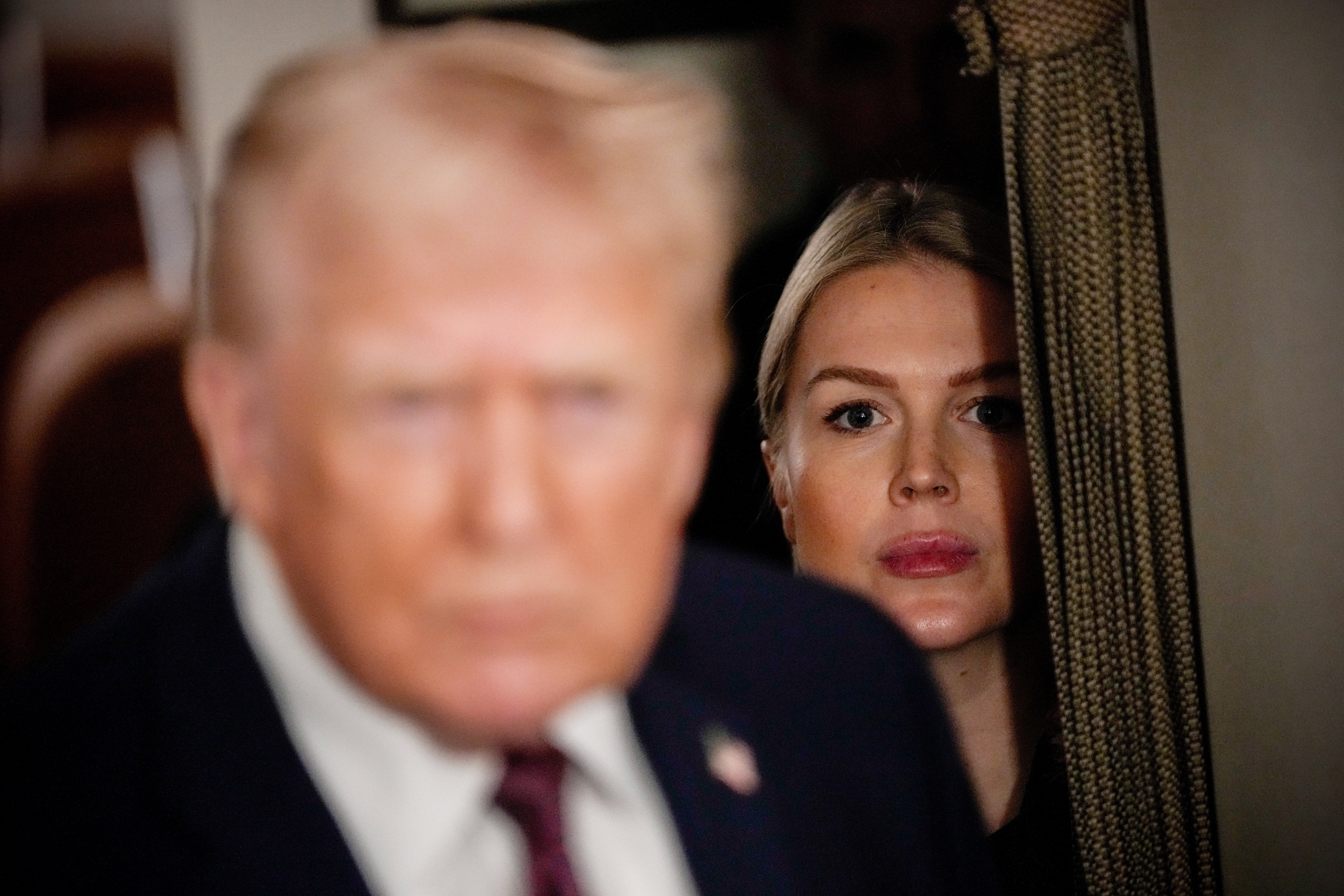
On January 28, 2025, a few days after Donald Trump’s second presidential inauguration, Karoline Leavitt addressed the media for the first time as White House press secretary. At twenty-seven, Leavitt was the youngest person ever to hold the job. She had climbed the ranks of the MAGA inner circle quickly. She graduated from college in 2019; made an unsuccessful bid for Congress, with Trump’s endorsement, in 2022; and was eventually elevated to press secretary for his 2024 presidential campaign. Speaking to reporters at the White House that January, Leavitt showed that she was quick-thinking, combative, and a native speaker of Trump’s language of hyperbole and grievance. When a reporter asked about the consequences of the Trump administration’s push to slash federal spending, Leavitt said that the Biden administration had “spent money like drunken sailors” and that the Department of Government Efficiency—better known as DOGE—and the Office of Management and Budget had discovered “there was about to be fifty million taxpayer dollars that went out the door to fund condoms in Gaza,” in what she called a “preposterous waste of taxpayer money.” The Gaza condoms claim was, in fact, preposterously untrue. Some United States funding had gone to contraceptive healthcare in developing countries, but it was nowhere near the amount Leavitt claimed, and none of it had gone to Gaza. (That did not stop right-wing commentators from repeating her claim again and again.) The episode revealed how Leavitt would approach her tenure as press secretary: responding to scrutiny with irritation and displaying a Trumpian willingness to deny reality.
Last week, Trump announced that Leavitt will depart at the end of August, calling her “one of the best” presidential press secretaries in history. Over the past year and a half, she has been described as Trump’s “attack dog” and as having “all the subtlety of a Rottweiler.” Trump has said of Leavitt—in a totally not weird or creepy way—that “those lips, the way they move, they move like she’s a machine gun.” Leavitt will be Trump’s second-longest-serving press secretary, behind Sarah Huckabee Sanders, who held the job from 2017 to 2019. “The truth is since returning to the White House after the birth of my daughter, I have felt in my heart that I cannot be the best mom my two young children deserve while devoting the constant time, energy, and attention required of the White House Press Secretary,” Leavitt wrote on X. “President Trump has asked me to continue serving as a top advisor to him on the outside, and I will always remain a vocal advocate for MAGA and the Republican Party.” No replacement has yet been announced. Meanwhile, the midterms are less than three months away, and Trump’s approval rating is sliding.
What Leavitt seemed to understand better than many of her predecessors was that, inside the MAGA court, the goal of press relations is to put on a good show. She brought a Punch-and-Judy style to media briefings that is perfectly suited to the era of short-form video. “That’s a ridiculous line of questioning,” she told one journalist. “What a stupid question,” she said to another. “You’re a left-wing hack,” she replied when a reporter questioned her about the killing of Renee Good by a federal agent. “Your mom did,” she told a journalist by text, when he asked who suggested Budapest for a proposed meeting between Trump and Russia’s Vladimir Putin. The Financial Times’ Joe Miller has noted how Leavitt “transformed the famous White House briefing room into a production facility for viral social media clips.” This has all seemed to please her most vital spectator, her boss. But behind the scenes, according to several White House correspondents, Leavitt was often collegial and helpful, including to news organizations with which she enjoyed clashing publicly. Trump, too, likes to make himself available to reporters even as he threatens, sues, and demeans them. Leavitt was so successful because, as CNN’s Stephen Collinson wrote last week, she “understands the Trump id.”
For the past year and a half, Leavitt has helped define the relationship between the president and the US press. What legacy will she leave behind? One of her first moves was to welcome content creators—many of whom, such as the podcast host Tim Pool, have openly cheered on the Trump administration—into the White House media ecosystem, starting press briefings with a question from the “new media” seat. (Aida Alami wrote for CJR about the “surreal” quality Leavitt brought to the briefing room.) Would a future Democratic president be able to resist bringing supportive influencers into the press room? The White House also took control of who could participate in the media pool, which for decades had been managed independently by the White House Correspondents’ Association. I wonder if that, too, is here to stay. These changes, along with her constant criticism of the media and blasé attitude toward facts, have further degraded the relationship between the president and the press corps. “I won’t muck about with euphemisms such as misrepresented or stated without evidence or made false claims,” The Guardian’s Arwa Mahdawi wrote on Friday. “Leavitt’s legacy in government was attacking Trump’s enemies and spouting lie after lie after lie.”
What I find most troubling about Leavitt’s tenure is how she and the wider Trump administration seemed to conceptualize the role of their press relations team. In the post explaining her resignation, Leavitt wrote: “I have relished holding the liberal media accountable and ensuring the American people hear the truth about President Trump’s successes.” That’s a funny way of looking at it. Let’s not forget that Trump 2.0 has deployed armed agents to American streets to snatch people away; spawned unprecedented corruption in shady areas of finance and cryptocurrency; started a foreign war without congressional approval; and destroyed or remade American institutions, buildings, and monuments. But the White House press secretary believes it is the media that must be held accountable? I’m not against media criticism (it’s what we do here at CJR, after all). But this is such a willful misunderstanding of what federal communications officials exist to do, which is to inform US citizens about the actions taken on their behalf and with their tax dollars. Leavitt has instead treated requests for information as partisan attacks. Her contempt for the media extends to the American public, too.
We don’t yet know what’s next for Leavitt. Perhaps she will turn up as a host on Fox News, like her predecessor Kayleigh McEnany, or run for office again, like Huckabee Sanders, who is now the governor of Arkansas. Trump didn’t add much detail when he said, on Truth Social, that “Karoline will now be one of my top outside advisors, and an influential voice within the Republican Party.” What we do know is that Leavitt is leaving relations between the executive branch and the Fourth Estate far worse than she found them. Her impact may be felt for a long time.
Other Notable Stories …
By Jem Bartholomew
- Last Monday, the Washington Post reported that Donald Trump had used deception to secretly board a military flight from Turkey to the United Kingdom while returning from a NATO summit, because of a “credible threat to Trump involving Iran.” That left journalists and some White House staff, on the older version of Air Force One, in the false belief that they were on the same plane as the president—who had in fact been smuggled off via a catering truck—and raised questions about whether “unwitting passengers on the ‘decoy’ plane” were in “possible danger.” Reporters at the New York Times discussed the event, and the thinking behind covering it, in this “Times Insider” piece.
- On Wednesday, The Intercept and the Freedom of the Press Foundation filed a lawsuit against Trump and his staff, challenging a scheme announced last month for Truth Social—the strange social media company I wrote about in May, of whose parent company Trump is the largest shareholder—to charge for early access to Trump’s posts. “Trump is trying to enrich himself by privatizing government information that he has no right to sell,” Ben Muessig, The Intercept’s editor in chief, said. “We won’t let it stand.” The complaint has been filed in the Southern District of New York and alleges that the scheme restricts First Amendment–protected information.
- In the UK, the press is facing criticism after the death, on Friday, of Jason Arday, a former professorial chair at the University of Cambridge whose academic and personal achievements came under scrutiny in recent weeks ahead of the publication of his memoir, Great and Unfortunate Things. Arday, who was Cambridge’s youngest-ever Black professor, was accused of plagiarism and inconsistencies in statements about his career; on August 5, he stepped down from his job. The Good Law Project, which had been representing Arday, called for a public inquiry into his death, saying Arday faced “two weeks of relentless harassment” by the UK press despite private warnings that their “pursuit of Dr. Arday risked his suicide.” Arday had been attacked by right-wing outlets, in particular, as a DEI hire. The Good Law Project letter added: “There cannot be any doubt that racism lay at the heart of this story.”
- Wilmer Roberto Solano Dávila, a Venezuelan journalist based in Miami who was detained by US Immigration and Customs Enforcement (ICE) on July 26, was reportedly released on Friday, according to a post from the Association of Venezuelan Journalists Abroad (APEVEX). (I wrote for CJR about Solano’s detention this month.) “We are now putting our lives back together, piece by piece, like a puzzle,” Solano’s family wrote on his GoFundMe page, which has been closed for donations, on Saturday. “Although Wilmer is home, his immigration case continues, and we must move forward with his legal defense. But now, we can face the next steps together as a family.”
- Yalda Moaiery, an acclaimed Iranian photojournalist, learned last weekend that she had been sentenced to fifteen years in prison, Reuters reported. Moaiery’s work documenting dissent and the lives of women in Iran has repeatedly brought her into contact with the Iranian authorities. On February 3, according to the Committee to Protect Journalists, the intelligence wing of the Islamic Revolutionary Guard Corps raided Moaiery’s home in Tehran amid a wave of anti-government protests, seizing her phone, laptop, and other electronic equipment. (At the time, CPJ condemned the raid and called on Iranian authorities to “immediately cease targeting journalists.”) According to Reuters, Moaiery has ten days to appeal under a 2025 espionage law. In other news, on Sunday, Iran’s parliament advanced a bill that would criminalize interviews or communications with media outlets deemed hostile to the regime, Reuters reported, citing Iran’s Shargh newspaper.
- And for CJR, Kyle Paoletta reported on the Times Opinion desk, which has recently scaled up its original reporting, “leading to more overlap” with the news division “and, inevitably, more hard feelings.” Paoletta speaks to Times editors, writers, and producers—including Kathleen Kingsbury, the Opinion editor—about what makes the desk unique. “If the newsroom tells you how to understand the world,” Kingsbury tells him, “the work of the Opinion desk is to give you clarity and context around it.” But in terms of rigor and reporting standards, Matthew Rose, the editorial director of Opinion, tells him, “I would not draw any difference between the way we would think about it and the way the newsroom would think about it.”
Has America ever needed a media defender more than now? Help us by joining CJR today.