Sign up for the daily CJR newsletter.
My first day on the job, I fucked up. This was not a call-the-libel-lawyers-ASAP fuckup. Nor was it a who-spelled-Trump-as-Trummp-on-the-homepage fuckup. It was a lesser offense, a rookie mistake, though in this case, the rookie was sixty-nine years old and had been editing news copy since he was nineteen.
I’d just started my stint as a visiting editor at the Salt Lake Tribune, and the content management system was driving me nuts. So I moseyed over to another journalist in the newsroom and asked where I could find the strike-through function. “I mean, this lede is pretty clunky,” I added, gratuitously.
My new colleague patiently showed me how to execute the command, and then said something along the lines of, “By the way, Bill, that was my lede.”
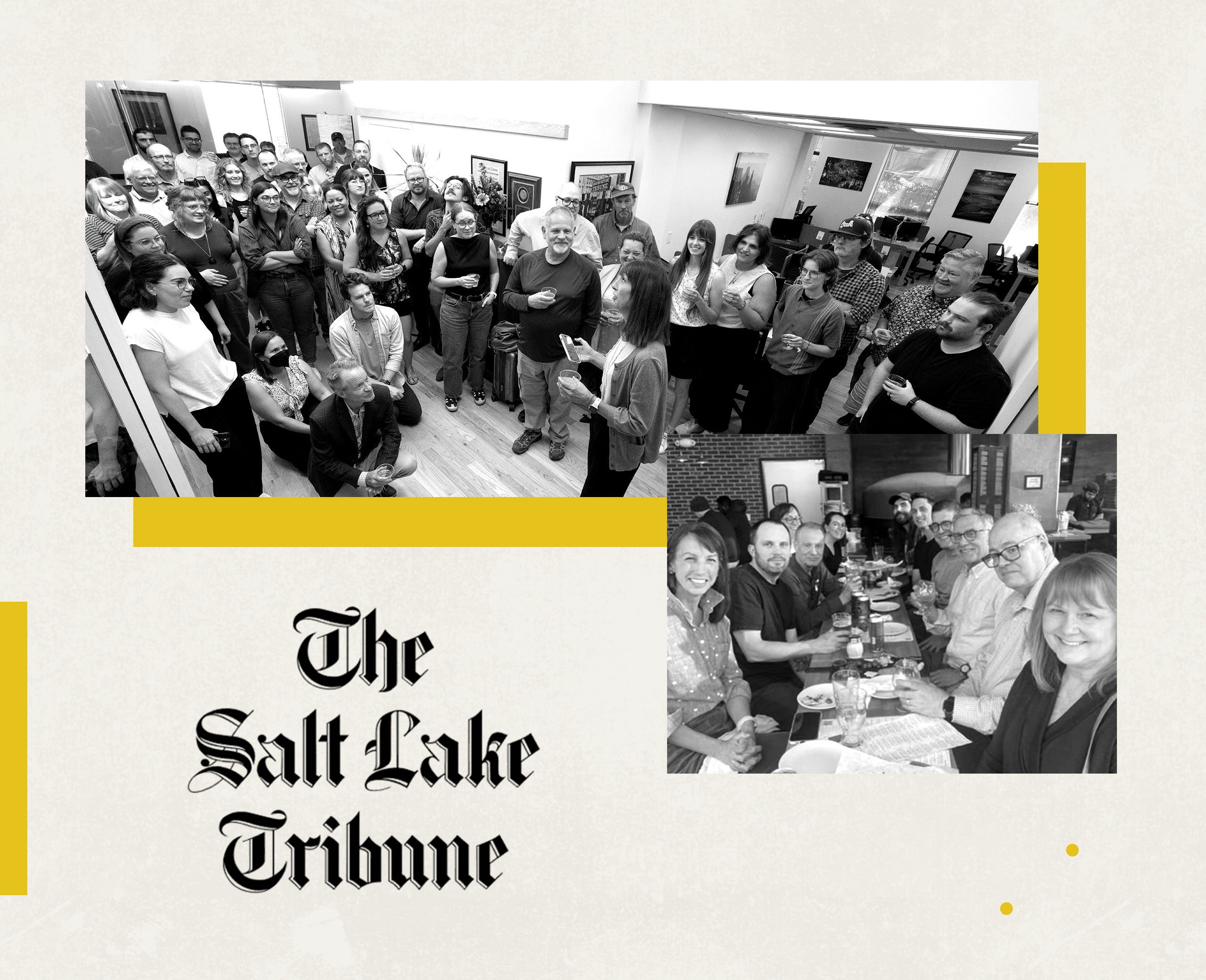
Such was the auspicious beginning for my nearly four months in the Tribune’s newsroom, where I regularly commissioned, edited, and backread stories, attended twice-daily news meetings, and participated in other gatherings, from story-planning sessions with senior editors to beers after work with the staff.
During that time, I handled stories ranging from a quick hit about a popular pizzeria to an examination of a secretive state agency that green-lighted a massive data center and a wide-ranging story looking at the impact of soaring fuel prices on Utahns. The newsroom broke major stories, including that of a city councilwoman accused of unwanted sexual advances by four on-the-record sources, and details about who profited when Immigration and Customs Enforcement secretly spent 145 million dollars for a warehouse near the airport.
In the process, I learned a lot about what has changed in local journalism since I was in the thick of it, three decades ago. Even more interesting, I saw what stayed the same.
First, some background: I spent the first fifteen years of my career in local newsrooms. Right after college, I moved to North Dakota, where I founded a weekly newspaper on the Standing Rock Sioux Indian Reservation. That paper, the Dakota Sun, is now defunct. From there, I was a reporter and editor at the Baltimore News-American (now defunct), the Tampa Tribune (now defunct), and the Miami Herald (still kicking, but with a fraction of the staff who used to work there). I left the Herald in 1995 to work at the Wall Street Journal, where I stayed for thirteen years before coming to Columbia Journalism School as academic dean.
Last fall—thirty years after I left Miami—I decided to return to local news. I knew things had changed a great deal, but I didn’t know the full extent. I wanted to learn more about how a local news organization can survive, or even thrive, these days. I’m convinced that the erosion of local news—some thirty-five hundred American newspapers have died in the past two decades—is at the heart of many of our problems today. When a local newsroom shrinks or disappears, people in that town lose touch with their community, their leaders, and with shared civic life. Great news organizations bring us together, and the elimination of them splits us apart.
Columbia had given me a paid, one-semester sabbatical. So, last fall, I reached out to some industry leaders, and even posted a position-wanted ad in Editor & Publisher, with this offer: I will work in your newsroom, for free, from January until May, and I’ll do whatever you need me to do. I’ll assign and edit stories, but I can also write obits and cover high school basketball games. My only requirements were that I actually work (and not simply observe) and that I be able to write about my experience for the Columbia Journalism Review, with the caveat that I’d follow internal rules about newsroom confidentiality.
I heard from a dozen or so editors, but they raised a lot of concerns. What would our HR department say? What would the union think? What would your CJR story reveal? And, most often: Why would you want to work when your employer is paying you to take four months off?
And then I made my pitch to Lauren Gustus, the CEO and executive editor of the Salt Lake Tribune. And her reaction was: How can we make this happen? She was also supportive of my doing this story. “We’re an open book and welcome feedback, so it was an easy decision,” she later told me.
The Tribune appealed to me for several reasons. I grew up in Colorado Springs, another Rocky Mountain city with conservative roots. The newspaper has a long legacy. It was founded more than a hundred and fifty years ago, vowing to be a “purely secular journal… the organ of no religious body.” In recent years, it has been at the center of the biggest changes in local journalism. In 2010, it came under the avaricious thumb of Alden Global Capital, which did what it usually does to local newsrooms. A few years later, Paul Huntsman (whose father was a local billionaire and whose brother had served as governor) bought the paper. Shortly thereafter, the Tribune won a Pulitzer for its coverage of Brigham Young University’s mistreatment of sexual-assault survivors. Even so, Huntsman soon realized that, as he put it, “the business model for local newspapers is broken and beyond repair.” He decided to help turn the Tribune into a nonprofit—the first major American daily newspaper to make that transition.
That move has been a success. Last year, the Tribune brought in about thirteen million dollars in revenue, a million dollars more than it incurred in expenses. Its revenue came from several streams: contributions from big foundations and individual donors, advertising in its online and twice-weekly print editions, and subscription fees, though the paywall would be removed shortly after I left Utah, in May. Similarweb’s ranking system regularly puts the Tribune’s traffic among the nation’s top two or three nonprofit news organizations, alongside such stalwarts as ProPublica and the Texas Tribune. It’s also ambitious, acquiring one newspaper in southeast Utah and starting another in the southwest corner of the state. Recently, management signed its first contract with the new newsroom union, guaranteeing a sixty-thousand-dollar salary floor, at least three weeks of vacation, and generous work-from-home provisions.
And Salt Lake City is a terrific news town. There’s the Church of Jesus Christ of Latter-day Saints, which dominates the geographical center of the city, along with much of the business community and state government. But the church’s influence isn’t monolithic. Yes, Utah bars won’t allow you inside without first scanning your ID, and the state has the lowest blood alcohol threshold in the country for DUI. But there are plenty of excellent breweries, and I’ve never had better coffee in the United States than at the shop three blocks from the newsroom. Yes, Utah gave Donald Trump almost 60 percent of the vote in 2024, but Kamala Harris racked up a ten-point margin in Salt Lake County. (My neighbor’s car still sported a Bernie! bumper sticker, and a house down the block displayed a Harris-Walz campaign sign.) The city is surrounded by gorgeous mountains, and it also lies near the Great Salt Lake, where plummeting water levels have exposed toxins that can be blown toward fast-growing cities.
The Tribune’s staff of around thirty reporters and video journalists compete against a few solid local TV stations, as well as the church-owned Deseret News and a government-focused nonprofit, the Utah News Dispatch. That means pretty much every major beat that the Tribune covers—politics, education, the environment, the LDS church—has rival reporters. You don’t see that in many metro markets.
This is the part of my account where I worry that I’m going to come over like Grampa Simpson, yelling at a cloud. Or a journalistic Rip van Winkle, waking up after a few decades and marveling at all the new gizmos that the kids are using these days. That’s part, but not all, of the story.
When I left local journalism, we were still using X-Acto knives to trim stories on the pasteup floor. The Miami Herald’s website hadn’t yet launched. But I also later ran the Wall Street Journal’s online newsroom, and worked at the all-digital Bloomberg News. I’ve spent a lot of time at Columbia teaching and studying how digital platforms and business models are transforming the news business.
Here are my main impressions from Utah:
Data. Numbers were at the foundation of countless editorial decisions. Maybe this shouldn’t have come as a surprise. I’ve visited newsrooms where Chartbeat—a prime provider of reader data—appears on huge screens above reporters’ heads. Years ago, I co-taught a class for Stanford students with Tony Haile, the founding CEO of Chartbeat.
But I wasn’t prepared for how deeply data would be embedded in the Tribune’s workflow and mindset. Morning meetings start with the analytics editor displaying Chartbeat on a shared screen, while about a dozen colleagues look on. Since the meeting starts at 9am, a few hours after most stories have gone live, we could observe enough statistics about page views, unique users, and time spent to see which headlines and stories were cutting through, and which were moribund. For many of us, data became a key determinant of success or failure. Editors would laud a story that “is doing well,” or push us to rework the headline of a story that “isn’t cutting it right now.” We prized third-party traffic from Google Discover, Apple News, and social media, even if the reasons for those boosts were often obscure.
And it wasn’t just the bosses. Reporters were expected to load up Chartbeat and see how their stories were performing. Some of them would start checking their numbers as soon as they woke up. If traffic to their story was meager, there’d be a sometimes painful postmortem—either privately or on a newsroom Slack channel—to see how we could have framed the story, or written the headline, to attract more eyeballs.
Mo’ paywall, mo’ problems. Even as we could see how our stories were performing on our website, we had less insight into how or why our journalism was resonating on other platforms. A story that got a few thousand visitors on the site might, in its video version, get hundreds of thousands of views on Instagram.
This gets to a thorny problem for many news organizations, especially those that depend upon paywalls to stay in business. While I was at the Tribune, it was a subscription site, though most stories other than high-enterprise pieces were free. Still, paywalled stories that got readers to subscribe were highly valued and, to a lesser degree than high-traffic stories, praised in our news meetings. That reflected a schism when you rely on ads and paywalls. More than a third of the company’s revenue last year came from subscriptions, but a quarter of it came from ads (both divided between digital and print). So did we want to make stories free, thus increasing the potential for ad revenue (since more page views generally lead to more dollars)? Or did we want to paywall stories, and incentivize readers to subscribe?
And which outcome was better for donors, who contributed more than a third of the Tribune’s revenue? Were they more likely to donate if they see our traffic soaring, or if they see that more readers are subscribing?
For reporters and line editors, who knew that page views were an important component of how they were being evaluated, there was obvious gratification in a traffic hit. That was coupled with concerns about impact: A paywalled story was often a lightly read story. A subscriber-only piece that got a lot of initial attention could fall short if people couldn’t read beyond the first few paragraphs. For example, a well-written paywalled piece on how the warm winter had ended one ski area’s season drew thousands of page views, but the engaged time averaged out to just a few seconds.
Story selection. When I worked as a city editor in Miami, I would occasionally get “story suggestions” from executives at the Herald or Knight-Ridder (the CEO’s office was one floor above mine) about a routine community event. It was usually worded along the lines of “Up to you, but this is something you might want to cover.” I soon learned that I had about as much choice in these matters as a murder suspect being told that he can either testify against his codefendant or face the electric chair. Or, as one of my colleagues used to say, “We can either write that story today, or we can spend all day tomorrow explaining why we didn’t.”
Those memories lingered in Utah, especially since my main responsibility at the Tribune was to guide the reporters who were restarting our coverage of local business. Anyone who has covered this beat knows that it generates a ton of uninteresting press releases, often accompanied by pressure to follow up. Shortly after I arrived, I learned about the upcoming annual Silicon Slopes Summit conference, which draws hundreds of businesspeople to the city and is a sign of Utah’s stature in the tech industry. A few days before the event was to begin, I asked Sheila McCann, the deputy executive editor, “I guess we need to do an advance story about this, right?” She responded with one very useful word: “Why?”
She was right; few people read these obligatory stories. And this is where data can be your friend, when it liberates you from covering stories you don’t want to write and that people don’t want to read. (As for that conference, we did run an excellent story looking at the transformation of Utah’s tech industry, which was pegged to the event but not solely based on it.)
In my former life, when I’d push back on these command stories, I’d often hear some version of the adage “There are no boring stories, just boring reporters.” It turns out that a lot of stories are boring, no matter who writes them, and being freed of doing those (or worrying about the consequences of not doing them) is a wondrous thing.
Headline “rodeos.” I loved these. No more toiling in quiet agony as you try to craft a compelling headline. Just drop a story budget line or draft into the Slack channel, and invite your colleagues to help write a headline that will get far more traffic than the lousy one you’ve been struggling with all day. That’s how a headline about a sentencing for a therapist who secretly recorded his patients as they undressed went from starting with “Harsher than plea deal” to “‘The victims trusted you.’”
And then there was the push and pull between clever headlines that made us chuckle but wouldn’t draw much traffic from a newsletter, or the homepage, or a Google search. Especially prized were so-called “curiosity gap” headlines—that is, purposely opaque headlines meant to entice rather than inform. “The second LDS temple of Dallin Oaks’ presidency has been announced,” read one. Was it in Utah? (No, it’s near Seattle.) “The Jordan River: Is it safe to swim?” (Yes.) “Will the LDS Church encourage its members to get the measles vaccine?” (Also yes, more or less.)
Sensibility and sensitivity. Some things about the Tribune’s culture took me a while to understand or adapt to. Other local newsrooms I’ve worked in routinely named adults who were charged with crimes, if the crimes themselves were newsworthy enough. The Tribune rarely identifies suspects in minor crimes because, as versions of its boilerplate language note, the paper “generally does not name individuals charged with lower-level offenses.” That could even apply to a butcher who allegedly cut the hoof off a live steer, a couple accused of using bolt cutters to free a shackled immigrant, or a man charged with starting a fire in a wooded area just steps from the state capitol.
Editors also tended to be keenly sensitive to readers’ comments. A story about Utah officials killing three wolves—and in particular, the Instagram post that showed the lined-up carcasses—set off pushback from some readers and a discussion among editors about the propriety of a photograph showing the dead animals. There was a spirited discussion among the staff, which culminated with the decision to update the piece by pushing the picture deeper into the text and adding this editor’s note: “A photo of the wolves killed by state officials is included lower in this story.”
When I headed to Utah last January, I thought I’d be inundated with a host of new challenges and confusing priorities. After all, the last time I had worked in a local newsroom, we were talking about the O.J. Simpson trial, Microsoft’s release of Windows 95, and a new company called Amazon that billed itself as “Earth’s biggest bookstore.”
Then again, 1995 is also when People magazine named Brad Pitt the sexiest man alive. So maybe some things didn’t change that much? Which gets to my point.
For all its financial and editorial success, for all its efforts to embrace the digital world, the Salt Lake Tribune’s newsroom doesn’t look or operate that much differently from the ones in Florida and Maryland where I worked in the 1980s and 1990s. Yes, the means of delivery are newer, especially in the Tribune’s use of video and social media. And the reliance on data to drive newsroom priorities is a significant change. But the beat structure, with an emphasis on government accountability reporting and community news, is more or less the same. The daily pace was almost identical: one news meeting in the morning and one in the afternoon, along with constant pressure to ensure there were enough stories for a respectable showing the next morning. The use of artificial intelligence was limited, mostly to tweak a headline or search reams of documents for names or other details. There was the same adherence to traditional standards for accuracy and fairness. And unlike many boutique startups, the Tribune doesn’t afford itself the luxury of focusing on just one or two topics. It sees its mission much the way metro newspapers used to, with a responsibility to cover a wide swath of beats and areas as best it can with the few dozen journalists who work there.
The Tribune has made one revolutionary step, but it isn’t in its news products or processes. It’s the business model. By becoming a nonprofit, it opened a spigot of cash, from ten-dollar tip jar contributions to foundation grants that hover in the million-dollar range. That move has shielded the Tribune from many of the vagaries that bedevil other local news organizations, especially those that depend on tech companies’ opaque search algorithms, crappy advertising streams, and ceaseless AI slop.
Is this reliance on traditional beats and methods a good or bad thing? I’ve been wondering that ever since I got back. Because the usual mantra in the media world has been along the lines of: Embrace the future! Those who stay stuck in the old ways will be left behind!
I can’t predict what will happen, but for the time being, the Tribune’s path is sound. I don’t know how replicable its formula would be in other markets. Nor do I know how successful its traditional framework will prove in the years to come. I can say that the Tribune is managing to operate a strong, unionized local newsroom, providing comprehensive news coverage, and staying financially viable. If every city in this country had a Tribune in its corner, we’d be in a much better place.
Has America ever needed a media defender more than now? Help us by joining CJR today.