Sign up for the daily CJR newsletter.
At the end of Elon Musk’s fourth sit-down interview with Lex Fridman, one of the world’s most popular interviewers, in November of 2023, Fridman asked Musk about his inner life. Musk, momentarily taken aback, disappeared into another realm. “My mind is a storm,” he said. “I don’t think most people wanna be me. They may think they wanna be me, but they don’t know. They don’t understand.” There was a long pause. Fridman, with the earnestness of a concerned friend, followed up: “How are you doing?” Musk, his glassy eyes darting wildly back and forth, searched for words. “Overall okay,” he mumbled. For a brief moment, Musk appeared delicate, vulnerable—unreservedly human.
Fridman is the host of an eponymous podcast, shared on YouTube with close to five million subscribers. His videos have collectively been seen close to a billion times. In an age of TikTok attention spans, his interviews typically extend the length of a Godfather film—and occasionally, the entire trilogy. He is poised, neutral, sincere. He is almost always wearing a black suit—“to try to really take myself seriously and take every single moment seriously and everything I do seriously,” he has said—his dark hair mowed in a buzz cut. His wide-ranging interests—philosophy, science, politics—have parked him all over the internet, including in meme form: one depicts him as a Simpsons character asking his favorite question, What’s the meaning of life? During that interview with Musk, Fridman opened the conversation by asking about the Roman Empire. Musk joked that he was embodying a cliché: men thinking about the Roman Empire when they’re caught staring off into space. Except, in Fridman’s case, he very likely was, in all seriousness, deep in thought about the Roman Empire.
Some conversations on the podcast—such as one with Sean Kelly, a Harvard philosophy professor, talking about Nietzsche and existentialism—hew closely to what you might hear in an academic seminar. It might be easy to mistake Fridman’s show for a late-night, weed-fueled dorm room chat were it not for his lineup of guests. They include some of the most powerful leaders in the world, with whom he engages in astonishingly disarming, comfortable, revealing conversations. “Rather than simply interviewing me, I feel you’re trying to deeply understand India,” Prime Minister Narendra Modi told Fridman in March, when they had a three-hour sit-down. “And for that sincere approach, I genuinely congratulate you.” Donald Trump—who came on the show in September of 2024, just before the election—talked about his friends (who knew!), then joked about death in a way that was genuinely funny (“ticktock, ticktock”). “You have a great show, you have a great podcast. I’m sitting here and I do this, a lot of people see it,” Trump told Fridman. “And I go traditional also. You have traditional television, which is getting a little bit older and maybe less significant,” he continued. “I just see that these platforms are starting to dominate, they’re getting very big numbers.”
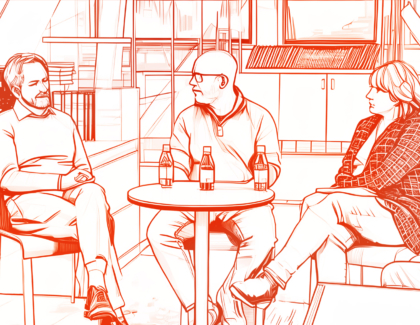
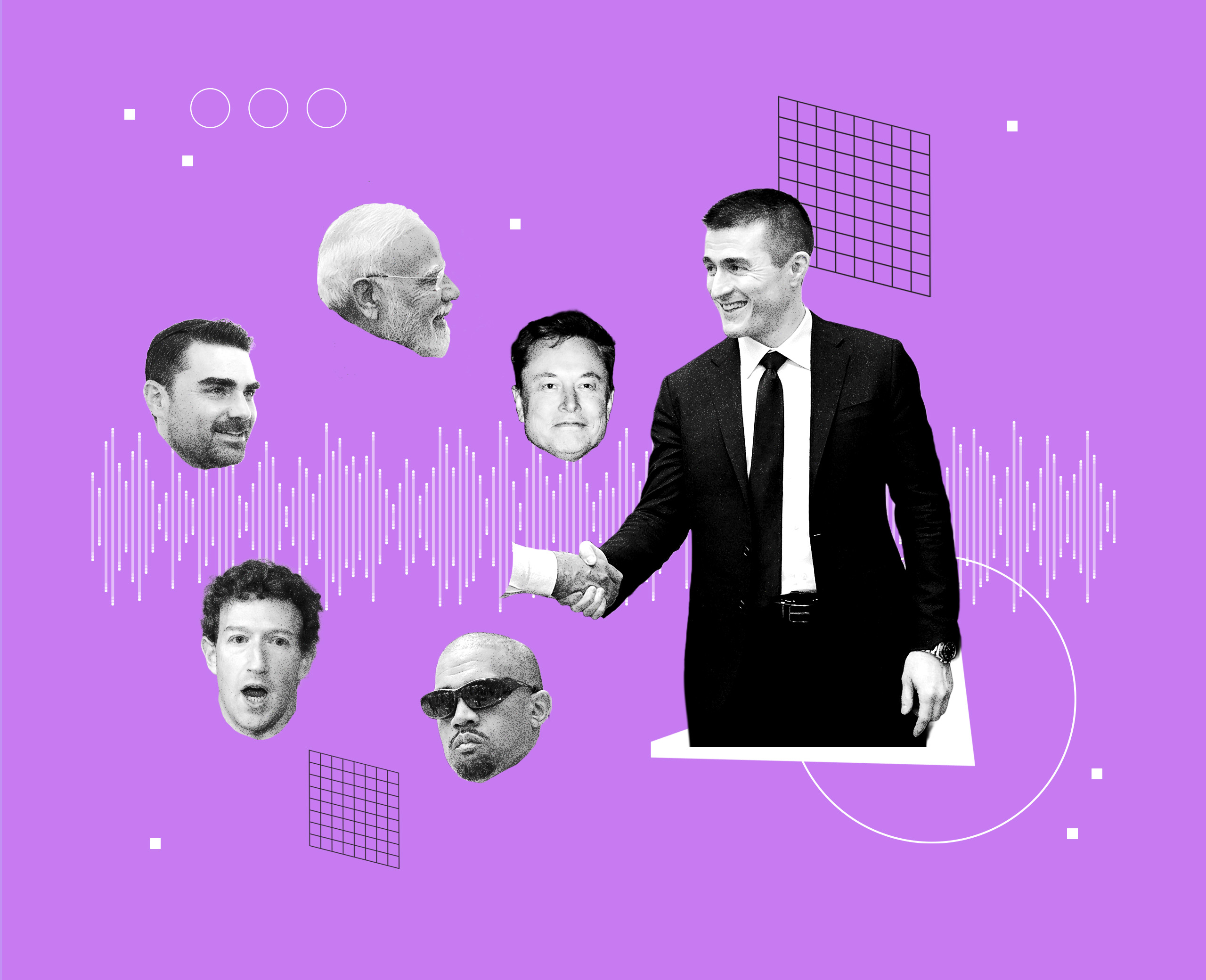
One moment, Fridman is deep in the Amazon, having a candlelit chat with Paul Rosalie, a conservationist, about the origins of life on Earth. The next, he’s in Ukraine at the height of the war, sitting down for a three-hour chat with President Volodymyr Zelensky. In February of 2024, he joined Tucker Carlson, the Fox host turned indie right-wing provocateur, inside a wood cabin as snow softly fell out the window. Three years ago, after Ye (Kanye West) tweeted that he was going to go “death con 3 On JEWISH PEOPLE,” Fridman, who is Jewish, invited him on the podcast. A year later, he had on Benjamin Netanyahu, the prime minister of Israel. He seems most comfortable in his podcast studio in Austin, a black suit before a black screen, talking with people from all walks of life about life itself.
Fridman is one of the many podcasters who don’t identify as journalists, though they are—unwittingly or not—creating platforms that are as powerful as newsrooms, if not more so. Joe Rogan has more subscribers than the New York Times; Carlson has more than the Wall Street Journal; Fridman more than the Washington Post. “I’m not a journalist nor a documentary filmmaker,” Fridman has told listeners, “just a fellow human being trying to understand the struggles and the beauty of other people, and I just sometimes bring a camera along.” He allows his subjects to speak largely uninterrupted for hours on end about their lives and their views—which is compelling enough on its own, and all the more so because his guests are increasingly disinclined to speak much, if ever, with members of the traditional press.
Accountability reporting this is not. “I don’t think there’s an adherence to journalistic norms,” Victor Pickard, a media professor at the University of Pennsylvania, told me, of the let-people-say-whatever podcast genre. “This, of course, brings in some legitimate concerns about the health of our broader discourse. It’s not so much about trying to stop these podcasts, but how do we guarantee a certain level of reliable information?”
Alongside big-get newsmakers, Fridman interviews astrophysicists, historians, writers, artists, engineers. Results vary. A significant portion of his conversations is presented as tech-bro modeling of the “good life” for his audience: guests, mostly men, explain their workout routines or how they biohack their bodies with salt and caffeine pills instead of eggs and coffee for breakfast as they answer questions about consciousness. He has also interviewed Douglas Murray, a conservative British commentator who has said that Europe is “committing suicide” by letting in immigrants from Africa and the Middle East. In their first of two interviews, Fridman introduced Murray as a “brilliant, fearless, and often controversial thinker,” and then Murray spoke freely about the dangers of critical race theory. The style of permitting guests to speak largely unfiltered reveals its darkness: “The moral responsibility is to be intelligent and informed on the issues you are discussing on your program,” Nathan J. Robinson, the editor of Current Affairs, told me. “To challenge guests who present falsehoods, to seek to establish the truth through critically interrogating your interviewees rather than just letting them spout propaganda that your audience won’t necessarily realize is propaganda.”
Fridman eschews the image of a journalist; rather, as he said on the episode with Kelly, from Harvard, he has always identified with Fyodor Dostoyevsky’s Idiot: “I see myself as The Idiot and an idiot,” as he put it. The novel’s central character is a young Russian prince who meets worldly figures with guilelessness. They make assumptions. He is, in fact, deeply intelligent and empathetic, a man whose reality is different from others’—and who makes a future all his own.
I discovered Fridman the way most people do: he popped up via my YouTube algorithm. I’d been having trouble with sleep, and my phone, ever listening, presented a clip of him interviewing Wojciech Zaremba, the cofounder of OpenAI, talking about their own sleep schedules. Zaremba had been experimenting with not going to bed until six or seven in the morning. “I still do that,” Fridman replied. They mutually wondered aloud whether there was a perfect sleeping pattern that led to the most “productive and happy life.” I watched, mesmerized, waiting for them to harness some new secret to existence. Soon, I was listening to hours-long podcasts that luxuriated in guests’ idiosyncrasies: Grimes on being techno-human; Ivanka Trump on her love of architecture; Pavel Durov, the founder of Telegram, on his banya rituals.
Fridman has his own idiosyncrasies, which he frequently attributes to his Russian roots. He was born in Tajikistan, while it was part of the Soviet Union. When he was around eleven, and the USSR collapsed, his family moved to the Chicago suburbs. He does not often talk about himself on his podcasts, and was unwilling to speak with me (or a fact-checker), but in 2021, during an “Ask Me Anything” session, he discussed the feelings of alienation and identity loss he experienced over the course of that transition. “I think it hit me the hardest personally because I was a popular kid in Russia,” he said. “When we moved here, I went to the opposite of being popular or feeling like that. I felt like an outcast.”
The family moved to Philadelphia, where his father, a celebrated plasma scientist, became a professor at Drexel University’s engineering school. Fridman went to college there, and got seriously into judo, at a club in south Philly, before pivoting to Brazilian jiujitsu, in which he eventually became a black belt. He stayed at Drexel to earn a doctorate, which he completed in 2014, in electrical and computer engineering, writing his dissertation on “Learning of Identity from Behavioral Biometrics for Active Authentication”—a study of what could be understood about someone based on the “cognitive, behavioral, and physical aspects of their interaction” with desktop computers and mobile devices. In 2015, he joined MIT as a postdoctoral associate at the Center for Transportation & Logistics; later, he became a research scientist there.
Friends who knew Fridman in the aughts recall him experimenting with early iterations of podcasting. “He was very focused; he had very clear desires and goals that he wanted to meet,” Ray Huxen, his former judo coach, told me. “When he made a decision to commit to something, he was very committed to it, and he wanted to be as good as possible and work as hard as possible.” Around the same time that Fridman was establishing a career as a scientist, he debuted his first YouTube podcast, Take It Uneasy. The interviews (most of which have since been taken down) were grainy and awkward; from behind a camera, he talked mostly with people known in the judo world.
Then, in April of 2018, he pivoted to the Lex Fridman Podcast, for which he began interviewing a wide range of scientists and academics, often for two or three hours. Fridman fan pages proliferated, as did subreddits, including an “uncensored” page for those who wanted to speak freely (Fridman is notorious for blocking critics). “When I first came across this podcast, I had no preconceived thoughts or opinions about the host,” Amanda Mendoza, administrator of the “Lex Fridman Podcast Followers” Facebook group, told me. “My attention was caught by the content of the conversations and the repeated topics from guest to guest—their feelings on love, life’s meaning and purpose, mortality, beauty, advice for youngins. I appreciated the attempts at highlighting the humanity in each speaker.”
Fridman’s real break came in 2019, when he was the lead author on a controversial study at MIT that focused on the Tesla Autopilot program. The research, which claimed that human beings do not become distracted when driving a semiautomated vehicle, caught the attention of Musk, who invited Fridman to visit Tesla’s headquarters for a one-on-one interview. It was his first time meeting Musk, and only his eighteenth podcast episode. The interview, which is short and highly technical—about the “transition to electrification” versus “autonomy” of Tesla’s cars—opened the door to Silicon Valley.
The Musk interview drove Fridman’s viewership, previously in the thousands, into the millions. He then catapulted to prominence by way of association, as he collected titans: Jack Dorsey, Zaremba, Mark Zuckerberg, Sam Altman, Marc Andreessen. The media began to descend. The Atlantic referred to Fridman as a “tech-world whisperer.” Business Insider was blunter, calling Fridman’s podcast a “safe space for the anti-woke tech elite” and depicting him as playing up his MIT credentials for access. (According to MIT’s press office, Fridman has been affiliated with the school since 2015 and is currently a research scientist at the Laboratory for Information & Decision Systems.) A Telegraph headline asked, “Is Lex Fridman the world’s most dangerous podcaster?”
Gradually, his interviews got wilder, more expansive. Fridman developed his signature Zen style—a style that feels, on the surface, like the antithesis of journalism. He projects a soft neutrality, steering conversations without pushing them, frequently opening with the earnestness of a child discovering the world: What is socialism? What is existentialism? When Kanye yelled at him—“I don’t trust you!”—during their interview, in 2022, Fridman scrunched up his face; for a moment, watching, I wondered if he might cry. “I gotta tell you, I have to be honest,” Fridman replied. “This is silly, ’cause you don’t know me, but it hurt when you said you don’t trust me.”
Plenty do trust him, though. His loyal listenership has enabled him to become part of YouTube’s sponsor partnership program, which has paid out more than a hundred billion dollars to its top creators in the past four years. (A YouTube spokesperson declined to release the official revenue generated by Fridman’s page, citing company policy. Fridman has a relatively inactive Patreon account, with only 416 paid subscribers.) He doesn’t go for interruptive ads; unlike many influencers, he often only briefly notes in episodes that he has sponsors in the “comments section.” But more recently, he started opening his show with philosophical rants promoting some of those sponsors: Call of Duty, Athletic Greens, Element, Shopify, Zocdoc, Fin, Notion. These are not typical advertisements but, in typical Fridman style, authentic endorsements of things he seems to love, or says he does. “I sprained my ACL a while back,” he announced during a recent ad-read. “It felt close to a hundred percent today.” During jiujitsu practice, he added, “I was able to go hard with a bunch of two-hundred-plus-pound meatheads, and they were just going wild. Anyway, on the way back, that ride back on the way from jiujitsu, I was sipping an Element drink and listening to country music and just had this deep sense of gratitude.” Athletic Greens, he has announced, reminds him of home when he’s away: a “great way to drink in the Texas heat.” And Shopify? Elicits a speech about American capitalism: “Shopify, to me, in a small sort of philosophical way, represents distributed capitalism where anyone can sell to anyone.”
Five years ago, Fridman provided a rare look into his non-podcast existence in a “day in the life” video. Most of the clip is just him updating his viewers on what he’d been up to: drank a liter of water, permitted himself one bathroom break, made a coffee, completed the day’s first (of two) four-hour “deep work” sessions programming machine-learning models. He typically eats one meal a day, after running at least six miles; lately, he’d been listening to an audiobook about Nazi Germany. Halfway through the video, clearly bored with the format, he permitted himself to monologue: “If I want to have a role in this world of making a positive change, I think about Nazi Germany and what it means to be a hero in those times. I think it’s much more difficult than people realize. It means standing against the masses. It requires a kind of mental toughness, mental fortitude that I don’t think I’m ready for. And I need to be.” Then he polished off his Athletic Greens smoothie, ate a bowl of cauliflower and ground beef, and took a medley of pills: magnesium, potassium, electrolytes, fish oil. “I don’t know if this is a good day-in-the-life video, but it’s a good day in my life,” he said. The video has 2.2 million views.
The chance to expatiate, without the prospect of adversarial questioning, has caught on, with major appeal for political guests. Part of Fridman’s growth owes to his connection to the dude-pod-sphere, where male talkers often cross-promote one another to an audience of fellow terminally online guys. According to a recent study from the University of Southern California’s Annenberg School for Communication and Journalism, podcast hosts are predominantly male and 77 percent white. In addition to Rogan, a “close friend” who gave Fridman a watch during one of their interviews,” there is Hasan Piker, a left-of-center livestream host who spends hours on Twitch, offering leftist takes on the news in real time. There is the All-In Podcast, featuring four men who cover, as their bio reads, “all things economic, tech, political, social & poker.” Theo Von is a stand-up comic turned podcaster whose politics are murky—he attended Trump’s inauguration and interviewed Bernie Sanders, whom he thanked “for always putting the focus back on real Americans.” There’s Andrew Huberman, a Stanford neuroscientist with seven million subscribers, who delivers health tips to live a better, more balanced life.
Unlike some of these hosts, Fridman has professed no political orientation. In the lead-up to the 2020 election, Huxen, Fridman’s former judo coach, wrote him a heartfelt, fifteen-paragraph email asking that he use his X platform—with some 4.4 million followers—to denounce Trump, for the sake of democracy. “I believe in empathy, love and reason as a powerful guide through difficult times,” Fridman responded. “I do want to do my small part in building a better world and think deeply about how best to do so. The tweet you mentioned is a step in a journey of a thousand miles. I have ideas, but I’m also an idiot, so each step is taken humbly. Let’s chat at some point on the phone.” (Huxen viewed the lack of engagement as a cop-out: “I felt a little dismissed,” he told me.)
In the absence of discernment, there is plenitude: Fridman has invited figures from all parts of the political spectrum on his show. In the lead-up to the 2024 election, he had on Trump and other right-wing personalities, from Robert F. Kennedy Jr. to Tulsi Gabbard to Jared Kushner. He also did an interview with Sanders, and another with Ezra Klein and Derek Thompson, the authors of Abundance; on the same episode, he lamented that Alexandria Ocasio-Cortez had turned him down. In 2023, Fridman dipped into a strange sort of helicopter correspondence, traveling to the West Bank to interview Palestinians. Even he seemed a little confused about what he was trying to accomplish in the interviews. He spoke with a Palestinian father of seven, who talked about not having water; a Palestinian Christian about being among Muslims and Jews; a third-generation refugee, who talked about his hopes for peace; and a shopkeeper who told him he didn’t like politics because, “in the end, we’re all human.” Then someone put a keffiyeh over Fridman’s head and offered him tea. It is informative, if bizarre, to see a series of characters talking, leading to no apparent point—a situation, as the writer Vivian Gornick would say, without a story.
Fridman tries to get at the core of who someone is, rather than what they stand for, and trusts his viewers to determine the truth. He is never aggressive or confrontational, and he hardly ever challenges falsities. He made a rare interjection during Trump’s appearance, when Trump called Kamala Harris a “communist.” Fridman replied, “There’s a lot of people listening to this, myself included, that doesn’t think that Kamala is a communist.” Trump bulldozed: “Well, she’s a Marxist.” Fridman tried to correct him: “Her father’s a Marxist” (which, as The New Yorker found after speaking with him, was false). “She’s advocating—.” Trump interrupted, “That’s a little unusual.” That was that; the conversation carried on. When Netanyahu defended the Israeli settlements in the West Bank that have been the source of unchecked violence against Palestinians, claiming the settlers had a right to their “ancestral homeland,” Fridman was silent. When Kennedy mentioned that the “CIA today is the biggest funder of journalism around the world,” Fridman nodded along. He did the same when Modi referred to the RSS—a violent right-wing Hindu-nationalist movement responsible for countless mob attacks on India’s religious minorities—as a “sacred organization.”
This lack of pushback makes Fridman a nonthreatening interlocutor for guests—and, in turn, something of a threat to journalism, as he cuts into the potential interviews of incredulous reporters. Tiresome as his airy, contextless interviews sometimes are, when viewed in contrast to substantive journalism, they are nevertheless reshaping the news environment: If business and political leaders can burnish their image on softball podcasts while reaching larger audiences than they would in more “mainstream” outlets, what incentive do they have to submit to serious questioning? “This is not journalism—it is glorified PR,” Siobhan McHugh, a podcast scholar at the University of Wollongong in Australia, told me. “Fridman facilitates his subjects to put forward aspects of themselves they would like to highlight.” That, in turn, “allows him to gain access to significant global figures as guests, whose presence further fuels listener numbers.” That doesn’t necessarily mean “we can’t gain some insights from his podcast,” she added. Still, as Robinson, of Current Affairs, has said of Fridman’s interview with Ye: “If an anti-Semite isn’t angry at you by the end of the interview, you have likely done a bad job interviewing them.”
Fridman’s posture of acceptance has not kept criticism from turning in his direction. Such is the burden of being a podcast celebrity. Yet Fridman always expresses genuine surprise when the internet strikes. He has begun offering disclaimers at the beginning of interviews with political figures: “Any time I talk about politics, half the audience is pissed off at me,” he said, before talking with Klein and Thompson. “And no, there is no audience capture. I get shit on equally by different groups across the political spectrum, depending on the guest. Why? I don’t know.”
Lately, as his profile has grown, and negative attention has mounted, he’s found the pressure a lot to take. This past July, at the end of an interview with Demis Hassabis, the founder of Google’s DeepMind, he described being “in this strange position of being attacked online from all sides.” He continued, “There’s been days when it’s been rough on me mentally. It’s not fun being lied about. It does hit pretty hard on a psychological level when I’m getting attacked over this.” In early October, Fridman said on X that he was depressed. “Feeling down about the world and about myself. Normal human things. I’m sure soon it’ll be better,” he wrote. He promised to do a long solo episode on Dostoyevsky soon, which he hoped would articulate why he thought “humans are beautiful and fascinating and for the most part awesome.” Then, for ten days—a Twitter eternity—he went dark.
Clearly, Fridman’s interviews have fans, who are choosing podcasts over mainstream outlets in staggering numbers. Scroll through any of his videos’ comments sections, and you will find viewers denigrating the traditional press. “Media distortion made Ivanka into someone she clearly is NOT,” someone wrote about an interview Fridman did with Ivanka Trump, from July of last year. “We need to see people for who they are and not what big brother wants us to see.” Fridman, speaking on Huberman’s podcast, opined: “The media machine, the propaganda machine, that I’ve gotten to see every aspect of, it’s still fueling that division between America and China, between Russia and India.” Last year, when New York magazine published a cover story depicting Huberman as, among other things, a bad boyfriend, Fridman tweeted: “It’s heartbreaking to see a hit-piece written about my friend Andrew Huberman,” and described the article as “simply trash click-bait journalism desperately clinging on to relevance.”
Platforms are symbiotic. An influencer can only have sway if their audience is large; a news organization can only survive if its readership does. By this measure, the outlook for major news outlets is dire: according to a Gallup poll, 31 percent of Americans between eighteen and twenty-nine feel “confident” in media organizations’ ability to report the news accurately and fairly. This demographic, key to media companies’ longevity, is increasingly going elsewhere to find out what’s going on in the world: a recent Pew study found that more than half of young Americans have now turned to social media, mostly YouTube and Facebook, as their main source of news. In 2024, Spotify’s three top shows were Rogan’s, Call Her Daddy, and Von’s. (The New York Times’ The Daily made the top five, but The Rachel Maddow Show, CNN, and PBS News Hour did not make the top fifty.)
This cohort of personality-driven podcasters, Fridman among them, feeds into a growing market for intimate, long-form conversations that come across to millions of people as deeply authentic—in other words, exactly the opposite of PR. “There’s more than one way to conduct an interview,” Bhaskar Sunkara—the founding editor of Jacobin and the president of The Nation, who was a guest on Fridman’s podcast three years ago—told me. Sunkara appreciated the open-ended spirit of the exchange. “Allowing speakers to talk at length on their own terms, about wide-ranging topics—one can glean a lot about people’s worldviews,” he said. “I think there’s just as much value in that as a more hostile, combative interview.”
Ideally, there would be room for both. The question is what will happen if trends keep heading in the same directions: podcasters ascendant as newsrooms shrink. When I spoke recently with Jeremy Morris, a professor of media and cultural studies at the University of Wisconsin–Madison, he noted that traditional media has a clear ethical responsibility, at least in theory, to the public: to report the news fairly and accurately. In the United States, the airwaves, at least, are also governed, however loosely, by the Federal Communications Commission. Podcasters have a duty only to produce content their audience enjoys, which makes them helpful barometers of public opinion but unreliable shapers of it. “One of the concerns is that this space is largely unconstrained by broadcast-style regulation or professional norms such as impartiality, and the incentives of algorithmic platforms may amplify sensational and partisan approaches, which of course has implications for trust,” Amy Ross Arguedas, of the Reuters Institute, said.
Even so, there are things that we as journalists can learn from the success of news influencers such as Fridman—for instance, that the public does not always need to be led by the hand. “There’s no one way to do journalism or to operate as a public intellectual or public figure,” Sunkara said. “I think we should trust the sophistication of people to be able to listen to material and not be convinced by the last person they listen to.”
Fridman, at least, appears to enjoy the pleasures of interviewing without the burdens of reportorial responsibility. As he said on Huberman’s podcast, paraphrasing Hermann Hesse (a fellow Idiot fan): “Learn what is to be taken seriously and laugh at the rest. I think I try to be silly, laugh at myself, laugh at the absurdity of life, and then in part, when I’m serious, just try to be positive.”
This piece is part of Journalism 2050, a project from the Columbia Journalism Review and the Tow Center for Digital Journalism, with support from the Patrick J. McGovern Foundation.
Has America ever needed a media defender more than now? Help us by joining CJR today.