Sign up for the daily CJR newsletter.

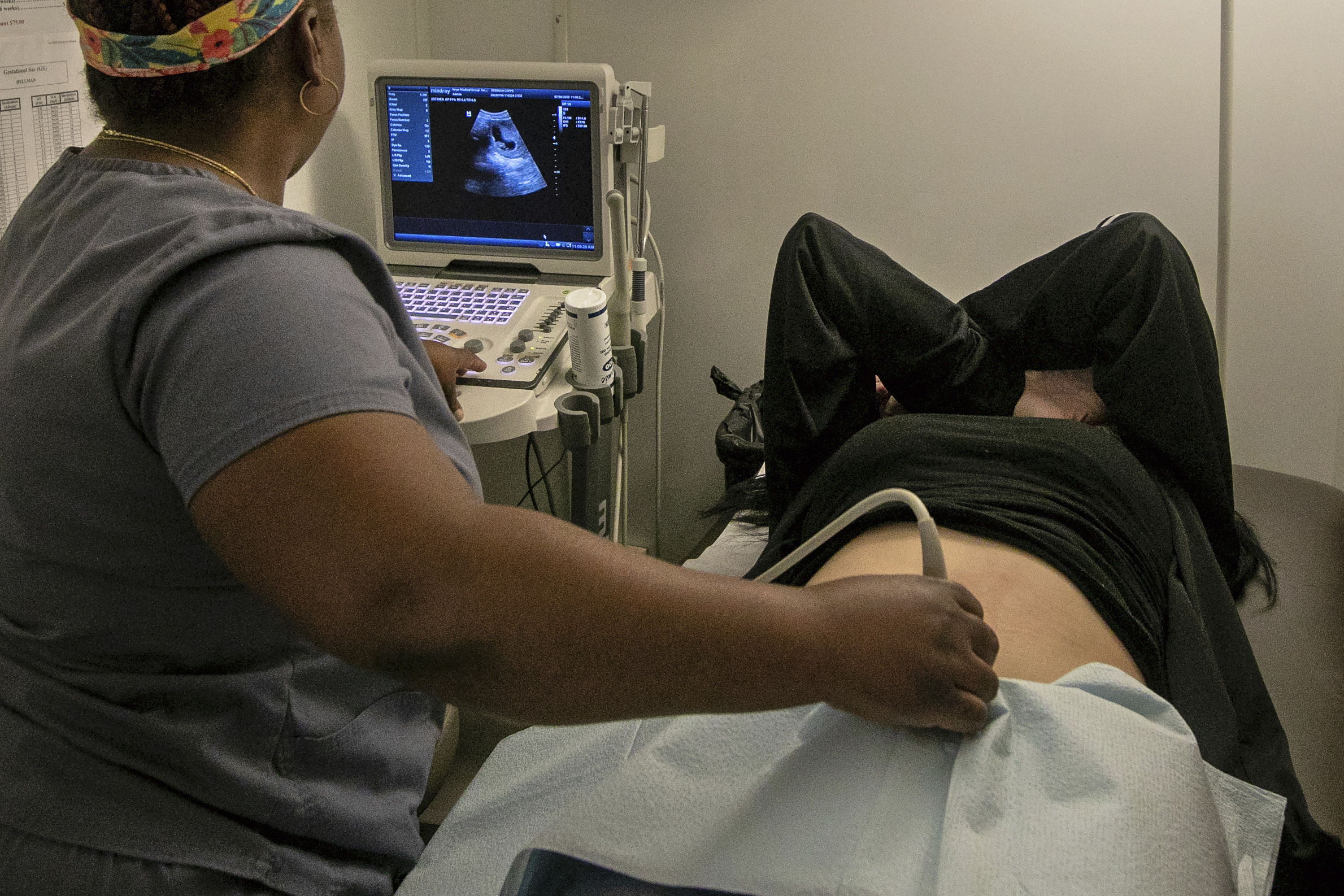
Kaylee Hall confirmed her third pregnancy through an at-home test, but because of a previous miscarriage, she wanted reassurance that everything was progressing normally. When she couldn’t get an appointment with her doctor immediately, she ended up at the Abundant Life Pregnancy Resource Center, what’s known as a “crisis pregnancy” facility. A nurse performed a sonogram and told her the pregnancy was viable. Hall was thrilled. But just days later, she was in the hospital for an emergency surgery. Not only was her pregnancy not viable, it was potentially life-threatening.
In a moving piece for the Dallas Morning News, Emily Brindley shares Hall’s story and looks at a growing problem in Texas and across the country: women turning to crisis pregnancy centers, whose primary mission is preventing abortion, because of a lack of other maternal care. Last year, Brindley did a project on the rural maternal-care system in Texas, which she described to me as “crumbling.” “In those gaps, that’s where we see pregnancy centers pop up in urban areas and rural areas,” she said.
Her report on Hall also explores whether crisis pregnancy centers are providing patients with adequate care. “There is a lot of discussion and debate around pregnancy centers, but a lot of it focuses on whether centers should be getting state funding,” Brindley told me. “There has been less discussion of whether the care provided at pregnancy centers is high quality and what impact the care that’s being provided might have on actual patients.” Because the centers are not medical facilities, they are largely unregulated.
Hall is still struggling with the grief of her pregnancy loss and the trauma of nearly losing her life. She worries that other vulnerable patients may also suffer because they receive misinformation that delays necessary care. She and her doctor have filed complaints with the Texas Medical Board against Abundant Life, accusing the center of practicing medicine without a license. “I saw three other people in the lobby,” Hall told Brindley. “Did you have the same ultrasound tech telling all of them their babies are fine?”

Is an AI vibe shift upon us? Over the past couple of weeks, a slew of journalists have talked openly about how they use AI in their work in ways that, until recently, felt at least a bit verboten. There was the Wall Street Journal profile of Nick Lichtenberg, a Fortune writer churning out AI-generated stories at scale. Wired talked to tech reporters about how they are using AI in their workflows, including Kevin Roose of the New York Times, who created a team of Claude agents to help edit his book. The Atlantic looked at how AI is “creeping” into the pages of the Times. And Megan McArdle, a columnist at the Washington Post, posted a cringe-inducing thread on X about the many ways she’s using AI, including the admission that she has “occasionally gotten past writer’s block by asking it to write a Megan McArdle column on the topic.”
And then came the news that AI wasn’t creeping into the Times so much as setting up camp. On Monday, The Wrap broke the news that the paper had cut ties with Alex Preston, a freelance writer and novelist who admitted to using AI to help write a book review that wound up plagiarizing from The Guardian. The Times added a note to the review, saying a reader had alerted it to the plagiarism. “For staff journalists and freelance writers alike, reliance on AI and inclusion of unattributed work by another writer is a serious violation of the Times’ integrity and fundamental journalistic standards,” a spokesperson for the Times told me.
Preston, for his part, has been appropriately self-flagellating. “Oh god it’s awful and I’m so ashamed. Such a total car crash,” he said in a note he sent to Sam Leith, the literary editor of The Spectator. “It was absolutely an improper use of AI, and a complete failure of judgment on my part. I was ashamed when it was put to me, and I admitted it straight away.”
My understanding of the Times’ policy is that the use of AI tools is allowed and encouraged, but it must be disclosed and AI cannot be used for content or idea generation. That seems pretty straightforward. In practice, it’s a bit less clear. For example, the Times hasn’t added a note to a Modern Love column written by Kate Gilgan, who admitted to The Atlantic that she used AI to seek “inspiration and guidance and correction” and “as a collaborative editor.” When I asked the Times if it planned to add a disclosure, the spokesperson told me: “Journalism at the Times is inherently a human endeavor. That will not change. As technology evolves, we are consistently assessing best practices for our newsroom.” I’m not sure what that means.
The question hanging over all of this is: What are journalists supposed to do with AI? Should we go AI ourselves? Should we encourage it? Should newsrooms give out awards for its use? It seems to me AI can be a helpful and important reporting tool (see my column about Jmail). It can do a quick grammar review and spellcheck. It can handle tasks that are tedious, time-consuming, or genuinely beyond what one person can do alone. But the real work can’t be replicated by a machine: good ideas, deep reporting, shaping an argument. If you find that you’re outsourcing all of that, maybe it’s worth asking yourself why.
Last Thursday, Jeremy Diamond, CNN’s Jerusalem correspondent, and his crew traveled to Tayasir, a Palestinian village in the West Bank, to cover the aftermath of a brutal settler attack. Several residents had been beaten, including a seventy-five-year-old man whose teeth were knocked out and whose skull was fractured.
Settler violence in the West Bank has surged since the start of the Iran war. At least nine Palestinians have been killed by Israeli settlers, according to United Nations data, and there have been more than 150 attacks. When the Israeli military arrived in Tayasir, rather than confront the violence, they went after the Palestinians in the village and the CNN team.
What followed was an extraordinary scene caught on camera. Within seconds, soldiers pointed their rifles at the journalists, demanding they stop filming. One soldier put Cyril Theophilos, a CNN photojournalist, into a choke hold, pushing him to the ground and damaging his equipment. The group was detained for two hours, but the team was undeterred. Diamond kept reporting, continuing to question the soldiers, who said that they believe the entire West Bank belongs to Jews, described all Palestinians as terrorists, and talked about avenging the alleged killing of an Israeli settler.
The Israeli military suspended the battalion involved in the detention and assault of the CNN team. That was an unprecedented move—and it has drawn backlash from the highest levels of the country’s government: Itamar Ben Gvir, Israel’s national security minister, condemned the decision, calling it a “grave mistake that harms our fighters and Israel’s deterrence capability.”
If you have a suggestion for this column, please send it to laurelsanddarts@cjr.org. We can’t acknowledge all submissions, but we will mention you if we use your idea. For more on Laurels and Darts, please click here. To receive this and other CJR newsletters in your inbox, please click here.
Has America ever needed a media defender more than now? Help us by joining CJR today.