Sign up for the daily CJR newsletter.
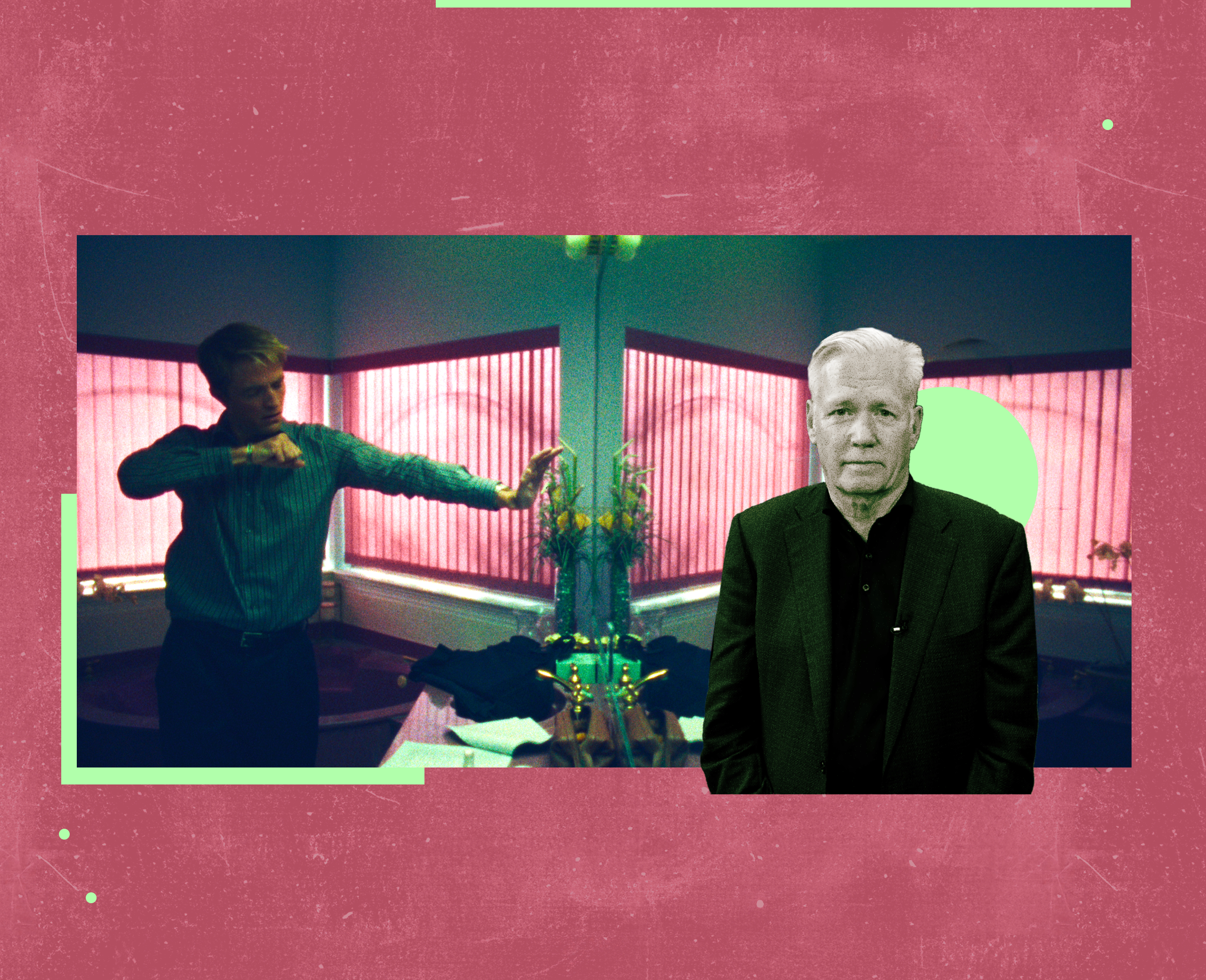
Chris Hansen feels ambushed. He is standing outside a Regal movie theater in Times Square. He has just seen Primetime, a new movie about Chris Hansen starring Robert Pattinson. Tourists mill about as a camera crew records the scene. “I’m not objective, because the character is, you know, me. But it was so detached from reality,” he says. “I’m not sure what the point of it was.” He then interviews moviegoers. “I watch a lot of your stuff on YouTube. I felt like it was very overdramatized,” a man tells him. “Overdramatized,” Hansen emphasizes. “I happen to agree with you.”
Hansen is a journalist best known for To Catch a Predator on NBC, a popular franchise that began in 2004 as a segment on Dateline. With the help of a somewhat sketchy cyber-vigilante group called Perverted-Justice, the show used chat rooms, adult decoys posing as children, and hidden cameras to ensnare sexual predators in stings set up across the United States: a kind of fucked-up Candid Camera. “I felt like he had superpowers. He’s able to put these guys in a trancelike state and essentially just systematically dismantle their lives on camera,” Lance Oppenheim, the director of Primetime, told me.
Hansen told me he first heard about Primetime late last year. In January, he said, he asked a mutual acquaintance to contact Oppenheim to get a read on his approach. The acquaintance talked to the director and, according to a text message Hansen read to me, described the film as “a love letter to Chris.” Oppenheim disputed that account to me. “I never said that,” he said. “It’s funny that as a journalist he is saying things that I didn’t say. I’ve seen him say that a few times.” He approached the film as a fan of Hansen. “I loved the show. I don’t think I’d be making films the way I make them if it wasn’t for the show and the reality distortion,” he said. (A Cameo his wife bought him from Hansen inspired the movie.) But Oppenheim, who also codirected the upcoming Elizabeth Holmes documentary with Nathan Fielder and is best known for visually inventive documentaries including Some Kind of Heaven and Spermworld, brings the same highly stylized surreal aesthetic to Primetime, his first feature film.
It wasn’t until May 26, the day before the release of the film’s teaser trailer, according to emails shared with me, that Hansen first heard from A24, the studio behind Primetime. An A24 representative gave him a heads-up, saying she “would love to touch base” about “working together throughout the release,” but shared no details. By August, Hansen had grown wary of what he came to see as “the whole sneaky, disingenuous Hollywood method.” His team asked A24 why they hadn’t come to him sooner. “While the film didn’t require individual consultation or permission during production, we’d love to have Chris’s support of the film to the extent he feels comfortable,” they wrote, in a message shared with me. “If not, we certainly understand.”
“They seem eager to whore me out in a promotional campaign,” Hansen said. “All this bullshit about Robert this and Robert that and We’ll do a podcast, you can fly to London. I don’t care, honestly. I’m really fucking busy being the real Chris Hansen. It’s a seven-day-a-week job.”
In an appearance on Jesse Watters’s Fox show several weeks ago, Hansen aired his suspicions that he was set up. He said he had gone to the offices of A24 for a private screening, but when he refused to sign a nondisclosure agreement, executives wouldn’t let him see the film. “The lawyers at A24 wanted me to sign away my rights to my name, image, and, you know, brand, essentially, as well as any potential legal rights that would come out of the movie,” Hansen told me. “It might be standard if you’re a film critic or if you’re the wife of a Hollywood producer,” he added. “But if you’re Chris Hansen there’s nothing standard about it.” (A24 has said that the release was standard.)
At its height, To Catch a Predator averaged more than ten million weekly viewers, an enormous number for an unscripted show in that era. “The internet was ubiquitous, but we didn’t socialize on it yet. Social media didn’t exist yet in 2004. There was no Facebook yet in 2004,” David Osit, the director of Predators, a documentary about the show, told me.
To Catch a Predator was a voyeuristic spectacle, serving as both performative justice and public pillory. Predators would arrive on the scene, greeted by a decoy who would invite them to relax in the kitchen. Then, like an avenging angel, Hansen would emerge to confront them (denial) and explain that they were being recorded for TV (repentance and bargaining). Police officers waited outside with guns drawn to arrest them (acceptance). “Have a seat,” he would tell each man. (It was always a man.) After laying out lurid chat logs as evidence of deviant intent, he would say the line: “You see how this looks, right?” Both Hansen and his show became cultural phenomena, getting regularly spoofed on shows like The Simpsons and South Park and on late-night TV. Hansen testified before a congressional subcommittee and regularly spoke to parent groups about the “epidemic” of online sexual predation.
Yet the narrative was misleading. Despite the show’s disproportionate focus on “stranger danger,” according to research from David Finkelhor, a sociologist who runs the Crimes Against Children Research Center, roughly 90 percent of perpetrators of child sexual abuse are someone the victim knows. Even online, most perpetrators are not strangers: a 2023 analysis published in the Trauma, Violence, & Abuse journal found that 68 percent were acquaintances or family members. NBC News responded to critics by saying that the show served a public purpose: helping parents understand the potential dangers of the internet while deterring would-be predators. “What this show and many of the versions after it do is keep us in this antiquated idea that threats come from outside the home, from complete strangers,” Luke Malone, the coauthor of One in Five, a book about child sex abuse prevention, said. “We’ve been dealt a collective miseducation about who is the most at risk of harming kids and under what circumstances. And I think Hansen’s a huge driver of that miseducation.” While Hansen concedes that “maybe the majority of the times it happens in the family,” he argues that “it doesn’t make it happen any less between strangers.” He adds: “The danger is everywhere.”
What made the show such compelling television also made it a questionable journalistic enterprise. “If humiliating perverts and needlessly terrifying parents is the best use that newsmagazines can make of hours of primetime television, then perhaps they should be allowed to die and the time given over to the blood sport of reality programming,” Douglas McCollam wrote for CJR in 2007. “At least no one would dare to call it news.”
This tension culminated in an incident whose retelling constitutes the act-three climax of Primetime. In November of 2006, Bill Conradt, an assistant district attorney in Texas, was caught in a sting on the show, having engaged in sexually explicit online conversations with a decoy posing as a thirteen-year-old boy. After Conradt failed to show up at the designated sting house, Hansen and his crew joined the police on a raid of his home—a break from the show’s format—where the prosecutor fatally shot himself before he could be arrested. A state investigation later revealed that child sex abuse material was found on several of Conradt’s personal devices. Hansen was live on the Today show the next morning, and To Catch a Predator later aired the story.
Conradt’s sister subsequently sued NBC, alleging that the network was responsible for her brother’s death and had pressured police into using unnecessarily aggressive tactics to obtain dramatic footage. Both Hansen and police denied that Dateline was at fault in Conradt’s suicide. “You don’t want to see anybody do that to themselves,” Hansen told me. “But to make the leap that we were out in the streets cheering on this arrest and forcing this guy to take drastic action—it just wasn’t the case.”
NBC settled with the family in 2008 for an undisclosed amount, after the show had already ended. In the years since, the program has lived on through reruns on MSNBC and, now, on YouTube, where Hansen posts a new predator-catching series and a growing crop of copycats mimic his style. “The reason it’s endured is that it’s linked to a sort of performance of good versus evil that is deeply appealing in a stratified time,” Osit told me. “And many people need those stories to feel like they can survive in the world.”
Primetime has already proved to be a breakout box office hit, with Gen Z audiences showing up: 69 percent of audiences were under the age of thirty. Whatever Hansen’s concerns about the movie, he is seizing on the moment—before screenings, he is running ads for his streaming network, TruBlu. A podcast episode he posted about his reaction to the film already has more than six hundred thousand views. And Hansen said he’s seen a big increase in traffic to all his platforms. Last week, he announced a book deal with Simon & Schuster to write thrillers inspired by his career. On Primetime’s opening day, he dropped a trailer for his next big project: a documentary called I Am Chris Hansen.
He is intent on telling his own story. He rejects what he sees as a “twisted, dark, dishonest” depiction of him as a maniacal, ratings-hungry monster. “They’re criticizing the way that we went after people who prey on children. They’re just as big of predators as the people who get caught in these investigations. It’s dirty. It’s disingenuous,” he told me, of the filmmakers. “It’s just an insult to the thousands of men and women who try to protect children from predators every day.” The movie, he said, reduces “an important piece of work” to just another behind-the-scenes TV drama. “Fuck Chris Hansen, and we’ll do whatever the fuck we want,” he said. “That’s their attitude.”
But that is not Oppenheim’s attitude. “He’s a hero, and a complicated hero at that. What makes him complicated is not the fact that he’s going after these guys. These guys are mentally disturbed, and they’re there to do something horrific,” he told me. “I wanted to show what the effects were on someone who does this work.” He added, “I’ve made a film that visually and spiritually and stylistically attempts to own that and is not intending to be representational of reality in any way.”
Becoming a cultural phenomenon comes with a price: at some point, the story starts to reveal more about the culture that created it than the person at its center. “There’s a mythology that does not belong to Chris Hansen, that has grown from underneath him,” Oppenheim said. If Hansen wants to talk or possibly even collaborate, he’d be open to it, he told me. This week, Hansen invited Pattinson and Oppenheim to appear on his podcast.
“Chris isn’t the main story. We are. We are the main characters of the story of why To Catch a Predator is popular,” Osit said. “Whether Chris feels like he’s done something wrong or not, it’s all there. It’s all just in front of us.”
Has America ever needed a media defender more than now? Help us by joining CJR today.