Sign up for the daily CJR newsletter.
Last June, Kenia Jackeline Merlos, her four children, and her sister were at a park in Washington State when they were arrested by Immigration and Customs Enforcement (ICE) officers. The children and Merlos’s sister spent two weeks in custody, but Merlos was detained for months. At a loss for how to help, her sister contacted an independent journalist, Antonio Sánchez, a reporter who for nearly a decade had been the lead anchor for Univision Portland—the area’s only Spanish-language news outlet—before starting his own broadcast on YouTube. He broke the story of Merlos’s detention and continued to cover her case until she was released.
The story was later picked up by national outlets. “I trusted Antonio to share my story because of his professionalism, his reputation in the community, and the respect he has shown for others in similar situations,” Merlos told me. “He took the time to understand the details, and he kept sharing until I got released. He followed my story until the end.”
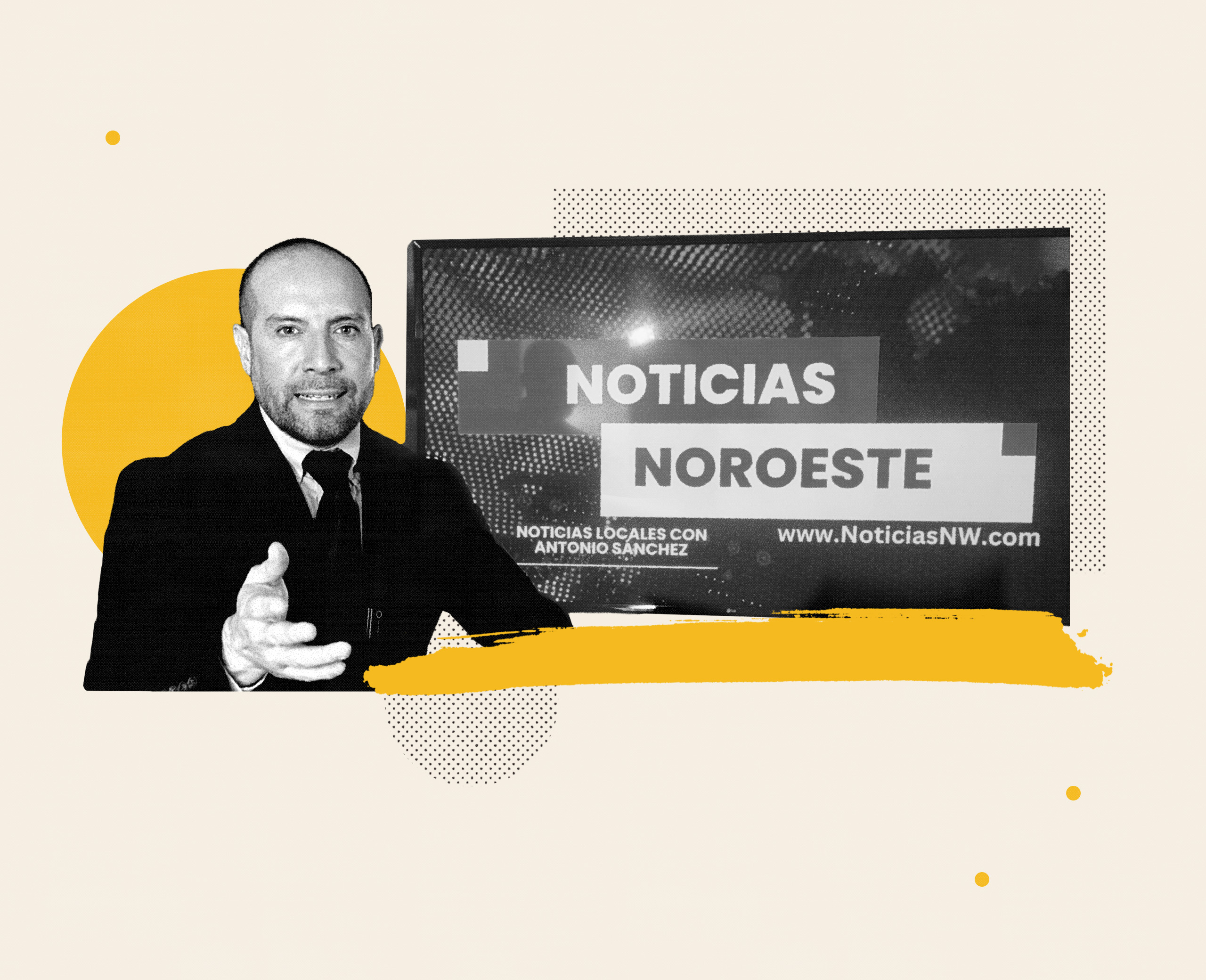
Sánchez, who is forty-five, grew up in Calexico, California, near the border with Mexico, where he spoke Spanish at home. His newscast, tailored to the Spanish-speaking community in the Portland area—“Están cayendo como moscas muertas” (They’re dropping like flies), he reported of turnover in President Trump’s cabinet—reaches about fifty thousand people per week and has nearly ten thousand subscribers. His reports cover everything from local politics to crime to weather, broadcast from a basement in Southeast Portland. Acoustic foam is checkered across the ceiling, turquoise carpet covers the vinyl flooring, and a television screen behind the desk bears the name of his show: Noticias Noroeste.
Going solo hadn’t been part of his career plans. But in September of 2024, he was laid off from Univision Portland, and the station, KUNP-TV, announced it was severing ties with Univision and transitioning to English-language news and sports coverage. “I started getting all these messages asking what’s going to happen,” he said.
A few weeks later, Trump won the presidential election. The messages kept coming. “They were asking, ‘What’s going to happen to us? A new government is about to take over.’ I felt like maybe I could create something while I look for a job,” Sánchez said.
He ordered a teleprompter, a microphone, and lights on Amazon; soundproofed the basement; and asked a friend to create a logo. Startup costs ran about fifteen hundred bucks. He produced his first broadcast on Inauguration Day. “Even if it looked bad, it was always going to air,” he said, “because I promised people that I would do something.”
Since then, he has dedicated twelve or more hours each day to reporting, producing, and editing. “I want to preserve that tradition of doing everything they watched on television,” he said. Sánchez wears a suit and sits at a desk as he runs through the top stories. But he has made changes, too. “I talk in sayings—that’s very typical in Spanish, and that’s something you don’t do in English news,” he told me. His style also differs from most Spanish-language news in the United States, where Univision and Telemundo operate under the umbrella of an English-language parent company and tend to align with American broadcast standards. “The media in general has a problem with finding real connection with the audience,” Ismael Nafría, an independent journalist and former board vice president of Sembra Media, a nonprofit that supports Spanish-language media, told me. “The language issue is so important if you want to build something authentic and something real.”
Sánchez built trust quickly. Last fall, reporting on ICE arrests around Portland, he drew a record eighty thousand viewers. He also found himself pushing back against misinformation from local social media influencers who had told audiences they’d witnessed ICE raids—which Sánchez’s reporting revealed were actually local drug raids. “I’m almost like their 211,” he said of his relationship with viewers. “The language barrier makes it harder for them to pick up a phone and call a helpline. But they can message me, and I’ll respond quickly.”
Sánchez initially envisioned Noticias Noroeste as temporary—something to fill the gap left by Univision until a larger station resumed local Spanish-language coverage. But then he thought, “I had to keep doing it.” A new channel, Telemundo Portland, started up about six months ago, but its broadcast is anchored out of Kansas City and includes only a two-minute local segment.
Sánchez said he supports his broadcast through advertising. He brings in at least three thousand dollars per month through ads, sometimes more, and funds are paid to him directly. His ads come from Multnomah County, the Tualatin Valley Water District, and the City of Portland, among others; most are PSAs. “I can’t be worried about, ‘Oh my God, my views went down, my views went up.’ I don’t care. I’m not an influencer, I’m a journalist,” he said. Once revenue allows, he hopes to hire interns. Eventually, he said, he’d like to move into a bigger space.
In January, Merlos was invited to celebrate Noticias Noroeste’s first anniversary party. She said she was nervous—she expected a roomful of “fancy people”—but was surprised to find Sánchez had invited other Portlanders who had been detained by ICE. It was a chance to connect with others who understood firsthand what she and her family had been through. “It’s important to get connected,” she told me. “No one else is going to understand your situation.”
Has America ever needed a media defender more than now? Help us by joining CJR today.