


Sign up for the daily CJR newsletter.
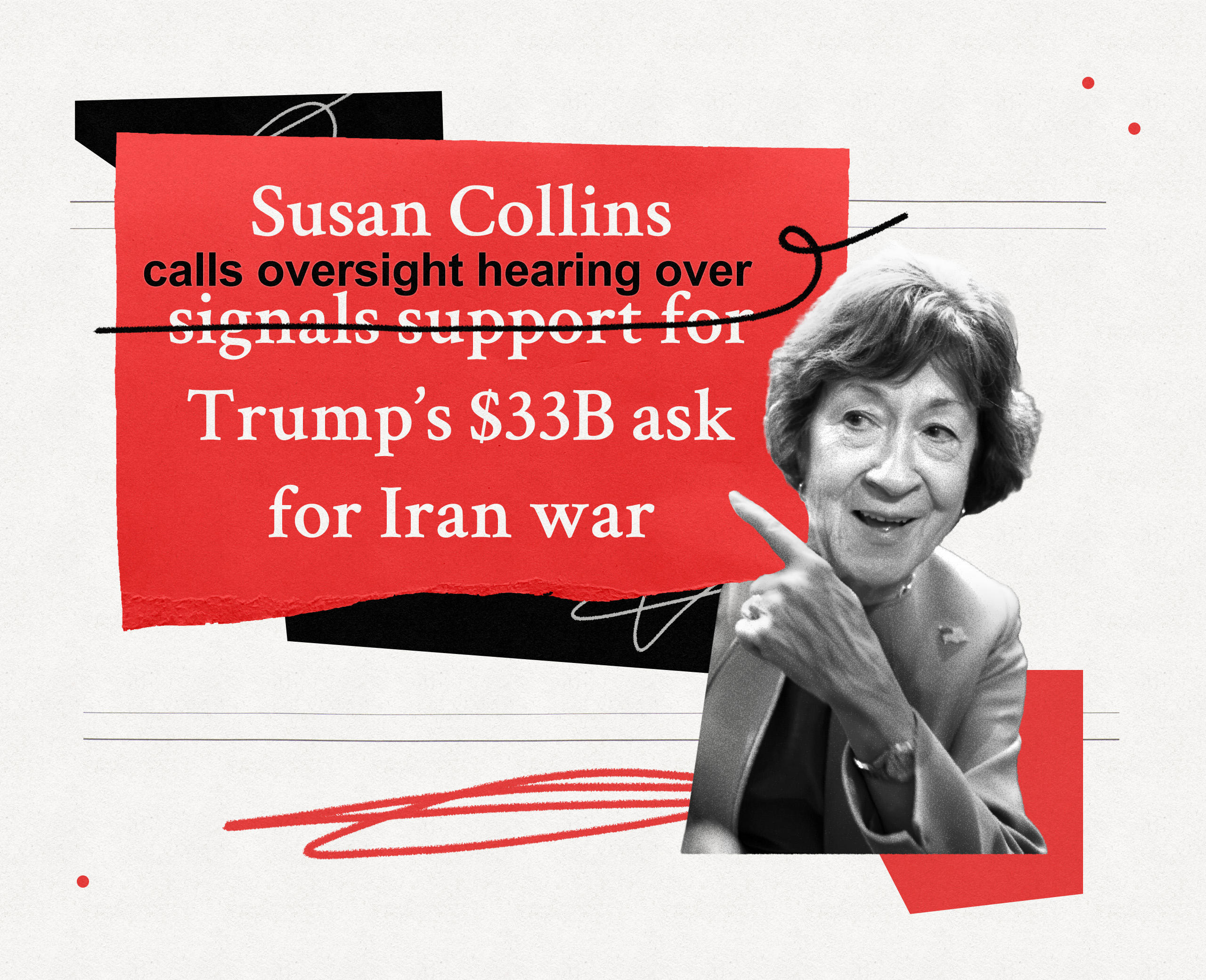
On the afternoon of July 21, the Portland Press Herald, Maine’s largest newspaper, posted a routine story about its senior senator: “Susan Collins calls oversight hearing over Trump’s $33B ask for Iran war.” The next day, Dan Aibel, a reader in New York, noticed something odd: the headline didn’t match the URL for the story, which mentioned Collins “signaling support” for the funding. At some point, it appeared, the original headline had been changed to bolster the idea that Collins was pushing back on an unpopular war rather than preparing to continue funding it. Beyond that, the headline was of questionable accuracy: though questions of oversight did arise during the hearing, it had been a routine proceeding. Aibel, a vocal online critic of Collins, called Kirby Wilson, the Press Herald’s politics editor: Had someone adjusted the headline? Yes, Wilson told him, he had—at the request of the senator’s staff.
This is often how things work in Maine. Many reporters who have covered the state have stories about receiving nitpicking calls and emails from Collins’s staff immediately after publishing an article referencing her, sometimes only tangentially. (“If I had a nickel for every time she whined that we didn’t exclusively ask questions about whatever fire station she was visiting at the time, I’d be rich,” Lia Russell, a former reporter for the Bangor Daily News, once tweeted.) That includes me: In 2020, I covered a protest in support of the United States Postal Service, which was then facing upheaval under Louis DeJoy, a Donald Trump appointee. In my story, I quoted an organizer who took a passing shot at Collins’s support for a controversial 2006 postal reform bill. Her staff quickly caught the reference and successfully pressured my editors to add a lengthy rebuttal defending her vote.
The fealty to Collins extends beyond story tweaks and friendly headlines. In the aggregate, local news coverage paints a picture of a Collins who is perpetually cutting ribbons on projects she helped bankroll, checking the excesses of her party, and making common-sense deals with Democrats. For that reason, liberal critics have long accused Maine’s press of aiding Collins’s political career by burnishing her image as a principled moderate. “Whenever anyone asks me how Senator Susan Collins has been able to hold onto her seat for so long in a liberal-leaning state,” Andy O’Brien, an independent reporter, wrote in April, “I always point to the incumbency advantage and the ‘Collins Media Industrial Complex.’”
Other journalists and political observers told me that the friendly coverage is not part of some grand plan on the media’s part to reelect Collins so much as a consequence of harried newsrooms struggling with nuance on deadline. It’s fear of retaliation from a powerful home-state politician and the subscribers who support her. And it’s part of the ever-thorny challenge of striving for balance while also making clear to readers what’s really going on.
In an email, Wilson, from the Press Herald, told me that he had changed the Iran headline after Collins’s team reached out because the original was “not precise in the context of the hearing.” He added, “We independently wrote a revised headline informed by our own judgment.” (Collins’s office did not respond to my repeated requests for comment.) Even so, Steve Greenlee, the Press Herald’s top editor from 2021 to 2024, told me that Collins’s office was “extremely aggressive” about managing coverage during his tenure. “Whenever you published a story with her name in it, you would wait for the phone to ring with the Washington, DC, area code,” he told me. Making changes to stories post-publication is usually considered verboten unless it’s to correct a factual error. Eventually, Greenlee grew tired of saying no to Collins’s staff and stopped answering their calls.
Local journalists feel genuine pressure not to anger Collins. Alex Seitz-Wald, a former national reporter for NBC News who now helps run a small paper called the Midcoast Villager based in Camden, Maine, said some of that comes from a fear of losing access. “As a national reporter you’re always moving on to another state, another story, and if you burn your relationship with them it’s fine,” he said. “But in a local news context, especially in a small state, there’s extra challenges to maintaining those relationships that lead people to feel like they need to be deferential.”
In 2015, Reade Brower, a local businessman, took over as the owner of the Press Herald and several other Maine papers. He met several times with Collins, building a friendly relationship. In “Standing up for Sen. Collins, the person,” a 2019 column for the Rockland, Maine, Courier-Gazette, Brower praised her efforts to lift damaging tariffs on Canadian newsprint, noting that he’d reached out to her for help; in that column and several others, he defended Collins’s commitment to civility and bipartisanship. Brower, who gave up ownership of the Press Herald in 2023 once it converted into a nonprofit, also emphasized that he would never interfere with his papers’ coverage. Collins “never pressured me to do anything,” he told me over the phone.
But those working in Maine newsrooms do sometimes worry, for instance, about losing readers over a perceived liberal bias: Greenlee said he would hear from readers who canceled their subscriptions because coverage didn’t match what they had heard on talk radio or on Fox News. “When you see that every month in the subscription reports, it does make you question whether you’re being fair to a conservative point of view,” he told me. “There’s also a fear of subscriptions dropping so much that you won’t have a newspaper anymore.”
When it comes to Trump, Collins is often criticized for expressing “concern” over his latest move on abortion rights or immigration enforcement and only rarely backing that up with decisive action. Yet journalists struggle to point out the discrepancy—plus, they know if they do, Collins and her staff will react. This influence over the local press has helped Collins project a moderate image regardless of the facts, O’Brien told me. “People wonder why Susan Collins is so entrenched in Maine,” he said. “Part of it is she’s an incumbent, and part of it is it’s an image that’s cultivated by her PR people and by the Maine media to give the impression that she’s something she’s not.”
For all its faults, the national press has slowly learned how to call out bad faith in the Trump era without appearing to support or oppose a politician. Reporters and editors have adapted somewhat to covering Trump’s falsehoods. CNN no longer airs his rallies in full. The New York Times might rebut a particularly outrageous claim within a headline (“Trump Falsely Claims X”), rather than bury a fact-check in a story.
Why not do the same with Collins? In October, the Times published “Susan Collins Defies Trump but Rarely Stops Him,” an analysis that largely embraced the critique O’Brien and others have been making for decades. The story tracked Collins’s positions on major Republican initiatives since 2017, showing how, despite her many bipartisan votes on small or nonbinding pieces of legislation, she rarely casts a deciding vote against her party’s biggest priorities. Greenlee, for his part, said the Press Herald did point out when Collins voted against her stated values from time to time. “But we should have been louder about it,” he told me.
Occasionally, journalistic deference toward Collins evolves into something more. In 1997, the managing editor of the Bangor Daily News became her communications director, and later returned to serve as the paper’s head editor for twelve more years. During Collins’s last reelection campaign, in 2020, Bill Green, a beloved local sportscaster who had retired the year before, cut a now-famous ad supporting her. Just last month, Green released another pro-Collins spot. (Over text, Green pointed out to me that he was not a working journalist when he expressed support for Collins.)
Yet there are signs that the tradition of deference may be slipping. In late September, ProPublica revealed that the FBI had opened a bribery investigation into Collins. Notably, Maine’s largest outlets ran front-page stories on the investigation, which documented payments to Collins’s campaign from Navatek, a defense technology company, in exchange for her office’s support for government contracts. (Collins has since claimed that the FBI cleared her. In fact, the investigation was aborted when the incoming Trump administration dismantled the FBI’s anti-corruption unit.)
In recent weeks, Phil Hirschkorn, a prominent Maine broadcast journalist for News Center Maine, has been attacking the ProPublica report. “Did this ‘favor’ happen?” Hirschkorn posted on X. “Did @SenatorCollins advocate for any Navatek contracts after $8 million Pentagon awarded in Aug. 2019? She says NO.” But at the final Maine Senate debate, which Hirschkorn moderated, he pressed Collins to give an example of a time she had cast a deciding vote against her own party. “At one point, I had organized people to vote against Secretary Hegseth,” she responded. “As you undoubtedly have read, at the very last minute, one of our Republicans changed his mind. Otherwise he would’ve been defeated for that job.” (Hirschkorn did not respond to my request for comment.) Hearing her reply, Hirschkorn smiled and called Collins out for her evasion. “So,” he said, “that didn’t change the outcome.”
Has America ever needed a media defender more than now? Help us by joining CJR today.