Sign up for the daily CJR newsletter.
Stories about the crisis of journalism almost always begin with a now-familiar tale of technological disruption. First the internet shattered the traditional newspaper “bundle.” Then social media came along and further balkanized the audience. Now artificial intelligence threatens yet more upheaval. Yet we are hardly the first generation of journalists to confront this degree of change.
Before the rise of modern mass media, around the turn of the twentieth century, the United States supported a sprawling and wildly prolific newspaper culture. At the end of the Revolutionary War, there were thirty-seven newspapers in the former colonies. By 1900, that number had soared to more than twenty thousand—accounting for more than half the newspapers in the entire world, in a country with about 5 percent of the world’s population. That astonishing rate of growth owed as much to economics, public policy, and long-term demographic shifts as it did to any singular technological innovation. As we struggle to adapt to our present age of media fragmentation, the nineteenth-century American newspaper landscape offers some surprisingly pertinent lessons. More than merely a precursor to twentieth-century journalism, it was a complex ecosystem in its own right: decentralized, self-organizing, and populated by a remarkable diversity of local voices.
The pages of these small weekly papers often contained an eclectic assortment of opinion, poetry, jokes, sermons, and local news—an unruly jumble that feels closer in many ways to modern social platforms than to the professionally edited big-city dailies that followed. The first independence-minded newspapers sprang to life out of real-world debates percolating in taverns and coffee shops across the colonies: a distributed network of conversation, social connections, and shared idealism that powered the revolution. And while new technologies played an important role in accelerating the growth of the press during this period (steam power, wood-pulp paper, the telegraph, and the Linotype, to name a few), technology alone cannot explain the extraordinary zeal for newspapering that propelled America’s nineteenth-century press.
When the United States first took shape, the press thrived in no small part due to government policies. Unlike the colonial press, which was deeply tethered to governmental authority—printers were licensed by the British Crown and subject to censorship and sanctions—the early US press benefited from both First Amendment protections and government policies expressly designed to support the growth of the news trade. The 1792 Post Office Act and a laissez-faire copyright regime allowed newspapers to reprint and reframe stories without fear of legal reprisal. As Ethan Zuckerman, a media scholar at the University of Massachusetts at Amherst, has argued, the act was an early investment in the public commons, helping create a broad-based, heterogeneous news ecosystem. What role might public policy play in fostering a digital news commons today? In recent years, Australia and Canada have tried requiring payments from Big Tech platforms to news organizations. (Oregon tried and failed to pass legislation requiring Big Tech to pay for news.) Short of imposing a direct “link tax” on publishers, how else might we envision a modern counterpart to the Post Office Act—one that treats news not as a legacy industry to preserve but as a public good to be reimagined?
Governments have many tools at their disposal—from tax incentives to support for public and nonprofit media—that do not involve directly funding or sponsoring private news organizations. If that commons is to thrive, however, we must also grapple with the realities of authorship, ownership, and authenticity in the digital era. The legal scaffolding of copyright, though revised periodically, is still largely rooted in the analog print economy of the nineteenth century. Today, however, that framework is proving ill-suited to the challenges posed by mass copying, instant sharing, and AI-generated content.
In the nineteenth century, most newspapers operated in a legal gray zone. Before the Copyright Act of 1909 expanded federal protections for published works, news fell largely outside the scope of copyright law, and editors freely copied from one another, often without attribution. That fluidity helped accelerate the spread of information but also blurred the lines between originality and attribution. In a sense, the nineteenth-century newspaper ecosystem functioned as a vast, decentralized network for remixing and redistributing content at scale.
Today, we are seeing a higher-stakes version of the same dynamic at work. AI systems now train on large bodies of published content, scraping and remixing text at massive scale, often without consent or compensation. The current copyright framework strains under a world where headlines, snippets, and summaries often circulate more widely than the original articles. What does it mean to create new content from a soup of other people’s work? Who owns the output when the author is, at least in part, an algorithm?
Like the “exchange editors” of the nineteenth century—who compiled local narratives from far-flung clippings—AI systems can now recombine fragments into seemingly coherent wholes. The modern AI-enabled newsroom may come to resemble a digital pastepot: a remix engine echoing the viral textual culture of the pre-wire-service era. But who decides whether those wholes are fit for publication?
We may be entering the age of the hybrid editor: part human, part machine, shaping the public sphere from the infinite scroll of digital content. That shift demands not just new tools but new legal and epistemic frameworks to govern what news means in a world where its makers are no longer entirely human. Or the old small-town editor—trading subscriptions for whiskey or eggs, soliciting poems and bits of gossip from the neighbors, and freely exchanging newspapers with fellow editors all over the country—may be a better avatar for the news creator of the future than the comfortably middle-class newsroom typewriter jockeys of the mid-twentieth century.
If the nineteenth century teaches us anything, it’s that the shape of media is not preordained. It emerges from technological possibility, yes—but also from infrastructure, law, social norms, and public investment. The challenge, then, is not to restore the old order but to create space for experimentation and reinvention. In the fading pages of nineteenth-century newspapers we can rediscover a time when news was social, participatory—and often chaotic—yet also capable of spreading ideas, fueling reform, and helping communities imagine themselves into being. Consider the abolitionists, temperance advocates, women’s-rights crusaders, and other reformers who leveraged cheap print and open networks to amplify their voices during this formative era. If we can recover the spirit of our editorial forebears—with their scissors, pastepots, and willingness to try new things—perhaps we can yet find a way to keep this story alive.
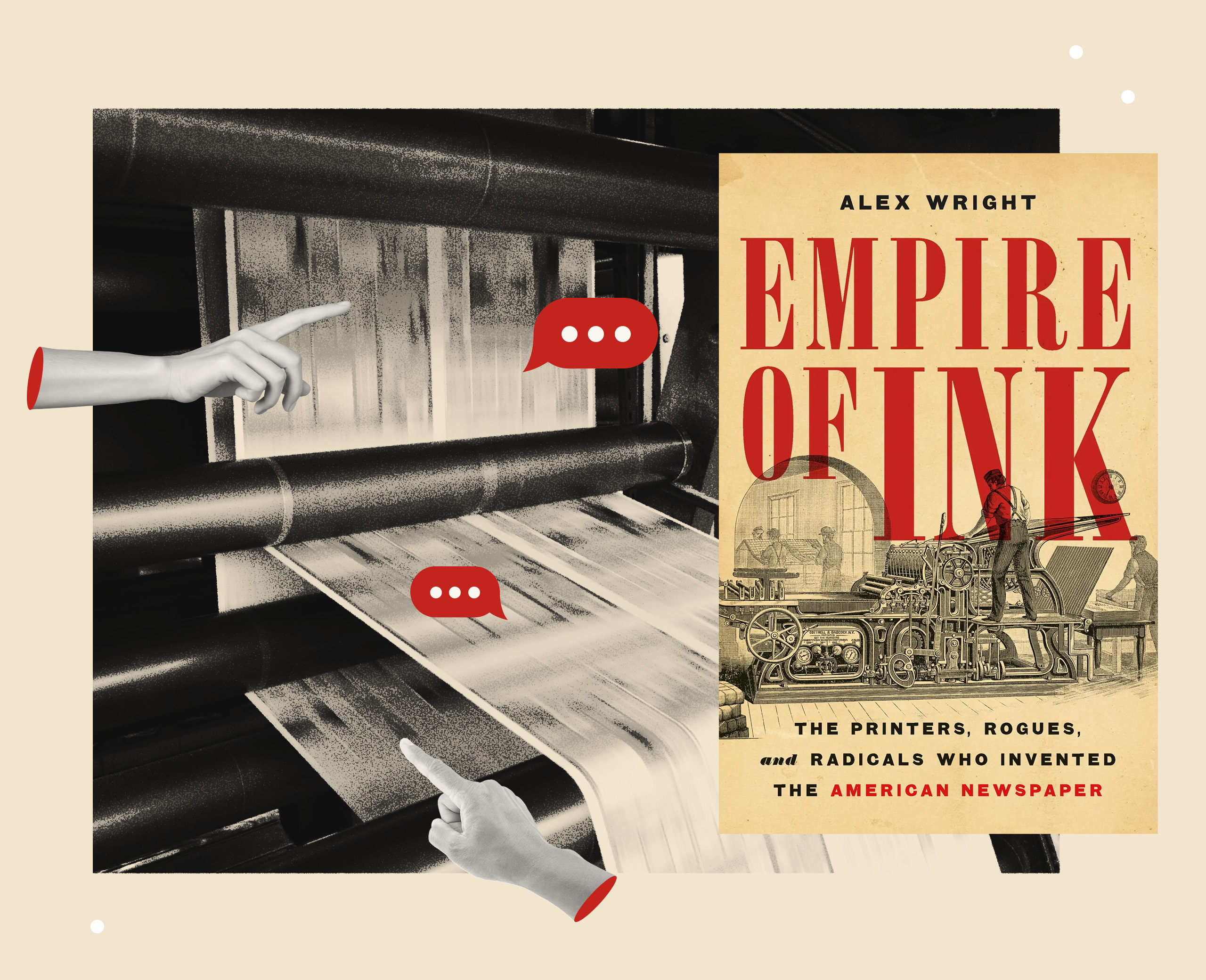
Adapted from Empire of Ink: The Printers, Rogues, and Radicals Who Invented the American Newspaper (Basic Books, 2026).
Has America ever needed a media defender more than now? Help us by joining CJR today.