Sign up for the daily CJR newsletter.
In announcing that CBS News Radio would end in late May, Bari Weiss and Tom Cibrowski, the editor in chief and president of CBS News, respectively, wrote that their network had “delivered original reporting to the nation” for almost a century. “CBS News Radio,” they claimed, “served as the foundation for everything we have built since 1927.” But the truth is somewhat different—when the Columbia Broadcasting System debuted, in September of 1927, with sixteen affiliated stations stretching from Rhode Island to Iowa, the network had no news division and instead promised “radio showmanship,” with “exclusive celebrities” supplying “music and fun.” (One reviewer wrote that its three-hour premiere declined “in quality with astounding speed” and that “no one not paid to” listen “could have survived it.”)
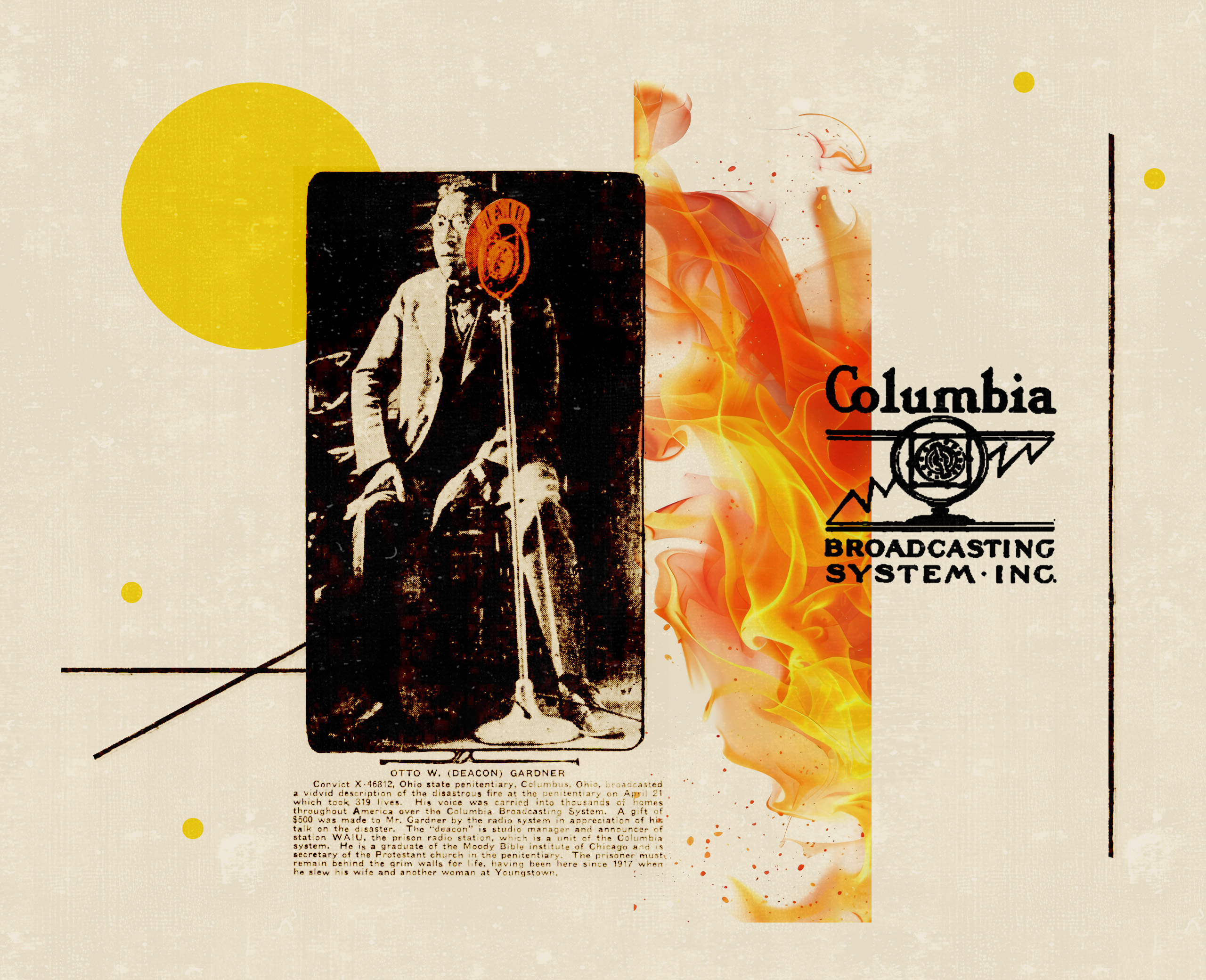
The network’s fortunes changed with a spontaneous moment of eyewitness news commentary that’s nearly been lost to history. On April 21, 1930, a fire broke out at the Ohio Penitentiary, in downtown Columbus. Soon listeners would hear an unexpected voice broadcasting over the airwaves—a man identified not by a name, but by a number: “Convict X-46812.” Listeners heard him describe an inferno that killed three hundred and twenty-two prisoners and still ranks as the deadliest disaster in the history of US prisons. For the first time, breaking news, direct from the scene, crisscrossed America over CBS. This unexpected broadcast—eight years before Edward R. Murrow began working as a reporter—captured the public’s attention and showed that CBS could rebrand by investing in newsgathering. Only then did CBS start hiring the people who would build its news division. The network’s legacy of original and compelling reporting begins not with Murrow, but with the forgotten voice of a Black prisoner named Otto Gardner, known among inmates as “Deacon.”
Gardner entered the penitentiary in 1918, to serve a life sentence for murdering his wife and sister-in-law, and within its walls he found religion and radio. By April of 1930, at age thirty-five, he’d earned a degree from the Moody Bible Institute and worked in the prison’s Protestant chapel, where his duties included managing a radio studio upstairs. The inmates used the facility to broadcast musical performances over one of the original CBS affiliates, Columbus station WAIU, with Gardner likely acting as announcer. The chapel stood next to a cellblock under construction where, on Easter Monday of 1930, two inmates set a fire in a failed escape attempt. The blaze began around 5pm and spread to a block overcrowded with eight hundred men, whose survival depended on whether their fellow prisoners and a few guards could free them ahead of the flames and smoke. Chester Himes—who was then an inmate, before becoming the author of the “Harlem Detective” series of novels—described “the strangled screams, the choked unended prayers, the curses and coughs and gasps and moans and wails of the convicts trapped in their cells.”
From a skyscraper studio downtown, the staff of WAIU saw the smoke and broke the news around 6pm. By 7, Fred Palmer, the station manager, was inside the prison, reporting back by telephone so an announcer could repeat his words on-air. At a time when remote broadcasting required cumbersome technology and advance notice, this was about as close to eyewitness news as radio could get. In time, the WAIU crew found that the chapel studio, beside the burned cellblocks, had survived. Around 9pm, after the blaze died out, WAIU switched its coverage to the penitentiary, arranging with CBS in New York to carry the broadcast nationwide. The first breaking news report in CBS history went out to seventy-two affiliates at 11:15pm, with Deacon Gardner at the microphone.
No recording of this broadcast survives; accounts conflict as to who spoke first. Most likely, Palmer introduced Convict X-46812, then Gardner began with the facts: where and when the fire started, how it spread, the rescue efforts and rising death toll. “All the convicts in the top lanes of the prison, about three hundred and sixty, were either burned or smothered,” he said. “As soon as a body was passed out, the doctors examined it to see if life was still left.” Through the chapel’s windows, Gardner saw the injured and dead lying in the yard, bathed by floodlights as armed soldiers watched for a riot. “These prisoners who are not aiding or working now are milling about in the yard,” he said, “but their morale is wonderful. No one has tried to escape.” (That was less than accurate; the prison teetered on the brink of revolt.)
At some point, Gardner shared the air with an editor from the Columbus Dispatch, but Deacon left a deeper impression on listeners—especially when he praised the character of the other inmates. “Many of them were badly burned carrying their brothers from the burning buildings,” he said. “I’m glad and proud to call them brothers.”
For weeks afterward, newspapers across the country praised the broadcast. “Radio for the first time in history gave millions of listeners eye-witness accounts of a catastrophe at the time of its happening,” the Kansas City Star declared. Press coverage marveled at the “intensely dramatic account” from this “radio hero,” as the Kentucky Post called Gardner. The Chicago Defender reported that Gardner “startled America” thanks to “his vivid and amazing description.” William S. Paley, the twenty-eight-year-old president of CBS, sent Gardner a thank-you note with a five-hundred-dollar check. (Gardner refused Paley’s money, but CBS made sure the press heard about the offer.)
Paley had purchased the failing network eighteen months before the fire, after the original owners lost a fortune. The older, richer, more popular NBC had a pioneering record in news, which CBS had followed by broadcasting bulletins or sending sportscasters to cover events like political conventions. But anything CBS could do, NBC had already done better. The prison fire gave CBS an opportunity to distinguish itself—as the New York Times put it, “The Columbia Broadcasting System demonstrated its initiative” by airing Gardner’s “graphic word picture.” “That broadcast was an immense news scoop for us,” Ted Husing, a CBS announcer, wrote in a memoir five years later. “We began crowing about it in our advertising.”
There was a concern, however: Paley didn’t want the attention generated by the prison fire to antagonize newspaper publishers, who already saw radio as a competitor. Edward Klauber, a former Times editor who was working for Edward Bernays—the public relations mastermind, hired to help CBS out—urged him to reconsider. In a memo a week after the fire (now among Bernays’s papers at the Library of Congress), Klauber wrote that “if the broadcasting of news is sound and a public appetite has been created for it, this appetite will be satisfied by someone if Columbia and NBC both withdraw from that field.” Soon after, Paley hired Klauber as network vice president, trusting him to serve “as my adviser, guide, and mentor on how CBS should handle news.” Klauber brought on people who shared his journalistic sensibilities, building a staff that could cover the next breaking news event rather than waiting for reporting from an affiliate like WAIU. This formed the nucleus of what we now know as CBS News.
Three years later, Klauber hired Murrow, age twenty-seven, to fill a job booking speakers on the network. Although he had no reporting experience, Murrow would work alongside news professionals, in an organization imbued with the journalistic values Klauber had learned at the Times. Another three years would pass before Murrow made his first radio news report, relying on the infrastructure and ethos Klauber brought to CBS. “If there be standards of integrity, responsibility, and restraint in American radio news,” Murrow said in the 1950s, “Ed Klauber, more than any other man, is responsible for them.”
In 1935, the same year Murrow joined the network, Husing looked back on the Ohio prison fire as the event that helped CBS “start on its way toward the position it now occupies.” Gardner became a footnote, misremembered if remembered at all. Paley’s memoir falsely describes “an inmate [who] seized the microphone and began broadcasting the…roar of the flames…and the screams of the dying.” Within a year, Paley added, CBS started promoting itself as “the ‘News’ Network.”
Like Gardner, Murrow used his observations to claim insight into the people his audience could not see—to suggest depths of character not even a camera could capture. “How long these people will stand up to this sort of thing I don’t know,” Murrow said in August of 1940, after an early air raid on London by Nazi Germany, “but tonight they’re magnificent. I’ve seen them, talked with them, and I know.” Such vivid, intimate reporting, uniquely suited to radio, is what drew listeners to CBS in those years, building a reservoir of trust that would last the network for decades. Today, CBS leaders say they seek to rebuild that trust, but they invoke Murrow’s legacy without seeming to understand what created it: the bond he formed with audiences who knew he said what he believed. As for CBS’s original eyewitness reporter, Gardner got out on parole in 1947. Two years later, the Ohio State News checked in on this “forgotten hero” to find that he had become a Baptist minister, dedicated to helping prisoners. The Reverend Gardner died in 1967 and rests in Columbus’s Eastlawn Cemetery, with many victims of the 1930 fire.
Has America ever needed a media defender more than now? Help us by joining CJR today.