Sign up for the daily CJR newsletter.
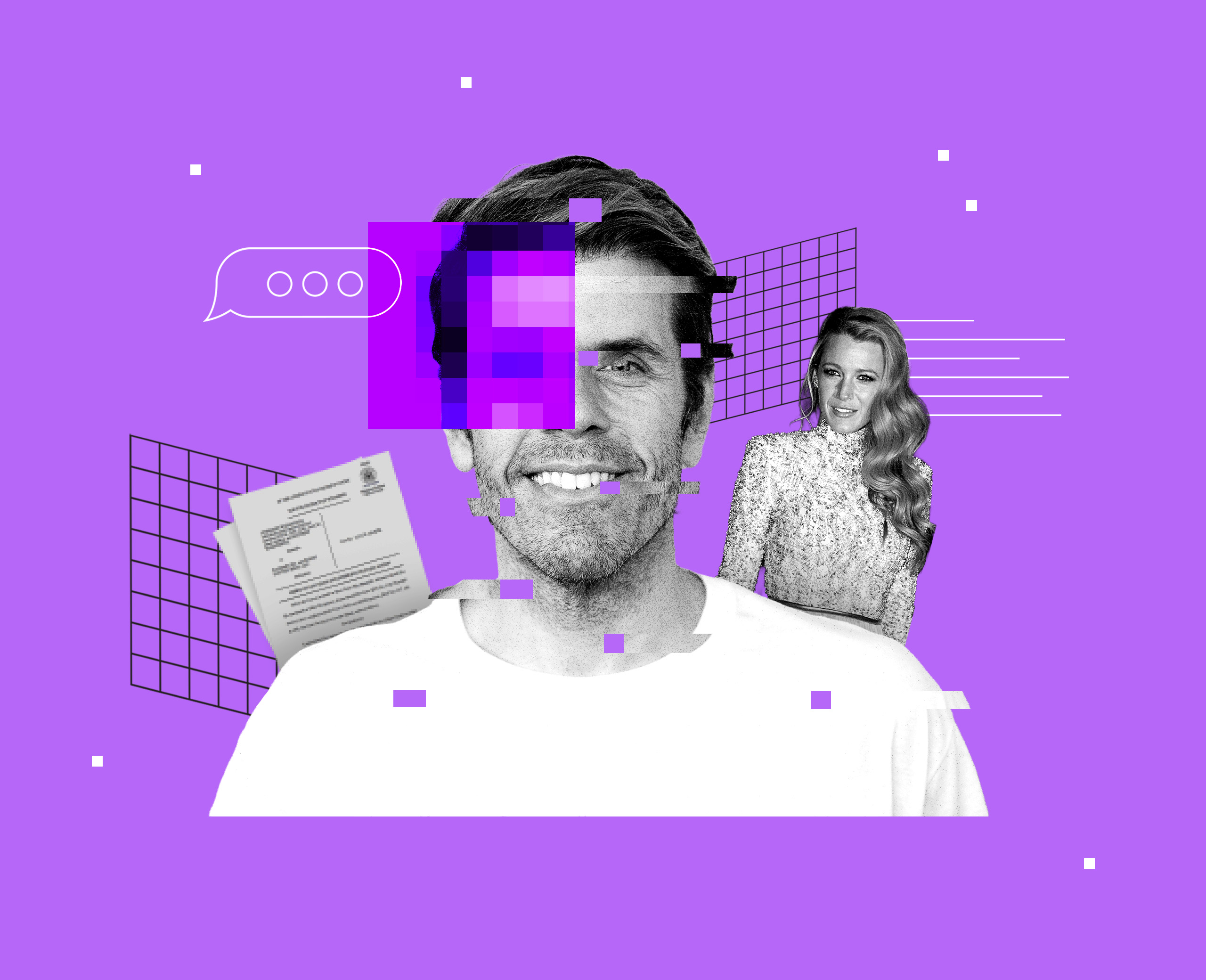
In July, when Perez Hilton—the celebrity-chronicler of long standing whose name is splashed across the banner of his website in hot pink—learned that he was being subpoenaed by Blake Lively, the actress, he yelped with joy. “My initial reaction was ‘This will get me a lot of attention,’” Hilton said. He posted a video on his YouTube page, showing himself dancing with his eight-year-old daughter to Beyoncé’s “Texas Hold ’Em.” “I naively thought it would be easy,” Hilton told me, of his chances to overcome the actual legal burden. “I was wrong.”
This was not Hilton’s first legal scrape. Over the years he’s been sued for disseminating unfinished songs by Britney Spears; deposed in a defamation case involving Lindsay Lohan; sued by Colin Farrell for posting images from a sex tape; and banned from TikTok for criticizing Charli D’Amelio—a social media star, who was then fifteen—for dancing in a bikini. (His account was later restored.) Despite all that, Hilton viewed the Lively subpoena as something different, and much more daunting. “This is a massive, sprawling case with tentacles everywhere,” he told me. “It was really, truly toxic and overwhelming.”
For more than two decades, Hilton has posted to his eponymous blog in the grand tradition of the newspaper gossip column—replete with juicy tidbits and blind items about the relationships, fashion choices, and unwise remarks of popular entertainers, on whose photographs he used to doodle expressions of shock and, sometimes, phallic imagery. He has picked on Miley Cyrus, Kirsten Dunst, and Jennifer Aniston. He has targeted the children of stars and outed prominent figures in Hollywood, such as Clay Aiken, circa 2006. (“I am not some safe, cookie cutter, queer-eye-for-the-straight-guy homo,” Hilton said at the time. “I am dangerous.”) Paris Hilton, from whom he derived his nom de plume, became a friend and was treated with kid gloves.
Perez Hilton, who is now forty-seven, grew up in Miami, a child of Cuban immigrants. In 2002, he moved to Los Angeles, where he started blogging. In just a few years, he exploded in influence: by 2007, he had nearly two million readers a month, many of them navigating to the site as much for his reporting as his own persona, since he became enmeshed in the culture he covered. These days, he is a single father of three living in Las Vegas. (He fell in love with the city in 2018, while working as a celebrity host at Chippendales, and moved there in 2023.) He has publicly addressed his history with baiting, or bullying, and has since toned down some of his more explicit posts while expanding his presence on YouTube and social media. He earns a living from advertising on his website and podcast, monetizing his social media, selling merchandise, striking brand deals, recording Cameo videos, and doing a bit of acting. He calls himself the “queen of media” and “the original influencer.”
For Hilton and his followers, the “Blake Lively Saaaagaaaa,” as he called it, was catnip—not to mention a source of clicks. Lively had starred in a 2024 film adaptation of Colleen Hoover’s novel It Ends with Us alongside Justin Baldoni, who also directed the movie. It was a major commercial success, but fans noticed that something was off: the two stars did not appear together on the red carpet, and Lively had unfollowed Baldoni on Instagram. Soon a dispute erupted into public view: Lively claimed that she experienced systematic sexual harassment on set and that Baldoni and his company Wayfarer Studios, which produced the film, coordinated a smear campaign intended to intimidate her and prevent her from defending her rights. (Lively’s legal team did not provide comment for this story; Baldoni’s did not respond to requests.) In December of 2024, Lively filed a complaint with the California Civil Rights Department. The filing set in motion a series of suits and countersuits between Lively and Baldoni, who claimed that the real battle was not over his alleged behavior but rather creative control of the film. (Baldoni also sued the New York Times for libel, for its coverage of the claims; that case was promptly dismissed. In September, the Times filed its own suit to recover legal fees.)
Initially, Hilton was a Lively defender. “I believed her, and I supported her,” he told me. “Until I read everything that Justin Baldoni filed. He came through with receipts—proof, timeline, screenshots—as they say. And I changed my mind. I’m allowed to do that.” Lively’s legal team alleged that Hilton’s change of heart was not the result of research, however. Rather, they suggested that he was an active participant in Baldoni’s smear campaign. They pointed to more than five hundred YouTube videos and posts that Hilton had produced on the It Ends with Us controversy, nearly all of them critical of Lively. When I asked Hilton about those videos, he replied that there were “probably a lot more”—and noted that his reporting on Lively had been based on his review of legal filings and conversations with sources. He has said repeatedly that no one ever paid him or told him what to write, and he told me the same.
Lively’s subpoena of Hilton was filed in New York, where most of the Lively-Baldoni legal battle has taken place—and remains ongoing. But Nevada, where Hilton lives, happens to have one of the most protective shield laws in the country: journalists in the state cannot be compelled to testify in nearly any civil or criminal proceedings. The statute does not define the term “journalist,” though a rule promulgated by the Nevada Supreme Court states that a journalist is “any person who gathers, prepares, collects, photographs, records, writes, edits, reports, or publishes news or information that concerns local, national, or international events or other matters of public interest for dissemination to the public.” Hilton believed he qualified.
Still, there was a problem. Hilton’s insurance would not foot the bill for a lawyer to defend against a subpoena. He would have to cover his legal costs out of pocket. Instead of finding an attorney, he did two things legal experts always advise against: he decided to represent himself and to use ChatGPT to help draft his legal briefs. At first, this did not go smoothly. An early filing written by ChatGPT, which Hilton nicknamed Dad, invented several legal references. “There’s this phenomenon called ghost law,” Hilton said. “They make up citations, they make up anything.” After a set of embarrassing errors was called out on social media, Hilton started double- and triple-checking every citation, and asked ChatGPT to review its own output. The process went more smoothly from there—so much so that Hilton came to see AI as a great legal leveler. “Now that I know that I can so effectively use ChatGPT, I’m not going to be paying a lawyer unless it’s absolutely necessary,” he told me.
On July 28, Hilton filed an AI-assisted motion to quash the subpoena under his legal name, Mario Lavandeira Jr. “I anticipate that the subpoenaing party may attempt to characterize me as merely a ‘content creator’ or social media personality,” read the brief, which was filed in the US District Court of Nevada, in Las Vegas. “That framing is inaccurate and misleading. I am a journalist—a globally recognized one—with a decades-long track record of reporting on matters of public interest.” The brief went on: “My work and I have been cited by mainstream outlets, referenced in legal filings, and are followed by millions. I adhere to journalistic standards, protect my sources, and conduct my job in the same professional capacity as any reporter.”
Hilton argued that he was entitled to protect his sources for his Lively-Baldoni coverage under the First Amendment and Nevada’s shield law. “This is a matter of great public interest,” Hilton told me. “We’re dealing with very hot topics like sexual harassment and allegations of workplace impropriety and allegations of retaliation on both sides.” Now there was nothing to do but hope for the best and wait for a judge to make a decision. Hilton, always the showman, was able to drum up attention in the local media and on Page Six. The national and mainstream media largely ignored the story. But, even if they didn’t know it at the time, they had a stake in the outcome: if the judge in the case determined that Hilton had to cough up his sources, that ruling could erode protections that all journalists have long enjoyed.
More than half a century earlier, in 1968, Earl Caldwell, a reporter for the Times, published a series of stories about the Black Panthers based on confidential sources he had developed inside the organization. Afterward, the Justice Department issued a grand jury subpoena demanding his notes. Caldwell refused to comply. James C. Goodale, who was then the chief counsel for the Times, felt an obligation to offer support, particularly in light of other threats to press freedom that were compounding at the time, under the direction of President Richard Nixon. But he needed a constitutional argument.
Historically, courts have viewed subpoenas as an essential tool in the administration of justice and compliance as an obligation of every citizen. As Goodale recounts in his memoir Fighting for the Press (2013), news organizations once routinely capitulated to government subpoenas, turning over notes and testifying about their newsgathering. But he believed that if the First Amendment was to have meaning, then journalists needed an out. “If reporters had to disclose their sources, no one would speak to them,” he wrote. “If no one speaks to them, reporters would not publish anything, and their speech would be curtailed.” He devised a three-part test that would create a qualified privilege for the press, arguing that the government should be able to compel journalists to testify only if they had information that was material, relevant, and not obtainable through other means.
In 1972, Goodale and the Times had the opportunity to make that argument to the Supreme Court, in a case merged with that of another journalist, Paul Branzburg, who had reported on the manufacture of hashish in Kentucky. But when the decision came down—Branzburg v. Hayes—it was not what the journalists hoped for: a five-justice majority ruled that journalists, like nearly everyone else, have to testify in response to subpoenas for grand jury testimony. But the dissent fully embraced the test Goodale put forward, and accepted that journalists were entitled to a qualified privilege. That dissenting opinion became the basis of a legal framework for shield law protections at the state level, which Goodale was involved in establishing.
Over the next several decades, nearly every state in the nation adopted (or strengthened) shield laws, and these were generally upheld by lower courts. There is no shield law at the federal level, though the US Attorney General’s office has since the 1970s tended to follow guidelines modeled on the Branzburg dissent. Recent administrations have pursued leak investigations that led to journalists being subpoenaed; when Merrick Garland became the attorney general, under Joe Biden, he moved to bolster press protections. Those safeguards have, however, been thrown out under Pam Bondi, the attorney general serving Donald Trump.
State shield laws vary tremendously. Some, like Nevada’s, provide “absolute privilege,” meaning that journalists almost never have to testify. Others provide privilege in more limited circumstances. Some define journalism broadly. Oregon’s shield law offers absolute privilege for anyone “connected with, employed by or engaged in any medium of communication to the public.” Others extend protections only to journalists working for established news organizations. Alabama’s shield law provides qualified privilege only to journalists working for a newspaper or a broadcaster.
The legal debate over shield laws is grounded in deeper constitutional questions about the meaning of the First Amendment, which declares that Congress shall make no law “abridging the freedom of speech, or of the press.” In a 1975 lecture, Justice Potter Stewart argued that protection of the press should be considered with respect to “organized” journalism, conceptually distinct from the speech clause and the rest of the Bill of Rights: “The publishing business is, in short, the only organized private business that is given explicit constitutional protection,” he wrote. The courts have recognized that journalists perform functions essential to democracy: checking the power of the government, serving as a forum for public debate, and acting as a surrogate for the public in accessing places average people can’t go. But the Supreme Court has never directly weighed in on the meaning of the First Amendment’s press clause—or, for that matter, defined who is a journalist and who is not.
Over the past half century, the courts have lodged plenty of skepticism toward the press—including, notably, when justices ruled that though journalists had a right to publish the Pentagon Papers, they could still be locked up in the likely event that they harmed national security. Even so, according to quantitative analysis by the legal scholars RonNell Andersen Jones and Sonja R. West, news organizations have largely held on to their own judgment on a range of questions, from publishing national security information to withholding sources. Recently, that appears to have changed. In the course of their research, Andersen Jones and West have found a growing hostility and skepticism toward the media on the part of the Supreme Court and an embrace of other types of speakers, including politicians, religious institutions, and corporations. The shift has dovetailed with a series of legal rulings undermining source protection, particularly at the federal level, where no shield law exists.
In a climate of mistrust of the institutional media—in the courts and among the public—many press freedom advocates are focusing less on professional status and more on the function that journalists perform. In other words, the rights of all journalists may very well depend on protections in place for those operating at the margins of the profession, whether they’re influencers chronicling celebrities or livestreamers filming Immigration and Customs Enforcement agents in the streets. “Constitutional rights for the press and statutory rights for the press aren’t really, at base, about protection for the press,” Andersen Jones told me. “They’re about protections for the audience.”
“I go right back to the First Amendment, that the rights of the press are not bestowed upon full-time professional journalists that just work at the New York Times,” Trevor Timm, the executive director of the Freedom of the Press Foundation, said. “They’re bestowed on everybody.” Timm argues that new technologies and platforms have opened up the practice of journalism to a broader range of people and the law needs to follow them where they are. His organization was one of the few to highlight the Hilton case, documenting every turn on the US Press Freedom Tracker, its public database of attacks on the press. “The thing that’s clear in my mind is that Perez Hilton is gathering information, talking to sources, and publishing things in order to have the public consume them,” Timm told me. “That fits the definition of a journalist.”
Hilton appeared in court in Las Vegas on August 28. He wore a floral blazer with a silver metallic sheen, and sneakers to match; his jacket popped against a black shirt and trousers. During the hearing, he made the case that even though Lively’s suit was filed in New York, the Nevada shield law should apply. The judge, Richard Boulware, seemed skeptical. New York’s shield law, while robust, offers only qualified privilege to nonconfidential sources. If the subpoena were enforced there, Hilton believed, he would almost certainly be compelled to comply. Outside the courthouse, he remained defiant. “As a journalist, I will continue to protect my sources,” he told a group of local reporters.
A few days later, on September 2, Boulware made a decision. Not only would Nevada’s shield law not apply, but Hilton was required to produce a detailed “privilege log” and forensic analysis from experts on data extraction—which Hilton said was well beyond his capacity as a pro se litigant. (Privilege logs are routine in similar cases.) The hearing would have been an unmitigated disaster except for one bit of serendipity: Dawn Thoman, a local attorney doing pro bono work on children’s rights, attended as a show of support for Hilton. She offered to make an introduction on his behalf to the Nevada chapter of the American Civil Liberties Union.
The following week, Hilton was in the ACLU’s office, signing on as a client. A few days after that, Chris Peterson, the Nevada ACLU’s legal director, contacted Lively’s legal team to inform them that the organization had taken Hilton’s case. In response, Lively’s representation said they planned to withdraw the subpoena. The official explanation they offered to the Nevada ACLU was that they had been able to obtain the information they were looking for elsewhere. Hilton didn’t buy that. “They did not want to be seen as taking on the ACLU because she’s the alleged victim here,” he told me. (Lively’s team did not comment.)
Hilton was overjoyed. “If it were not for the ACLU of Nevada stepping in and agreeing to represent me, Blake Lively would still be pursuing me,” he said. He continues to believe that the subpoena was part of a fishing expedition intended to intimidate and punish him and other bloggers and social media personalities who had covered Lively critically. Lively continues to pursue a subpoena against a podcast called Popcorned Planet and its host, Andy Signore, a YouTuber based in Florida. (On December 2 the judge in the case ruled that Signore is not a journalist and would have to turn over his notes.)
But for Hilton, it was over. On his YouTube channel, he let out a signature whoop. The Nevada ACLU had gotten a good outcome for its client, though there was also a sense of missed opportunity. The ACLU generally sues governments. Getting involved in a civil case was a departure that came with potential: in Peterson’s view, Hilton’s case provided a chance to litigate on a critical First Amendment matter and to use a celebrity platform to bring awareness of the need for press freedom to the wider public. “Mr. Hilton reaches an audience,” as Peterson told me.
Hilton had done an extraordinary job as a pro se litigant, Peterson said, but had gone as far as he could—especially because of the possibility that his case could end up with the Court of Appeals for the Ninth Circuit, potentially setting an important precedent. “We’re living in an age right now where there are a lot of people with power; both private individuals and in government are trying to discredit what it means to be a journalist,” he observed. “They’re trying to make it sound as though the smaller, more independent people that may be covering and videotaping aren’t real journalists. We had an interest in ensuring that people like Mr. Hilton, who may be acting independently and aren’t part of a major news organization, are still receiving the protections that are there.”
When I reached Hilton to talk about the impact of his case, he was picking up his kids at school. “¡Oye, vamos por allá!” he yelled to them in Spanish (“Listen up, we’re going that way!”). He seemed proud of his role in the public debate but also relieved to have his life back. Speaking with me, he was forthright that, though he has long embraced a journalistic identity, he also maintained an idiosyncratic ethical code: Many of his tips have come from publicists, managers, or celebrities themselves. If he knows and trusts them, he will publish the information without checking or identifying the source. When he writes about Las Vegas, he has a different standard —he does not cover scandals, for fear of getting banned from the clubs and casinos. “You have to play by the rules here,” he said. “I’m happy to be a cheerleader. I’m not going to stab anybody in the back or betray anybody or anything like that.”
To accept Hilton, in those terms, as worthy of press protections may not seem obvious. Certainly, considering him as a journalist means taking an expansive view. “A lot of creators working in the digital space,” he told me, “perhaps lawyers or maybe journalists working for a newspaper or a broadcast channel may not perceive them to be journalists, but they are. And they probably will outlast a lot of the legacy media.” Moving forward, one sees the boundaries being pushed in every direction: Julian Assange, not a journalist, was prosecuted for publishing classified information, something that mainstream news organizations do regularly; media figures from major outlets such as Don Lemon, Megyn Kelly, Paul Krugman have migrated to digital platforms and begun operating independently. Depending on the laws where they live and work, their mileage from shield laws may vary.
The right of journalists to protect their sources was forged in the civil rights era by a reporter doing consequential work on behalf of a powerful media institution with support from top constitutional lawyers. Today, it is being defended by an independent celebrity blogger writing legal briefs using AI. “In my view, people who are engaged in the constitutionally protected press function need protection in order to shore up the newsgathering ecosystem for all of us,” as Andersen Jones said. Hilton, however unwittingly, has been blazing the trail for twenty years. “I am not a snob,” he said. “I believe that anybody who is functioning as a journalist should be protected by the laws. It’s as simple as that.”
This piece is part of Journalism 2050, a project from the Columbia Journalism Review and the Tow Center for Digital Journalism, with support from the Patrick J. McGovern Foundation.
Editor’s note: This piece has been updated to correct a copyediting error.
Has America ever needed a media defender more than now? Help us by joining CJR today.