Sign up for the daily CJR newsletter.
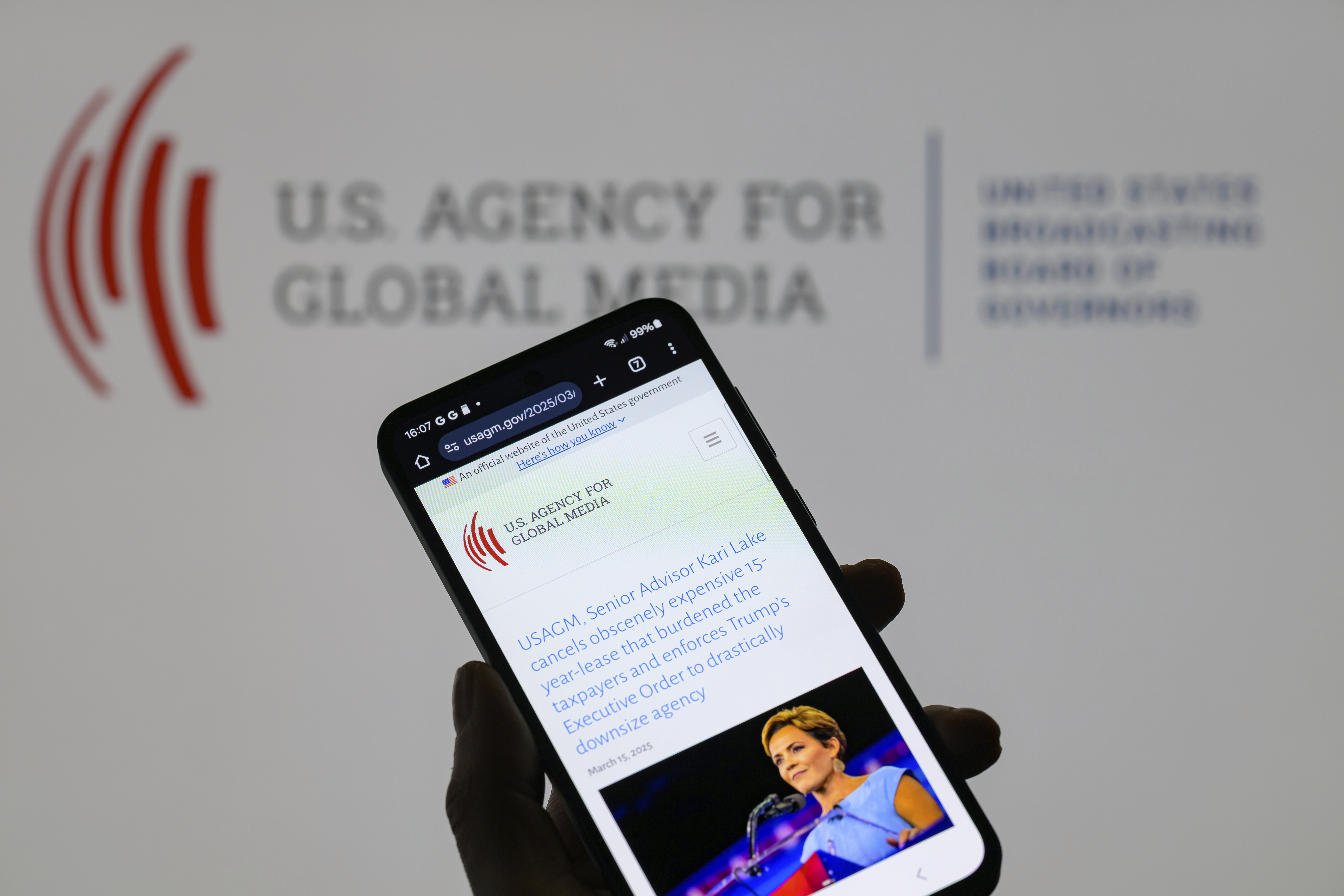
On Saturday, a federal judge ruled that Kari Lake, who has been leading the United States Agency for Global Media (USAGM)—which oversees congressionally funded news outlets including Voice of America (VOA), Radio Free Europe/Radio Liberty (RFE/RL), and Radio Free Asia—was elevated to the position of acting CEO unlawfully. The judge declared her mass layoffs at VOA and others last year null and void.
From the beginning, there was a stark imbalance between Lake’s dubious authority and her sweeping actions at USAGM. The chief executive of USAGM requires Senate confirmation, but Trump never nominated Lake for the role. Instead, last March, he named her the senior adviser to Victor Morales, who was then the acting chief executive, and who immediately delegated his authority to her. Then, in July, she was formally elevated to acting CEO, without congressional approval. Lake, a MAGA loyalist and former TV journalist, who has cast herself as “Trump in heels,” caused confusion last year by referring to herself, variously, as deputy CEO and acting CEO. (She gave up the acting CEO position on November 19 but remains at USAGM.)
Whatever her role, Trump made clear that she was in charge, and Lake oversaw deep and scathing cuts. At the start of last year, VOA broadcast news in forty-nine languages; by January of this year, that had fallen to just six. Lake placed at least thirteen hundred VOA staffers on administrative leave; she gutted RFE/RL, which found itself “fighting for its life”; she arranged for VOA to distribute coverage from One America News Network, a pro-Trump channel, drawing accusations that USAGM had become a purveyor of administration propaganda. “I told President Trump, when he called me and asked me to lead the Voice of America, that we will focus on accurate and honest reporting,” Lake said in a speech to the Conservative Political Action Conference last February. “It won’t become Trump TV, but it sure as hell won’t be TDS TV—you can find all the Trump Derangement Syndrome that you want over on CNN, MSNBC, CBS, 60 Minutes, the Washington Post, and the New York Times.”
Two lawsuits were filed against Lake last year: one by a group of employees—including Patsy Widakuswara, VOA’s White House bureau chief, Jessica Jerreat, VOA’s press freedom editor, and Kate Neeper, USAGM’s director of strategy and performance assessment, all of whom remain on paid leave—and another by Michael Abramowitz, the VOA director. Saturday’s ruling responded to the former, and was written by Royce C. Lamberth, a Ronald Reagan appointee who serves as a judge in the US District Court for the District of Columbia. “The Court finds that these expansive delegations were an unlawful effort to transform Lake into the CEO of US Agency for Global Media in all but name,” he wrote, adding that Lake’s actions therefore cannot stand. Lake attacked the ruling as “bogus” and said it came from an “activist judge”; she told NPR’s David Folkenflik that she will appeal. (The agency has until March 11 to respond.) But if Lamberth’s decision holds up in higher courts, hundreds of journalists for USAGM could be reinstated. Skye Perryman, the president and chief executive of Democracy Forward, which served as cocounsel for the plaintiffs, said the ruling was “a win in the fight against autocracy.”
At the time of writing, though, much remains uncertain. Can Lake continue at USAGM after such a critical ruling? What about the hundreds of journalists laid off or forced onto administrative leave, many of whom have since moved on? USAGM newsrooms have been gutted like fish; can they simply be refilled and stitched up and start swimming again?
It’s a particularly difficult time for USAGM staffers to be sidelined. Last Saturday, as US and Israeli forces began attacking Iran, Widakuswara wrote on X that VOA should be covering the war with the depth and expertise of its full staff of journalists. “None of that is happening right now. When Kari Lake placed almost all VOA staff on administrative leave in March 2025, she killed our 24/7 operation. She has never revived it,” she noted. “Instead of delivering authoritative journalism and piercing state censorship in Iran and elsewhere, VOA is producing limited content in a handful of languages, broadcasting almost exclusively the administration’s point of view.”
The work of USAGM—intended to operate independently, with a firewall against political interference from Congress and the president—has occupied a unique place in the international media environment. Its focus has been on nations where press freedom is suppressed, with the twin goals of providing news and spreading democratic values. “Some view these networks as soft-power influence operations; others consider them valuable news services,” Emily Russell explained in CJR in 2023, following her piece looking at USAGM outlets in Afghanistan. “In my view, they’re a combination of the two.” Trump has long been hostile to USAGM, accusing it of liberal bias, and, after taking office again, in 2025, he chose Lake with the intention of clipping its wings.
The consequences of eviscerating USAGM are clearly visible in the administration’s war on Iran. The justifications suggested by Trump—and his officials—for the imbroglio, which has now involved at least seventeen countries and reportedly killed more than thirteen hundred civilians, have shifted depending on the day and which reporter’s name Trump hears when he picks up the phone. But at least one of those justifications has been regime change, with Trump urging Iranians to rise up and “take over your government.” Yet Iran’s regime has stamped on press freedoms, locked up journalists (at least fifteen are currently behind bars), and imposed a severe internet blackout, making it difficult for Iranian civilians to even find out what’s going on—let alone dismantle a sophisticated police state with more than a million security forces and overlapping institutions designed to withstand military assault. On Sunday, Iran named Mojtaba Khamenei, the son of the slain Ayatollah Ali Khamenei, as its new supreme leader. Some analysts say he is even more hard-line than his father.
For the Trump administration, a fully equipped VOA Persian-language service might have been a useful tool to deliver fact-based news, combat Iranian government propaganda, and spread pro-democracy messaging inside Iran. Instead, Trump chose to kneecap it. When Radio Farda, the Persian-language service, sought to sidestep the internet blackout and broadcast into Iran during recent protests, it was forced to rent from commercial contractors, as Lake blocked RFE/RL from using USAGM’s transmission equipment. According to a post from the Save VOA campaign on X, “No matter how much Kari Lake claims that VOA Persian is delivering the president’s message directly to Iran, the reality is that she has crippled our capacity to reach audiences everywhere.”
The White House, meanwhile, is busy posting propaganda of its own: apparent clips of the US military bombing Iranian vehicles, buildings, and aircraft spliced with video game footage from Call of Duty and Grand Theft Auto. Whether the Trump administration’s video-gamification of war—not to mention the air strike on an Iranian girls’ school in Minab that killed at least a hundred and seventy-five people—sells the Iranian public on American values will, I’m sure, become clear in the weeks to come.
Widakuswara, the VOA White House bureau chief stuck on administrative leave, said in a statement with her coplaintiffs that the federal ruling made them feel “vindicated and deeply grateful.” She added, of Lake: “Even as we work through what this ruling means for colleagues harmed by her actions, it brings renewed hope and momentum to the next phase of our fight: restoring VOA’s global operations and ensuring we continue to produce journalism, not propaganda.”
Other Notable Stories …
- On Wednesday, Estefany Rodríguez, a journalist for Nashville Noticias, a Spanish-language outlet, was arrested and detained by Immigration and Customs Enforcement (ICE), Carolina Abbott Galvão reported for CJR. Lawyers for Rodríguez said that she was not shown a warrant. Afterward, the Department of Homeland Security claimed there had been a warrant and all was aboveboard. But one of Rodríguez’s attorneys told Abbott Galvão that the warrant was only received days after the fact, and that a box was checked—“the failure to establish admissibility subsequent to deferred inspection”—indicating that it was issued “well after arrest, which still appears to have been warrantless.” The day before Rodríguez’s arrest, she’d been covering ICE raids in Nashville; the Committee to Protect Journalists said her detention would likely deter other journalists from reporting on ICE in their communities. Rodríguez’s attorneys, who filed a petition for her release, said they intend to add a claim for First Amendment retaliation.
- The Department of Justice announced on Wednesday that it planned to appeal a magistrate judge’s decision on February 24 blocking the government from searching the electronic devices of Hannah Natanson, the Washington Post reporter who had her home searched and devices seized by the FBI on January 14 as part of a leak investigation. At the time, Maddy Crowell wrote for CJR that “Natanson’s experience is virtually without comparison.” Law enforcement officials have said the search was part of an investigation into Aurelio Luis Perez-Lugones, a systems administrator with top-secret clearance who has been charged with unlawfully obtaining and sharing classified materials. Matt Murray, the executive editor of the Post, wrote to staff that “this extraordinary, aggressive action is deeply concerning and raises profound questions and concerns around the constitutional protections for our work.”
- In the UK, the publisher of the Telegraph has been acquired by Axel Springer, the media group that also owns Politico and the German newspaper Bild, in a deal worth about 770 million dollars. Axel Springer won the battle to acquire the Telegraph, a conservative newspaper, by muscling out the Daily Mail and General Trust (DMGT), a British right-wing media empire. DMGT had previously agreed to a takeover worth about 670 million dollars, although the UK’s Labour government referred it to competition authorities in February, setting up months of expected delays. Axel Springer’s higher offer is not expected to be referred to competition regulators. In other news, last week the Telegraph was reprimanded by Ipso, a UK press standards agency, for having “published an entirely fabricated story about a wealthy banker complaining of the impact of school fee increases,” The Guardian reports.
- Fabrizio Romano, the soccer transfers journalist with more than twenty-seven million followers on X, posted a two-minute-fourteen-second video on Tuesday (labeled: #ad) promoting the “Global Humanitarian Role of Saudi Arabia” and praising the work of the King Salman Humanitarian Aid and Relief Centre. Romano has a history of partnering with brands, betting companies, and even the soccer clubs he’s supposed to be covering to make content. But this appears to be the first time he has done PR work for a state-backed organization, that state being the one that tortured and murdered Jamal Khashoggi in 2018. For CJR, in 2023, I profiled Romano, whose reporting on soccer transfers has become gospel to many fans. That position, I wrote, relied on the reputation he’d built with audiences “for accuracy, speed, and trustworthiness that more traditional news reporters can only dream of.” In two minutes and fourteen seconds, Romano did more to tarnish that reputation than all his previous brand deals combined.
- Last week saw the launch of The Key, an online magazine, which is a project of the Palestine Festival of Literature. It will focus on “high-quality analysis, interviews, essays, reviews and reportage about Palestine” and aim to be “a home for journalists who have had their stories spiked in mainstream outlets.” The editor in chief is Sara Yasin, the former managing editor of the LA Times. In a lucid essay on press coverage of the Israeli war on Gaza, she wrote that, for journalists, “questioning the calcified ‘both sides’ approach meant risking being branded a troublemaker or an ‘activist,’ even when their reasoning was rooted in conventional journalistic standards.”
- And Paul Conroy, the British war photographer, died from a heart attack last Saturday, his brother told the BBC. He was sixty-one. Born in Liverpool, Conroy covered a string of conflicts, including in Libya, Ukraine, and Syria, and had recently returned from an assignment in Cuba. He “put others before himself and approached his work with courage, humanity, and professionalism,” Vaughan Smith, founder of the Frontline Club, said. Conroy was wounded in Homs, Syria, in the same air strike on a press center that killed Marie Colvin, a Sunday Times correspondent, and Rémi Ochlik, a photojournalist, in 2012. It left Conroy with a hole in his leg. He later said in an interview: “I’ll never play for Liverpool. Everton, maybe.”
Has America ever needed a media defender more than now? Help us by joining CJR today.