Sign up for the daily CJR newsletter.
In 2018, President Trump met with North Korean dictator Kim Jong Un in Singapore. There was a theatrical handshake—broadcast wall-to-wall on US TV, including on ABC, which cut into The Bachelorette to air it—before the duo disappeared for talks. There followed what CJR’s Pete Vernon referred to at the time as a few hours of “dead air”—to pass the time, CNN’s Chris Cuomo chatted with the former NBA star Dennis Rodman (somehow “one of the few people with firsthand knowledge of both leaders,” Vernon noted), while on Fox, Sean Hannity compared Trump’s trip to President Reagan urging Mikhail Gorbachev to “tear down this wall”—before Trump and Kim emerged to word of an agreement (albeit vague) to rid the Korean Peninsula of nuclear weapons, and Trump sat down with Hannity to take a victory lap. A year or so later, Trump and Kim shook hands again, this time inside North Korea, after Trump took a few steps into the country—a moment “made for TV,” as many journalists told us, even if the footage was shaky and took place at nearly three in the morning, Eastern time. During a press availability, Trump was asked whether any substantive progress had actually been made on denuclearization, and Trump dismissed the question as “fake news.” A different Fox host, Tucker Carlson, was invited along on the trip, after interviewing Trump at a G20 summit in Japan. During that interview, Carlson praised the cleanliness of Japanese cities, and contrasted it with “filth” in their US counterparts. Trump concurred, but suggested that he had already moved to clean up Washington, DC. “When we have leaders of the world coming in to see the president of the United States, and they’re riding down a highway, they can’t be looking at that,” he said. “I really believe that it hurts our country.”
The world doesn’t stand still—since Trump’s first term, Cuomo has left CNN under a cloud; ditto Carlson, at Fox—but some things never change, like Trump proposing an attention-grabbing summit with an adversarial world leader, and journalists telling us that the whole exercise is made for TV. Recently, Trump announced that he would be meeting Vladimir Putin, the president of Russia, in Alaska, to discuss an end to the war in Ukraine (or, at least, to discuss further discussions about ending the war in Ukraine). Ahead of time, before a hand had even been gripped, numerous members of the media wearily concluded that the existence of the summit was a win for Putin. The Russian leader “is a global pariah facing an international warrant for his arrest, but the United States is welcoming him to American soil for the first time since 2015,” The Atlantic’s David A. Graham noted. “Without stopping his aggression against Ukraine, and despite blowing through a series of deadlines, he gets a photo op with Trump.” Russian state media—which the Kremlin tightly controls—suggested a similar conclusion, albeit without the weariness. “The whole world is waiting for the meeting,” the state-owned news agency TASS enthused.
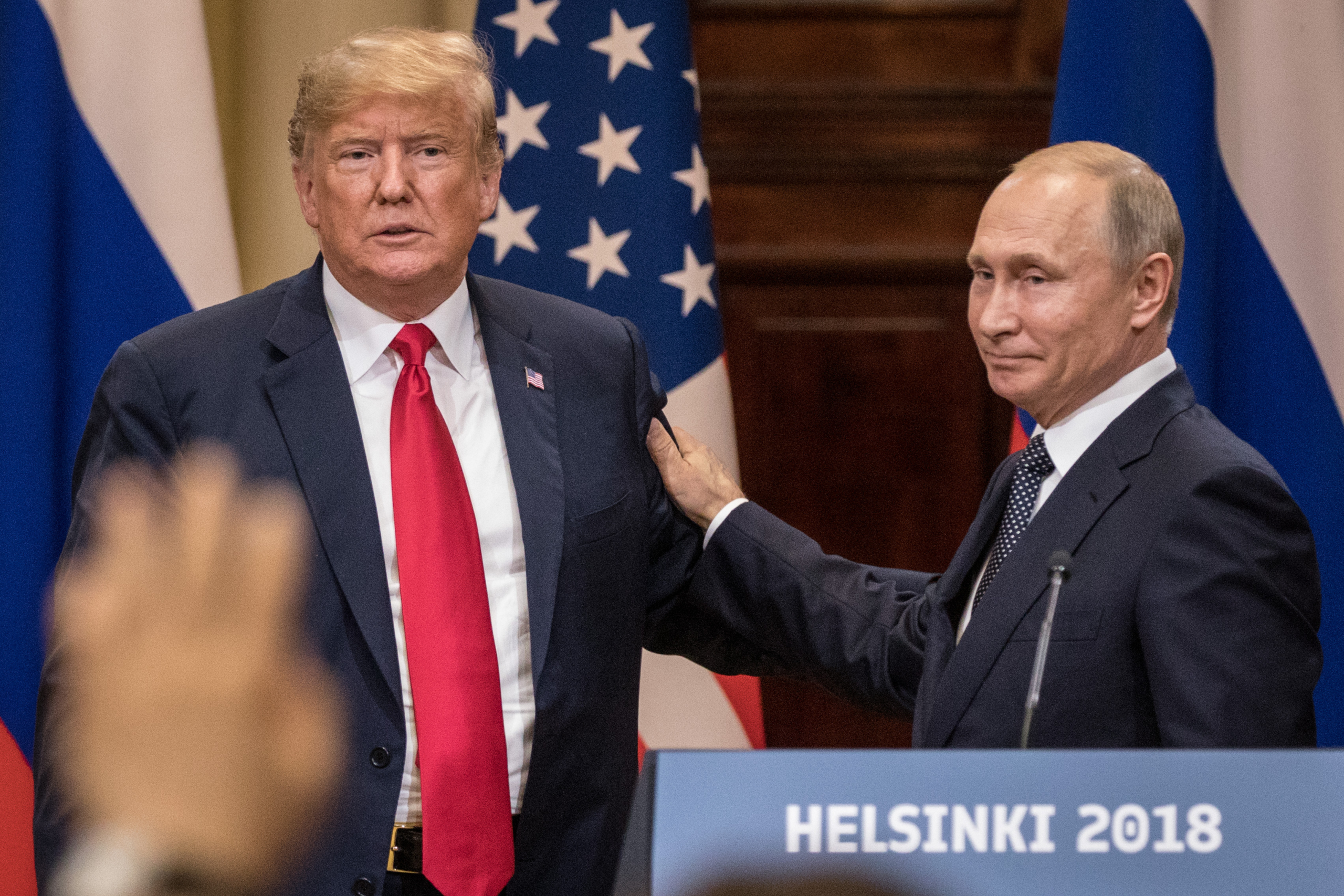
On Friday, Putin arrived in Alaska, and the optics duly opticked. He walked down a literal red carpet to meet Trump, who clapped his hands as Putin approached; Putin grinned and chuckled as the pair exchanged a lengthy handshake. Shortly afterward, journalists barked questions at Putin, including “Will you stop killing civilians?”; Putin pulled a confused expression; an aide tried to shepherd the journalists out of the room. (The right-wing podcaster Jack Posobiec, who was part of the traveling press pack, suggested that the attempted questions were at best rude, and at worst an effort to sabotage the summit.) After the leaders talked, there was what was billed as a “press conference”—though, as CNN’s media reporter Brian Stelter noted afterward, it really wasn’t, since no reporters were allowed to ask any questions. As Trump and Putin left the stage just twelve minutes after taking it, it wasn’t exactly clear what had happened during the talks, beyond a Trump remark that while progress had been made, there would be “no deal until there’s a deal”; as The New Yorker’s Susan B. Glasser put it, “stunned journalists” were left “to interpret the cryptic outcome,” wondering “was that really it, after all Trump’s hype?” With airtime to fill, and no Rodman to turn to, some reporters and anchors went off vibes. “The way that it felt in the room was not good,” Jacqui Heinrich said on Fox. “It did not seem like things went well.”
Because, again, some things never change, Trump subsequently sat for an interview with Hannity. Those hoping to glean hard details about the prospects for peace in Ukraine might have been disappointed. After gushing about the “historic” nature of the summit and a military flyby that he described as an “epic show of force” (his voice inflecting just for a moment after “show” in a way that, at least to me, accidentally illuminated the shallowness of the whole affair), Hannity turned to his guest, who quickly proceeded to whine about the “Russia, Russia, Russia hoax,” the Rigged Election of 2020, and Joe Biden. Hannity asked Trump to grade the Putin meeting on a scale of one to ten; Trump replied that it “was a ten, in the sense that we got along great.” Hannity told Trump that he’d seen a lot of world leaders come and go since he started his radio career, in the eighties, and suggested that Trump was uniquely willing to selflessly expend his political capital to solve big problems. “Why?” he asked. “Is it to save lives? Do you want to save the world?” (“Number one is lives, and number two is everything else,” Trump replied.) A tough interview this was not, though at one point, Trump still expressed regret at saying yes to it. “I think that today’s meeting went really well, and I think we maybe will have a good result, but I just don’t like to talk about it,” he said. “I said, you know what, I’ll do it, Sean. But that was like two days ago.”
After so many years of this sort of thing, it’s hard to know what more to say about any of it: the summits seemingly aimed, mostly, at delivering compelling visuals; the flagrant (not to mention breathtakingly hypocritical) right-wing media boosterism; and so on. As I’ve written many times in this newsletter over the years, I tend to dislike optics as an organizing principle of political journalism—often, they tend to distract from the substance of what’s actually happening. But when the optics are so often the point, it’s impossible not to talk about them. Indeed, they seem integral to pretty much everything Trump does these days, and not just in the staged showmanship sense that the “made for TV” cliché dutifully conveys; he is, it seems, himself trapped in an endless feedback loop of perception-shaping, in which the perception that counts for the most might be his own. The Putin summit came at the end of a week in which Trump also personally unveiled his picks for Kennedy Center Honors—and said he would host the award ceremony himself—and attempted an effective federal takeover of law enforcement in Washington, DC, both sending a message (again) about his power over Democratic-led cities and, it would seem, reacting to exaggerated messages he’d heard about the crime rate in the District. In 2019, Trump told Carlson that he didn’t want visiting world leaders seeing what he saw as urban blight. The world leader Trump doesn’t want to be exposed to this might now be himself; apparently, he announced the DC measures after seeing tents for homeless people en route to his golf club in Virginia.
Optics also do matter at summits involving world leaders, and Trump clearly didn’t invent that idea, even if he has stretched it past its absurdist endpoint. Putin is a master of wielding optics, too. In 2022, shortly before launching his full-scale invasion of Ukraine, he memorably spoke with French president Emmanuel Macron from the opposite end of a ridiculously long table, which itself sent a clear visual message (though, on the subject of world leaders’ own perceptions of reality driving how they shape the perceptions of others, Putin was seemingly afraid of catching COVID-19 at the time; indeed, some observers have speculated that the broader isolation of the pandemic may have warped his view of Ukraine). The friendlier vibes on display on Friday told their own story about Putin, Trump, their relationship, and, most of all, what Trump is willing to indulge to make it look normal.
In the end, though, the substance coming out of the summit will prove most important, and there has been some of that to chew over, even if it’s fuzzier than crisp visuals. Some of Putin’s remarks in the not-a-presser presser were very 2022; allowed to speak first, he expounded on the idea that Ukraine is a threat to Russia’s security. Though that event and the subsequent Hannity interview didn’t tell us much more about Ukraine’s fate, Trump announced on Truth Social on Saturday that he backs a resolution to the war without a ceasefire being brokered first, essentially acceding to Putin’s preference as Russia continues to devastate Ukraine; in a separate post yesterday, Trump appeared to place the onus for ending the war back on Volodymyr Zelensky, the Ukrainian president. On one of the Sunday shows yesterday, Steve Witkoff, a Trump official who took part in the talks, said that Russia had agreed to some sort of US- and European-backed security guarantee for Ukraine, albeit outside of the framework of NATO. On another, however, Marco Rubio, the secretary of state, declined to get into too many details, suggesting that the negotiations playing out in the press could derail them—a valid point, perhaps, but one that he should raise first with his boss, who literally rolled out the red carpet for Putin in front of the world’s cameras. Today, Zelensky will visit the White House, alongside top European leaders. The last time he was in town, it was, famously, very much the public-facing optics—Trump and his vice president, J.D. Vance, berating Zelensky in front of the media—that drove the story.
We’ll have to see if that happens again today. But the watching press should keep in mind that, however newsworthy they appear, they might not count for all that much in the long run. After Zelensky’s dressing down in February, Trump appeared to soften his stance toward him. Separately, shortly after returning to office in January, Trump suggested during an interview with Hannity (who else?) that he might try to rekindle his relationship with Kim. “He liked me, and I got along with him,” Trump said. (The bromance score out of ten remained unclear.) Recently, however, North Korean officials communicated via their state media apparatus (which makes Russia’s look like Woodward and Bernstein) that while Kim has a decent relationship with Trump, denuclearization is off the table, and personal relations won’t change that fact. Since Trump’s first term, of course, North Korea has contributed fighters to Russia’s war against Ukraine, as part of a broader strategic partnership. Before Friday’s summit, Putin and Kim spoke by phone and affirmed their countries’ mutual commitment. There was no red-carpet visual. The meaning, nonetheless, was clear enough.
Other notable stories:
By Jem Bartholomew
- Last week, after a targeted Israeli attack killed six more journalists in Gaza (which CJR covered here), multiple news outlets published a piece by one of them, Al Jazeera’s Anas Al-Sharif. “If these words of mine reach you, know that Israel has succeeded in killing me and silencing my voice,” he wrote. For the journalists who remain in Gaza, life continues to be a brutal struggle for sustenance. “Our freelancers are all surviving on small amounts of food. … Some of them have lost 20 or 30 kilos,” Phil Chetwynd, the global news director of Agence France-Presse, said in an interview with the Reuters Institute for the Study of Journalism. “A lot of them talk about dizziness, headaches, and weakness. Some days, they are just not able to get up.” AFP has been calling for Israeli authorities to allow the evacuation of its freelancers since July; the news agency said that while it has seen its reporters die in conflict zones since it was launched in 1944, no AFP journalist has ever died of starvation. The humanitarian situation in Gaza is now so bad that even Israeli media organizations—which, since Hamas attacked the country on October 7, 2023, have rarely covered the plight of Palestinians—have started “reporting on hunger in Gaza for the first time,” according to The Guardian, “albeit as a debatable issue.” This morning, we’re publishing a special report by Azmat Khan, Meghnad Bose, and Lauren Watson, who solicited new approaches to defending press freedom in Gaza, in light of the fact that “letters, condemnations, and Israeli court cases have failed to change the world’s deadliest place for journalists.” You can read it here.
- When Trump’s Truth Social platform introduced an AI search tool this summer, it promised to be another megaphone in the president’s alternative media landscape. (See CJR’s piece on what it means to have a social media executive in chief here.) And early reports showed how Truth Search’s AI selectively cited conservative media outlets such as Fox News, the Washington Times, and The Federalist. But a few weeks on, the AI search tool, which is powered by Perplexity, appears to be contradicting and fact-checking many of Trump’s favorite claims. In exchanges with the Washington Post tech reporter Drew Harwell, the tool said that the 2020 election wasn’t stolen, that the Trump family’s crypto investments represent a conflict of interest, and that tariffs are a tax on American consumers. “Their own AI is now being too ‘woke’ for them,” David Karpf, a professor at George Washington University, told the Post.
- Research from NewsGuard uncovered a Russian propaganda group—dubbed Storm-1679—that spreads disinformation by impersonating news outlets and government agencies online. Politico wrote about how its own branding was being impersonated to spread false stories about the invasion of Ukraine. Most of the propaganda is often debunked immediately—one researcher likened Storm-1679’s approach to “throwing spaghetti” at the wall—but some of it has been shared on social media by high-profile figures including Donald Trump, Jr., and Elon Musk; for instance, a fake E! News video alleging that USAID was paying for celebrities to visit Ukraine. The research comes as a new documentary explores the plight of journalists working in Russia amid the country’s authoritarian crackdown on the free press. My Undesirable Friends: Part I – Last Air in Moscow, directed by Julia Loktev, follows a group of independent journalists, in what The New Yorker’s Justin Chang calls “an astonishing epic of uncertainty, anxiety, and despair, and of defiant, illogical hope”.
- In podcast-land, the New York Times highlighted the rise of the “womanosphere,” a collection of podcasts growing audiences among conservative women and an inverse of the manosphere (which is defined as a collection of online communities that promote “narrow and aggressive definitions of what it means to be a man—and the false narrative that feminism and gender equality have come at the cost of men’s rights”). Rising womanosphere influencers include Brett Cooper, Alex Clark, Allie Beth Stuckey, and Katie Miller, the wife of Trump’s White House deputy chief of staff Stephen Miller. When Miller had Vice President J.D. Vance on her show last week, she asked him softball, humanizing questions about his TV guilty pleasures (Emily in Paris), music tastes (Mazzy Star), and cheesecake recipe. It’s “another reminder that Republicans are doing a far better job of spreading their talking points on new media than the Democrats,” The Guardian’s Arwa Mahdawi wrote.
- And Leonard Tow, who made his fortune in cable television and became a major donor to causes including journalism and the arts, died at his home in Connecticut last Sunday. He was ninety-seven. After starting his career as a teacher, Tow joined cable company the TelePrompTer Corporation, where he was credited with boosting cable subscribers twentyfold; then, in 1973, he launched Century Communications Corporation, alongside his wife, Claire. Their company grew to 1.6 million subscribers and was sold in 1999 in a deal worth over five billion dollars. Tow became a major philanthropist in the arts, education, healthcare, criminal justice reform, and the media, funding, among other things, Columbia University’s Tow Center for Digital Journalism, which frequently collaborates with CJR. According to an obituary in the Times, Tow, a lifelong theatre lover, continued to attend shows right up to his passing.
Has America ever needed a media defender more than now? Help us by joining CJR today.