Sign up for the daily CJR newsletter.
Before the year ends, the president’s deficit commission will bring forth a plan for cutting the deficit. While commission co-chairs Alan Simpson and Erskine Bowles have announced that everything that costs the government money is on the table—wars, hunger programs, agricultural price supports, entitlements like Social Security and Medicare, and thousands of other programs—only Social Security has risen to the top. That’s largely because of the public relations machine created by billionaire investment banker Peter G. Peterson and a mainstream news media that has just begun to pay attention to Social Security. (Peterson is a CJR funder.) If anything, Peterson’s message has gotten through. A Gallup poll found that more than half of current retirees expect their benefits to be cut, and sixty percent of all Americans believe that Social Security won’t be able to pay benefits when they stop working.
The stories and columns that have appeared border on the wonkish and the elliptical, and have failed to tell ordinary Americans what’s at stake. What does all this talk mean for them? CJR went to the metropolitan area of Champaign-Urbana, Illinois, to find out. This is the fourth of a series of posts that discuss how possible changes in Social Security will affect the area’s residents. The entire series is archived here.
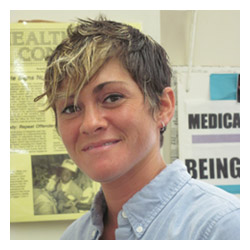 Twenty-nine-year old Laurie Cooper is a self-reliant, hard-working woman who wants to be a firefighter, and she’s trying to become one. “It’s hard to get the job. Every white American good old boy wants the job,” she told me. “People come from three hours away to apply for these jobs. Even if you pass all the tests and get on the lists, they may have only have two openings.” Hoping to boost her chances, she is studying at a junior college for an EMT certificate, and works as a volunteer fire fighter in Bondville, a town of about 500. The night before we talked, Cooper was fighting a barn fire. “I like being that person who can take care of people in their traumatic state,” she said. “There are so many reasons I want to be a fire fighter. It’s very emotional.”
Even though she’s on call 24/7, Cooper has a day job in Champaign. She’s the building manager at the First United Methodist Church and makes about $37,000 a year keeping the church and its grounds tidy and ship-shape. You name it, she does it—from changing light bulbs to fixing motors and pumps. Cooper started at the church in 2003 as a custodian with no particular skills; but she knew how to clean. Her predecessor recognized her drive and told her to buy a tool belt and some basic tools and get to work. When he left two years later, she got his job. “I was scared to death,” she recalled. “I had never dealt with a budget or talked to a board of directors.” Now she meets with them monthly.
Her income has increased by about $5,000 since she started, and she says she doesn’t see herself earning more than $40,000 or $42,000, or staying at the job too many more years. To supplement her income, she does odd jobs for older members of the church. The church provides health insurance and a pension plan, to which she contributes nine percent of her salary. She now has about $21,000 in the account. If she continues to have employment that offers a pension plan, like municipal fire departments, she’ll be better off than most workers her age. Employer-provided pensions are becoming rarer, and Cooper told me she knows she has to save. “I have saved a lot of money by being frugal,” she explained.
Still, Social Security will be crucial to her future financial security. At sixty-seven, her normal retirement age, the Social Security Administration estimates that her benefit will be about $1500 a month. Who knows whether that will be adequate to live on in forty years? But it will be a floor that Social Security guarantees to everyone.
We talked a lot about the program, and Cooper admitted she didn’t know very much about it. I asked her what Social Security means. “I really don’t know,” Cooper replied. “I have always associated it with retirement.” Is it a welfare program? “I have no idea,” she said. She didn’t know about Social Security’s disability benefits; nor its survivors’ benefits.
Disability benefits might be of interest to her, especially if she becomes a firefighter, one of the most dangerous occupations around. I told her about them and pointed them out on her annual statement from Social Security. If she were to become disabled and made it through all the hoops to qualify, she would have a benefit of $1376 a month. She told me she was glad we were having this talk. “It makes me look at my paper work,” she said. It made me think that Social Security supporters haven’t done such a hot job of educating younger people about the program.
We chatted a bit about raising the retirement age. People like Cooper will be directly affected by any change that would increase the age to seventy or seventy-two for full retirement benefits. Cooper said she had heard some talk about this at work. “People at work are already retirement age, but they are not retired yet because they need more money,” she told me.
She wasn’t keen on working longer to receive her full benefit. “I would not prefer that,” she said. “I won’t say I won’t be working at that age, but I want that choice. The idea of being in my seventies and still working doesn’t leave me much time to enjoy myself. I’m saying I wouldn’t like to be forced to work until seventy-four or seventy-two. Growing up I always had it in my head I would be in my sixties and retire.”
Click here for more from Trudy Lieberman on Social Security and entitlement reform.
Has America ever needed a media defender more than now? Help us by joining CJR today.