Sign up for the daily CJR newsletter.
Five weeks ago, I wrote in this newsletter about the growing hunger crisis in Gaza and the toll that it was taking on members of the media: staffers at Agence France-Presse had warned that their colleagues were starving to death; Anas al-Sharif, a reporter at Al Jazeera who had won a Pulitzer Prize for prior work with Reuters, had written on social media that he was “resisting the fainting that follows me every moment.” Three weeks ago, I wrote about an Israeli strike that killed al-Sharif and five other journalists. Israel claimed that al-Sharif was a Hamas militant, but the evidence that it offered was practically impossible to corroborate, and even if taken at face value—which was not advisable given Israeli officials’ habit of making flimsy claims of militancy against other journalists they have targeted—they appeared to be out of date. Various critics accused major Western news organizations, including Reuters, of nonetheless taking Israel’s claims at face value, or, at least, organizing coverage of the strike around them. As I wrote at the time, the coverage was certainly organized around the character of al-Sharif and not the other five journalists who were killed alongside him, against whom Israel made no claims of militancy. The Committee to Protect Journalists called their deaths “murder. Plain and simple.”
A week ago, Israel struck a hospital in Gaza and killed another media worker, Hussam al-Masri, a camera operator on contract with Reuters, which was running a livestream from a vantage point at the hospital. Nine minutes later, Israel struck the site again, killing four more journalists who, according to CPJ, were covering the aftermath of the initial strike: Moaz Abu Taha, a freelance video journalist who had also worked with Reuters; Mariam Abu Dagga, a visual journalist who worked with the Associated Press; Mohammed Salama, a camera operator for Al Jazeera; and another independent journalist, Ahmed Abu Aziz. CNN later reported that the second Israeli strike was actually a pair of strikes; NBC reported that at least four munitions were fired at the hospital; either way, it seemed a clear example of the sort of “double tap” attack that arouses particular condemnation from the international community, given its tendency to kill reporters and aid workers. (In some ways, it put me in mind of a deadly double blast in Afghanistan that I covered in 2018.) Benjamin Netanyahu, Israel’s prime minister, said that the strikes were a “tragic mishap,” adding that Israel “values” journalists’ work. Israeli officials subsequently suggested that, actually, the attack had been aimed at taking out a Hamas camera that was supposedly being used to document the movements of Israeli troops, adding that six terrorists were killed in the process. But, as CPJ noted, Israel’s claims failed to address certain key questions, including whether the supposed Hamas camera was the same as the Reuters one; NBC reported that the Reuters camera was the only one in that position, while, according to a video investigation that the New York Times published over the weekend, even if Israel’s claims about the camera are taken seriously, it has offered no justification for the sequencing of the strikes. Officials in Gaza claimed that some of the terrorists Israel claimed to have killed died in separate actions, not at the hospital. In any case, this time, Israel did not claim that any of the dead media workers were terrorists. The country said that it doesn’t target journalists “as such.”
The top editors of Reuters and the AP expressed outrage about the strikes, and demanded a “clear explanation” from Israeli officials. Not that they necessarily expected to get one: “we have found the IDF’s willingness and ability to investigate itself in past incidents to rarely result in clarity and action,” they wrote, “raising serious questions including whether Israel is deliberately targeting live feeds in order to suppress information.” A Reuters spokesperson later told NBC that—whereas the outlet alerted Israeli forces as to the precise whereabouts of its staff earlier in the war, in the name of protecting them—Israel has since killed so many journalists that it has stopped doing so; nonetheless, Reuters said, Israel was “fully aware” that it had a camera perch at the hospital. On the news side, however, some critics once again found Reuters’s coverage of the strikes to be excessively credulous of Israeli claims. One such critic was Valerie Zink, a Canadian photojournalist who worked on contract for Reuters, but said that she could no longer do so since the agency’s coverage had “perpetuated Israel’s propaganda” and played a role in “justifying and enabling the systematic assassination” of journalists in Gaza. Zink posted a statement announcing her decision on social media, attaching a photo of a Reuters press card that had been cut in two.
Zink and others were making a specific version of a broader claim that has often been repeated in media circles since Hamas attacked Israel on October 7, 2023, and Israel launched its assault on Gaza: that Western news organizations have collectively failed to stand up for the journalists Israel has murdered, a tally that is on the cusp of passing two hundred, according to CPJ, and is already well past that milestone according to Reporters Without Borders (RSF) and other press-freedom groups. I haven’t always been convinced by the most generalized and hyperbolic versions of this claim—the aforementioned press-freedom groups have devoted a lot of focus to killings in Gaza, which, as I see it, have also generated substantially more press coverage than killings of journalists that regularly occur in countries all over the world. Equally, some of the criticisms of proportion are fair: the sheer numerical toll in Gaza is unprecedented, and the response in Western media doesn’t seem to have matched the scale of the outrage that greeted, for example, Saudi Arabia’s assassination of the Washington Post contributor Jamal Khashoggi or Russia’s imprisonment of the (since freed) Wall Street Journal correspondent Evan Gershkovich. As the New York Times columnist Lydia Polgreen put it in an astute recent column, the response to journalists’ deaths in Gaza has often been “more muted,” and “more likely to give equal weight to Israeli accusations despite the lack of verifiable evidence.” (Polgreen patiently deconstructed Israel’s claims about al-Sharif, in particular, contending not only that they lacked credibility, but that even if they were true, “the history of war correspondence is replete with examples of fighters turned reporters.”)
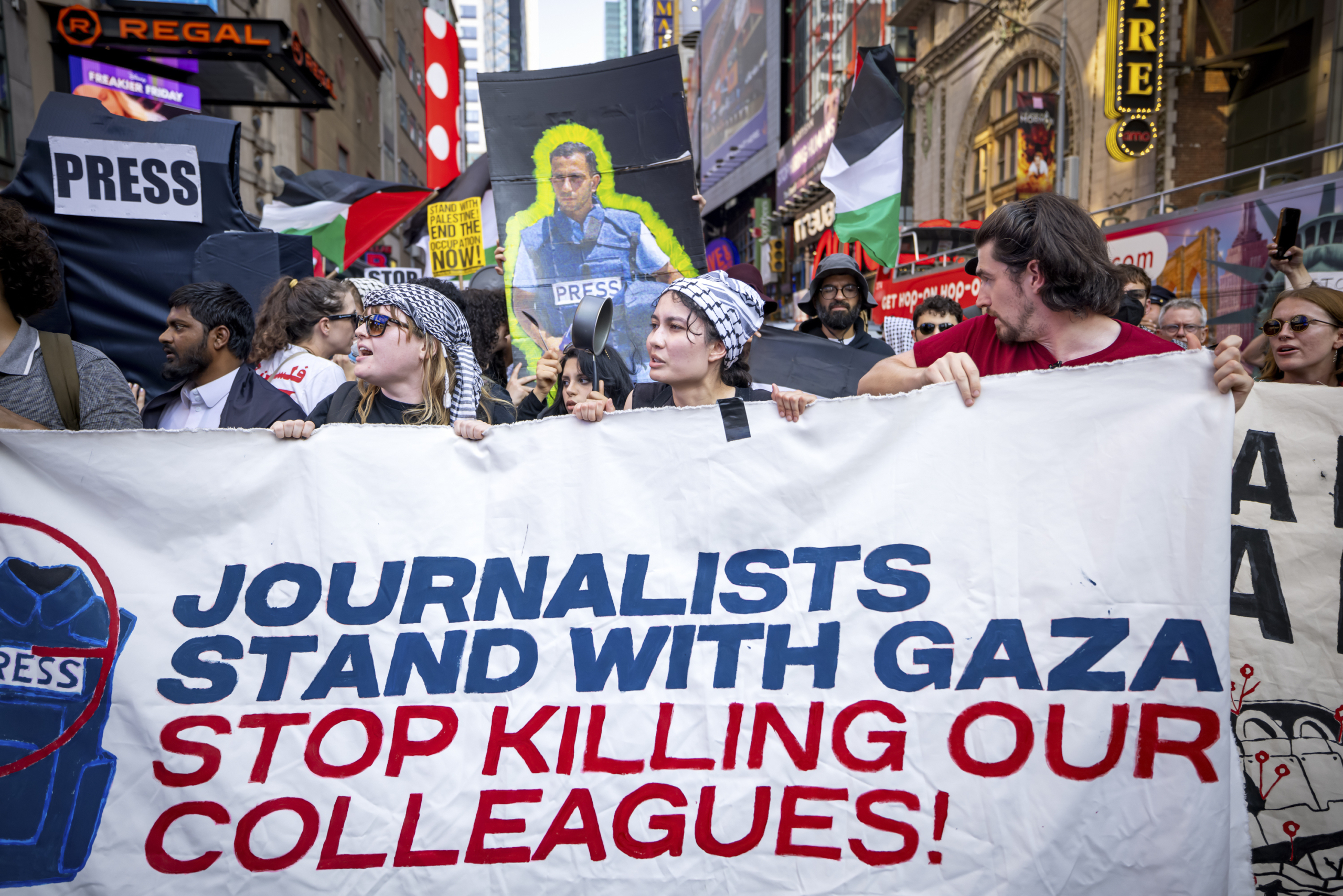
Azmat Khan made a similar point recently in CJR (also using the word “muted”), adding that journalism organizations “have not been inclined toward collective action” when it comes to defending their colleagues. Yesterday, we did see some collective action—RSF and the advocacy organization Avaaz coordinated a campaign that saw some two hundred and seventy news outlets in more than seventy countries and territories, from Tunisia to Tibet, black out parts of their front pages, or cut into broadcasts, to draw attention to the plight of journalists in Gaza and a series of associated demands: protection for the journalists and an end to impunity for crimes against them; access to Gaza for the foreign press, without Israeli military escorts; passage to safe countries for Gazan journalists who wish to leave the territory; and stronger action from the international community, in the lead-up to next week’s United Nations General Assembly. CJR was among the US-based outlets to participate in the campaign, alongside outlets including NPR and The Intercept. At least one major US outlet that did not take part—CNN—covered it. Others took stances of their own over the weekend. An editorial in the Post acknowledged the “heavy price” paid by Palestinians “who have served as the outside world’s eyes and ears.” An editorial in the Times described their deaths as “one more layer of the agonizing human tragedy in Gaza.” An accompanying illustration depicted a cracked lens, styled as an eye.
Still, these outlets did not take part in RSF’s campaign, and the editorials were framed, at their highest level, around Israel’s efforts to keep outside media out of Gaza—an important thing to highlight, for sure, but one framed here, in part, as self-defeating for Israel’s “cause.” Farther down, the Times, for one, explicitly condemned the double-tap strike. But this should have been the headline—Israel, a country that has justified targeting certain journalists as terrorists and fleetingly expressed regret about killing others, launched a strike on a location known to be used by journalists, then launched follow-up strikes that any reasonable observer should have expected to kill journalists, without offering up the slightest pretext that any of those who were, indeed, killed had it coming. This isn’t to excuse credulous treatment of Israel’s claims of militancy when those are made. (In addition to all the caveats that I outlined three weeks ago, the Israeli magazine +972 has since reported on a dedicated “Legitimization Cell” within the Israeli military, part of whose job has been “to identify Gaza-based journalists it could portray as undercover Hamas operatives, in an effort to blunt growing global outrage over Israel’s killing of reporters.”) But this felt like a moment that offered no possible excuses for failing to offer the strongest of possible statements.
Not that statements alone seem likely to change anything. In recognition of this fact, CJR has, in recent weeks, convened ideas for what more Western news organizations might do to end the killing of journalists in Gaza. Following the killing of al-Sharif, Khan, Meghnad Bose, and Lauren Watson presented “innovative, perhaps unconventional ideas” from a range of thinkers, whose suggestions included reporters trying to slip into Gaza without Israeli permission, or teaming up to approach Gaza’s border with Egypt and demand entry; Western journalists going on strike in solidarity with their Palestinian counterparts, or in aid of getting their employers to append notes about the death toll to stories featuring official Israeli claims; and newsrooms simply refusing to quote Israeli officials’ claims until they’re given the right to see the reality on the ground for themselves. Beyond the bailiwick of the press, Fadi Quran, of Avaaz, suggested that Western governments sanction Israeli officials responsible for attacks on the press, while Kenneth Roth, the former head of Human Rights Watch, called on prosecutors at the International Criminal Court to charge Israel with war crimes specifically in relation to deliberate attacks on journalists. Last week, after the hospital strikes, Joel Simon, the former head of CPJ, expanded on the latter point in a separate piece for CJR, weighing whether the targeted killing of al-Sharif, in particular, could be considered a war crime. “Amid the relentless violence against the press in Gaza, I have wondered if there is any plausible path to justice,” Simon wrote. “After speaking with experts in international humanitarian law, I believe that there is, however tenuous and uncertain.”
Essential to this argument, Simon went on, is establishing al-Sharif’s status as a civilian, something that might be achieved—in spite of Israel’s “flimsy and unsubstantiated” attempt to cast him as a militant—by pointing to the contextual pattern of Israel attacking reporters who cover its military actions; even if al-Sharif’s militancy had been established, it would be fair to question whether the collateral killing of the five journalists who died alongside him was proportionate. Both Simon and Roth suggested that while journalists typically are civilians and protected as such, bringing a journalist-specific case under international law would be beneficial since journalists’ work helps protect other civilians. This is true. But their civilian status comes first; journalists are people, too. In total, some twenty human beings were killed at the hospital last week. Ultimately, stopping civilians from being killed will stop journalists being killed. At the grandest political level, that’s where this has to end.
Has America ever needed a media defender more than now? Help us by joining CJR today.