Sign up for the daily CJR newsletter.
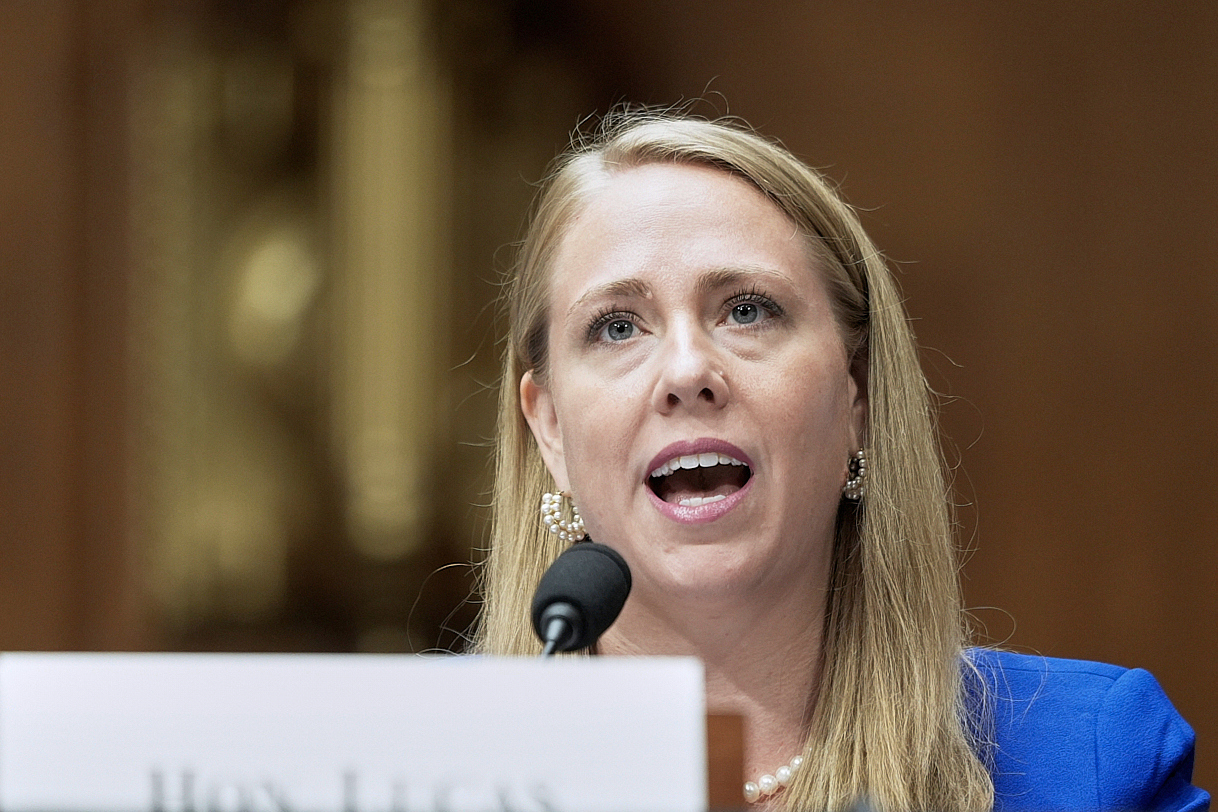
On December 17, 2025, Andrea R. Lucas, Donald Trump’s pick for chair of the Equal Employment Opportunity Commission (EEOC), a federal agency formed in 1964 to enforce civil rights law in the workplace, posted a video of herself on X. “Are you a white male who has experienced discrimination at work based on your race or sex?” Lucas, wearing a red blazer and sitting at a wooden desk, asked. “You may have a claim to recover money under federal civil rights laws.” Her agency, she continued, is “committed to identifying, attacking, and eliminating all race and sex discrimination—including against white male applicants and employees.” Lucas, a Republican, urged white men with claims to “contact the EEOC as soon as possible.”
The video caused “shock and consternation inside the agency,” Rebecca Davis O’Brien, a labor reporter at the New York Times, later wrote. It was also a pretty good crystallization of how, since Trump retook office, the EEOC has distorted the intent of the 1964 Civil Rights Act and weaponized the agency to enforce Trump’s MAGA agenda. The EEOC has voted to rescind guidance for employers on workplace harassment; dismissed cases that sought to defend transgender employees and job applicants with criminal records; and focused its ire on diversity, equity, and inclusion (DEI) measures, which the White House has claimed are “racially discriminatory” and JD Vance, the vice president, has called “evil.”
Last Tuesday, in the clearest expression yet of this trend, the EEOC filed a federal civil rights suit against the Times, alleging that the newspaper engaged in “unlawful employment practices” when it did not hire a white man for the role of deputy real estate editor. The suit unites two of the Trump administration’s pet grievances: DEI initiatives and critical news organizations, which it has attempted to bully into line, or at least tangle up in onerous litigation. A spokesperson for the Times, Danielle Rhoades Ha, was quick to denounce the suit as “politically motivated,” saying it deviated from standard agency practice. “The allegation centers on a single personnel decision for one of over 100 deputy positions across the newsroom, yet the EEOC’s filing makes sweeping claims that ignore the facts to fit a predetermined narrative,” Rhoades Ha said.
The lawsuit is based on a complaint from a Times employee filed to the agency in July of last year. But when the suit was filed, on May 5, in the US District Court for the Southern District of New York, it was brought in the name of the federal agency, not the complainant. The EEOC’s case relies heavily on a Times statement published in February of 2021, under the headline “A Call to Action.” The statement highlighted the underrepresentation of people of color in leadership positions at the company and outlined a “bold plan for building a more diverse, equitable and inclusive” organization, such as by increasing the number of Black and Latino employees in leadership positions by 50 percent by 2025. A more diverse Times, the note said, would lead to stronger reporting and “more coverage that captures the lives of people and communities of color with deeper understanding and nuance.” The EEOC suit alleges that two Times employees involved in hiring a deputy real estate editor were motivated by “desired demographic goals” when the white male claimant was not included among four finalists for the role. (These four, the suit says, were a white female, a Black male, an Asian female, and a multiracial female.) This is the basis for the EEOC’s claim that the Times acted “with malice or with reckless indifference” to the claimant’s federally protected rights as a white male.
One of the strange things about this episode is that the claimant apparently still works at the Times. Based on details in the suit, New York’s Charlotte Klein identified him last week as Bryant Rousseau, a senior editor and producer on the international desk. (Rousseau also describes himself online as a “conceptual artist, working across all media.”) Journalists at the Times were reportedly baffled that someone would “sell out the paper to the administration” like this, Klein wrote. “You’re giving the Trump administration a weapon while they’re trying to persecute journalists,” a Times reporter told her.
Anyone wanting to sue a private employer under civil rights law must file a complaint with the EEOC. The agency currently has three commissioners—two Republicans and one Democrat. (Trump fired two of its Democratic commissioners in January of 2025; they sued, claiming the president does not have that power over an independent agency, but the lawsuit is on hold while the Supreme Court considers a similar case, relating to the Federal Trade Commission’s independence from executive power.) Commissioners must vote on whether to authorize litigation. Kalpana Kotagal, the commission’s only Democrat, who voted against suing the Times, wrote on LinkedIn last week, “Regrettably, I fear this litigation is driven not by the merits, but by a desire to advance the administration’s political agenda.”
Kotagal also pointed out that the lawsuit came “on the heels of New York Times reporting on the weaponization of the agency.” This seemed to refer to recent articles by O’Brien. On January 27, the Times published O’Brien’s profile of Lucas, who claimed that her mission was to implement “a really ambitious civil rights agenda” that would “restore a focus on equality as opposed to equity,” and said that, during Joe Biden’s presidency, “everyone collectively lost their minds” in support of DEI initiatives. (Lucas shared the article on social media, commenting, “Hit piece or highlights reel?”) O’Brien followed with a story, published April 27, on how employees at the EEOC felt they were “under intense pressure from leadership to bring in cases that fit the Trump administration’s priorities.” Kotagal’s comments suggested the EEOC could be targeting a news organization in retribution for critical reporting—an allegation that would be nothing new for this administration.
Speaking to CJR, Chai Feldblum, a former EEOC commissioner, and Karla Gilbride, who was until recently the agency’s general counsel, both said that the Times’ efforts to increase diversity in the newsroom were not inherently illegal or discriminatory. “This lawsuit is completely consistent with everything Chair Lucas has been saying, every ideological position of this administration, that somehow expanding diversity is inconsistent with merit-based hiring,” Feldblum said. “And that is simply false.” Gilbride said that it is uncommon for the agency to take on individual cases based on a “failure to promote” someone, and “the fact that the agency chose to do that here does indicate to me that this is a priority area, that the chair is putting a lot of resources in to try to find a case that fits this narrative about DEI.” (A spokesperson for the EEOC told CJR that the agency could not comment on ongoing litigation.) The litigation seeks a jury trial and compensation.
What has been missing from this conversation so far are the basic demographic facts of US journalism. Racial and ethnic minorities make up about 42 percent of the US population, according to the most recent census, in 2020, but remain grossly underrepresented in the media industry. About 76 percent of “reporting journalists” identified as white in a Pew Research Center survey from 2023. Last year, people of color represented about 28 percent of TV news employees, and 16.6 percent of the radio news workforce. And the percentage of top editors of color is in decline, according to the Reuters Institute for the Study of Journalism, falling from 29 percent in 2024 to 15 percent in 2025.
In the past year, CJR has covered the marked shift away from DEI efforts in newsrooms, in terms of both hiring and coverage. In February, half of the Washington Post’s unionized members who identify as Hispanic or Latino were let go, according to the Washington Post Newspaper Guild, along with 45 percent of Black members and 43 percent of Asian members. Black former staffers at the Post told CJR that the commitment to diverse coverage in the newsroom ended long before that. And last year, CBS News gutted its race and culture team, and NBC disbanded all its verticals dedicated to reporting on underrepresented groups. The Trump administration’s complaints about “reverse discrimination” seem disconnected from reality; being a white man is no barrier to success in journalism.
In one of O’Brien’s recent Times stories, she reported on how employees at Lucas’s EEOC have faced pressure to bring—or keep alive—cases against white men, even when the evidence seems weak. In one case, “employees had to justify abandoning the case of a white man who said he was the victim of discrimination because he didn’t get a job,” O’Brien wrote. “The job, the office’s review found, went to another white man, and all the other applicants were also white men.”
Other Notable Stories …
By Jem Bartholomew
- Last Wednesday, MS Now reported that the FBI, led by Kash Patel, had launched a criminal leak investigation into a journalist at The Atlantic, Sarah Fitzpatrick, after she reported allegations of “conspicuous inebriation and unexplained absences” by Patel last month. Patel had already sued the magazine and its reporter for defamation; a criminal leak investigation would represent a new low for US press freedom. The FBI denied it was investigating Fitzpatrick, but—as I wrote for CJR on Thursday—Patel’s lawsuit itself is dystopian enough.
- In a court filing last Thursday, ABC accused the Federal Communications Commission of creating “a chilling effect on First Amendment–protected free speech” with its investigation into whether The View—an ABC morning talk show—is subject to federal rules requiring broadcasters to provide equal airtime for political candidates. (An exemption for equal-time rules applies to “bona fide” news programs. ABC lawyers argued The View had already received an exemption, in 2002.) ABC’s forthright stance toward the FCC—whose chairman, Brendan Carr, has sought to leverage the regulator’s power to pressure critics of the Trump administration—marks a departure from December of 2024, when the network settled a defamation lawsuit with Trump for fifteen million dollars.
- The Pulitzer Prize Board announced its 2026 award winners last Monday, including a Special Citation for Julie K. Brown, the journalist at the Miami Herald whose investigative reporting in 2017 and 2018 documented systematic abuse by Jeffrey Epstein. Also among the winners was Hannah Natanson, central to a team from the Washington Post that picked up the Pulitzer Prize for Public Service, for “piercing the veil of secrecy” of the Trump administration’s remaking of the federal government. Natanson, as Maddy Crowell wrote for CJR, had her home raided and devices seized in January by the FBI. There was an update on Natanson’s case last week: a second court said that the Department of Justice cannot search her devices, and reaffirmed an earlier ruling that a court should examine them instead.
- James Murdoch, the second son of media mogul Rupert Murdoch, is in advanced talks to buy Vox Media’s New York Magazine and its podcast division, according to a report last week in the Wall Street Journal. Last fall James—alongside his siblings Prudence and Elisabeth—lost out to older brother Lachlan in a de facto succession battle over future control of their father’s media empire. The younger Murdoch siblings agreed to accept about 1.1 billion dollars each to walk away and let Lachlan secure the right-wing legacy of Fox Corporation and News Corp, which means James will have plenty to spend in his pursuit of New York.
- Earlier this month, the US State Department barred most executives from La Nación, Costa Rica’s leading newspaper, from traveling to the US, the paper said in a statement. In 2022, La Nación had broken stories about a sexual harassment investigation that implicated former Costa Rican president Rodrigo Chaves, who, at the time, was running for office. As president, Chaves “cozied up to Trump officials and has often used his position to frame the newspaper as an enemy of his administration,” the Times reported. In an editorial, the paper said that withdrawing visas for five of its seven executives looked like an effort “to punish La Nación’s editorial stance.” “Applying such a measure to nearly the entire board of a media outlet is unprecedented in our history,” the editorial said.
- In the UK, prison authorities have banned a man convicted of murdering five members of his family from communicating with the media after he spoke to a New Yorker reporter for a story that makes damning allegations about the British justice system. Jeremy Bamber, who has been incarcerated since 1986 and is serving what in Britain is known as a whole-life order, has always maintained his innocence. His case was the subject of an In the Dark podcast series—“Blood Relatives”—by New Yorker staff writer Heidi Blake last fall. The UK prison service cited a need “to protect victims from serious distress and maintain confidence in the justice system.” The prohibition on Bamber’s speech comes as, in the US, “some states have created enormous barriers to speaking with incarcerated people,” according to the Freedom of the Press Foundation.
- And Ted Turner, the media mogul and creator of CNN who revolutionized cable news, died “peacefully” on Wednesday at his home in Florida, according to the network. Turner, who was eighty-seven, said in 2018 that he had Lewy body disease, a progressive brain disorder. One of a long list of business achievements, Turner’s launch of CNN, in 1980, is credited with ushering in the twenty-four-hour news cycle. (“I learn more from CNN than I do from the CIA,” George H.W. Bush is widely quoted as saying when he was president.) “Ted’s entrepreneurial spirit, creative ambition, and willingness to take risks changed the media industry forever,” David Zaslav, the chief executive of Warner Bros. Discovery, CNN’s parent company, said. “Ted believed the world deserved access to news as it happened, and he acted on that conviction.”
Has America ever needed a media defender more than now? Help us by joining CJR today.