Sign up for the daily CJR newsletter.
Last Saturday’s “No Kings” protests were the country’s largest mass demonstration in recent history. Organizers claimed that close to seven million people turned out at thousands of locations nationally to protest against the authoritarian policies of President Donald Trump.
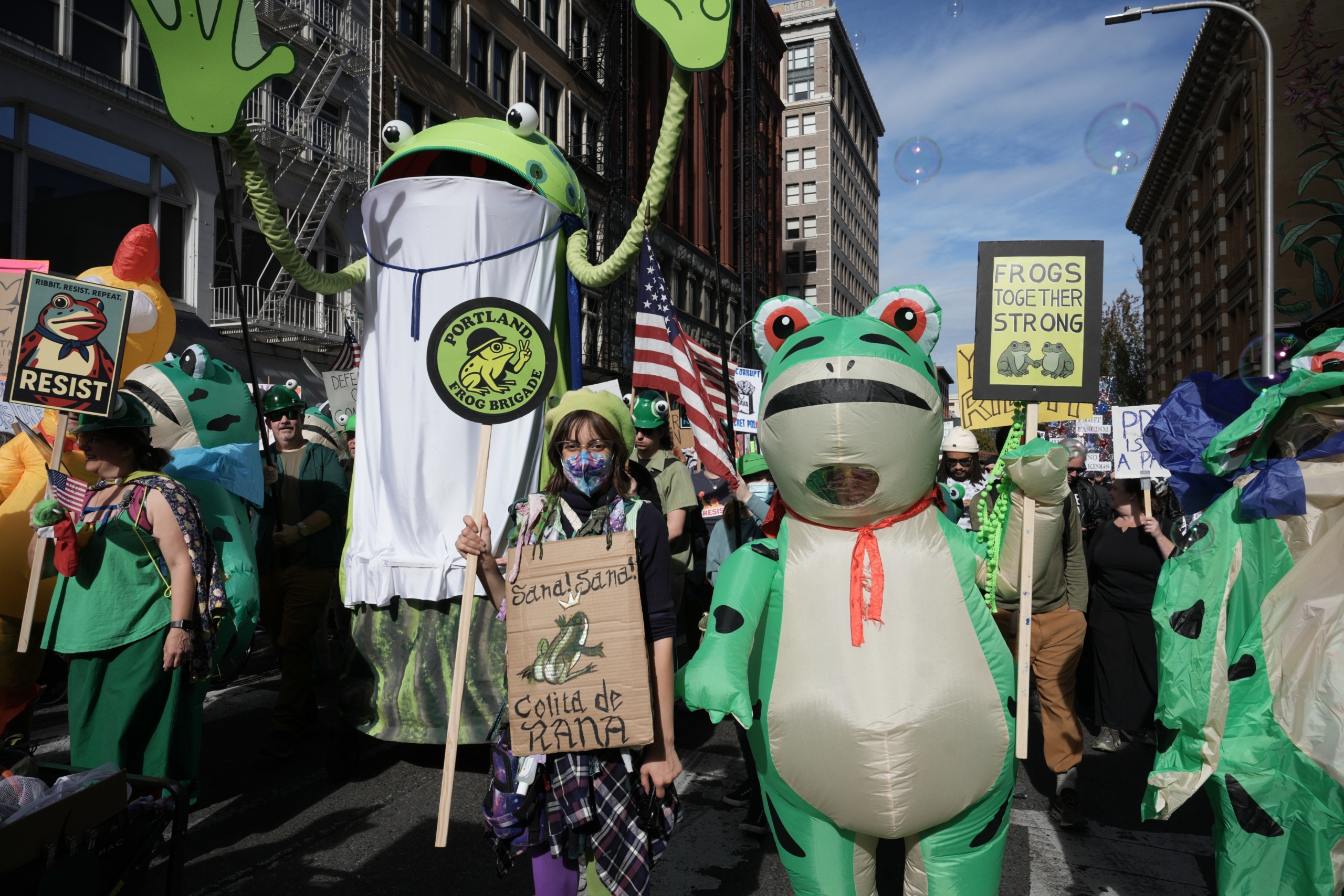
The Sunday covers of national and local newspapers, including the Los Angeles Times, the Washington Post, Portland’s Oregonian, and the Daily Sentinel in Grand Junction, Colorado, reflected the magnitude of this show of public dissent, with stories highlighting the size of the crowds and the protesters’ costumes and signs.
The focus of the conversation among media critics, however, was the conspicuous absence of a lead story on the Sunday cover of the New York Times, which ran two small images of the protests below the fold, along with a teaser to the story on page A23. That relatively muted attention prompted callouts from journalists including Margaret Sullivan and Bill Mitchell, with Mitchell calling the Times’ decision an “epic fail.” CJR’s Bill Grueskin also gave a dart to the Times in this morning’s newsletter.
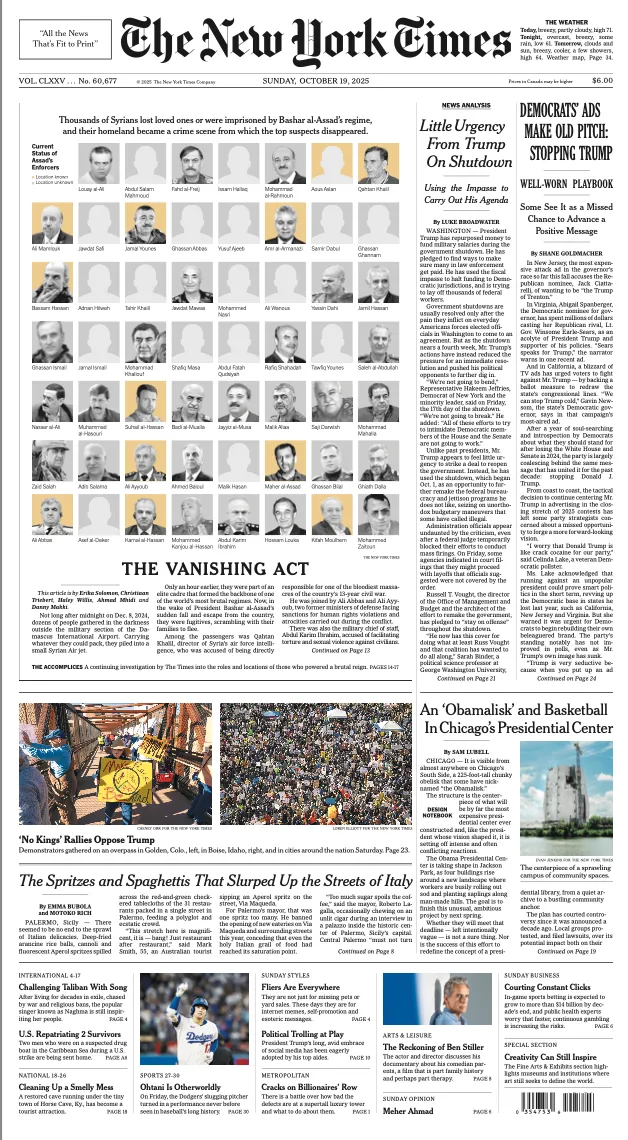
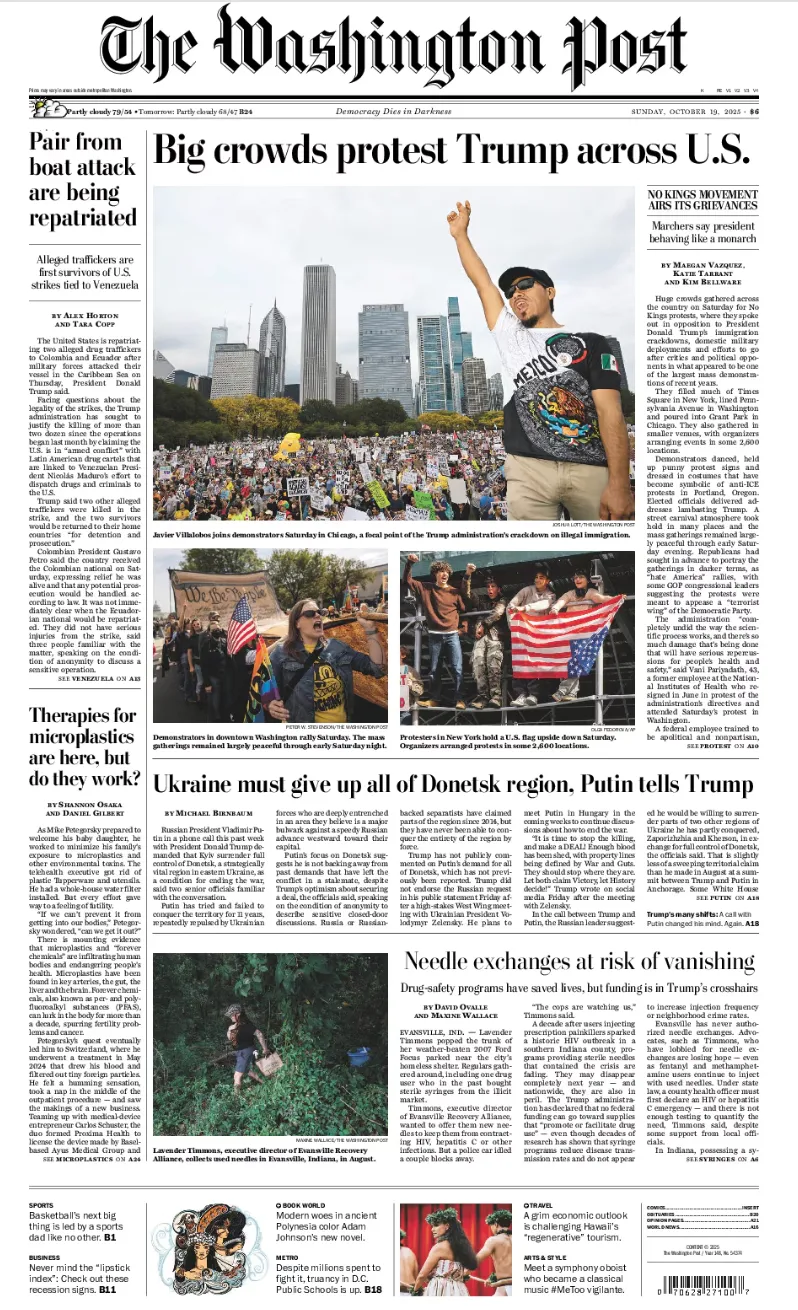
There was no lack of video and images of the protests shared on social media, of course, but prominent media coverage has the ability to set the narrative about a protest’s message and shape an audience’s response. Stephen Adler, the board chair for the Reporters Committee for Freedom of the Press and a member of CJR’s board, felt the protests didn’t receive enough attention from media. “Objectively, it was a large enough protest in a large enough number of cities that it was newsworthy. The fact that it was so peaceful was in itself newsworthy. And the fact that it was certainly one of the biggest mass protests in a long time in the US was newsworthy.”
In a comment to Grueskin, New York Times spokesperson Nicole Taylor said that the placement of their print story below the fold did not mean it was less significant to the Times. She wrote: “The Times had more than 20 reporters and a dozen photographers covering the ‘No Kings’ protests in 28 locations around the US and the world on Saturday. We displayed that comprehensive journalism prominently on our homepage, where millions of readers spent time with our live coverage, articles, photo slideshows, and video pieces.”
She continued: “Using print alone to measure a story’s significance, impact, or reach is a partial and outdated assessment.”
Kelly McBride, senior vice president at the Poynter Institute, agrees that judging the impact of a story based on its placement in print is “a very old standard.” She pointed out that the story on the No Kings protests was one of just a handful included on the Times front page at all.
Danielle Brown, a journalism professor at Michigan State University, felt that the Times’ treatment of the story was disappointing. But, she said, the Times’ print edition reaches a small proportion of readers, and the amount of coverage overall and the social media attention the protests received was robust.
Saturday’s No Kings protests were peaceful demonstrations. Lack of conflict can lead to less coverage, according to media experts. “There’s an unfortunate tendency among some news organizations to pay more attention to something that’s violent,” Adler said. “So that would be an irony, if the fact that it was so well organized and so well disciplined actually worked against the newsworthiness of the protest.”
But stories about peaceful protests can be hard to write compellingly, McBride said, and news organizations may not want to devote a lot of space to them, even if important. “It’s sort of like reading about something that’s already happened that went exactly as you thought it was going to,” she said.
She added that crowd size alone may not be a reliable metric for the journalistic significance of a protest. Reporting accurately on crowd numbers is notoriously difficult and controversial. Earlier this year, the Times explained its approach to covering crowds, noting that the paper focuses on what happens at a protest, not the number of protesters.
Arguably a far bigger problem than how the Times covered the protests is the ongoing inaccurate coverage by conservative media outlets, multiple sources said. Kathleen Culver, the director of the journalism school at the University of Wisconsin-Madison, said that when she Googled the protests on Wednesday, the top search result was a Fox News story headlined “Violent symbolism, threats steal show at nationwide ‘No Kings’ protests.”
“That is an incredibly misleading headline and framing of a news story that Fox is engaged in there, and it is important for us to be critical of that,” Culver said.
What do the protesters themselves think of the media coverage? Brooks Brown, cofounder of an initiative called Operation Inflation that handed out a few hundred inflatable animal costumes during Portland’s No Kings protests, said that he felt the media was “broken in a really, really bad way.”
Recently, Brown said, a reporter asked him whether George Soros was funding Operation Inflation—referring to a right-wing conspiracy theory. (Operation Inflation is crowdfunded.) He wanted to redirect attention from Trump’s descriptions of Portland as a violent war zone and show how peaceful and nonthreatening the protesters were.
Brown got the idea to distribute the costumes earlier this month, after a Portland protester in a frog costume made headlines when they were pepper-sprayed. “The way the media handled the frog wasn’t how the media handled the person who got shot in Chicago,” Brown said, noting that in his view the pepper spray attack on the frog had provoked more outrage.
“There’s no way you can do anything but just show the violence that’s being visited on protesters,” he said. The strategy seems to be working. Costumed protesters have continued to generate attention from the mainstream media even days later.
On Tuesday, The Oregonian published a story about the arrest, during No Kings Day, of a sixty-one-year-old woman in Alabama wearing an inflatable penis costume. “A dangerous person, eh?” an onlooker says to police in a video of the incident. Another chimes in: “They’re a danger to everybody, can’t you tell?”
Has America ever needed a media defender more than now? Help us by joining CJR today.