Sign up for the daily CJR newsletter.
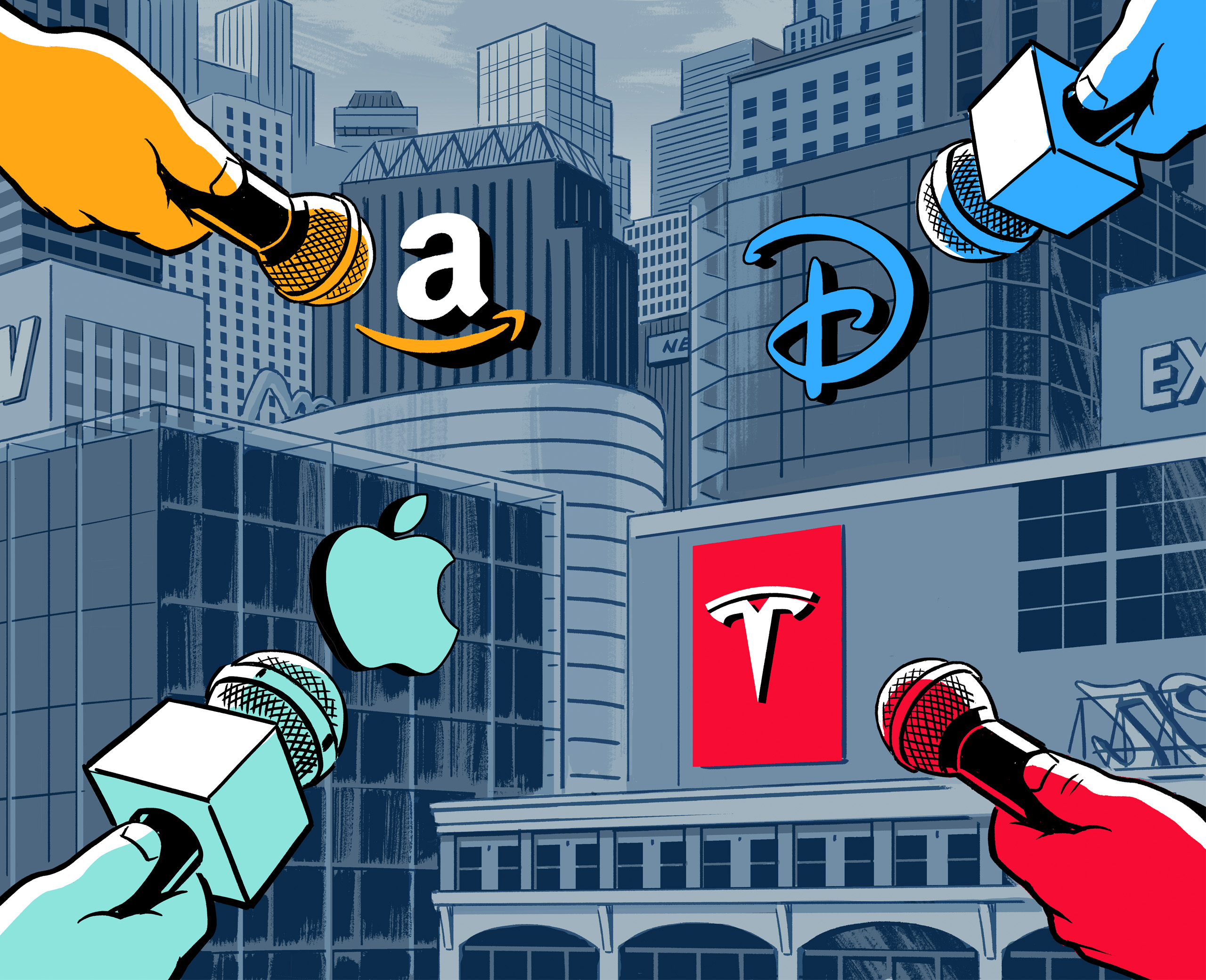
In 2018, Apple became the first publicly traded company to be valued at a trillion dollars. Today it’s worth over four trillion. Tesla’s at 1.3 trillion. Amazon is nearing three trillion. Major corporations in the United States have never been as rich and powerful as they are now. How do you adequately cover any given behemoth? For some reporters, the answer is to make it your whole job. We spoke to four reporters whose beats are focused on a single company. These reporters operate within strange parameters: They are deeply intertwined with the companies they cover, spending years collecting secrets and turning dark corners. They rarely gain access to leaders at the company itself. But through their obsessiveness, they do outstanding work from the outside in, acting as a check on corporate impunity. As Brooks Barnes, who covers Disney for the New York Times, told us, “I feel like these companies have all become more and more fortified. At one point I counted how many PR people they have. There’s one of me; there’s an army of them.” Their comments have been edited for length and clarity.
 Illustration by R. Kikuo Johnson
Amazon
O’Donovan, the former Amazon reporter at the Washington Post, is now a tech reporter at the San Francisco Standard.I’m assuming we’ll all get news via the chip implanted in our brains. But the question of who will be providing that news is a good one. I would like to think that, twenty-five years from now, our state and local governments will have realized the value of all the small local outlets that exist in towns across our country that provide a really important service to local communities. My hope is that we’ll be funding local news robustly and there will be public funding.
The Post was hiring an Amazon reporter. I thought that was really funny, since Jeff Bezos owned it, and kind of badass and cool. I live in the Bay Area, so there was an expectation of going to Seattle and sourcing up with all different kinds of people. Tech companies use annual events throughout the year—you know, big fancy press conferences with demos and food and one-on-one interviews set up and stuff—to get their narrative out there. So going to those is a part of it.
People inside Amazon are very tight-lipped. It’s not like you’re going to take them out for a glass of wine and they’re just going to start spilling all the details. The company has a very well-documented history of retaliating against employees who leak information or don’t act the way they want them to. So it’s not some easy thing of like, “Oh, I’m going to butter you up and you’re going to fall for my charm.”
There are, however, pockets of employees within the company who have very specific concerns and frustrations, and that is usually a productive starting point for a conversation. And you go to happy hours, you meet people for coffee. You put face time in. Being anonymous, or a voice on the phone, doesn’t get you the kind of honesty, respect, and fair treatment that you get when someone feels like you’re a person.
What’s interesting about a job like this is that you’re kind of in the Amazon press corps. Because the Seattle Times has their person; Bloomberg has their person; the New York Times has their person. But you’re not on the campaign bus with a politician. You’re just there for a company who doesn’t have to tell you anything if they don’t really want to—outside of earnings.
 Illustration by R. Kikuo Johnson
Tesla
Niedermeyer—the author of Ludicrous: The Unvarnished Story of Tesla Motors (2019) and Elon Take the Wheel: The Danger and Delusion of Tesla’s Self-Driving Technology (2026)—has been reporting on Tesla since 2008 for a variety of outlets, including Bloomberg, Slate, and Automotive News.My first writing on Tesla ever dated back to my very first few months writing about the auto industry. I had left college in 2008, and I couldn’t get a job doing anything except writing blog posts for twenty-five bucks for a site called TheTruthAboutCars.com. My dad was a big auto-industry nerd, and he used to write for them. At the time, Tesla was on the brink of bankruptcy, and no one took them particularly seriously. Then, in 2015, Tesla started a battery swap program, and it didn’t make sense to me. The whole thing was so jarring: they were gaming the credits system for hundreds of millions and potentially up to a billion dollars from a fake battery swap station. The environmental mission was a facade, the technology was a facade, and it all propped up a financial facade. I just started digging into every aspect of their business, and that led to the book Ludicrous and another decade of craziness on top of that.
Tesla wrote a blog post attacking me for the battery swap reporting, and I was told by an anonymous source that Elon himself drafted that blog post. That was the signal from the company to come after me on social media; that was the heyday of the abuse. I still tried to do the right thing from a journalistic perspective and have a relationship with the company. But I realized that they are in the business of information control and narrative. Yes, they make cars; yes, they sell them; yes, people like their cars; yes, they are able to show some profit here and there, but that is overshadowed by the goals of fundraising and of protecting and pumping the stock price.They made clear that in the informational sense, they saw it as an all-out war.
I was definitely ahead of the curve that Elon was not trustworthy and he was not a good influence on our society. But I’ve been surprised by his ability to grow his influence and to reveal depths of badness that I could not have imagined.
I’m not in it for money, or to conform to a certain ideal of journalism. My work is really about impact. And not only have I not had the impact I’d hoped for, but Elon has become bigger and more trusted than ever, despite deserving that trust less than ever. That has been an extreme challenge on a personal and professional level.
 Illustration by R. Kikuo Johnson
Apple
Gurman, a tech reporter and editor for Bloomberg News, has been covering Apple for nearly seventeen years.Writing about Apple started from my passion about the company. When I was in high school, I was just really interested in everything Apple was doing. I was one of the first people in line for the original iPhone back in 2007. When the App Store launched, in 2008, I started making iPhone apps. Before the original iPad came out, I found domain names related to tablets—which was the first tangible information that Apple was close to launching a tablet—and sent the tip to MacRumors.com. I started writing for 9to5Mac.com while still in high school. And I’ve been writing about Apple ever since.
The Apple community, myself included, is a pretty opinionated crowd. What’s really fun for me is when I get to go to different Apple conferences and meetups and I get to talk to people who have this really strong interest. Having the pulse of the community is really important.
Every company has different policies of how they work with different beat reporters. Sometimes companies make executives widely available for interviews. Any good reporter is someone who should be able to work with the company and get access, and also be able to get stories even if access isn’t given.
I’ll be quite honest with you—covering Apple and covering tech at the pace we do, it’s all-encompassing. It’s constantly on my mind. I’m constantly thinking about it. You see how fast things are moving now, how fast companies are launching products. Keeping up is really important. We have a responsibility to keep people informed. My schedule is basically timed with the news. Right as news breaks, I’m ready.
 Illustration by R. Kikuo Johnson
Disney
Barnes is the chief Hollywood correspondent for the New York Times.In 2007 I was hired by the Times to cover Disney, more broadly, corporately, and Hollywood. And as the years went on, my job broadened to all of Hollywood. I kept the Disney part because it just kept becoming sort of more central to the general story of Hollywood.
Part of working a beat is making bets that certain people will be good sources down the line, and cultivating relationships in the old-fashioned, boring way: coffees and drinks and events. If you’re only doing this when things are necessarily bad, that doesn’t ever really work, but if you already have a conversation going with them, even if it’s a light one—you touch base every, I don’t know, four or five months and they’re used to talking to you. I’ve found that helps, especially at Disney.
You know, at one point I counted how many PR people Disney has. There’s one of me; there’s an army of them. I feel like these companies have all become more and more fortified. You used to be able to call a mid-level executive and have a conversation off the record. Now it feels like people are trained not to touch reporters, and every senior executive seems like they have their own PR person.
I’ve learned over the years to never ask and only tell. I don’t say, “I’m doing a story on this. Would you make someone available?” Instead it’s: “I’m doing a story on this, and I’d love to hear your side. If not, you know, we’ll do it anyway.”
Has America ever needed a media defender more than now? Help us by joining CJR today.