Sign up for the daily CJR newsletter.
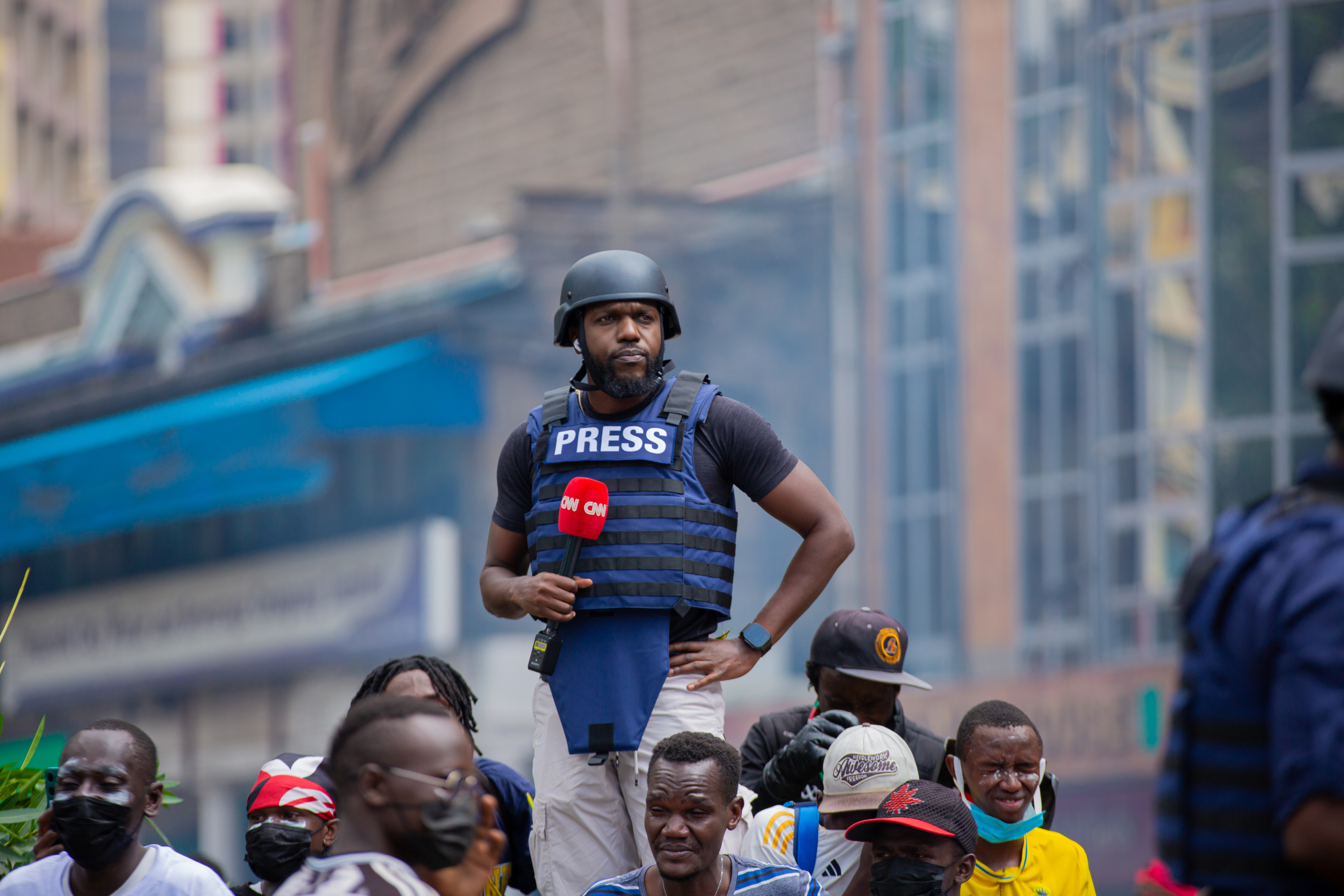
In recent months, Larry Madowo, CNN’s Africa correspondent, has reported on a troubling trend: young men from countries including Kenya, Nigeria, and Uganda being recruited to Russia with promises of civilian work, only to find themselves fighting in Ukraine. Madowo’s reporting has exposed a pattern of deception and forced conscription, illustrating how Africans can be drawn into global power struggles that undermine their interests.
From his base in Nairobi, Madowo, who was born in Kenya, covers politics, conflict, business, and culture across the continent. He began his career as a business reporter at two of the country’s largest TV stations, Kenya Television Network and NTV, and later worked for CNBC Africa and the BBC. He joined CNN in 2021, and led the network’s investigation last year into Tanzania’s disputed election, documenting evidence that security forces fatally shot protesters. He also reported on the fragile peace process between Rwanda and the Democratic Republic of the Congo following a United States–brokered agreement aimed at easing decades of conflict in the region’s mineral-rich east. And he hosts African Voices, CNN’s long-running program profiling artists, athletes, and entrepreneurs; recent episodes have focused on Nomzamo Mbatha, a South African actor, and Pheelz, a Nigerian Afrobeat producer.
Critics have accused Madowo of reinforcing Western stereotypes about the continent, particularly when he covers what some view as “negative” stories, such as those involving conflict, political repression, and crisis. Madowo rejects that framing. His mandate, he said, is “to report Africa accurately, not always positively.” Our conversation has been edited for length and clarity.
MO: You’ve reported across Africa for global audiences for several years. How does your role as an African correspondent differ from that of a foreign correspondent parachuting in?
LM: I can’t speak for non-Africans who report on Africa, because that’s not my experience. My lived experience is as somebody who was born and raised in Africa, who has lived in other parts of the world, and who made the decision to come back and report on Africa. The reason I did that is because I had been critical for a long time of how Africa is covered in the global media. I felt that we were caricatured as Africans, and I could either complain or get involved.
My mission was, and still is, to report Africa accurately, not always positively. Because Africa has been covered so badly by Western media, some Africans expect that if you’re an African reporting in global media, then you will only tell positive stories, which is definitely not possible. We have to represent and reflect the reality on the ground. There will be lots of positive, uplifting stories, but there will also be more challenging ones, and we have to cover the full breadth of that. So with every story, I’m trying to give a more three-dimensional view of the continent, its opportunities, its challenges, its innovation. That’s the job.
You’ve talked about reporting Africa accurately. How do you define accurate coverage when reporting on the continent for international audiences?
Accurate is true. It means providing an unvarnished view of things, the positives and the negatives, the reality, warts and all. I think this is where some Africans who consume our coverage struggle with it. Because Africa has been covered so badly by Western media, some people expect us to lean into the “Africa rising” narrative, or to highlight only the bright spots. And there are many. But there are also places where things are not going well, whether it’s democratic backsliding, military takeovers, poverty, inequality, or corruption. Those are also part of the complex and layered story of the continent.
I’m aware of the significance of a platform like CNN in shaping narratives, so I try not to lean only in one direction. It has to be a measured mix of stories.
You recently reported on Kenyans and other Africans who were recruited by Russia to fight in Ukraine, sometimes under misleading promises of civilian work. How did you come across the story, and why did you pursue it?
I remember anchoring in Atlanta in the weeks leading up to the war in Ukraine. At the time, it was a war that was obviously framed around NATO, Europe, and North America. But over the past two or three years, I started seeing an increase in families on social media asking about sons who had disappeared in Russia.
What pushed me toward the story was families reaching out directly. They would say, “We’re looking for our son. He was offered a job in Russia, and we believe he was driven into the war in Ukraine.” In some cases, a comrade had told them he had been killed, but they didn’t know where to start.
Then I realized these stories weren’t isolated. Similar cases were emerging in Nigeria, Ghana, Uganda, and Kenya. But earlier coverage had anonymized the people involved, and when everyone is anonymous, it becomes easy to dismiss the story as propaganda. I needed people willing to show their faces, share their experiences, and provide evidence—their injuries, the contracts they signed. I wanted to show the reality through people who had actually been there. That’s what made the story powerful.
That story connects global conflict to local realities in Africa. Do international audiences fully grasp how these struggles play out in African lives?
I think, increasingly, people are paying attention to that. At CNN International, we try to highlight how geopolitical struggles in other parts of the world affect Africa, whether it’s the current conflict in Iran or policy decisions in Washington that affect visas and travel. What we try to do well at CNN is connect those dots. Because of our global footprint, we can approach a story from multiple angles, with regional expertise in different parts of the world. My perspective as an African who has lived and worked in Europe and North America helps me understand how these decisions resonate with audiences both on the continent and beyond.
These geopolitical tensions are not abstract for people here. African business leaders worry about them. Parents and young people think about them because they affect mobility, where you can work, where you can study. We saw that during the war in Ukraine, when supply disruptions pushed up the price of basic commodities like wheat. The same is true with shifts in global oil markets, including in the current conflict in Iran or whatever is happening with President Trump’s decisions. When those things move, people here feel the impact directly.
Western media has long been criticized for portraying Africa primarily through crisis, conflict, corruption, and humanitarian disasters. How do you think about that legacy when deciding which stories to pursue?
I’m not a defender of Western media. I’m not here to speak for all of Western media. I’ve only worked for two Western organizations, the BBC and CNN, so I can’t speak for the others. I can only speak to the work I do at CNN.
I’m very intentional about the stories I tell and the angles I choose. I try to highlight African agency, that Africans are not just victims that things happen to. We have a role in these stories and a perspective on them. I make sure the voices and experts we speak to are Africans with lived experience.
I also try to show how some crises in Africa have global foundations. That includes colonization, the transatlantic slave trade, the “Africa risk premium” when countries borrow, and the broader perception of Africa as a risky place, which is often more imagined than real.
Beyond the news, we have programs like African Voices, Marketplace Africa, Inside Africa, and Connecting Africa that focus on business leaders, artists, innovators, musicians, and athletes who are shaping the continent in real time.
I welcome criticism of my work. It makes me a better reporter. It pushes me to be more careful about everything I say, write, and do. But criticism is only one part of it. What people may not realize is that there are also death threats that come with this job. There are serious security challenges. There are countries I can’t go to right now because some of the threats have been so serious that CNN has had to take additional precautions. I can’t speak about those measures for obvious reasons.
You also host African Voices. How do you see that work fitting alongside your reporting on protests, political crises, and other hard-news stories from the continent?
One of the reasons I enjoy hosting African Voices is that it allows for deeper conversations with some of the continent’s most prominent figures. We talk about art, music, sports, and technology without framing it primarily for a Western gaze. It is simply two Africans having a conversation about issues that matter to us, and the rest of the world happens to be watching.
The fact that I can cover hard-news investigative stories about government security forces killing people, whether it’s in Tanzania or Kenya, or reporting on police brutality, and then also have conversations about culture and creativity—that’s the balance I try to bring to our coverage. And I think that balance has been missing for a long time in the way Western media has portrayed Africa. The two things can be true at the same time: there can be places where democracies are failing, and at the same time people are thriving, building, and creating. We should be able to sit with both of those realities at the same time.
As someone who has covered the continent widely, what advice would you give journalists who want to cover Africa responsibly?
I think Africa is still greatly undercovered. In English and French, the larger countries tend to be relatively well covered, places like Côte d’Ivoire, Senegal, Nigeria, Kenya, and South Africa. Beyond those, many places still receive very little attention. There are so many stories that everybody could be reporting on something different.
My concern is that a lot of people want to move into commentary instead of reporting. Commentary is easy to produce. Everyone wants to have an opinion on TikTok or Instagram, because opinion takes no reporting, no fact-checking, no verification. But it should build on the work of reporting, so there need to be more reporters out there speaking to people, verifying facts, asking public officials questions, documenting what is happening, taking pictures and video, and doing the work of checking public statements and records to build stories from that.
Has America ever needed a media defender more than now? Help us by joining CJR today.