Sign up for the daily CJR newsletter.
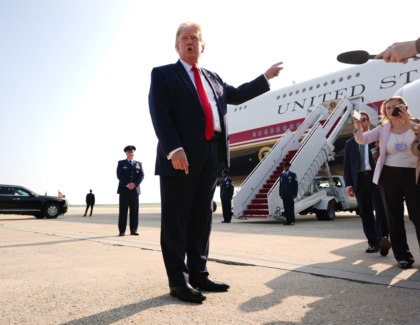
On Friday, reporters aboard Air Force One asked President Donald Trump about his intention to sue the BBC. He had been threatening legal action against the UK public broadcaster since a leaked memo pointed out that one of its documentary shows had spliced together clips from a speech Trump gave shortly before the 2021 US Capitol riot. The story, published on November 3 by the right-wing British newspaper The Telegraph, engulfed the BBC in crisis, and prompted the resignations of Tim Davie, BBC director general, and Deborah Turness, head of BBC News. The BBC apologized to Trump for its “error of judgement” and issued a correction to the report, but said it would not pay a settlement. “We’ll sue them for anywhere between a billion and five billion dollars, probably sometime next week,” Trump said. “It was worse than what CBS did with Kamala.”
Everyone reading this will know that journalists edit things all the time, not just because airing or printing speeches in full is unfeasible but because it would be absurdly tedious—and particularly for Trump, who often says tens of thousands of words a day. Journalism does not tell people simply what happened; it makes a determination on what is meaningful and informs the audience accordingly. In this case, the BBC went too far. Panorama, a BBC investigative documentary show, aired an episode called “Trump: A Second Chance?” in the UK in October last year, in which Trump’s words were edited to make it appear as if he said, “We’re gonna walk down to the Capitol…and I’ll be there with you, and we fight, we fight like hell,” in a single sentence. In reality, these two phrases were spoken about fifty minutes apart.
The BBC’s error is regrettable not so much for its content—the program’s larger point that Trump was cheering on an antidemocratic riot still holds true—as for how it was ultimately weaponized to call the broadcaster’s legitimacy into question. Some might consider a single incautious edit to be an outlier among thousands of hours of good BBC reporting. But for those seeking to discredit that reporting, the error was confirmation of the worst kind of liberal bias. It was evidence, in the words of White House press secretary Karoline Leavitt, that the BBC was “one hundred percent fake news” and a “leftist propaganda machine.”
Trump’s comparison of the BBC’s edit and “what CBS did with Kamala” is revealing. His lawsuit against CBS News’s 60 Minutes for what he characterized as deceptive editing of an interview with Kamala Harris in order to help her campaign was widely seen as having no legal merit, yet was eventually settled by Paramount, CBS’s parent company, which agreed to pay Trump sixteen million dollars. This gutless capitulation may have greased the wheels for the Ellisons’ takeover of Paramount. But I see a much more apt parallel in the Trump administration’s assault on public service media. Even before his election, the Heritage Foundation’s Project 2025 outlined a plan to strip funding for the Corporation for Public Broadcasting. Congress achieved that in July, revoking more than 1.1 billion dollars. Similarly, in the UK, conservatives have for years worked to undermine, attack, and ultimately defund the BBC. The outsize attention placed on this editing error significantly advances that agenda.
To understand the full picture of what’s happening, it’s worth considering the British Broadcasting Corporation’s unique position in the UK media landscape. The BBC stands like a giant over everything else, dominating the scene like the Empire State Building over 1930s Manhattan. BBC News says it reaches 74 percent of UK adults each week. Compare that with Fox News and CNN, which in a 2020 study each reached 39 percent of US adults a week, according to Pew. BBC News is trusted by 60 percent of the UK public, making it the most trusted newsroom; in the US it is the second-most-trusted newsroom, after the Weather Channel.
One reason the broadcaster is so highly regarded is that it is mandated to report with “impartiality.” (Just two weeks ago, CJR reported that the company was planning an expansion into the US that hinged precisely on its political neutrality.) In the UK, defenders of the BBC say its values provide insulation from polarization that will serve to prevent the UK’s slide into a hopelessly divided society. Critics would like to see it carved up and privatized. The BBC gets the bulk of its funding—nearly five billion dollars last year—from a mandatory license fee paid by British households. This is one of the mechanisms that is supposed to ensure its independence from the government. In practice, the BBC has never been free from political interference. Every ten years, its board and the government renegotiate the terms of its royal charter. Despite calls for change, five of the board members are politically appointed by the government.
The current scandal was conceived as far back as Boris Johnson’s time as prime minister, from 2019 to 2022. Johnson’s administration appointed two BBC Board members: Richard Sharp, a Conservative donor, and Robbie Gibb, a former director of communications for the Conservative prime minister Theresa May. In 2023, Sharp was forced to resign amid accusations of “cronyism,” after it was revealed that he had guaranteed a one-million-dollar personal loan for Johnson. Gibb remains on the board. He was an editorial adviser to the 2021 launch of the right-wing GB News network, and the public face of a consortium of investors that in 2020 took over the Jewish Chronicle—where the money came from, however, has never been revealed—after which the publication became a staunch defender of Israel’s actions during the obliteration of Gaza. According to The Observer, Gibb was heard last year saying that, if he didn’t get his way at the BBC, he would “blow the place up.”
On November 3, the Telegraph began publishing a series of articles based on a leaked memo written by Michael Prescott, who left his post as external adviser to the BBC’s editorial standards committee in June. Earlier in his career, Prescott was the political editor at the Murdoch-owned Sunday Times; then he joined the world of corporate PR. His interview panel for the BBC role included Gibb, and the pair are reported to be friends. Prescott’s memo alleged systemic liberal bias at the BBC. He highlighted the edit to Trump’s speech, calling it “distortion,” and adding that he was “shocked” at the BBC’s “failure to try to balance the anti-Trump Panorama with an equally aggressive look at Harris.” Prescott also accused the BBC of “effective censorship” for “celebrating the trans experience without adequate balance or objectivity” and of presenting an “overly simplistic” narrative about British colonial racism, and said its Arabic service gave the appearance of “a desire always to believe the worst about Israel.” In the memo, Prescott wrote that his letter did “not come with any political agenda.” One commentator, the former Labour comms chief turned podcaster Alastair Campbell, described it as MTBL—a “memo to be leaked.”
Gibb is reported to have “ambushed” Turness, the former BBC News head, with the criticisms at a board meeting a few weeks ago, The Observer reported. The Guardian reported that Gibb put her “on the rack” for an hour over the accusations of “woke” bias. It was also Gibb, the New York Times reported, who pushed to delay the BBC’s apology over the Trump edit for a full week, while pressure built, because he wanted the corporation to be “more repentant.” (Gibb has been contacted for comment.)
One irony of this situation is that while those on the British left tend to defend the BBC on principle, they are often exasperated by its deference to the right-wing press domestically and critical of its acquiescence to the narratives of UK allies, such as Israel, internationally. Last week, the new Equator magazine published a nearly eight-thousand-word investigation into the BBC’s coverage of Gaza, which in the words of one source has been characterized by “a kind of performative neutrality.”
Gibb’s allies say he’s trying to save the BBC from itself. To me, though, his behavior resembles less a tree surgeon trying to prune an oak for stronger growth than a lumberjack sizing it into planks of wood.
Whatever Gibb’s motives, the wolves quickly began circling. The leader of the Conservative Party said that BBC “heads should roll.” Johnson urged the director general to “explain or quit.” Trump admirer Nigel Farage said the corporation was “infected with left-wing bias.” The Conservative chair of the House of Commons media select committee demanded answers from the BBC chair. The Daily Mail, GB News, Spectator, Sun, Express—all right-wing media—stuck the boot in. Even the centrist Labour government, trailing the right-wing Reform Party in the polls, told the BBC to “get their house in order.”
Trump’s provocations and legal threats provided jet fuel for these attacks, which ultimately led to the downfall of Davie and Turness. The chances of Trump’s legal success appear slim, however, as the Panorama program was never broadcast in the US.
The BBC has come under pressure before. But what makes these contemporary attacks on public broadcasting feel different are the scale of organization and coordination from its right-wing foes. As one BBC source told The Guardian last week, “Make no mistake, this was a coup.” The BBC’s enemies have adopted Trump’s playbook: allege bias, jump on mistakes, magnify errors, extort apologies, threaten legally, intimidate politically—in other words, bend media organizations so far out of shape, so submissive to the right, that no one cares much whether they’re saved.
Many BBC insiders are reported to be shocked, angry, and sad over the events of this month. They, and all defenders of public media, need to regroup ahead of negotiations over the BBC’s royal charter in 2027, to ensure these attacks don’t become existential. It’s clear what result the White House favors. “BBC News is dying because they are anti-Trump Fake News,” Leavitt wrote on X. “Everyone should watch GB News!”
Other Notable Stories…
- On Wednesday, the House Oversight Committee released more than twenty thousand documents relating to the convicted sex offender Jeffrey Epstein. Several emails mentioned Trump. Other documents indicated that Steve Bannon, formerly Trump’s chief strategist and the former executive chairman of Breitbart, advised Epstein for years on how to rehabilitate his reputation. Correspondence between Epstein and the author Michael Wolff made Wolff appear “less as a reporter than as a media adviser to Epstein,” as David Graham wrote in The Atlantic. Wolff said in a comment to the magazine: “You ingratiate yourself so that people—your subject—will talk to you.” As pressure built on the president, Trump told House Republicans on Sunday to vote to release all the Epstein files. Jon Allsop wrote for CJR in July that even if Trump’s power to set the media agenda is often exaggerated, “the Epstein story has seemed to finally expose the limits of Trump’s power to make the news cycle obey his touch.”
- On Thursday, Sami Hamdi, a pro-Palestinian British political commentator who was detained by US immigration authorities for more than two weeks, finally landed back in the UK. (Aida Alami wrote about his detention in this newsletter.) Speaking to reporters after his release, Hamdi said his detention was an attack on “the freedoms of ordinary Americans and citizens worldwide. It was an attack on their freedom to speak the truth in the face of hatred.”
- Tina Brown went on the New York Times’ The Interview podcast. The former New Yorker and Vanity Fair editor, now writing a Substack, shared her views on a number of media stories, including Epstein’s efforts to rehabilitate himself in New York’s elite social scene (after receiving an invitation to a dinner with Epstein, Charlie Rose, Woody Allen, and Prince Andrew, Brown said, “I yelled into the phone: ‘What the hell is this—the Predator’s Ball?’”); Bari Weiss and the Free Press (“I’m an admirer”); Tucker Carlson (“He was wonderful.… And then something strange happened. He had a head transplant and turned into this kind of frothing lunatic”); Zohran Mamdani (“you don’t have to like his ideas” to be “very glad” about his win); and Jeff Bezos (“I saw him as a big savior of the Washington Post, and it seems like he’s just totally flipped”).
- A takeover plan for the British newspaper The Telegraph fell apart on Friday, as investment firm RedBird Capital Partners pulled out. The deal, worth around 670 million dollars, is the latest to collapse in a two-and-a-half-year saga over the sale of the media group. The takeover’s collapse came after internal and external pressure: the influential Charles Moore, The Telegraph’s former editor and now columnist, opposed the deal last month, and a long piece by the business editor made connections between RedBird and China. (RedBird Capital’s chair sits on the advisory council of China’s largest sovereign wealth fund.) “A new sale process is likely to revive interest from GB News investor Sir Paul Marshall,” The Guardian reports.
- And Jim Avila, the former ABC News correspondent, has died at age seventy after a long illness, the network said. Avila reported on the White House during Barack Obama’s second term, and won numerous awards over his career for his coverage of politics, justice, law, and consumer investigations. After Avila’s investigation in 2012 into the safety of “pink slime” beef products, ABC was sued by a beef company in South Dakota. Despite ABC News standing by its reporting and issuing no retractions or corrections, the Walt Disney Company, which owns ABC, settled the lawsuit for at least 177 million dollars. “I wish they had had the chance to hear my side of the story,” Avila told the Sioux City Journal. Almin Karamehmedovic, ABC News’s president, paid tribute to Avila as “a gifted journalist and a generous colleague.”
Has America ever needed a media defender more than now? Help us by joining CJR today.