Sign up for the daily CJR newsletter.
At 2:30am ET on Saturday, Donald Trump posted a video on Truth Social—the social media platform he owns and uses for fleeting thoughts, administration propaganda, and policy announcements—in which he said that “major combat operations” were underway in Iran. About fifty minutes earlier, Reuters and the Associated Press had reported on witnesses in Tehran, the capital, hearing explosions and seeing thick smoke rise into the sky. Residents were described as running in the streets in panic. For about half an hour, reports circulated that Israel was attacking Iran, until the New York Times clarified that the US was also involved, citing a US official. In his Truth Social video confirming the Times’ reporting shortly afterward, Trump—whose white “USA” baseball cap and open collar seemed to perfectly capture his swaggering sense of impunity—urged Iranians to rise up and “take over your government, it will be yours to take.”
The strikes appeared calculated to benefit from a moment of Iranian weakness. In December, Iranians staged the largest anti-government protests since the Islamic Revolution of 1979. On January 8, Iran “was plunged into darkness when the regime shut down most internet and phone access,” Susie Banikarim wrote for CJR, providing cover “for a sweeping crackdown, one of the most violent periods in Iran’s history.” (Banikarim applauded Nilo Tabrizy, an Iranian journalist whose work was critical to illuminating those protests; she was among more than three hundred laid off from the Washington Post less than a week later.) Morgues began filling up, and images circulated online of body bags at medical centers as researchers and journalists battled the near-total communication blackout to verify information. According to the Human Rights Activists News Agency (HRANA), a US-based NGO focused on Iranian human rights, more than seven thousand killings by the Iranian regime have been confirmed; nearly twelve thousand more cases are under review.
Over the weekend, news organizations scrambled to work out what was happening—which targets US and Israeli forces were hitting, how many civilians were being killed, how Iran might retaliate, and whether Iran’s supreme leader, Ali Khamenei, was even alive. On TV, breaking news broadcasts were soon full of bleary-eyed analysts; on the internet, live blogs from major newspapers kept pinging with updates before you could read the preceding post. Reports emerged of missiles hitting at least fourteen Iranian cities; Iran hit back at Israel and other countries across the region with ties to the US military.
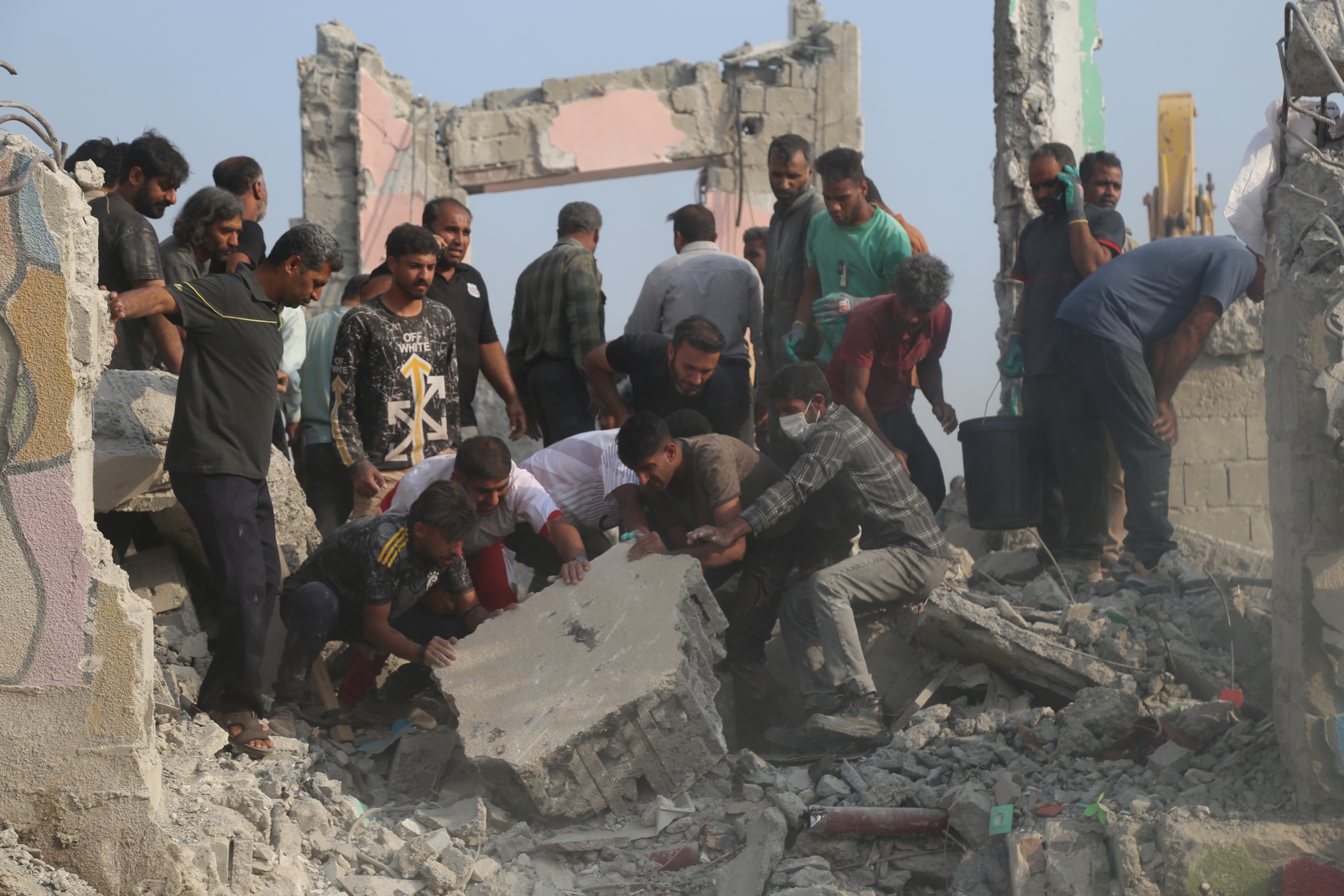
One of the most shocking documents to emerge in the first hours was video, verified by Reuters, the Times, and others, showing the aftermath of an Israeli air strike on a girls’ school in the city of Minab that killed at least a hundred and seventy-five people, most of them presumed to be children, according to Iranian state media, and buried an unknown number under wreckage. Later, in a BBC News report, a small child’s backpack could be seen in the rubble, covered with dust. “I am really shocked at the almost non-reporting today of the striking of a school in Iran in which 80–100 children may have been killed,” Ben de Pear, a former editor at Channel 4 News, wrote on social media. “I fear that we have become so inured to the killing of children in Gaza, that the destruction of the school” in Iran has been “completely drowned out.”
On Saturday afternoon Eastern time, reports began circulating that Khamenei had been killed in the air strikes. That was initially denied by the Iranian foreign minister—who told NBC News that Khamenei was alive “as far as I know”—as well as by Iranian news agencies Tasnim and Mehr, which reported that he was “steadfast and firm in commanding the field.” At 4:37pm, Trump posted again: “Khamenei, one of the most evil people in History, is dead.” Outlets approached the claims with caution at first, but Iran state media ultimately confirmed the news. After hours of frantic and uncertain coverage, the confirmation of Khamenei’s killing gave news organizations a ledge of certainty to rest on—editors hit publish on a flurry of informative obituaries, usually prepared long in advance for world leaders, detailing Khamenei’s influence and legacy.
The US-Israeli attack was significant in scale and brazen in character, yet the tone of news coverage might be best described as shocked but not surprised. The drumbeat of war had grown louder in recent weeks, as reports documented a ramped-up US military presence in the region. As the bombs continued to rain down, it was encouraging to see several outlets foreground the question of legality. As in the case of its attack on Venezuela in January, the Trump administration did not seek approval from Congress, as stipulated by the US Constitution, for waging war against Iran. Several news organizations quoted Thomas Massie, the Republican US representative from Kentucky, who has been a key figure in trying to safeguard Congress’s role as the sole US body that can authorize war. The editorial board of the Times posted a picture, asking, “Why Have You Started This War, Mr. President?”
But the Sunday front pages of the Times and Post did not mention the question of legality, and other outlets, such as CBS News and Fox News, uncritically accepted the administration’s framing of the attack as a “preemptive strike.” Though news organizations did vital reporting before the US assaults in both Venezuela and Iran, exposing the brutality of those regimes, Kourosh Ziabari, an Iranian freelance journalist based in New York who writes for outlets including New Lines Magazine and Foreign Policy, told CJR that the attack must “be framed as what it is: an unlawful and illegal military strike.”
The press focused largely on the gap between Trump’s rhetoric and his actions. Multiple outlets pointed out that he gained momentum as a presidential candidate a decade ago by promising to end “forever wars,” and his America First platform presumably meant extricating the US from overseas entanglements. And yet Iran last June joined a long list of countries Trump has bombed since returning to office in 2025, including Venezuela, Nigeria, Syria, Iraq, Yemen, and Somalia. (“This is not what we thought MAGA was supposed to be. Shame!” Marjorie Taylor Greene, the former Republican congresswoman and onetime MAGA loyalist, wrote on X.) BBC News pointed out that Trump’s warning of “imminent threats from the Iranian regime” contradicted the view of analysts and US intelligence assessments, not to mention Trump’s own claims that the US had “obliterated” Iran’s nuclear program. By Sunday, the military reported that three US troops were killed and five others seriously wounded in the attack. “We may have casualties,” Trump said in his initial video. “That often happens in war.”
Another key question raised by media outlets: What happens next? To state the obvious, killing a ruler is not the same as toppling a regime, as this Times diagram helped visualize. Trump’s call for Iranians to rise up betrays a shockingly naive conception of post-regime-change power dynamics; as foreign interventions earlier this century should have taught us, years of bloodshed could be in store for Iran. On Sunday morning, The Atlantic’s Michael Scherer spoke with Trump, who said that Iran’s new leadership wanted to engage: “They want to talk, and I have agreed to talk, so I will be talking to them,” Trump told Scherer. He wouldn’t say when. As of Monday morning, Israel had begun striking Hezbollah targets in Lebanon, explosions continued to be heard in Dubai, Abu Dhabi, and Doha, and the US Department of Defense (or War) said that three US planes had crashed over Kuwait in a “friendly fire incident.” (It said all crew members survived.) The conflict appeared to be spiraling.
In January, after the US invaded Venezuela, CJR wrote that a press focus on military maneuvers “seemed to come, disappointingly, at the expense of attention to the humanitarian cost of the attack.” Reporters covering this new war will find, as they have in recent months, that “it’s difficult to get voices out of Iran,” Mohamad Bazzi, the director of the Kevorkian Center for Near Eastern Studies and an associate professor of journalism at New York University, told CJR the other day. NetBlocks, a global internet monitor, reported an “internet blackout” in Iran on Sunday, with national connectivity at 1 percent. But journalists must navigate a moral blackout, too. In the days and weeks to come, as the Iranian people endure more hardship, it’s crucial that the press bear witness to their suffering. As de Pear put it, “The reporting of wars seems to have been inverted; what the powerful say and do is being reported first, and the killing of innocents is mentioned in passing, if at all.”
Other Notable Stories …
- On Thursday, Netflix declined to top Paramount Skydance’s offer for Warner Bros. Discovery, noting that the “deal is no longer financially attractive.” That makes Paramount, which is controlled by the Trump-aligned Ellison family and already owns CBS, Comedy Central, and Nickelodeon, the presumed winner of the monthslong bidding war for the studio, which includes CNN and Discovery. Even so, the deal is not certain and still must win regulatory approval. Politicians and press freedom groups have voiced their disdain. “Ellison will readily throw the First Amendment, CNN’s reporters, and HBO’s filmmakers under the bus if they stand in the way of expanding his corporate empire and fattening his pockets,” Seth Stern, the chief of advocacy for the Freedom of the Press Foundation, said. Senator Elizabeth Warren, for her part, called the merger “an antitrust disaster.”
- A federal judge prohibited the Justice Department from searching the contents of devices it seized from the home of Hannah Natanson, a reporter for the Post, in January as part of a probe into leaked classified documents. Magistrate William Porter’s ruling expressed concerns that granting access would give government investigators “carte blanche to rummage through all of the data it seized ‘when probable cause exists for only a narrow subset,’” CNN reported. Porter also chastised Justice Department attorneys for not informing him of the applicability of a law meant to protect journalists from government search and seizure when they had sought permission to raid Natanson’s home.
- According to the Committee to Protect Journalists (CPJ), a hundred and twenty-nine members of the press were killed in 2025, the highest number since CPJ began collecting data more than thirty years ago. Israel was responsible for two-thirds of those deaths, CPJ found, the same share as in 2024. “Attacks on the media are a leading indicator of attacks on other freedoms, and much more needs to be done to prevent these killings and punish the perpetrators,” Jodie Ginsberg, CPJ’s chief executive, said.
- In the aftermath of the US attack on Iran, Bari Weiss, the editor in chief of CBS News, made headlines once again for obscuring the distinction between her personal opinion and her role as newsroom chief. She reposted a video of Masih Alinejad, a newly appointed CBS contributor who has been targeted in Iranian assassination plots, criticizing New York mayor Zohran Mamdani’s statement condemning the military action—with a fire emoji as a caption.
- After Mexican forces killed El Mencho—the leader of the Jalisco New Generation Cartel and the country’s most wanted drug lord—fake news flooded social media. It’s possible that some false accounts, which depicted violence and mayhem—a commercial plane on fire, gunmen seizing Guadalajara’s international airport—could be linked to a cartel propaganda campaign. “They are trying to show that the Mexican government doesn’t have control over the country,” Jane Esberg, an assistant professor at the University of Pennsylvania who has studied how Mexican criminal groups use social media, told Reuters.
- And as the Winter Olympics ended, The Athletic—owned by the Times—scooped up six of the Post’s laid-off sports reporters and editors. Candace Buckner, Ava Wallace, and Adam Kilgore will have national reporting and investigative roles. Jason Murray will become The Athletic’s deputy editorial director, and Barry Svrluga and Spencer Nusbaum will cover the Washington Commanders and Nationals, respectively. In other news, Statusreported that NOTUS is hiring Paige Winfield Cunningham to cover healthcare and Sam Fortier to cover people and power in Washington. Both are former Post reporters.
Has America ever needed a media defender more than now? Help us by joining CJR today.